
- 384 pages
- English
- ePUB (mobile friendly)
- Available on iOS & Android
eBook - ePub
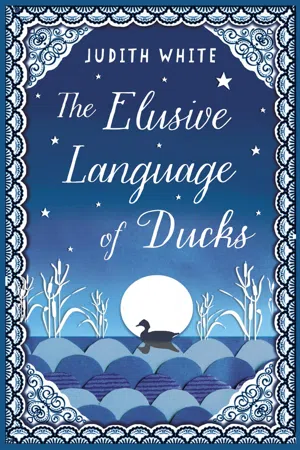
The Elusive Language of Ducks
About this book
As if it will make up for her loss, they bring Hannah a duckling to care for. They were well meaning, and it could have done the trick. However, Hannah's focus on the duck progressively alienates those around her. As the duck takes over her world, past secrets are exposed. Will Hannah's life unravel completely?This funny, moving and insightful novel contemplates the chemistry between one person and another: a man and another man's wife; a woman and a duck; a woman and her dead mother; a drug addict and his drug. Beautifully written, it is a penetrating and compassionate view of marriage, dependency, obsession, addiction, and love.
Frequently asked questions
Yes, you can cancel anytime from the Subscription tab in your account settings on the Perlego website. Your subscription will stay active until the end of your current billing period. Learn how to cancel your subscription.
No, books cannot be downloaded as external files, such as PDFs, for use outside of Perlego. However, you can download books within the Perlego app for offline reading on mobile or tablet. Learn more here.
Perlego offers two plans: Essential and Complete
- Essential is ideal for learners and professionals who enjoy exploring a wide range of subjects. Access the Essential Library with 800,000+ trusted titles and best-sellers across business, personal growth, and the humanities. Includes unlimited reading time and Standard Read Aloud voice.
- Complete: Perfect for advanced learners and researchers needing full, unrestricted access. Unlock 1.4M+ books across hundreds of subjects, including academic and specialized titles. The Complete Plan also includes advanced features like Premium Read Aloud and Research Assistant.
We are an online textbook subscription service, where you can get access to an entire online library for less than the price of a single book per month. With over 1 million books across 1000+ topics, weāve got you covered! Learn more here.
Look out for the read-aloud symbol on your next book to see if you can listen to it. The read-aloud tool reads text aloud for you, highlighting the text as it is being read. You can pause it, speed it up and slow it down. Learn more here.
Yes! You can use the Perlego app on both iOS or Android devices to read anytime, anywhere ā even offline. Perfect for commutes or when youāre on the go.
Please note we cannot support devices running on iOS 13 and Android 7 or earlier. Learn more about using the app.
Yes, you can access The Elusive Language of Ducks by Judith White in PDF and/or ePUB format, as well as other popular books in Literature & Literature General. We have over one million books available in our catalogue for you to explore.
Information

Chapter 1

THE GARDEN PATH
Sitting in the grass in the spring sunshine. Somewhere nearby a starling was munching on a song, savouring every whistley morsel before spitting it out for inspection in long chewing-gum threads.
The duckling was lying with its head resting on Hannahās ankle. Her other foot contained it in a safe haven. It appeared happy to be there. She wondered whether it thought it was a foot, or whether her feet were ducks.
It had been lumbered upon her; there was no doubt about that. When her husband had arrived home from Hamilton, several weeks ago now, he had hesitantly made his way down the garden path as she greeted him from the front door. He was carrying a bright orange carry-bag with a hard base, rather like a doctorās medical bag, full of quackery. Heād opened it, less than triumphantly, for her to see inside.
From the start sheād been aware of the whole projected scenario, the band-aid for the gaping wound. It did not stick. It somehow marginalised her grief.
And what are you going to do with this? sheād asked her husband. She closed herself tight against the chirruping fluff skittering in the straw.
Itās for you. From Claire and Bob.
I donāt want it. I donāt want another creature to look after.
Thatās OK. I thought you might say that. Donāt worry, it was going to die anyway, itās been abandoned. But what shall we do with it?
It smells revolting, she said.
I know, I . . . itās been running around in its mess since yesterday morning. And the water has sloshed everywhere.
Turning, she went inside. From the bedroom her mother called to her. No, she didnāt, but always there was the echo of her voice lingering there, hovering in Hannahās head like wind chimes, waiting for the right breeze to knock a memory resonating into life.
She passed through the hall, through the sitting room and out to the deck where she leaned on the railing, staring across the valley. The magnolia tree beside her, winding across the deck, was just sneaking into leaf. Theyād lived in this same house for twenty-two years, on the quarter-acre section in a hilly suburb near the centre of the city. The area used to be a patchwork of sections the same size as theirs, houses surrounded by daisy-dotted lawn stretching from fence to fence, with paths from the road to the houses framed by flowers. Over-laden plum trees had provided for sauce and jam, gorging kids, rows of preserving jars in wash-houses, and still there were plenty of plums for the birds. Lemon and grapefruit trees, heavy with balls of juice, grew in sunny corners. Neighbours talked over the fences and shared produce from their vegetable gardens, squared out at the bottom of the sections.
Now they were crammed in by apartments, town-houses and palatial new villas which, from time to time, sprouted a shroud of white plastic, like nursery-web spiders in a hedge, to allow workmen to repair leaks from poor construction. Video cameras surveyed properties. Alarms, like frightened birds, spasmodically startled the peace. Generally, there was no communication amongst the neighbours. Hannah and Simon used to be more than friendly with Eric, the man next door, but recently even he had withdrawn. And his music, which used to thread so enticingly from his house to theirs, had stopped.
Hannah.
An alarm, startling her. Simon had followed her to the deck, was standing beside her.
Sheād placed her head into her cupped hands.
Hannah.
I donāt want a duck. I donāt want anything.
I know. Iām sorry. Come inside. Iāll get rid of it.
How can you just get rid of it? Iām not pregnant. This creature has been born.
Heād stood there helplessly. He pitied her, she could see that. But she was pushing him, nudging him away from her, forcing him right up to the edge of the cliff. She was the last straw in a ducklingās carry-bag.
Where did you put it?
On the front lawn.
On the lawn? Where the cats can get it?
Once again sheād turned from him, passing back through the house to the lawn, which was surrounded by trees and shrubs and ferns. She picked up the bag and returned inside, to the bathroom. She scooped the duckling into the bath. It ran skittering in panic on the shiny white porcelain. Simon stood at the door, watching. She took out the mash and the water dish.
Can you empty this into the compost, said Hannah, handing him the carry-bag. Have you got clean straw?
Oh yes, I think I have. Claire gave me some stuff. And fresh mash. The duckling will need a heat source, I believe.
When he returned with the carry-bag, she wiped it clean with paper towels and put it on a towel on the heated tiles in the bathroom, with the fresh straw that his aunt had provided. The carry-bag was made of strengthened plastic and its corners could be straightened rigidly to create a box. She leaned over the bath and cupped her hands around the noisy duckling, releasing it into the straw. Already there were two small heaps of mess in their bath. She brought out the disinfectant, turned on the tap and started swishing and scrubbing. She knew nothing, nothing at all, about ducklings. Nor about ducks of any description, except that they quacked and ate bread in parks.
Later, sheād googled āducklingsā and found: They must always have water. They have no teeth and can choke on their food if they donāt have water, as they canāt chew. Ducklings are messy and will slop their water everywhere, will walk in it. Donāt give them bread as they are not made for it. Ducklings might like the odd worm, but not too many. Too much protein and they will develop angel wings ā wings that stick up. They eat greens and mash.
So sheād placed a bowl for water in its box. A green china jam dish from the cupboard, the size of about a third of an orange, in the shape of a flower. When the duckling stood in it, the bowl contained its fluffiness perfectly. The petals opened around its yellow form like an eggshell.
And that was several weeks ago. She had reluctantly agreed to look after the helpless creature until it was strong enough to fend for itself, before returning it to Te Awamutu or setting it free amongst other ducks in a park somewhere.
She leaned over and picked a dandelion leaf growing from the base of a rock. So tiny was the duckling that she had to rip up the leaf. She dangled the narrow strips in front of its beak so it could snap them up.
SOMETHING, SOMEONE, TO CARE FOR
When her mother came to live with them after she became ill, Hannah would lurch from sleep, wondering whether she might have passed away overnight. There were times when the anxiety was so insistent that she was forced to get out of bed and pad down the stairs to stand at her motherās door, listening for the soft snoring that filled the room.
Once, confronted by silence, she eased open the door, crept in and stood by the bed. Moonlight filtered in through the curtains and settled around the shapes of the motionless bedclothes, across her motherās face, the dark cavity of her open mouth, empty of breath. Hannah touched her cheek. Slapped her vigorously, calling. Suddenly her mother heaved and yelped, struggling in vain to sit up.
Oh, oh, Iām sorry Mum, I . . . was just looking for your teeth. She grabbed the first reason ā however ludicrous ā that came into her head.
Hannah, for heavenās sake, whatās happening?
Nothing, Iām sorry. I just, I was just checking, that you were all right. Ssssh, itās OK. Go to sleep.
I was asleep. Where are my teeth?
Theyāre in the glass. Itās OK. I had a dream that youād lost them.
Are they there?
Now, every morning, Hannah was awakened by her husband perfunctorily plodding around the house, his weight wrapped thickly around his middle, whereas hers returned to fill her head, unseen except for the pull of flesh from around her cheeks, her mouth. The weight of heavy deliberation.
Her first task was to check on the little duckling in the carry-box in the bathroom, to make sure he hadnāt drowned in his water or died in his sleep from lack of whatever it was that ducklings needed that she hadnāt been able to offer.
From the local pet shop she had bought supplies of straw to line his box, and special baby chook mash. Each day he ate a little more.
When he spotted her, the duckling peeped an urgent staccato code, for which she didnāt have the key, but it soon threaded its way from its helplessness to the part of her that had become habituated to caring for the helpless. She only had to pick him up to soothe him. All he desired was to nestle into somebody, to sleep with his head pushed into a fold of arm or flesh. All he really wanted, of course she realised, was a mother duck.
Because of this, when she was at home the woman carried the duckling on her shoulder under her hair. If she was working at her desk, the ducking snuffled into her neck before settling to sleep. It was a strange companionable thing to have this downy ball rummaging through the blonde grassy shelter of her hair. At other times she spread a towel across her lap and heād sleep there as well. Eventually, she noticed that, as long as she removed him from time to time, he didnāt poo when he was upon her. She supposed that, in the wild, this was Natureās way of preventing mother ducks from being covered in the excrement of their brood.
VENTURING OUT
Gradually, as the weeks passed, the woman introduced the duckling to the outside world. She took him into the garden, looking for worms and pulling out weeds along the way. The duck kept close by her, almost dangerously so as she clambered on her knees around him while he pecked and skittered amongst the grass and plants. He wasnāt strong enough yet to tear at leaves, so she continued to do this for him. As she didnāt know which plants were poisonous for ducks, she guided him towards the dandelions and discouraged him from eating other vegetation. They discovered the fleas that erupted from the soil when she pulled away a brick or a piece of wood. He liked slaters and small cockroaches. The special purring chirrup he made when he ate rose in intensity whenever he made a bountiful find.
The garden had been neglected. Its parched soil felt malnourished, screaming with thirst. When they first moved here, twenty-two years before, theyād been surrounded by a low hedge, a lawn filled with daisies, and with plums, lemons, figs and mandarins on the lawn out the back.
She and Simon had laboured over the soil, digging in compost, and buying native trees, flaxes and ferns to attract birds. It was a project theyād enjoyed, quietly working alongside each other, often until dark when their tools and the weeds dissolved into shadows. In the early days, theyād kick off their shoes and fumble their way inside, laughing, without switching on electric lights. Theyād fling off their grubby clothes to sink into a hot bath together, their skin stinging from the sun, the water muddying from their shared toils. They sipped wine or smoked a joint, ate previously prepared delicacies, and looked at each other in flickering candlelight from each end of the bath.
Over the years, the garden was developed to a point where it needed less attention. From time to time theyād revisit it with the same fervour, spending full weekends doing maintenance: weeding and pruning, planting and feeding the soil. But basically it looked after itself. The trees grew into a lush barrier from the rest of the world. It was only from the deck that they could look over and beyond to the neighboursā backyards, and over to the other side of the valley where houses and apartments were continually being crammed into any available space.
After her mother came to live with them, Hannah finished teaching and took on editing work that she mostly could do from home. Her motherās stay also coincided with Simon shifting from a solid day-job into semi-retirement. He took on engineering work that he could do from home, or which alternatively led him away for days or weeks at a time to other cities, sometimes other countries, on contract. Although they were spending more time in the house together, they spent less time nurturing each other. Hannah could see this clearly now. Sheād been involved in the care for her mother. The garden became a shell that locked them against the world, into themselves. And their connection through their computers into separate domains left them trudging through different ethereal wastelands, and somewhere along the way they had become disconnected, their fingers seldom touching, moving onwards from a perspective that had once met, along parallel paths that steered them into an infinity apart.
And after her mother arrived, neither Hannah nor Simon had ventured into the undergrowth of the garden, neither of them pulled weeds or re-planted. Neither of them spent days or hours labouring until thei...
Table of contents
- Cover
- Title
- Copyright
- Contents
- Prologue
- Chapter 1
- Chapter 2
- Chapter 3
- Chapter 4
- Chapter 5
- Chapter 6
- Chapter 7
- Chapter 8
- Chapter 9
- Chapter 10
- Chapter 11
- Chapter 12
- Chapter 13
- Chapter 14
- Chapter 15
- Chapter 16
- Chapter 17
- Chapter 18
- Chapter 19
- Chapter 20
- Chapter 21
- Chapter 22
- Chapter 23
- Chapter 24
- Chapter 25
- Chapter 26
- Chapter 27
- Chapter 28
- Chapter 29
- Chapter 30
- Chapter 31
- Acknowledgements