
eBook - ePub
Evolving Ourselves
How Unnatural Selection is Changing Life on Earth
- 400 pages
- English
- ePUB (mobile friendly)
- Available on iOS & Android
eBook - ePub
About this book
If Darwin were alive today, he would likely recognize that technology has evolved so far, and so fast, that the origin, evolution, and future of life itself is no longer just driven by natural selection and random mutation. Why are genetic conditions like autism, asthma, and allergies on the rise at unprecedented, biologically impossible speeds? What traits does our world select for, and what does that mean for us? Will our children be a different species?
Today’s humans have altered the nature of our world so much, and developed such profound capabilities for re-crafting our bodies and environment, that random mutation and natural selection are no longer the primary determinants of which species survives and how they change over time. The nature of the evolution of our world is now increasingly defined and driven by: Un-Natural Selection-- where the traits being selected for have little to nothing to do with our ability to survive and thrive--and Non-Random Mutation-- in which drastic changes to our environment wreak havoc on what gene are expressed and passed down.
Evolving Ourselves is the story of how our massive human perturbation and, increasingly, our specific designs and desires are altering life on Earth. It is a chronicle of where our remarkable new capabilities for altering our bodies, other living creatures, and our environment are taking us in the near term, and introduces the possibility that we might cause our own extinction in the long run.
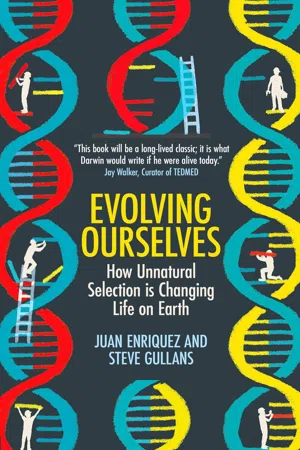
Today’s humans have altered the nature of our world so much, and developed such profound capabilities for re-crafting our bodies and environment, that random mutation and natural selection are no longer the primary determinants of which species survives and how they change over time. The nature of the evolution of our world is now increasingly defined and driven by: Un-Natural Selection-- where the traits being selected for have little to nothing to do with our ability to survive and thrive--and Non-Random Mutation-- in which drastic changes to our environment wreak havoc on what gene are expressed and passed down.
Evolving Ourselves is the story of how our massive human perturbation and, increasingly, our specific designs and desires are altering life on Earth. It is a chronicle of where our remarkable new capabilities for altering our bodies, other living creatures, and our environment are taking us in the near term, and introduces the possibility that we might cause our own extinction in the long run.
Frequently asked questions
Yes, you can cancel anytime from the Subscription tab in your account settings on the Perlego website. Your subscription will stay active until the end of your current billing period. Learn how to cancel your subscription.
No, books cannot be downloaded as external files, such as PDFs, for use outside of Perlego. However, you can download books within the Perlego app for offline reading on mobile or tablet. Learn more here.
Perlego offers two plans: Essential and Complete
- Essential is ideal for learners and professionals who enjoy exploring a wide range of subjects. Access the Essential Library with 800,000+ trusted titles and best-sellers across business, personal growth, and the humanities. Includes unlimited reading time and Standard Read Aloud voice.
- Complete: Perfect for advanced learners and researchers needing full, unrestricted access. Unlock 1.4M+ books across hundreds of subjects, including academic and specialized titles. The Complete Plan also includes advanced features like Premium Read Aloud and Research Assistant.
We are an online textbook subscription service, where you can get access to an entire online library for less than the price of a single book per month. With over 1 million books across 1000+ topics, we’ve got you covered! Learn more here.
Look out for the read-aloud symbol on your next book to see if you can listen to it. The read-aloud tool reads text aloud for you, highlighting the text as it is being read. You can pause it, speed it up and slow it down. Learn more here.
Yes! You can use the Perlego app on both iOS or Android devices to read anytime, anywhere — even offline. Perfect for commutes or when you’re on the go.
Please note we cannot support devices running on iOS 13 and Android 7 or earlier. Learn more about using the app.
Yes, you can access Evolving Ourselves by Juan Enriquez,Steve Gullans in PDF and/or ePUB format, as well as other popular books in Biological Sciences & Physiology. We have over one million books available in our catalogue for you to explore.
Information
NOTES

What Would Darwin Write Today?
1. Just to point out how radically the world has changed, the word “allergies” was not even around when Darwin was writing. It was not until 1906 when a Viennese MD noticed the reactions some of his patients had to certain foods or seasonings that he coined the word and medical concept. See Richard Wagner, “Clemens Von Pirquet, Discoverer of the Concept of Allergy,” Bulletin of the New York Academy of Medicine, 40, no. 3 (1964): 229–35.
2. Because this is not an academic treatise on the origins and development of the theory of evolution, throughout this book we will use “Darwin” as a shorthand for a far more complex and varied cast of scholars and theorists who helped flesh out the concepts and drivers of how life evolves. But first and foremost we do want to recognize that alongside the far more famous Charles Darwin, one underrecognized and underappreciated mind stands out. Alfred Russel Wallace should be described as a co-discoverer of the theory of evolution. (Not that Darwin and Wallace agreed on everything; see, for instance, M. J. Kottler, “Darwin, Wallace, and the Origin of Sexual Dimorphism,” Proceedings of the American Philosophical Society 124, no. 3 (1980): 203–26, accessed August 28, 2014, http://www.jstor.org/discover/10.2307/986370?.
3. Though Darwin and Wallace did not speak specifically of random mutation, the basic principles of Darwinian evolution were merged with Mendelian genetics in the early twentieth century to create the modern synthesis theory of evolution, which continues to be taught today, and which prescribes that evolution involves the combination of natural selection and random mutation.
4. Were Darwin writing an updated version of On the Origin of Species or The Descent of Man today, many of the original chapters, the deep historical ones—on the natural origin of species, on the history and evolution of life on Earth, of humans—would likely be quite similar, though he would be able to flesh them out with overwhelming scientific evidence. But the book’s new chapters, those covering our time, current evolution, and the future of life would likely be quite different.
5. Max Roser, “Life Expectancy,” OurWorldinData.org, accessed August 29, 2014, http://www.ourworldindata.org/data/population-growth-vital-statistics/life-expectancy.
6. James Melkie, “Sir David Attenborough Warns Against Large Families and Predicts Things Will Only Get Worse,” Guardian, September 9, 2014, accessed August 29, 2014, http://www.theguardian.com/tv-and-radio/2013/sep/10/david-attenborough-human-evolution-stopped.
Is Autism a Harbinger of Our Changing Brains?
1. L. Torian, M. Chen, P. Rhodes, and H. I. Hall, “HIV Surveillance—United States: 1981–2008,” Morbidity and Mortality Weekly Report (MMWR) 60, no. 21 (2011), accessed August 29, 2014, http://www.cdc.gov/mmwr/pdf/wk/mm6021.pdf.
2. For a gene to spread really quickly across a population, there needs to be an extraordinary selection bias favoring a beneficial trait or disfavoring a deleterious feature. For example, a gene mutation that confers resistance to a new infectious disease or a mutation that slows metabolism during times of famine. Those people who lack the beneficial genetic variant die without reproducing, or reproduce at a diminished rate. Deleterious genetic variants are generally lost from a population and thus difficult to observe in humans today. Studies of genetic adaptation in humans suggest there are hundreds of mutations that have been positively selected for over the past 80,000 years since humans departed Africa. The newly acquired traits appear to enhance or modify resistance to infections, reproduction, olfaction, external body appearance, and nutrition, among other things. The rate at which a mutation propagates varies according to its relative benefit and the rate of reproduction. As an example, it has taken fewer than 10,000 years for mutations encoding lightened skin, which enhances vitamin D synthesis, to become highly prevalent in humans in northern latitudes where sunlight is diminished. See B. F. Voight, S. Kudaravalli, X. Wen, and J. K. Pritchard, “A Map of Recent Positive Selection in the Human Genome,” PLoS Biology 4, no. 3 (2006): 446–58; P. C. Sabeti, S. F. Schaffner, B. Fry, J. Lohmueller et al., “Positive Natural Selection in the Human Lineage,” Science 312, no. 5780 (2006): 1614–20. Also an overview of adaptive evolution is available at “Adaptive Evolution in the Human Genome,” Wikipedia, accessed October 31, 2014, http://en.wikipedia.org/wiki/Adaptive_evolution_in_the_human_genome.
3. Scott Grosse et al., “Centers for Disease Control and Prevention. Newborn Screening for Cystic Fibrosis,” Morbidity and Mortality Weekly Report 53, no. RR13 (2004): 1–36.
4. Centers for Disease Control and Prevention, “Sickle Cell Disease (SCD),” CDC.gov, accessed September 7, 2014, http://www.cdc.gov/ncbddd/sicklecell/data.html.
5. Centers for Disease Control and Prevention, “Autism Spectrum Disorder (ASD),” CDC.gov, accessed October 31, 2014, http://www.cdc.gov/ncbddd/autism/data.html.
6. Dr. Gerald Fink, Whitehead Institute seminar, November 2, 2012, attended by one of the authors (Juan Enriquez). These numbers are way too specific, given what we currently know about autism and related spectrum disorders. There are likely many underlying and overlapping conditions with the same symptoms but different causes. But these estimates do provide an order of magnitude of likelihood.
7. X. Liu and T. Takumi, “Genomic and Genetic Aspects of Autism Spectrum Disorder,” Biochemical & Biophysical Research Communications 452, no. 2 (2014): 244–53; A. M. Persico and V. Napolioni, “Autism Genetics,” Behavioural Brain Research 251 (2013): 95–112; I. Iossifov, B. J. O’Roak, S. J. Sanders, M. Ronemus et al., “The Contribution of De Novo Coding Mutations to Autism Spectrum Disorder,” Nature 515, no. 7526 (2014): 216–21; doi:10.1038/naturel3908. S. De Rubeis, X. He, A. P. Goldberg, C. S. Poultney et al., “Synaptic, Transcriptional and Chromatin Genes Disrupted in Autism,” Nature 515, no. 7526 (2014): 209–15; doi:10.1038/naturel3772.
8. J. Baio, “Prevalence of Autism Spectrum Disorders—Autism and Developmental Disabilities Monitoring Network, 14 Sites, United States, 2008,” Morbidity and Mortality Weekly Report (MMWR) 61, no. SSO3 (2012), accessed August 21, 2014, http://www.cdc.gov/mmwr/preview/mmwrhtml/ss6103al.htm.
9. J. Baio, “Prevalence of Autism Spectrum Disorder Among Children Aged 8 Years—Autism and Developmental Disabilities Monitoring Network, 11 Sites, United States, 2010,” Morbidity and Mortality Weekly Report (MMWR) 63, no. SS02 (2014): 1–21, accessed August 28, 2014, http://www.cdc.gov/mmwr/preview/mmwrhtml/ss6103al.htm.
10. American Psychiatric Association, Diagnostic and Statistical Manual of Mental Disorders, Fifth Edition (DSM-5) (Arlington, VA: American Psychiatric Publishing, 2013). This is considered the textbook “bible” on all mental disorders and conditions. In May 2013 a controversy exploded around the publication of this new edition, the DSM-5. Previously, the expert authors, nicknamed by one blogger “The Gods of the Mind,” differentiated Asperger’s as a separate condition from autism, but in the updated version Asperger’s is part of autism spectrum disorder (ASD). (Perhaps this redefinition might reclassify people like Einstein and Warhol as autistic?) “DSM-5 Diagnostic Criteria,” AutismSpeaks.org, accessed August 28, 2014, http://www.autismspeaks.org/what-autism/diagnosis/dsm-5-diagnostic-criteria. For a more non-technical discussion of the topic see Amy S. F. Lutz, “You Do Not Have Asperger’s,” Slate.com, accessed August 28, 2014, http://www.slate.com/articles/health_and_science/medical_examiner/2013/05/autism_spectrum_diagnoses_the_dsm_5_eliminates_asperger_s_and_pdd_nos.html. It is worth noting that the DSM-5 text, like Darwin’s books, is largely descriptive with little regard to underlying biology or disease mechanisms. It is ripe for major revisions in the future as a more mechanistically based understanding of psychiatric conditions is uncovered, a vision promulgated by Dr. Tom Insel, director of the National Institute of Mental Health (NIMH). See Tom Insel, “Director’s Blog: Transforming Diagnosis,” NIMH.NIH.gov, April 29, 2013, accessed August 28, 2014, http://www.nimh.nih.gov/about/director/2013/transforming-diagnosis.shtml.
11. S. Sandin, P. Lichtenstein, R. Kuja-Halkola, H. Larsson et al., “The Familial Risk of Autism,” Journal of the American Medical Association 311, no. 17 (2014): 1770–77.
The DarWa Theory Revisited . . . and a Glimpse at a New Theory
1. Darwin’s grandfather was a polymath, poet, abolitionist, and bohemian, a far-from-uptight gentleman who was far ahead of his time on many subjects, including evolution, something he foreshadowed in two books, Zoonomia and The Botanic Garden. He was a great mentor, inspirer, and supporter of his young and more conservative grandson.
2. Charles Darwin, The Descent of Man and Selection in Relation to Sex (London: John Murray, 1871), 2.
3. Darwin preferred the term “variation” instead of “mutation,” the latter of which became the dominant term with the advent of the modern synthesis theory of evolution that fused Darwin, Wallace, and Mend...
Table of contents
- Cover
- Title
- Copyright
- Contents
- What Would Darwin Write Today?
- SYMPTOMS OF REAL-TIME EVOLUTION
- HOW DOES EVOLUTION REALLY WORK NOW?
- A WORLD OF NON-RANDOM MUTATION
- EVOLVING OURSELVES . . .
- THE FUTURE OF LIFE
- EPILOGUE
- Acknowledgments
- Appendix: Darwin—True or False: Did He Get It Right?
- Glossary
- Notes