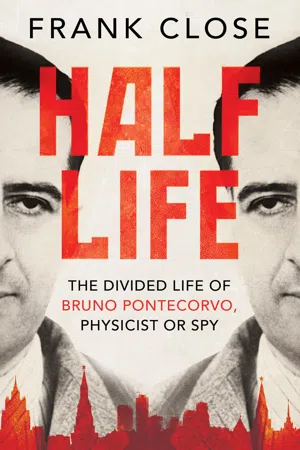
Half Life
eBook - ePub

Half Life

  1. 320 pages
  2. English
  3. ePUB (mobile friendly)
  4. Available on iOS & Android
eBook - ePub

Half Life

About this book

The memo landed on Kim Philby's desk in Washington, DC, in July 1950. Three months later, Bruno Pontecorvo, a physicist at Harwell, Britain's atomic energy lab, disappeared without a trace. When he re-surfaced six years later, he was on the other side of the Iron Curtain.One of the most brilliant scientists of his generation, Pontecorvo was privy to many secrets: he had worked on the Anglo-Canadian arm of the Manhattan Project, and quietly discovered a way to find the uranium coveted by nuclear powers. Yet when he disappeared MI5 insisted he was not a threat. Now, based on unprecedented access to archives, letters, surviving family members and scientists, award-winning writer and physics professor Frank Close exposes the truth about a man irrevocably marked by the advent of the atomic age and the Cold War.

Frequently asked questions

Yes, you can cancel anytime from the Subscription tab in your account settings on the Perlego website. Your subscription will stay active until the end of your current billing period. Learn how to cancel your subscription.
No, books cannot be downloaded as external files, such as PDFs, for use outside of Perlego. However, you can download books within the Perlego app for offline reading on mobile or tablet. Learn more here.
Perlego offers two plans: Essential and Complete
  • Essential is ideal for learners and professionals who enjoy exploring a wide range of subjects. Access the Essential Library with 800,000+ trusted titles and best-sellers across business, personal growth, and the humanities. Includes unlimited reading time and Standard Read Aloud voice.
  • Complete: Perfect for advanced learners and researchers needing full, unrestricted access. Unlock 1.4M+ books across hundreds of subjects, including academic and specialized titles. The Complete Plan also includes advanced features like Premium Read Aloud and Research Assistant.
Both plans are available with monthly, semester, or annual billing cycles.
We are an online textbook subscription service, where you can get access to an entire online library for less than the price of a single book per month. With over 1 million books across 1000+ topics, we’ve got you covered! Learn more here.
Look out for the read-aloud symbol on your next book to see if you can listen to it. The read-aloud tool reads text aloud for you, highlighting the text as it is being read. You can pause it, speed it up and slow it down. Learn more here.
Yes! You can use the Perlego app on both iOS or Android devices to read anytime, anywhere — even offline. Perfect for commutes or when you’re on the go.
Please note we cannot support devices running on iOS 13 and Android 7 or earlier. Learn more about using the app.
Yes, you can access Half Life by Frank Close in PDF and/or ePUB format, as well as other popular books in Biological Sciences & Science General. We have over one million books available in our catalogue for you to explore.

FIRST HALF

Midway on our life’s journey, I found myself in dark woods, the right road lost.”
—Dante’s Inferno
ONE

FROM PISA TO ROME

MOST OF THE SCIENTISTS WHO WORKED ON THE MANHATTAN PROJECT grew up in the 1930s, in an era when fascism was on the rise. Large numbers of intellectuals rejected such tyranny; many chose to follow the red banner of communism instead. Bruno Pontecorvo was not unusual in this regard. The events that would lead to his singular role in the history of the Cold War stemmed from experiences during his youth and early manhood, and flowered as a result of the influential people he came in contact with. Their seeds lay in his family history.
The Pontecorvos of Pisa were a wealthy and intellectually gifted Jewish family. In the nineteenth century, Pellegrino Pontecorvo introduced the spinning jenny to the Italian textile industry. His son Massimo, Bruno’s father, expanded the business, eventually owning three textile factories, which employed well over a thousand people.1
Bruno hardly knew his grandfather, as he was only five years old when Pellegrino died. Pellegrino nevertheless established the mould within which his children, and later their children, were formed. He was active in the international Jewish community, and in the 1880s rescued Jews fleeing the pogroms in Russia. He inspired the family’s liberal ethics, which became more radical and explicitly antifascist following Mussolini’s rise to power. Bruno and several of his relatives joined the Communist Party in the 1930s.
Pellegrino’s funeral in 1918 was a big affair. The Russian Revolution of the previous year had inspired unrest among workers throughout Europe, not least in Italy. Even though many Italian tradesmen were threatening to rise against their bosses, the community’s respect for Pellegrino was such that “labourers and industrialists alike” came en masse to his funeral to celebrate his life.2 Indeed, Pellegrino was held in such high esteem that he was given the title of Cavaliere del lavoro, similar to a knighthood in the United Kingdom, in recognition of his dedication to labourers’ rights.
That same year marked a sea change in global politics. World War I ended; the November Revolution overthrew the German Empire; Italy was in turmoil due to high unemployment and social conflict. The Bolsheviks had taken power in Russia, and there was a real possibility of revolution in Italy too. Into the mess goose-stepped Benito Mussolini.
In Pisa there was an antifascist demonstration in which several of Massimo’s workers were involved. The local fascist leader, Guido Buffarini Guidi, came to the factory and ordered Massimo to reveal the names of the participants, and the ringleader in particular. Massimo refused. Buffarini Guidi challenged him to a duel.3 Fortunately the duel never took place, but Massimo’s workers always remembered the support their boss had given them. Bruno’s sister Anna recalled that when one of them saw her father in the street many years later, the man threw his arms around Massimo’s shoulders and exclaimed that it was “like seeing the Lord resurrected.”4
It was into such a family, with antifascism at its heart, that Bruno Pontecorvo was born on August 22, 1913. Bruno was the fourth of eight children—three girls and five boys. Those were days of rigid gender roles: the girls were educated in the liberal arts; the boys were encouraged toward science and technical matters. The most intelligent of the children, in their parents’ opinion, was the eldest, Guido, born in 1907. He emigrated to the United Kingdom in 1938 as part of the Jewish exodus from fascism. There, he became a distinguished geneticist, and a fellow of the Royal Society. Paolo, “the most serious,” was born in 1909. In 1938 he moved to the United States, where he worked on radar and microwaves during World War II. The eldest of the three sisters, Giuliana, born in 1911, was “the most cultured.” She became a journalist and prominent communist.
Bruno was followed by brother Gillo in 1919, sisters Laura and Anna in 1921 and 1924, and finally, in 1926, the youngest brother, Giovanni. The children’s French governess, Mlle Gaveron, said there would be no need for her to spend time in purgatory “as she had been there already looking after the children—except for Bruno, who was heaven.”5
image
IMAGE 1.1. Bruno Pontecorvo as a child. (COURTESY GIL PONTECORVO; PONTECORVO FAMILY ARCHIVES.)
Each child was talented, so much so that Massimo and his wife, Maria, did not regard Bruno as particularly intelligent in comparison to his siblings. Years later, Bruno remembered that his parents described him as “the most gentle but the most limited.” They also said that his eyes showed him to be “sweet but not intelligent,” an opinion that left him with a shy disposition and an “inferiority complex that haunted me for the rest of my life.”6
Bruno inherited a natural aptitude for sports. Friends recall his love for alpine skiing, underwater swimming, and, above all, tennis. Throughout his life, Bruno would recount how, at age sixteen, he had been included on Italy’s national junior tennis team and been invited to attend a training camp in France. His parents refused to allow him to go, as they regarded the activity to be a distraction from serious study and wanted him to spend his time preparing for college. The disappointment of a young boy came across in the tale, even after nearly half a century had passed. His parents consoled him. They assured Bruno that his achievements in physics were also first-rate, and that with suitable dedication he could achieve great things there too. Bruno acquiesced—sort of: “Yes, but I would also like to be the Italian tennis champion.”7
Bruno’s mother, Maria, had grown up in a highly cultured family. Her father, Arrigo Maroni, had been the director of a hospital in Milan, enjoyed the opera at La Scala, and was well known in Milanese society. Her religious background was Protestant.8 Massimo Pontecorvo, however, was still a traditional Jew when Bruno was born. After Pellegrino’s death, Massimo continued to lead the family rituals, but attitudes toward religion in the home were changing. The younger members took part in the ceremonies, but they did so halfheartedly. Their mother was Christian, and the children were not actively Jewish. A young brother—probably Giovanni—even asked one of his older sisters about circumcision, only to be informed that she didn’t know what it was.9 There were no bar mitzvahs in the Pontecorvo family, no bris rituals, no burials in Jewish cemeteries, but nonetheless they “were Jewish enough for Mussolini.”10
Indeed, the Pontecorvos’ privileged and idyllic life began to unravel with the onset of Mussolini’s anti-Semitic laws. The family dispersed. Guido had already settled in Britain, and in 1939, with the threat of war looming, Giovanni, Laura, and Anna, still teenagers, moved there too. The three siblings completed their education in Britain, becoming, respectively, an agriculturalist, nurse, and language teacher. Bruno’s exodus in 1936, the first of his three great upheavals, had been more gradual.
Many Italian intellectuals—Jewish and Christian alike—believed strongly in the ideals of liberal socialism. Those Jews who foresaw the consequences of fascism from the start had adopted strong antifascist positions long before anti-Semitism became formalized. Bruno’s cousin Emilio Sereni was especially prominent in this regard.11 Sereni’s mother, Alfonsina, was Bruno’s father’s sister. Emilio, born in 1907, was a powerful intellectual, with a strong personality of almost overpowering intensity. By the age of twenty he was reading Marxist classics avidly, and he soon married Xenichka Zilberberg, the daughter of two heroes of the Russian Revolution.12 Sereni joined the Communist Party of Italy in 1927. In 1929, following in the tradition of his parents-in-law, Sereni, along with his colleague Manlio Rossi-Doria, founded an underground communist organization in Italy. The following year, the fascist police arrested Sereni and Rossi-Doria, and the Special Court of State Security, which the fascists had created to “defend the state,” sentenced them to fifteen years in prison. Granted amnesty and freed in 1935, Sereni fled from Italy to Paris, where he became the cultural manager of the Communist Party of Italy, and the chief editor of Lo stato operaio (The Workers’ State). It was during this period, in prewar Paris, two years after Bruno left Italy, that Emilio Sereni would begin to have a considerable influence over his younger cousin—an influence that would frame the course of Bruno’s life.
PHYSICS IN ROME
It was far from obvious that Bruno would end up a great physicist. Initially he followed the same route as his older brother Paolo, and at age sixteen enrolled at the University of Pisa to study engineering. After two years, he was doing well but disliked technical drawing, so he quit engineering and, in 1931, decided to concentrate on physics.
As it happened, Bruno’s childhood coincided with the emergence of atomic physics. He was born in the same year as the insight that every atom is like a miniature solar system, in which “planetary” electrons orbit a compact nucleus at the core. He was a student when physicists realized that an atom’s ability to shed energy through radioactivity results from the instability of the nucleus and began to home in on the neutron, a still-hypothetical constituent of the nucleus. This is when his eldest brother, Guido, made a pivotal intervention.
Guido was insistent: “For physics you must go to Rome.”13 Enrico Fermi was there, building a huge reputation. In 1926 Fermi had been appointed, at just twenty-five years of age, to a professorship at the University of Rome, funded by Orso Corbino, an influential Sicilian. At the time, nuclear physics was an exciting new field. Quantum theory was being used to build mathematical models of the properties of the nucleus, but experimentally it remained virgin territory. Fermi decided that the best way to revitalize Italian physics was to understand the atomic nucleus, in terms of both constituents and construction, and the relationships between the nuclei of different elements. With Corbino’s support, Fermi established a laboratory in the physics department on the Via Panisperna, in Rione Monti, a few minutes’ walk from the main railway station; to help in the endeavour, he gathered a team of young experimental scientists—a group that became known as the “Via Panisperna Boys.”
Guido’s insistence that Bruno go to Rome stemmed from his friendship with one of the Via Panisperna Boys, Franco Rasetti. He and Guido had been friends for years and had explored the Alps together as hiking companions. At that time, Bruno was a child, patronizingly known as “the cub.” Rasetti paid him little attention. Years later, when Bruno presented himself to Rasetti, announcing that he wished to complete his studies in Rome, Rasetti teased him: “Just out of your diapers and you want to become a physicist!”14
Although he was confident and spoke with ease—and was, in the words of Laura Fermi, “uncommonly good looking”—Bruno had a tendency to blush at the least provocation. In response to Rasetti’s joke about his youth, Bruno gave one of his familiar blushes, but Rasetti—well aware of the intellectual strength of the Pontecorvo family—encouraged Fermi to take a look at him.
Fermi gave him an informal exam. Years later, Bruno claimed that he showed only “mediocre knowledge.” Fermi explained to him that there were two categories of physicists: theoreticians and experimentalists. He then added: “If a theorist does not have exceptional ability, his work does not make sense. As for experimental physics, there exists the possibility of useful work, even if the person has only average intelligence.”15
Fermi was infamously slow to praise and blunt in his criticism. It’s unclear if Fermi was delicately giving his opinion, so as to guide Bruno toward experiment, or simply providing idiosyncratic commentary. In any case, in 1931 Bruno Pontecorvo entered the third year of physics at the University of Rome. This meant he had the good fortune to be studying physics in the annus mirabilis of 1932, when the atomic nucleus was discovered to have a labyrinthine structure of it own.16 By 1934 Bruno was ready to take part in genuine research as a member of Fermi’s team, right at the dawning of a new science: nuclear physics. At age twenty-one, he was destined to be at the epicentre of one of the greatest and most far-reaching discoveries of the twentieth century.
THE PREHISTORY OF NUCLEAR PHYSICS
At the end of the nineteenth century, atoms were believed to be the fundamental seeds of all matter. The standard model of that time asserted that all atoms of the same element were identical, that different elements consisted of different types of atoms, and that compounds formed from atoms of the constituent elements.17 Much of this remains true today. However, the scientists of yesteryear also believed that atoms were indestructible and impenetrable objects, like miniature billiard balls. This is not the case.
In 1911, working in Manchester, Ernest Rutherford discovered that an atom is mostly empty space, with a massive, dense kernel at its centre carrying a positive electric charge—a kernel that he called the nucleus. In 1913, the year of Bruno’s birth, Rutherford’s colleague, Danish theorist Niels Bohr, proposed that atoms are held together by the electrical attraction of opposite charges. In this model, negatively charged electrons orbit the positively charged nucleus.
At that stage, no one knew what an atomic nucleus consisted of. By the time Bruno started school, Rutherford had shown that the nucleus of a hydrogen atom is the simplest of all, consisting of a single positively charged particle, which he called a proton. Rutherford had deduced that the proton was fundamental to the nuclei of all atomic elements. As a student, Bruno would have learned that atomic nuclei are lumps of positive charge, made up of protons, and that the more protons there are in the lump, the greater the charge. It is the amount of this positive charge that determines how many negatively charged electrons can be ensnared in the outer regions of the atom. The chemical elements are distinguished by the complexity of their atoms—hydrogen, the simplest, consists of a single electron encircling a single proton, while helium has two protons in its nucleus, carbon has six—onward to uranium with ninety-two. The chemical identity of an element is a result of its electrons, and chemical reactions occur when electrons move from one atom to another.
This simple picture first started to change in 1932, when James Chadwick of Cambridge University discovered a third basic seed of matter, the neutron. Neutrons are similar to protons but carry no electric...

Table of contents

  1. Cover
  2. Title
  3. Copyright
  4. Contents
  5. Preface
  6. Prologue: Midway on Life’s Journey
  7. FIRST HALF
  8. INTERLUDE
  9. HALF TIME
  10. SECOND HALF
  11. AFTERLIFE
  12. Afterword
  13. Acknowledgments
  14. Acronyms
  15. Notes
  16. Bibliography