A Perfect Crime
eBook - ePub

A Perfect Crime

  1. 208 pages
  2. English
  3. ePUB (mobile friendly)
  4. Available on iOS & Android
eBook - ePub

A Perfect Crime

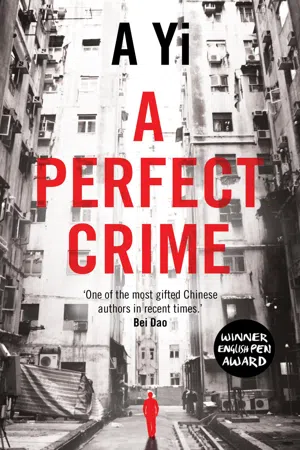
About this book

A chilling literary thriller about a motiveless murder in provincial China

'One of the most important voices to emerge from the People's Republic in years' Daily Express

On a normal day in provincial China, a teenager goes about his regular business, but he’s also planning the brutal murder of his only friend. He lures her over, strangles her, stuffs her body into the washing machine and flees town, whereupon a perilous game of cat-and-mouse begins.

A shocking investigation into the despair that traps the rural poor as well as a technically brilliant excursion into the claustrophobic realm of classic horror and suspense, A Perfect Crime is a thrilling and stylish novel about a motiveless murder that echoes Kafka’s absurdism, Camus’ nihilism and Dostoyevsky’s depravity. With exceptional tonal control, A Yi steadily reveals the psychological backstory that enables us to make sense of the story’s dramatic violence and provides chillingly apt insights into a country on the cusp of enormous social, political and economic change.
Frequently asked questions

Yes, you can cancel anytime from the Subscription tab in your account settings on the Perlego website. Your subscription will stay active until the end of your current billing period. Learn how to cancel your subscription.
No, books cannot be downloaded as external files, such as PDFs, for use outside of Perlego. However, you can download books within the Perlego app for offline reading on mobile or tablet. Learn more here.
Perlego offers two plans: Essential and Complete
  • Essential is ideal for learners and professionals who enjoy exploring a wide range of subjects. Access the Essential Library with 800,000+ trusted titles and best-sellers across business, personal growth, and the humanities. Includes unlimited reading time and Standard Read Aloud voice.
  • Complete: Perfect for advanced learners and researchers needing full, unrestricted access. Unlock 1.4M+ books across hundreds of subjects, including academic and specialized titles. The Complete Plan also includes advanced features like Premium Read Aloud and Research Assistant.
Both plans are available with monthly, semester, or annual billing cycles.
We are an online textbook subscription service, where you can get access to an entire online library for less than the price of a single book per month. With over 1 million books across 1000+ topics, we’ve got you covered! Learn more here.
Look out for the read-aloud symbol on your next book to see if you can listen to it. The read-aloud tool reads text aloud for you, highlighting the text as it is being read. You can pause it, speed it up and slow it down. Learn more here.
Yes! You can use the Perlego app on both iOS or Android devices to read anytime, anywhere — even offline. Perfect for commutes or when you’re on the go.
Please note we cannot support devices running on iOS 13 and Android 7 or earlier. Learn more about using the app.
Yes, you can access A Perfect Crime by A Yi, Anna Holmwood in PDF and/or ePUB format, as well as other popular books in Literature & Literature General. We have over one million books available in our catalogue for you to explore.

Information

The Game
The mystery of why I had killed Kong Jie attracted much attention among the general public. Speculation provided an opportunity for people to prove themselves more intelligent than their peers. Discussions were animated. Nothing was taken for granted: some read my letters and the notes scribbled in my textbooks; others interviewed my classmates, teachers and relatives. But I united them all in feelings of frustration when it came to the question of motive. I was holding the cards, after all, so why not play for a bit?
It also made the other inmates jealous.
Guys in prison are usually society’s weirdos and with that reputation comes their own private sense of dignity. They don’t talk about their crimes, like the stupid stuff you do when drunk. But different crimes demand different levels of respect. The murderers, for example, were consistently more arrogant than the petty thieves. They asked me what I was in for, but once I told them I’d killed a girl, stabbed her thirty-seven times leaving her innards spilling out and head down in a washing machine, they never spoke to me again.
Every time I was called out for questioning, they whistled in anger. ‘Off for another spanking!’ It was all to do with saving face. Their crimes had been explained away long ago.
One night I crept into a corner, a ghost, while the others snored under their blankets. But just as I was about to take a piss they surrounded me, putting me in a headlock. I’d heard of this before. I jumped and screamed.
They were suffocating me.
I don’t know how many times they punched and slapped me, like a farmer beating the ground with his threshing paddle. They then emptied the communal bucket of piss over my head. It didn’t feel like liquid, but more like solid fat. It knocked my head to one side. One of the prison officers grabbed me by the hair and nearly twisted my neck off.
‘Making a scene, huh?’ he said.
‘Why did you kill her?’ he continued.
I refused to give an answer. Just as his fist was about to smash into my cheek, I caught a whiff of its meaty smell. My body shook and I began howling.
‘My aunt! Because of my aunt!’
‘Your aunt?’
‘My aunt abused me.’
‘What’s that got to do with the girl?’
‘I wanted her to know I’m not a pushover.’
His voice was raspy, fierce and uncontrolled, as if his vocal cords had been scraped against an iron file. Everyone else started laughing, their voices like flowers in a country meadow. My answer may have been amusing, but at least it satisfied them.
‘You could’ve killed your aunt. Why the girl?’ the prison officer said.
‘My aunt’s strong. It was easier to kill the girl.’
The officer gestured to the others not to laugh.
‘And to think I thought you might have been someone.’
The others bent over, gasping, ‘strong’, ‘easier’, jumping around in their laughter. This lasted for some time. I decided to take a lesson from my favourite Hong Kong films. It was all a matter of patience. I could spend years grinding down my toothbrush, until it was sharp enough to murder them. Then I’d take them, one by one.
I looked at the overturned piss pot lying on the floor and tears of humiliation ran down my cheeks. The officer was yawning and flapped the blanket over his flabby belly. I tossed the wet towel on the floor, picked up the piss bucket and smashed it down on his head. He fell to the ground. Then I started smashing his face as if it was a stone. I nearly pulverised him.
Thinking he was dead, I turned to my fellow inmates, now trembling. But at that moment, the officer grabbed hold of my trouser leg. I heard him spit blood, then he spoke.
‘Go on, kill me.’
I picked up the bucket and hit him again. He gasped, his limbs twitched out and he fell unconscious.
‘He asked me to kill him,’ I said to the others, quietly. But it sounded too soft. ‘I’ve already murdered one person. Doesn’t make much difference now,’ I snarled.
The inmates seemed to realise that something was up and started beating at their washbasins. The officers came rushing and tried to bring order, but the cells were rowdy, like the boys’ changing room after PE.
I was put into solitary.
Again, the investigator asked me, ‘Why did you kill Kong Jie?’
‘Because I hate my aunt.’
‘But why kill Kong Jie if the person you hate is your aunt?’
‘I couldn’t kill my aunt, but I wanted her to know I’m not a pushover.’
It was a forced kind of logic, I know, but it was good enough. In order to make it more persuasive, I added something about wanting to rape Kong Jie, and then I decided to implicate old Mr He next door by making up something about how he and my aunt had hurt me badly. That they were in cahoots. I finished with some bull about my aunt being a country woman with the mindset of a petty capitalist. This made their eyes light up. The loose links of my logic had now become tight and unbreakable, all because of these buzzwords. I was feeling pretty satisfied.
In truth, it’s pretty difficult to kill a man. On one of our breaks outside, I saw the officer being led around, his face blue and swollen. He spotted me and in his eyes I saw panic because he couldn’t get his revenge. He wasn’t faking it. If it hadn’t been for the other guards, he would have accepted the death penalty as a price worth paying for being able to run over to me there and then and strangle me. I looked at him out of the corner of my eye, almost coquettishly. This would probably make him more sick.
A few days later I was led into a meeting room. I sat waiting until the door opened and then a man wearing reading glasses and with neatly combed white hair walked in. He bowed to each of the prosecutors, one by one.
‘Excellent, excellent,’ he said.
My first impressions were not good. This guy was a running dog if ever I’d seen one.
He acted like we were old acquaintances, asking me politely where he should sit. Wherever, I said. He said he didn’t want to cause me any pressure. Finally he moved a bench over and sat in front of me. Only then did I realise that he was right, having him sit in front of me like this made me feel trapped in his gaze. It was pretty uncomfortable. But I didn’t say anything.
‘Relax,’ he said. ‘I’m not a policeman and I don’t work for the judiciary. I have no legal right to punish or incarcerate you and I’m not here to pass judgement. I’m an old man of sixty-four and you are only nineteen, but here we are equals. I want us to talk, open up. Fate has brought us together.’
I took his business card:
VICE-PRESIDENT OF THE CITY EDUCATION
ASSOCIATION
MEMBER OF THE PROVINCIAL FAMILY EDUCATION
RESEARCH UNIT
He watched me read it, then said, ‘I’m just an ordinary citizen.’
He took out a packet of cigarettes and asked if I wanted one. I accepted without saying anything and he leaned over to light it. I remembered a film I saw once where a man lit a cigarette like this and was then captured by the prisoner and taken hostage himself. The lighter wouldn’t produce a flame, but he kept flicking patiently. I was starting to like him. Maybe I could tell him some personal things. The thought was a beautiful one, in the same way mathematics is beautiful and in that beauty you can find comfort. I needed the right person to listen. I just wanted him to listen.
He took a pile of loose papers from his briefcase, licked his finger and began flicking through them. They were covered in red notes. He put some to one side. He carried on like this for some time. I smoked alone. It was my first cigarette in ages and I was surprised by the taste. It almost tasted of shit. I felt dizzy, like I’d been drinking cheap booze. The sun came flooding through the window. I’d been longing for it while alone in my cell, but now I just felt hot and itchy.
Eventually he finished tidying the papers on the table, looked up. ‘Uh huh.’ He pinched the fingers of his left hand together (as if catching a mosquito) and spoke.
‘Do you think this kind of incident is an exception or quite common in today’s society?’
‘An exception.’
‘Uh huh. It does seem to be an exception, but in fact exceptionality and normality are united in their opposition. Normal behaviour contains abnormal behaviour and exceptional incidents embody society’s norms. We must find the reason here.’
The chances of us talking had been ruined. He was right, but it was the kind of right that gave no moral nourishment. I had no idea what he was doing here, other than showing off his education. He was like an old sheep, soft and warm, kind-looking. He could have decided to be a good listener.
Suddenly he asked me who I lived with before the age of five.
‘Grandpa and Grandma.’
‘What did they give you?’
‘Love.’
‘What kind of love?’
‘Unconditional. They spoilt me.’
‘To what degree?’
I began talking, it flowed out, moving stories of their love. His pen moved quickly. In the gaps between my stories he drew lines in his papers, as if solving a mathematical problem. He wanted answers and that made me despise him. If he’d given the matter two seconds’ thought, he would have realised no one could have such clear memories of life before they turned five. I reminisced about my short life just as he requested: when I went back to live with my parents, when I left again, my moves between schools in the village, county town and provincial capital, the pressures and troubles that had brought me to my critical juncture.
‘Do you think leaving the life in which ...

Table of contents

  1. Cover
  2. Title
  3. Copyright
  4. Contents
  5. A Beginning
  6. Prelude
  7. Build-up
  8. Action
  9. Execution
  10. On the Run I
  11. On the Run II
  12. On the Run III
  13. The Ending
  14. The Interrogation
  15. The Game
  16. In Prison
  17. On Trial
  18. The Appeal
  19. The Verdict
  20. Last Words