The Power of Negative Emotion
eBook - ePub

The Power of Negative Emotion

  1. 999 pages
  2. English
  3. ePUB (mobile friendly)
  4. Available on iOS & Android
eBook - ePub

The Power of Negative Emotion

About this book

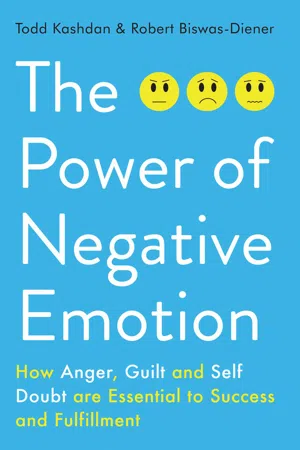
Feelings like anger, boredom, guilt, and anxiety might be uncomfortable, but they are also incredibly useful. In this ground-breaking book, acclaimed psychologists Dr Todd Kashdan and Dr Robert Biswas-Diener explain why positivity and mindfulness can only take us so far. To live life to the full, we need to cultivate 'emotional agility' – the ability to access our full range of emotions (not just the 'good' ones). Find out why: • Anger fuels creativity
• Guilt sparks improvement
• Self-doubt enhances performance
• Selfishness increases courageDrawing on years of scientific research and a wide array of real-life examples from sports, parenting, relationships, business and more, The Power of Negative Emotion is a bold handbook for a more fulfilling and successful life.
Frequently asked questions

Yes, you can cancel anytime from the Subscription tab in your account settings on the Perlego website. Your subscription will stay active until the end of your current billing period. Learn how to cancel your subscription.
No, books cannot be downloaded as external files, such as PDFs, for use outside of Perlego. However, you can download books within the Perlego app for offline reading on mobile or tablet. Learn more here.
Perlego offers two plans: Essential and Complete
  • Essential is ideal for learners and professionals who enjoy exploring a wide range of subjects. Access the Essential Library with 800,000+ trusted titles and best-sellers across business, personal growth, and the humanities. Includes unlimited reading time and Standard Read Aloud voice.
  • Complete: Perfect for advanced learners and researchers needing full, unrestricted access. Unlock 1.4M+ books across hundreds of subjects, including academic and specialized titles. The Complete Plan also includes advanced features like Premium Read Aloud and Research Assistant.
Both plans are available with monthly, semester, or annual billing cycles.
We are an online textbook subscription service, where you can get access to an entire online library for less than the price of a single book per month. With over 1 million books across 1000+ topics, we’ve got you covered! Learn more here.
Look out for the read-aloud symbol on your next book to see if you can listen to it. The read-aloud tool reads text aloud for you, highlighting the text as it is being read. You can pause it, speed it up and slow it down. Learn more here.
Yes! You can use the Perlego app on both iOS or Android devices to read anytime, anywhere — even offline. Perfect for commutes or when you’re on the go.
Please note we cannot support devices running on iOS 13 and Android 7 or earlier. Learn more about using the app.
Yes, you can access The Power of Negative Emotion by Todd Kashdan, Robert Biswas-Diener in PDF and/or ePUB format, as well as other popular books in Psychology & History & Theory in Psychology. We have over one million books available in our catalogue for you to explore.
CHAPTER 1

The False Nose of Happiness

IN SIXTEENTH-CENTURY DENMARK, Tycho Brahe was as renowned for his flamboyant lifestyle as he was for his scientific genius. Brahe’s nose was cut off in a duel (he replaced it with a metal one), and he attended parties with his pet moose (who drank copious amounts of alcohol), but Brahe’s lasting claim to fame is his contribution to astronomy. Instead of accepting ancient philosophical or religious notions about the nature of the heavens, Brahe carefully observed and charted all the stars he could see in the night skies. His notes led to a number of astounding discoveries, including the birth and death of stars, a phenomenon that contradicted ancient notions that all things celestial were fixed. False nose and inebriated moose aside, Brahe’s work earned him a place in history as the father of modern astronomy who formed the foundation on which his assistant, Johannes Kepler, and all modern astronomers, would build their science.
Today psychology is having a “Brahe moment.” Until this point, people have been pretty good about creating intuitive approaches to improving their quality of life. You’ve probably come across some of these theories, such as the Abraham Maslow hierarchy of needs—the idea that people have to satisfy basic requirements like food and safety before they can address their need for self-esteem and fulfillment. There’s also no shortage of commonsense advice on how to become happier: be kind, count your blessings, commute less, spend more time with friends and family, be frugal, and everything in moderation. Great suggestions, but is there reason to believe that these chestnuts are either universally applicable or always true?
Fortunately, we are living in a remarkable time in psychology, thanks to the introduction of sophisticated neuroscience, advanced statistics, handheld computers that allow for better sampling of daily experiences, and other methodological and technical breakthroughs. This is our Brahe moment, when the fundamental understanding of quality of life changes. In the field of psychology in general, and on the subject of happiness specifically, these new tools have yielded two transformative findings: first, we tend to go about the business of happiness all wrong; second, we can do something to fix this.
Why the Way We’ve Been Pursuing Happiness Is Not Going to Make Us Happy
Humans have come a long way since we lived in hunter-gatherer societies. As we spend less time worrying about shelter, drought, or our next kill, it makes sense that we would turn our collective attention to the pursuit of happiness. In fact, in a study of more than ten thousand participants from forty-eight countries, psychologists Ed Diener of the University of Illinois and Shigehiro Oishi of the University of Virginia discovered that people from every corner of the globe rated happiness as being more important than other highly desirable personal outcomes, such as a meaningful life, becoming rich, and getting into heaven.
The rush to happiness is spurred on, at least in part, by a growing body of research suggesting that happiness doesn’t just feel good: it’s good for you. Happiness researchers have linked positive feelings to a host of benefits, ranging from higher incomes to better immune system functioning to boosts in kindness. Not only are these desirable outcomes related to happiness, but science also points to positive emotions as their cause. Some researchers, like Barbara Fredrickson from the University of North Carolina, even argue that happiness is humanity’s evolutionary birthright. It is happiness, the argument goes, that helps people to build personal and social resources that are vital to success in life and—from an evolutionary point of view—survival itself.
But one question keeps raising its not so happy head: if happiness provides an evolutionary advantage, and if we value it so highly and possess thousands of years of good advice about how to achieve it, why isn’t it more widespread? Why aren’t we talking about the current happiness epidemic instead of skyrocketing rates of depression and anxiety? Examining data from the European Social Survey, University of Cambridge researchers Felicia Huppert and Timothy So calculated that only 20 percent of adults in the UK were psychologically flourishing. The figure for the US is even lower.
The Flourishing Scale
Eight statements with which you may agree or disagree follow. Using the following 1–7 scale, please provide a response for each statement.
7—Strongly agree
6—Agree
5—Slightly agree
4—Neither agree nor disagree
3—Slightly disagree
2—Disagree
1—Strongly disagree
____ I lead a purposeful and meaningful life.
____ My social relationships are supportive and rewarding.
____ I am engaged and interested in my daily activities.
____ I actively contribute to the happiness and well-being of others.
____ I am competent and capable in the activities that are important to me.
____ I am a good person and live a good life.
____ I am optimistic about my future.
____ People respect me.
Scoring:
Add the responses, varying from 1 to 7, for all eight items. The possible range of scores is from 8 (lowest possible) to 56 (highest possible). A high score indicates a person with many psychological resources and strengths.
How could this possibly be the case? It turns out that, despite all the attention being paid to the topic, people are not very good at making choices that lead to happiness. We don’t mean to criticize your gym workouts, Mediterranean vacations, meditation practice, or decision to put your kids in four different after-school enrichment activities. We’re as guilty as you when it comes to missing the mark where happiness is concerned. In fact, a range of brand-new research shows that, more or less, everyone is off the mark.
Let’s begin with the research of Barbara Mellers at the University of Pennsylvania and her colleagues Tim Wilson and Daniel Gilbert—author of the bestselling book Stumbling on Happiness. This trio conducted a series of studies on what can be called emotional time travel errors. Just as trained meteorologists make small mistakes that can have a big impact on forecasting the week’s weather, it turns out that people do much the same thing when predicting how an event will make them feel in the future. We overestimate, for instance, how happy we will be if our favored political candidate wins the election or our home team wins the game. We also tend to underestimate how difficult things will be, like moving to a new city.
Take, for example, the study in which Mellers and her colleagues investigated women who took a pregnancy test at Planned Parenthood. (It’s important that none of the women in this study were trying to get pregnant.) Roughly speaking, the women fell into two groups: those who dreaded having a baby and hoped for a negative result, and those who hoped the pregnancy test turned out positive. The researchers asked women to make predictions about how happy they would be if their hoped-for outcome came to pass. Women who were hoping for a negative result expected to feel a sense of elation if they ended up with an empty womb. Women who wanted to be pregnant also expected to feel joyful if they got the positive result they were hoping for.
After the test was over, the researchers found—to their surprise—neither agony nor ecstasy. In fact, they found nothing more than a tiny blip in the women’s emotional equilibrium. Women who wanted a baby were not crestfallen when told it didn’t work out; instead, they were mildly disappointed and then bounced back to their regular mood (we might expect different results if these women had been unsuccessfully trying for months or years). As for women who didn’t want a baby but ended up with an unplanned, living embryo inside them, their anticipated dread never materialized; instead, they had a softer reaction (and a small minority found an unexpected burst of pleasure). It turns out that one reason we wrongly predict what will make us happy in the future is that we overlook our capacity to tolerate, and even adapt to, discomfort. Sure, that new job—to take a different example—is intimidating the first week, but before long you’re cruising along as if you had worked there for years.
The big reason you should care about emotional time travel errors is that nearly every decision you make now is based on an assumption of how you expect to feel in the future. You purchase a dream suburban house with five bedrooms and a sprawling lawn, picturing yourself having coffee on the sweeping veranda while mentally minimizing the added thirty-minute drive to visit friends and to get to work. You give up being with your family for long stretches of time to have a better shot at that big promotion. You choose a mate, decide when (or whether) to have a baby, or select the part of the country where you’ll live, but these big decisions are often compromised by lack of insight into your emotional world. You’re not alone in this. It turns out that we all tend to exaggerate how positively we’ll feel in response to positive events and underestimate our capacity to tolerate distress. When it comes to how we’re going to feel in the future, we most often guess wrong.
Most damning of all when your pursuit of happiness is concerned is information gathered in a recent series of studies by Iris Mauss from the University of California, Berkeley. Mauss is a bit like Tycho Brahe; instead of accepting commonly held assumptions like “we can achieve happiness,” she prefers to chart the metaphorical skies to see what actually hangs in the emotional heavens. She even asks unpopular questions such as “Should people be pursuing happiness?” In one study, Mauss and her colleagues found that people who value the pursuit of happiness actually feel lonelier than other folks. Researchers manipulated the importance placed on happiness by having half the participants read a fake newspaper article extolling the many benefits of happiness. Those who read the article reported feeling lonelier than those who did not, and even produced lower rates of progesterone (a hormone that gets a boost when we feel connected to other people). It turns out that putting too much stock in happiness has health implications too!
To put it succinctly, we humans are horrible at guessing how happy we will feel in the future, and yet we base important life decisions on these flawed predictions. We purchase TVs, plan retirement, and say yes to dinner dates all because of an imperfect guess about how happy they will make us. No wonder we fare poorly in the happiness department, and business is booming for happiness authors, coaches, and consultants. The universal heavy-lifting approach to happiness—when someone follows a prescribed set of commonsense steps that are held out as helpful for everyone—doesn’t work. It’s a bit like Brahe’s false nose: a reasonably close approximation, but it won’t really help you smell any better. So what we—all of us—need with regard to happiness is a new set of strategies. We need a more relevant and complete understanding of what’s involved.
In a world where rejection, failure, self-doubt, hypocrisy, loss, boredom, and annoying and obnoxious people are inevitable, we, the authors, reject the notion that positivity is the only place to search for answers. We reject the belief that being healthy is marked by a life with as little pain as possible. In fact, it’s only when we are unwilling to take on the inevitable pain in life—whether it’s the death of a parent, a divorce, or not getting that big promotion at work—that pain turns into something we experience as suffering. Suffering arises when we turn our backs on an escalation in emotional, physical, or social discomfort.
Rather than working to promote more happiness, we endorse the ability to access the full range of psychological states, both the positive and the negative, to respond effectively to what life offers. In a word, wholeness. When faced with the inevitable challenges life brings, we fare best when we stop making ineffective or unnecessary attempts at controlling negative thoughts and feelings. A whole person acts in the service of what he or she defines as important, and sometimes that requires us to draw on the darker range of our emotions.
Scientific research supports the idea that what we usually see as negative feelings can be more beneficial than positive ones. Studies have shown the following, for example:
• Students who are confused but work through the confusion perform better on subsequent tests than their peers who “get it” right away.
• Centenarians—people who are a hundred years old or older—find that negative feelings, not positive ones, are associated with better health and more physical activity.
• Police detectives who have themselves been victims of crime show more grit and work engagement when working with civilian victims of crime.
• Spouses who forgave physical or verbal aggression were likely to receive more of it, whereas those who were unforgiving enjoyed a precipitous decline in spousal aggression.
• Workers who are in a bad mood in the morning but shift to a good mood in the afternoon are more engrossed in their work than their counterparts who were happy all day.
With regard to creativity, researchers have found that the ideas suggested by folks who experience both negative and positive moods are judged as 9 percent more creative than ideas put forward by happy people; at work, the stress associated with challenges appears to promote motivation. Ronald Bedlow and his colleagues, who conducted this last study on worker involvement, described their discovery this way:
We argue that it is the balance of being able to endure phases of negative affect and then engage in a shift to positive affect that is adaptive. Minimization of negative experiences and suppression of negative affect are functional neither for work motivation nor for personal development.
The Bedlow research team also emphasizes a vital and often overlooked point regarding psychological states: they’re temporary. When people speak of happiness, or depression for that matter, they make the assumption that these experiences are relatively stable. In the modern positive psychology movement it has become vogue to talk about sustainable happiness, as if once the switch is flipped on the smile is permanent. The truth is, we shift between states, positive and negative. People who are whole, those of us who are willing and able to shift to the upside or the downside to get the best possible outcomes in a given situation, are the healthiest, most successful, best learners, and enjoy the deepest well-being. We think of this as the 20 percent edge because wholeness describes those who experience positivity roughly 80 percent of the time but who can also avail themselves of the benefits of negative states the other 20 percent. We do not mean to suggest, of course, that these percentiles are exact figures that should be used as definitive cut-offs. Rather, we argue that the 80:20 ratio is a useful rule-of-thumb approach to understanding wholeness.
The Rising Tide of Anxiety
Anxiety is one of the top news stories of the last decade. Wars, terrorism, housing market crises, childhood obesity—all of these are important geopolitical and economic events. But the insidious rise in anxiety is every bit as noteworthy. Stress is epidemic and, like any virus, does not discriminate based on social class, IQ, or occupation. According to the Mental Health Foundation anxiety is the most prevalent mental health problem in the UK. More than one in ten people are likely to have a ‘disabling anxiety disorder’ at some state in their life. This statistic only highlights the suffering of people who wrestle with diagnosable anxieties. According to a YouGov survey a whopping one in five people report feeling anxious all of the time or a lot of the time. Anxiety in the US is even more widespread.
Paradoxically, we are increasingly stressed because we put such an emphasis on comfort. We have air purifiers, heated car seats, polariz...

Table of contents

  1. Cover
  2. Title
  3. Copyright
  4. Contents
  5. Introduction: The Promise of Wholeness
  6. Chapter 1. The False Nose of Happiness
  7. Chapter 2. The Rise of the Comfortable Class
  8. Chapter 3. What’s So Good About Feeling Bad?
  9. Chapter 4. How Positive Emotion Can Lead to Your Downfall
  10. Chapter 5. Beyond the Obsession with Mindfulness
  11. Chapter 6. The Teddy Effect
  12. Chapter 7. The Whole Enchilada
  13. Acknowledgments
  14. Notes
  15. Index