The Islamic Veil
eBook - ePub

The Islamic Veil

A Beginner's Guide

  1. 192 pages
  2. English
  3. ePUB (mobile friendly)
  4. Available on iOS & Android
eBook - ePub

The Islamic Veil

A Beginner's Guide

About this book

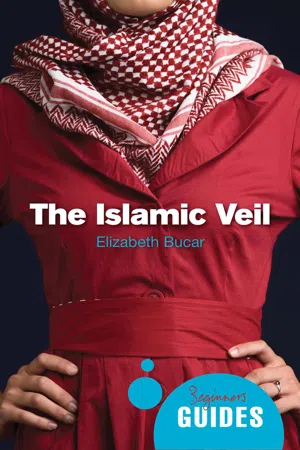
Banned in public institutions in France and Turkey, mandatory in Saudi Arabia and Iran, no other item of clothing incites such furious reactions. The Islamic veil – a catch-all term that encompasses everything from a simple headscarf to the all-covering burqa – has, over the past decade, become a heated battleground for debates on everything from women's rights to multiculturalism.Elizabeth Bucar goes beyond the simplistic question of whether the veil is "good" or "bad" to ask instead why it has become so politically symbolic. Cutting through the condescension and fear that typify the debate, she reveals the huge diversity of women's experiences of veiling. Her illuminating global perspective takes in everything from the new veiling movement among the Egyptian middle class to hijab fashion in Indonesia. It will be invaluable to anyone looking to understand the veil beyond its status as shorthand for Islamic fundamentalism and female oppression.
Frequently asked questions

Yes, you can cancel anytime from the Subscription tab in your account settings on the Perlego website. Your subscription will stay active until the end of your current billing period. Learn how to cancel your subscription.
At the moment all of our mobile-responsive ePub books are available to download via the app. Most of our PDFs are also available to download and we're working on making the final remaining ones downloadable now. Learn more here.
Perlego offers two plans: Essential and Complete
  • Essential is ideal for learners and professionals who enjoy exploring a wide range of subjects. Access the Essential Library with 800,000+ trusted titles and best-sellers across business, personal growth, and the humanities. Includes unlimited reading time and Standard Read Aloud voice.
  • Complete: Perfect for advanced learners and researchers needing full, unrestricted access. Unlock 1.4M+ books across hundreds of subjects, including academic and specialized titles. The Complete Plan also includes advanced features like Premium Read Aloud and Research Assistant.
Both plans are available with monthly, semester, or annual billing cycles.
We are an online textbook subscription service, where you can get access to an entire online library for less than the price of a single book per month. With over 1 million books across 1000+ topics, we’ve got you covered! Learn more here.
Look out for the read-aloud symbol on your next book to see if you can listen to it. The read-aloud tool reads text aloud for you, highlighting the text as it is being read. You can pause it, speed it up and slow it down. Learn more here.
Yes! You can use the Perlego app on both iOS or Android devices to read anytime, anywhere — even offline. Perfect for commutes or when you’re on the go.
Please note we cannot support devices running on iOS 13 and Android 7 or earlier. Learn more about using the app.
Yes, you can access The Islamic Veil by Elizabeth M. Bucar in PDF and/or ePUB format, as well as other popular books in Theology & Religion & Islamic Theology. We have over one million books available in our catalogue for you to explore.

1

Ethics

We are all ethicists. We grapple with what makes an action right or wrong, what makes a person virtuous or not, and what makes a society good or bad. While certainly not the only source of ethical systems for determining what is moral, religions have been key to shaping our reflections on these issues. Islam is no exception. Although there is no agreement among Muslims about the ethics of veiling, ethical debates are part of the story of the Islamic veil.
In everyday usage, the terms ethics and morality are often used interchangeably. Technically, morality is what people actually believe and do – our ideas about what is right and wrong, good and bad, which guide our actions and judgments of others – while ethics is the intellectual reflection on this morality. There is no exact cognate for ‘ethics’ in the Islamic intellectual tradition. Akhlaq, the Qur’anic term used to refer to the prophet Muhammad’s moral character, and adab, proper conduct or manners, are good parallels insofar as they have to do with correct behavior and virtue.
Islamic ethics draws on many sources including the Qur’an and the moral example set by the Prophet and his companions, referred to as the Sunna and recorded in traditions called the hadith. A Muslim living today has access not only to written sources for ethics, but to a long tradition of interpretation of these sources in various forums, some of which will be the focus of other chapters of this volume (e.g. sacred texts in chapter 2 and law in chapter 3). In developing ethical thought Muslims have also engaged in vigorous intellectual debate and interacted with various other ethical traditions, including Greek, Persian, Indian, Jewish, and Christian. In addition, Muslim believers make judgments and act out of a sense of what is moral everyday. This means part of the content of Islamic ethics is what, how, and why Muslims see certain actions as having particular moral meanings.
A couple of general principles of Islamic ethics will help orient the reader. First, Islamic ethics emphasizes norms like human dignity, justice, compassion, mercy, and duty to one’s family life. In terms of ethical reflection on the veil, chastity, dignity, shyness, obedience, femininity, and modesty are all common normative concerns. Second, Islam has no concept equivalent to Christianity’s ‘original sin’. The assumption is that humans are able to ‘be good’, even if the moral life (what is sometimes referred to as following the ‘straight path’) is difficult. Third, Islam teaches that each person has moral agency (Qur’an 81:28, 82:5) and therefore is responsible, and ultimately accountable, for his or her own deeds on the Last Day of Judgment. Finally, Islamic ethics is not just a moral code for right action. There is also a deep interest in how right action can make virtuous Muslims, strengthen relationships, and contribute to a just and stable society.
From one perspective, this entire book is about the ethical meaning of the Islamic veil, as shaped through traditional sources and modes of reasoning (chapters 2 and 3), historical events (chapter 4), or within specific dimensions of daily life (chapters 5, 6, 7, and 8). This chapter describes some general ways ethicists frame discussions about the meaning and power of the Islamic veil and attempts to translate some of these frameworks for the non-specialist in a more general way. To help organize these frameworks, I identify three types of ethical issues at stake for the Islamic veil, that have to do with moral issues in personal, interpersonal, and social arenas of life. Personal ethics involves a focus on how everyday practices, repeated over time, are part of an individual’s ethical formation. The veil, from the personal ethical perspective, has a role in forming the character and inner dispositions of Muslim women. Interpersonal ethics is concerned with relationships, including sexual relations between men and women. Within the interpersonal ethical rubric the veil is analyzed in terms of its effects on sexual norms between men and women, especially how it strengthens marital bonds and prevents immoral sexual desires. Social ethics looks at appropriate behavior for people as a whole and considers the veil’s impact on wider society.
Personal ethics: character formation through bodily acts
A good place to begin to understand how veiling creates a certain sort of person is with the significance of practices to Muslim ethics. The technical term for the emphasis on correct practices is orthopraxy in contrast with orthodoxy, which emphasizes correct belief. Certainly we can see the importance of practice in the five pillars of Islam – pilgrimage, alms-giving, prayer, witness of faith, and ritual fasting. This is not to say that Islam has no place for beliefs, but rather that we must also consider the meanings and effects of the physical actions of Muslims as well.
When scholars talk to each other about the ways actions affect the people who do them they almost always reference French philosophers like Michel Foucault or Pierre Hadot. These thinkers write about the manner in which bodily actions, which they categorize as ‘technologies of the self ’ (Foucault 1990) and ‘spiritual exercises’ (Hadot 1995), affect who a person is. This is not just an existential claim such as ‘you are what you do’ or ‘you are the sum of your actions’. Rather the core idea is that practices modify and transform a person who performs them.
The role of bodily practice in moral formation is crucial for understanding why some women veil, as well as how veiling affects them. This view of the moral life assumes that in order for a woman to be moral, she must do the right things. Think of a musician who logs in hours of daily practice in order to hone her craft. Some Muslims see veiling as a type of ‘practice’ that builds the skills necessary to be successful at being good.
Certain actions are also associated with specific virtues. If you do something often enough, these virtues are ‘imprinted’ on you. For the Islamic veil these virtues might include modesty, shyness, or obedience. During Saba Mahmood’s research on Egyptian Muslim women one of her informants describes a connection between veiling and becoming shy:
It’s just like the veil. In the beginning when you wear it, you’re embarrassed and don’t want to wear it because people say that you look older and unattractive, that you won’t get married and will never find a husband. But you must wear the veil, first because it is God’s command and then, with time, because your inside learns to feel shy without the veil, and if you take it off, your entire being feels uncomfortable about it (Mahmood 2005, 157).
Gaining shyness is not the extension of one’s initial tendencies, but a process of acquiring norms through bodily actions. Eventually the women come to feel shy spontaneously and want to wear the veil.
In traditional Islamic thought this change is described by the Arabic word malaka (habit or habitus). The medieval Islamic philosopher Ibn Khaldun describes malaka as ‘a firmly rooted quality acquired by doing a certain action and repeating it time after time, until the form of that action is firmly fixed’ in the disposition of a person (Ibn Khaldun 1958, 346).The idea is that specific actions, such as wearing a veil, are repeated as part of a program of moral training. That these actions are difficult is part of the point. In the beginning, veiling is hard. It takes a conscious effort. But after time, a woman acquires malaka so that she wants to veil and unveiling is what feels uncomfortable.
This role of practice in character formation should help shift us from seeing the veil only as a symbol (of piety, submission, identity) to seeing it as the means by which virtues are made. On the one hand this is a connection of inner and outer dimensions of the human life. The veil is not merely clothing, it is intimately linked to one’s inner orientation and spiritual development. On the other hand, the veil is not only the marker of piety or modesty: it is itself part of what defines piety. This is why bans on the veil are so egregious to some Muslims: they can be interpreted as taking away a woman’s ability to be and even become pious.
Interpersonal ethics: regulating sexual desires between men and women
Interpersonal ethics refers to those aspects of ethics that deal with issues arising from our relationships with other people. Unlike personal ethics, which is concerned mainly with the actions and virtues of individuals, and social ethics, which considers the moral life of the wider social unit, the interpersonal dimension of ethics looks at what is acceptable and desirable in our interactions with friends, family, and even strangers. For the Islamic veil, the interpersonal ethics most discussed are those concerned with human sexuality, such as the effect of women’s bodies on men and the danger of immoral sexual encounters.
In general, Islam sees human sexuality as positive: it both acknowledges sex as a human need and as potentially embodying virtues such as kindness, reciprocity, and generosity. Within the context of a legal marriage, spouses even have a right to sexual satisfaction that is independent of procreative aims (Ali 2006, 7). Islam teaches that sexual intimacy is an important part of a full human life.
Nonetheless, Islam does not support sexual anarchy or teach that sex is good under all circumstances. Specifically, moral sexual activity is limited to a legally married man and woman. In current ethical discourse, the term zina (which will be discussed more in chapters 2 and 3) is used to refer to illicit sex between unmarried partners. Sex is therefore good, because it is crucial for a fully human life, but morally regulated, because it is powerful and therefore potentially dangerous. Two of the most commonly discussed dangers are the chaos created by women’s sexuality and the insatiability of men’s sexual desire.
Veiling allows, in theory, for the power of human sexuality to be directed only towards its ethical goals in two ways. First, the public veiling of women is meant to prevent inappropriate sexual desires between men and women. It is best to separate unmarried men and women, but strict gender segregation is difficult, if not impossible, and the Islamic veil is a way separation is at least partially enacted. In this way, the veil acts as a mobile honor zone, protecting the honor of the woman no matter where she goes (Okkenhaug & Flaskerud 2005, 126). Second, veiling is meant to strengthen the marital bond by keeping a woman’s sensuality for her husband. As Iranian Ayatollah Murtaza Mutahhari (d. 1979) argued in the late 1960s, keeping sex for marriage allows one spouse to be ‘the cause for the wellbeing of the other’. He contrasts this to complete sexual freedom, where one’s spouse ‘gets in the way of that person’s “fun” like a prison guard’ and the family becomes resented (Mutahhari 1992, 14).
Social ethics: ensuring public dignity and making Islamic spaces
Social ethics is concerned with how a society should act as a whole. Here the concern is less with the behavior of individuals or even interactions between individuals, and more with the appropriate behavior of the collective. A classic example of Islamic social ethics is Abu Nasr Muhammad al-Farabi’s (d. 905/951) al-madinah al-fadilah (The Excellent City, 1906), which explores social ideals produce the greatest good for a city’s citizens. Examples of issues taken up by social ethicists are abortion, war, work, and a range of bio-medical issues.
Islamic social ethics reflects on the collective experience of Muslims, both in Muslim majority contexts and in contexts where Muslims are a minority. Since these social contexts are very different, what is moral in one may not necessarily be appropriate for another. Nevertheless, there are certain strands of Islamic social ethics that have been especially influential in debates around the Islamic veil, such as reflections on the impact of sexual desires on the social unit. The Pakistani Islamic leader, Said Abul A’la Maududi (d. 1979) thought ‘the most important problem of social life’ is ‘how to regulate the sexual urge into a system and prevent it from running wild’ (Maududi 1972, 141). The veil is offered as a way to regulate these urges for the benefit of society.
Arguments made in support of the veil within this area of ethical reflection often claim that the veil can do four types of things for society. First, some suggest that the veil can prevent men from being constantly aroused and distracted by women’s sexuality in public places. By hiding the more alluring parts of a woman’s body from view, such as her hair and her bosom, the Islamic veil in theory creates a sexually sanitized social space. This protects what Mutahhari refers to as ‘social dignity’. The ‘tranquility of the spirit of society’, he argues, demands ‘that a man and a woman choose a special way of relating to each other’ (Mutahhari 1992, 42).
Second, some argue the veil encourages economic productivity by visually segregating women and men so they are not distracted by their sexual desires for each other. Simply put, the workers will be able to get more done when they are not busy flirting or staring at each other lustfully. The same is said about places of learning, where boys and girls are assumed to listen, learn, and think better when not distracted by their raging hormones.
Third, some supporters of the veil think it allows Muslim women to more fully participate in society by protecting their modesty as well as their physical safety. If every woman veils the entire public sphere becomes an Islamic honor zone, and thus morally safe for Muslim women.
Finally, the veil is seen as a way to prevent social immorality by guarding women from external, especially Western, immoral influences. Through much of the twentieth and twenty-first centuries, many Islamic leaders have been concerned with undoing the effects of Western socialization, which they believe distort Islamic culture and values. Women are seen as especially vulnerable to Western infection, which some Islamists claim deprives women of their chastity, modesty, and honor. The Islamic veil is posited as one antidote for this social infection. In chapters 3 and 4, for instance, we will see that some Muslim leaders argued that public un-veiling was a cause of widespread social demise and immoral behavior and that public re-veiling would be necessary to establish social harmony.
Ethical critiques of the Islamic veil
This book is primarily an attempt to describe and explain the reasons why women veil and the power of this veiling in different dimensions of life. However it is helpful to point out some of the ethical critiques that are made about Islamic veiling so that the reader is not left with the impression that all Islamic ethical thought supports the veil.
In terms of the personal arguments for veiling, critics point out that it is a gross reduction of the full meaning of piety and modesty when they are linked too closely with the veil. Reducing piety to the veil for women is a flattening of a much broader personal process of character formation that occurs throughout one’s daily life. In terms of modesty, a headscarf can actually increase a woman’s beauty (as discussed in chapter 8 on fashion). Many women who wear the veil also use makeup. Other women enact modesty without the veil. For many Muslims, real modesty is an attitude, not a form of dress, marked by the avoidance of alluring looks, or flirtatious laughs. The nineteenth-century Muslim reformer Jamal al-Din al-Afghani (d. 1897) defined modesty as resistance of doing sinful actions (translated in Moazzam 1984, 78). More recently, the progressive Islamic leader Muhammad Said Ashmawi (b. 1932) argued, ‘the real meaning of hijab lies in thwarting the self from straying toward lust or illicit desires, and keeping away from sinful behavior, without having to conjoin this [understanding] with particular forms of clothing and attire’ (translated by Mahmood 2005, 160).
Critics of Islamic veiling also comment within the realm of interpersonal ethics. They argue that the veil is neither necessary nor sufficient to prevent illicit sexual desires. A man and woman can still flirt, or commit ‘adultery of the eyes’ (Maududi 1972, 180), even if the woman is wearing a veil. Others have argued that the Islamic veil is just as likely to create desire as to prevent it by marking women’s bodies as forbidden: cultural studies scholar Faegheh Shirazi has shown, for instance, how common stereotypes of the exoticism and sensuality of veiled women are used in Western advertisements (Shirazi 2001, 39–61). Finally, although the Qur’anic directives about sexual modesty considered in chapter 2 address both men and women, the current emphasis on women’s modest dress in the form of the veil neglects men’s role in interpersonal sexual ethics. In fact it seems to be men’s unruly desire that makes women’s bodies so troubling to sexual ethics in the first place. Sociologist Marnia Lazreg has argued that when men say the veil protects against sexual harassment, what they are really doing is giving themselves permission to act badly. She equates it to taking an aspirin every night to prevent a heart attack. ‘It’s a step that one takes’, she argues, ‘so that when a heart attack occurs, one can always say, “I did all the right things”’ (Lazreg 2009, 51).
Finally, some critiques of veiling can be categorized as arguments from within social ethics. Social reasons are often used to justify compulsory veiling of all women as the only way to guarantee a socially Islamic space. Critics of veiling, however, point out that requiring veiling undermines the ability of veiling to be a conscious virtuous choice: if veiling is mandatory, there is no way to make veiling a personal, moral decision. Others point out that mandatory veiling collapses a distinction in Islam between religion (din) and life (dunia). Muslim women do not devote every aspect of their daily lives to the worship of God. That would be equating Muslim veiling to a Catholic nun’s habit (as nuns do in fact devote their lives to religion). Women’s other daily tasks, cooking, cleaning, working, caring, in no way lessen their commitment to Muslim ethics, but these mundane activities are not themselves religious or necessarily moral (Lazreg 2009, 25). A woman can be pious, these critics argue, without having a religious or ethical motivation for every daily task.
Summary: the ethical impact of my temporary veiling
In the summer of 2004, I lived in Tehran, Iran, studying Persian and conducting research. Although I am not Muslim, like every other woman in Iran, I was required to veil in public, and so I did. Most of the time I wore a headscarf and a short coat-like garment called a manteau. When I visited Shi‘i shrines, I wore a long black chador that covered everything but my face.
For me, veiling was not part of a conscious attempt to be Muslim or more modest around men. I never intended it to affect me in any way. My Islamic dress was simply obedience to the national laws and respect for the customs of my host country. At first I felt awkward veiled. It was like dressing up in some exotic costume: sort of silly, a little embarrassing.
However, it did not take long for me to get used to the veil. A favorite break from my studies quickly became shopping for...

Table of contents

  1. Cover
  2. Title page
  3. Copyright page
  4. Dedication page
  5. Contents
  6. Acknowledgements
  7. List of figures
  8. Introduction
  9. 1 Ethics
  10. 2 Sacred texts
  11. 3 Law
  12. 4 Colonialism
  13. 5 Employment
  14. 6 Education
  15. 7 Identity
  16. 8 Fashion
  17. Conclusion
  18. Further reading
  19. Bibliography
  20. Index