
- 288 pages
- English
- ePUB (mobile friendly)
- Available on iOS & Android
eBook - ePub
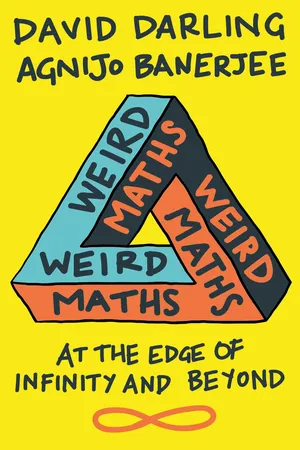
About this book
Is anything truly random? Does infinity actually exist? Could we ever see into other dimensions?
In this delightful journey of discovery, David Darling and extraordinary child prodigy Agnijo Banerjee draw connections between the cutting edge of modern maths and life as we understand it, delving into the strange – would we like alien music? – and venturing out on quests to consider the existence of free will and the fantastical future of quantum computers. Packed with puzzles and paradoxes, mind-bending concepts and surprising solutions, this is for anyone who wants life’s questions answered – even those you never thought to ask.
Frequently asked questions
Yes, you can cancel anytime from the Subscription tab in your account settings on the Perlego website. Your subscription will stay active until the end of your current billing period. Learn how to cancel your subscription.
No, books cannot be downloaded as external files, such as PDFs, for use outside of Perlego. However, you can download books within the Perlego app for offline reading on mobile or tablet. Learn more here.
Perlego offers two plans: Essential and Complete
- Essential is ideal for learners and professionals who enjoy exploring a wide range of subjects. Access the Essential Library with 800,000+ trusted titles and best-sellers across business, personal growth, and the humanities. Includes unlimited reading time and Standard Read Aloud voice.
- Complete: Perfect for advanced learners and researchers needing full, unrestricted access. Unlock 1.4M+ books across hundreds of subjects, including academic and specialized titles. The Complete Plan also includes advanced features like Premium Read Aloud and Research Assistant.
We are an online textbook subscription service, where you can get access to an entire online library for less than the price of a single book per month. With over 1 million books across 1000+ topics, weāve got you covered! Learn more here.
Look out for the read-aloud symbol on your next book to see if you can listen to it. The read-aloud tool reads text aloud for you, highlighting the text as it is being read. You can pause it, speed it up and slow it down. Learn more here.
Yes! You can use the Perlego app on both iOS or Android devices to read anytime, anywhere ā even offline. Perfect for commutes or when youāre on the go.
Please note we cannot support devices running on iOS 13 and Android 7 or earlier. Learn more about using the app.
Yes, you can access Weird Maths by David Darling,Agnijo Banerjee in PDF and/or ePUB format, as well as other popular books in Mathematics & Applied Mathematics. We have over one million books available in our catalogue for you to explore.
Information
āChapter 1
The Maths Behind the World
Even stranger things have happened; and perhaps the strangest of all is the marvel that mathematics should be possible to a race akin to the apes.
ā Eric T. Bell, The Development of Mathematics
Physics is mathematical not because we know so much about the physical world, but because we know so little; it is only its mathematical properties that we can discover.
ā Bertrand Russell
In terms of intellectual ability, Homo sapiens hasnāt changed much, if at all, over the past 100,000 years. Put children from the time when woolly rhinos and mastodons still roamed the Earth into a present-day school and they would develop just as well as typical twenty-first century youngsters. Their brains would assimilate arithmetic, geometry, and algebra. And, if they were so inclined, thereād be nothing to stop them delving deeper into the subject and someday perhaps becoming professors of maths at Cambridge or Harvard.
Our neural apparatus evolved the potential to do advanced calculations, and understand such things as set theory and differential geometry, long before it was ever applied in this way. In fact, it seems a bit of a mystery why we have this innate talent for higher mathematics when it has no obvious survival value. At the same time, the reason our species emerged and endured is because it had an edge over its rivals in terms of intelligence and an ability to think logically, plan ahead, and ask āwhat if?ā Lacking other survival skills, such as speed and strength, our ancestors were forced to rely on their cunning and foresight. A capacity for logical thought became our one great super-power, and from that, in time, flowed our ability to communicate in a complex way, to symbolise, and to make rational sense of the world around us.
Like all animals, we effectively do a lot of difficult maths on the fly. The simple act of catching a ball (or avoiding predators or hunting a prey) involves solving multiple equations simultaneously at high speed. Try programming a robot to do the same thing and the complexity of calculations involved becomes clear. But the great strength of humans was their ability to move from the concrete to the abstract ā to analyse situations, to ask if/then questions, to plan ahead.
The dawn of agriculture brought the need to track the seasons accurately, and the coming of trade and settled communities meant that transactions had to be carried out and accounts kept. For both these practical purposes, calendars and business transactions, some kind of reckoning had to be developed, and so elementary maths made its first appearance. One of the regions where it sprang up was the Middle East. Archaeologists have unearthed Sumerian clay trading tokens dating back to about 8,000 bc, which show that these people dealt with representations of number. But it seems that, at this early period, they didnāt treat the concept as being separate from the thing being counted. For example, they had different shaped tokens for different items, such as sheep or jars of oil. When a lot of tokens had to be exchanged between parties, the tokens were sealed inside containers called bullae, which had to be broken open to check the contents. Over time, markings began to appear on the bullae to indicate how many tokens there were within. The symbolic representations then evolved into a written number system, while tokens became generalised for counting any kind of object and eventually morphed into an early form of coinage. Along the way, the concept of number became abstracted from the type of object being counted, so that, for example, five was five whether it referred to five goats or five loaves of bread.

The Egyptians had a good understanding of practical mathematics and put this to effect in the construction of the Pyramid of Khafre at Giza, shown here together with the Sphinx.
The connection between maths and everyday reality seems strong at this stage. Counting and record keeping are practical tools of the farmer and the merchant, and if these methods do the job who cares about the philosophy behind it all? Simple arithmetic looks well rooted in the world āout thereā: one sheep plus one sheep is two sheep, two sheep plus two sheep is four sheep. Nothing could be more straightforward. But look more closely and we see that already something a bit strange has happened. In saying āone sheep and one sheepā thereās the assumption that the sheep are identical or, at least, for the purposes of counting, that any differences donāt matter. But no two sheep are alike. What weāve done is to abstract a perceived quality to do with the sheep ā their āonenessā, or apartness ā and then operate on this quality with another abstraction, which we call addition. Thatās a big step. In practice, adding one sheep and one sheep might mean putting them together in the same field. But, also in practice, the sheep are different and, digging a little deeper, what we call āsheepā ā like anything else in the world ā isnāt really separate from the rest of the universe. On top of this, thereās the slightly disturbing fact that what we take to be objects (such as sheep) āout thereā are constructions in our brains built up from signals that enter our senses. Even if we grant that a sheep has some external reality, physics tells us that itās a hugely complicated, temporary assemblage of subatomic particles thatās in constant flux. Yet, somehow, in counting sheep weāre able to ignore this monumental complexity or, rather, in everyday life, not even be aware of it.
Of all subjects, mathematics is the most precise and immutable. Science and other fields of human endeavour are, at best, approximations to some ideal, and are always changing and evolving over time. As the German mathematician Hermann Hankel pointed out: āIn most sciences, one generation tears down what another has built and what one has established another undoes. In mathematics alone each generation adds a new story to the old structure.ā From the outset, this difference between maths and every other discipline is inevitable because maths starts with the mind extracting what it recognises as being most fundamental and constant among the messages it receives via the senses. This leads to the concepts of natural numbers, as a way of measuring quantity, and of addition and subtraction as basic ways of combining quantities. Oneness, twoness, threeness, and so on, are seen as common features of collections of things, whatever those things happen to be and however different individuals of the same type of thing happen to be. So, the fact that maths has this eternal, adamantine quality to it is assured from the start ā and is its greatest strength.
Mathematics exists. Of that thereās no doubt. Pythagorasā theorem, for instance, is somehow part of our reality. But where does it exist when itās not being used or being instantiated in some material form, and where did it exist many thousands of years ago, before anyone had thought about it? Platonists believe that mathematical objects, such as numbers, geometric shapes, and the relationships between them, exist independently of us, and our thoughts and language, and the physical universe. Quite what sort of ethereal realm they inhabit isnāt specified, but itās a common assumption that theyāre somehow āout thereā. Most mathematicians, itās probably fair to say, subscribe to this school of thought and therefore also to the belief that maths is discovered rather than invented. Most, too, probably donāt care very much for philosophising and are happy just to get on with doing maths, in the same way that the majority of physicists, working in the lab or solving theoretical problems, donāt worry a lot about metaphysics. Still, the ultimate nature of things ā in this case, of mathematical things ā is interesting, even if we never arrive at a final answer. The Prussian mathematician and logician Leopold Kronecker thought that only whole numbers were given, or in his words: āGod made the integers, all the rest is the work of man.ā The English astrophysicist Arthur Eddington went further and said: āThe mathematics is not there till we put it there.ā The debate about whether mathematics is invented or discovered, or is perhaps some combination of both, arising from a synergy of mind and matter, will no doubt rumble on and, in the end, may have no simple answer.
One fact is clear: if a piece of maths has been proven to be true, it will remain true for all time. Thereās no matter of opinion about it, or subjective influence. āI like mathematics,ā remarked Bertrand Russell, ābecause it is not human and has nothing particular to do with this planet or with the whole accidental universe.ā David Hilbert voiced something similar: āMathematics knows no races or geographic boundaries; for mathematics, the cultural world is one country.ā This impersonal, universal quality of maths is its greatest strength, yet doesnāt, to the trained eye, detract from its aesthetic appeal. āBeauty is the first test: there is no permanent place in the world for ugly mathematics,ā remarked the English mathematician, G. H. Hardy. The same sentiment, but from the field of theoretical physics was expressed by Paul Dirac: āIt seems to be one of the fundamental features of nature that fundamental physical laws are described in terms of a mathematical theory of great beauty and power.ā
The flip side to the universality of maths, however, is that it can seem cold and sterile, devoid of passion and feeling. As a result we may find that although intelligent beings on other worlds share the same mathematics as us, it isnāt the best way to communicate with them about a lot of the things that matter to us. āMany people suggest using mathematics to talk to the aliens,ā commented SETI (Search for ExtraTerrestrial Intelligence) researcher Seth Shostak. In fact the Dutch mathematician Hans Freudenthal developed an entire language (Lincos) based on this idea. āBut,ā said Shostak, āmy personal opinion is that mathematics may be a hard way to describe ideas like love or democracy.ā
The ultimate goal of scientists, certainly of physicists, is to reduce what they observe in the world to a mathematical description. Cosmologists, particle physicists, and the like are never happier than when theyāve measured and quantified things and then found a relationship between the quantities. The idea that the universe is mathematical at its core has ancient roots, stretching back at least as far as the Pythagoreans. Galileo saw the world as a āgrand bookā written in the language of mathematics, and, much more recently, in 1960, the Hungarian-American physicist and mathematician Eugene Wigner wrote a paper called āThe Unreasonable Effectiveness of Mathematics in the Natural Sciencesā.
We donāt see numbers directly in the real world, so it isnāt immediately obvious that maths is all around us. But we do see shapes ā the near-spherical shape of planets and stars, the curved path of objects when thrown or in orbit, the symmetry of snowflakes, and so on ā and these can be described by relationships between numbers. Other patterns, translatable into maths, emerge from the way electricity or magnetism behaves, galaxies rotate, and electrons operate within the confines of atoms. These patterns, and the equations describing them, underpin individual events and seem to represent deep, timeless truths underlying the changing complexity in which we find ourselves. The German physicist Heinrich Hertz, who first conclusively proved the existence of electromagnetic waves, remarked: āOne cannot escape the feeling that these mathematical formulas have an independent existence and...
Table of contents
- Introduction
- A Note to the Reader
- Chapter 1 ⢠The Maths Behind the World
- Chapter 2 ⢠How to See in 4D
- Chapter 3 ⢠Chance Is a Fine Thing
- Chapter 4 ⢠Patterns at the Brink of Chaos
- Chapter 5 ⢠Turingās Fantastic Machine
- Chapter 6 ⢠Music of the Spheres
- Chapter 7 ⢠Prime Mysteries
- Chapter 8 ⢠Can Chess Be Solved?
- Chapter 9 ⢠What Is and What Should Never Be
- Chapter 10 ⢠You Canāt Get There from Here
- Chapter 11 ⢠The Biggest Number of All
- Chapter 12 ⢠Bend it, Stretch it, Any Way You Want to
- Chapter 13 ⢠God, Gödel, and the Search for Proof
- Acknowledgements