
eBook - ePub
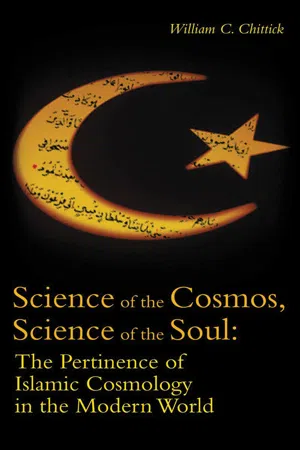
Science of the Cosmos, Science of the Soul
The Pertinence of Islamic Cosmology in the Modern World
- 176 pages
- English
- ePUB (mobile friendly)
- Available on iOS & Android
eBook - ePub
Science of the Cosmos, Science of the Soul
The Pertinence of Islamic Cosmology in the Modern World
About this book
With academic courses either encouraging commercialism, or cultivating zealots, Chittick states that it is impossible to understand classical Islamic texts without the years of contemplative study that are anathema to the modern education system. Insisting upon a return to the ways of the ancient wisdom tradition, which saw the quest for knowledge of the soul, the world, and God as a unifying spiritual discipline, Chittick maintains that the study of Islamic texts cannot be treated separately from self-understanding. Fascinating, radical, and a true challenge to modern trends in academic study, this book opens a new debate in Islamic thought.
Frequently asked questions
Yes, you can cancel anytime from the Subscription tab in your account settings on the Perlego website. Your subscription will stay active until the end of your current billing period. Learn how to cancel your subscription.
At the moment all of our mobile-responsive ePub books are available to download via the app. Most of our PDFs are also available to download and we're working on making the final remaining ones downloadable now. Learn more here.
Perlego offers two plans: Essential and Complete
- Essential is ideal for learners and professionals who enjoy exploring a wide range of subjects. Access the Essential Library with 800,000+ trusted titles and best-sellers across business, personal growth, and the humanities. Includes unlimited reading time and Standard Read Aloud voice.
- Complete: Perfect for advanced learners and researchers needing full, unrestricted access. Unlock 1.4M+ books across hundreds of subjects, including academic and specialized titles. The Complete Plan also includes advanced features like Premium Read Aloud and Research Assistant.
We are an online textbook subscription service, where you can get access to an entire online library for less than the price of a single book per month. With over 1 million books across 1000+ topics, weâve got you covered! Learn more here.
Look out for the read-aloud symbol on your next book to see if you can listen to it. The read-aloud tool reads text aloud for you, highlighting the text as it is being read. You can pause it, speed it up and slow it down. Learn more here.
Yes! You can use the Perlego app on both iOS or Android devices to read anytime, anywhere â even offline. Perfect for commutes or when youâre on the go.
Please note we cannot support devices running on iOS 13 and Android 7 or earlier. Learn more about using the app.
Yes, you can access Science of the Cosmos, Science of the Soul by William C. Chittick in PDF and/or ePUB format, as well as other popular books in Theology & Religion & Asian Religions. We have over one million books available in our catalogue for you to explore.
Information
Topic
Theology & ReligionSubtopic
Asian Religions1

A Vanishing Heritage
Intellectual understanding in the strict sense is found at the highest pinnacle of human selfhood, what the philosophers call the âactual intellect.â When such understanding leaves the realm of pure intelligence and descends to the level of thought and language, we are dealing with its expression, which will always be inadequate. To begin with, expression is simply transmitted knowledge, not actual understanding. Nonetheless, we can still appreciate that a distinction has always been drawn between these two sorts of knowledge in Islam and other traditions. It is this distinction that I need to clarify at the outset. Then I will suggest how ignorance of the foundational importance of intellectual understanding has contributed to the crises faced not only by Muslims, but also by the human community in general.
The intellectual tradition in Islam has addressed four basic topics: God, the cosmos, the human soul, and interpersonal relationships. The first three are foundational constituents of reality as we perceive it, and the fourth applies the insights gained from studying the first three to the realm of human activity. One can of course read about all these topics in the authoritative sources of transmitted knowledge, such as the Qurâan and the Hadith, but knowing them for oneself is another matter altogether. For the intellectual tradition, transmitted knowledge plays the role of pointers toward an understanding that must be actualized and realized by the seeker.
Perhaps the best way to understand the difference between transmitted and intellectual knowledge is to reflect upon the difference between âimitationâ or âfollowing authorityâ (taqlÄ«d) and ârealizationâ or âverificationâ (taáž„qÄ«q), terms that designate the two basic paths of acquiring knowledge. In order to be a member of any religion, culture, society, or group, one needs to learn from those who are already members, and this process of learning goes on by way of âimitation.â This is how we learn language and culture, not to mention scripture, ritual, and law. In the Islamic context, those who have assumed the responsibility of preserving this transmitted heritage are called the ulama, that is, the âknowersâ of the tradition.
In transmitted knowledge, the question of âwhyâ is pushed into the background. When someone asks the ulama why one must accept such-and-such a dogma or why one must pray or fast, the basic answer is âbecause God said so,â which is to say that we have the knowledge on the authority of the Qurâan and the Sunnah. In the same way, parents correct their childrenâs speech by calling on the authority of usage or the rules of grammar.
Intellectual knowledge is altogether different. If one accepts it on the basis of hearsay, one has not understood it. Mathematics is a science that does not depend on the authorities. Rather, it needs to be awakened in oneâs awareness. In learning it, students must understand why, or else they will simply be imitating others. It makes no sense to say that two plus two equals four because my teacher said so. Either you understand it, or you donât. You must discover its truth within yourself. The Muslim intellectuals held that to imitate others in intellectual issues is the status of a beginner or a student, not a master, but to imitate the Qurâan and the Prophet in transmitted matters is to follow the right path.
In short, there are two basic sorts of knowledge, and each has methods proper to it. Taqlīd or imitation is proper to the transmitted sciences, and taងqīq or realization is proper to the intellectual sciences.
IJTIHÄD
The word taqlÄ«d is often discussed in the writings of modern-day Muslim thinkers, who typically describe it as the bane of Islamic society. These discussions, however, do not focus on taqlÄ«d as the opposite of taáž„qÄ«q, but rather as the opposite of ijtihÄd. Given the prominence of this issue among contemporary Muslim writers, I need to make clear at the outset that I am talking about something else.
IjtihÄd means the achievement of sufficient mastery in the discipline of jurisprudence (fiqh) to exercise independent judgment in deriving the Shariah (Islamic law). Someone who reaches this rank is called a mujtahid. Such a person does not need to follow the authority of other jurists in matters of the Shariah. Nonetheless, his or her mastery remains on the level of transmitted knowledge, which is to say that it is still based on the Qurâan, the Hadith, and reports from the forefathers and the masters of the discipline. Given the qualifications needed to become a mujtahid, most Sunni Muslims over the past few centuries have held that the gate of ijtihÄd is closed. Shiâites, in contrast, consider it always open.
From the point of view of jurisprudence, a person who is not himself a mujtahid must imitate someone who is â whether the mujtahid be alive (as in Shiâism) or long dead (as in Sunnism). One follows a mujtahid because one can only learn the Shariah from someone who already knows it. This is not the situation in the intellectual sciences, however. A mujtahid, with all his or her mastery of the transmitted science of jurisprudence, is by no means a muáž„aqqiq, one who has achieved taáž„qÄ«q or realization in intellectual knowledge. To begin with, intellectual knowledge does not depend upon transmission. A muáž„aqqiq can, in principle, grasp all the intellectual sciences without the help of past generations or divine revelation. You do not need a prophet to tell you that two plus two equals four or that God is one. The knowledge itself, once known, is self-evident, which is to say that it carries its own proof in the very act of understanding it.
The ulama of the Shariah implicitly recognize the differing nature of intellectual knowledge when they tell us, as they often do, that faith (Ä«mÄn) on the basis of imitation is unacceptable to God. A Muslim cannot be true to his tradition if he says, âI have faith in God because my parents told me to.â Someone like this would be saying that if he had been told not to believe in God, he would not, so his faith would be empty words.
Although in theory we can distinguish between transmitted and intellectual knowledge, in practice the two have always been closely intertwined, and the intellectual sciences have always built on the transmitted sciences. One cannot speak properly without grammar, and one cannot understand specifically Islamic teachings without the Qurâan and the Hadith. However, the fact that people may have an excellent knowledge of the transmitted sciences does not mean that they know anything at all about the intellectual sciences. Nor does the ability to recount the metaphysical and cosmological theories of the great Muslim intellectuals prove that a person has any understanding of what the theories mean.
Both the transmitted and the intellectual sciences are essential to the survival of any religion, but both are now being lost. By and large, however, transmitted sciences are better preserved than intellectual sciences, and the reason is obvious. Anyone can memorize Qurâan and Hadith, but few can truly understand what God and the Prophet are talking about. One can only understand in oneâs own measure, and fewer and fewer people undertake the training necessary to develop their talents and capacities.
It is obvious that one cannot understand mathematics (or any other science) without both native ability and training. Even if one happens to have a great aptitude, one will never get very far without years of study. If this is true of sciences like mathematics or grammar, which deal with realities that are relatively near at hand, it is much more true of metaphysics, which deals with the deepest realities, the furthest from our everyday experience.
THE ROLE OF THE INTELLECTUAL TRADITION
It is important to stress that no religion can survive, much less flourish, without a living intellectual tradition. This becomes clear as soon as we ask ourselves the questions: What was the intellectual tradition for? What function did it play in society? What was its goal? In other words: Why should people think? Why shouldnât they just blindly accept whatever theyâre told? The basic Muslim answer is that people should think because they must think, because they are thinking beings. They have no choice but to think, because God has given them minds and intelligence. Not only that, but in numerous Qurâanic verses God has commanded them to think and to employ their intelligence. To think properly a person must actually think, which is to say that conclusions must be reached by oneâs own intellectual struggle, not by someone elseâs. Any experienced teacher knows this perfectly well.
No doubt, this does not mean that God requires everyone to enter into the sophisticated sort of study and reflection that went on in the intellectual sciences, because not everyone has the requisite talents, capacities, and circumstances. Nonetheless, people have the moral and religious obligation to use the minds that God has given them. As the Qurâan puts it, âGod burdens a soul only to its capacityâ (2:286). If peopleâs capacity includes thinking, then they have the duty to think. But God does not tell them what to think, because that would be to make imitation and hearsay incumbent in intellectual matters. It would defeat the very purpose of human intelligence, which is for us to understand for ourselves.
No doubt many if not most people are unreflective and never even ask themselves why they should bother thinking about things. They simply go about their daily routine and imagine that they understand their situation. Observant Muslims of this sort seem to assume that God wants nothing more from them than following the Shariah. But this is no argument for those who have the ability to think. Anyone who has the capacity and talent to reflect upon God, the universe, and the human soul has the duty to do so. Not to do so is to betray oneâs own nature and to disobey Godâs instructions to ponder the signs.
Given that some Muslims have no choice but to think, learning how to think correctly must be an important area of Muslim effort. But what defines âcorrectâ thinking? How do we tell the difference between right thinking and wrong thinking? Does the fact that people have no choice but to think mean that they are free to think whatever they want? The Islamic answer to these sorts of question has always been that the way people think is far from indifferent. Some modes of thinking are encouraged by the Qurâan and the Sunnah, and some are discouraged. Islamically, it is incumbent upon those who think to employ their minds in ways that coincide with the goals of the Qurâan and the Sunnah. In other words, the goal of the Islamic intellectual tradition needs to coincide with the goal of Islam, or else it is not Islamic intellectuality.
So, what is the goal of Islam? In general terms, Islamâs goal is to bring people into harmony with the way things actually are. In other words, it is to bring them back into the presence of God, from which they emerged in the first place. However, everyone is going back into Godâs presence in any case, so the issue is not going back per se, but how one gets there. Through the Qurâan and the Sunnah, God guides people back to him in a manner that will ensure their permanent happiness. If they want to follow a âstraight pathâ (áčŁirÄáč mustaqÄ«m), one that will lead to balance and happiness and not to disequilibrium and misery, they need to employ their minds, awareness, and thinking in ways that harmonize with God himself, the true Reality. If they occupy themselves with illusion and unreality, they will follow a crooked path and most likely not end up where they would like to go.
The history of Islamic intellectual expression is embodied in the various forms that Muslims have adopted over time in attempting to think rightly and correctly. The intellectual tradition was robust and lively, so disagreements about the best way to express its findings were common. Nonetheless, in all the different schools of thought that have appeared over Islamic history â whether they dealt with intellectual or transmitted learning â one principle has always been agreed upon: God is one, and he is the only source of truth and reality. He is the origin of all things, and all things return to him. This is tawងīd, âasserting the unity of God.â It is expressed most succinctly in the first half of the Shahadah, the testimony of faith: âThere is no god but God.â This statement is commonly known as kalimat al-tawងīd, âthe words asserting unity.â To think Islamically is to recognize Godâs unity and to draw the proper consequences. Differences of opinion arise concerning the proper consequences, not the fact that God is one.
The consequences that people draw from tawងīd depend largely on their understanding of God. Typically, Muslims have sought to understand God by meditating on the implications of Godâs names and attributes as expressed in the Qurâan and the Sunnah. If God is understood as a lawgiver, people will draw conclusions having to do with the proper observance of the Shariah. If he is understood as wrathful, they will conclude that they must avoid his wrath. If he is understood as merciful, they will think that they must seek out his mercy. If he is understood as beautiful, they will find him lovable.
God, of course, has âninety-nine namesâ â at least â and every name throws a different light on what exactly God is, what exactly he is not, and how exactly people should understand him and relate to him. Naturally, thoughtful Muslims have always understood God in many ways, and they have drawn diverse conclusions on the basis of each way of understanding. This diversity of understanding in the midst of tawងīd is prefigured in the Prophetâs prayer, âO God, I seek refuge in Your mercy from Your wrath, I seek refuge in Your good pleasure from Your anger, I seek refuge in You from You.â
THE CURRENT SITUATION
I said that the Islamic intellectual tradition has largely, though not completely, disappeared. This is obvious to those who have studied the history of Islamic civilization. Scholars often discuss its disappearance in terms of the âgolden ageâ of classical Islam and the gradual decline of science and learning. Given that almost everyone agrees that Islamic scholarship in its various forms does not match up to its greatness in the past, there is little to be gained by trying to prove the point, or by mapping out the history of the decline, or by suggesting what may or may not have gone wrong.
Instead, I want to assume that the intellectual tradition is not what it used to be, and that it still has something to offer. What this something is, however, cannot be rediscovered or resuscitated as long as intellectual knowledge is treated as another form of transmitted knowledge, as is normally done by modern scholarship. We have numerous experts in Islamic philosophy and Sufism, among both Muslims and non-Muslims, who have made tremendous contributions to textual and historical studies but who deal with their subject as a repository of historical information, not as a living tradition whose raison dâĂȘtre is the transformation of the human soul. As one of my old and now deceased professors at Tehran University once remarked about his young colleagues, they know everything one can possibly know about a text, except what it says.
Despite the definition of âintellectualâ provided earlier, some people will claim that the Muslim community has a vibrant intellectual life and that the intellectual tradition is not in fact disappearing. But this would be to fall back on current meanings of the word intellectual. No doubt there are tens of thousands of Muslim intellectuals in the ordinary sense â that is, writers, professors, doctors, lawyers, and scientists who are concerned with current affairs and express themselves vocally or in writing. But I have serious doubts as to whether any more than a tiny fraction of such people are intellectuals in the technical sense in which I am defining the term. Yes, there are many thoughtful and sophisticated people who were born as Muslims and who may indeed practice their religi...
Table of contents
- Cover
- Title
- Copyright
- Contents
- Introduction
- 1. A Vanishing Heritage
- 2. Intellectual Knowledge
- 3. The Rehabilitation of Thought
- 4. Beyond Ideology
- 5. The Unseen Men
- 6. The Anthropocosmic Vision
- 7. The Search for Meaning
- Notes
- Index