One Child
eBook - ePub

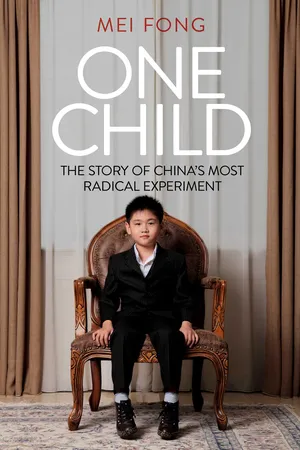
One Child

The Story of China's Most Radical Experiment

  1. 256 pages
  2. English
  3. ePUB (mobile friendly)
  4. Available on iOS & Android
eBook - ePub

One Child

The Story of China's Most Radical Experiment

About this book

For over three decades, China exercised unprecedented control over the reproductive habits of its billion citizens. Now, with its economy faltering just as it seemed poised to become the largest in the world, the Chinese government has brought an end to its one-child policy. It may once have seemed a shortcut to riches, but it has had a profound effect on society in modern China.Combining personal portraits of families affected by the policy with a nuanced account of China's descent towards economic and societal turmoil, Pulitzer Prize-winning journalist Mei Fong reveals the true cost of this most controversial of policies. Drawing on eight years spent documenting its repercussions, she reveals a dystopian legacy of second children refused documentation by the state, only children supporting their parents and grandparents, and villages filled with ineligible bachelors. An exceptional piece of on-the-ground journalism, One Child humanizes the policy that defined China and warns that the ill-effects of its legacy will be felt across the globe.
Frequently asked questions

Yes, you can cancel anytime from the Subscription tab in your account settings on the Perlego website. Your subscription will stay active until the end of your current billing period. Learn how to cancel your subscription.
No, books cannot be downloaded as external files, such as PDFs, for use outside of Perlego. However, you can download books within the Perlego app for offline reading on mobile or tablet. Learn more here.
Perlego offers two plans: Essential and Complete
  • Essential is ideal for learners and professionals who enjoy exploring a wide range of subjects. Access the Essential Library with 800,000+ trusted titles and best-sellers across business, personal growth, and the humanities. Includes unlimited reading time and Standard Read Aloud voice.
  • Complete: Perfect for advanced learners and researchers needing full, unrestricted access. Unlock 1.4M+ books across hundreds of subjects, including academic and specialized titles. The Complete Plan also includes advanced features like Premium Read Aloud and Research Assistant.
Both plans are available with monthly, semester, or annual billing cycles.
We are an online textbook subscription service, where you can get access to an entire online library for less than the price of a single book per month. With over 1 million books across 1000+ topics, we’ve got you covered! Learn more here.
Look out for the read-aloud symbol on your next book to see if you can listen to it. The read-aloud tool reads text aloud for you, highlighting the text as it is being read. You can pause it, speed it up and slow it down. Learn more here.
Yes! You can use the Perlego app on both iOS or Android devices to read anytime, anywhere — even offline. Perfect for commutes or when you’re on the go.
Please note we cannot support devices running on iOS 13 and Android 7 or earlier. Learn more about using the app.
Yes, you can access One Child by Mei Fong in PDF and/or ePUB format, as well as other popular books in Politics & International Relations & Chinese History. We have over one million books available in our catalogue for you to explore.
1
AFTER THE QUAKE
Two sorts of errors are absolutely commonplace. The first of these is the idiotic belief that seismic events are somehow “timed” to express the will of God. People will seriously attempt to guess what sin or which profanity led to the verdict of the tectonic plates.
— Christopher Hitchens
I
The road to Huimei’s school was red.
I blinked, wondering if my mind had conjured this mirage after three hectic days on the road. But there it was: not a comforting earthen red, but a scarlet gash made up of thousands of shredded fireworks, lit to honour the recent dead.
Huimei’s mother tottered up the path. Four days before, Tang Shuxiu was working at a Beijing construction site when the building began to sway. Eight hundred miles away, a powerful earthquake was ripping through her hometown, tearing up major cities along the western Sichuan basin and unleashing as much force as the Fat Man bomb in Nagasaki. Tremors were felt as far away as Bangkok and Bangladesh.
As news of the quake unfolded, Tang dialled home frantically, trying to reach her teenage daughter. There was no answer.
The next day, Tang and her husband, Liu, set off for home. I tagged along, a random reporter they’d met. My presence barely registered except as an extra set of hands to help with their luggage. All those weary miles home, the couple doggedly lugged bags crammed with instant noodles, charcoal cakes, gardening gloves, sanitary napkins, and floral quilts. There were shiny thermos flasks the colour of Mao’s Little Red Book, reams of tissue-thin toilet paper, disposable chopsticks, and a giant pack of cigarettes. Tang even packed a gallon of cooking oil over her husband’s objections. Of course, the bottle leaked over everything — our clothes, bags, hands. Toward the end, we were covered with a film of grease, our faces glowing incongruously, like film stars at a photo shoot.
Now Tang was unceremoniously dumping this precious cargo to race up that red path. Tin mugs and exercise books lay in the rubble of the school grounds, and a basketball hoop swayed at an impossible angle. A notice, written on torn-off exercise paper, said:
The government has done a lot to save the children of this school.
The government hopes parents coordinate with them to claim the bodies.
Tang and Liu made their way to the edge of the field, to a man with a plastic folder.
I remember her screams when they told her. The sound was a wound tearing open, a sound humans shy away from as instinctively as dogs from the scent of rotting meat. That sound meant, Game over.
II
In the beginning, the Sichuan earthquake, China’s deadliest in years, was viewed as a simple tragedy. The earth moved, buildings crumbled, and about seventy thousand people died.
In time, I would see it as a devastating illustration of the tragedies of the one-child policy, writ large.
Many people had no idea Shifang, the area near the epicenter, was a test case for the one-child policy. Before the 1980 nationwide launch of the one-child policy, population planners had experimented in Sichuan, in particular Shifang County, using coercive methods to drastically lower birthrates. Scholars believed Sichuan was chosen first because it is the heartland of rural China, home to a tenth of China’s people. It was also Deng Xiaoping’s birthplace. Whatever the reasons, the methods worked astoundingly well. By 1979 Shifang County’s population growth had drastically plunged, and 95 percent of couples there had pledged to have only one child. Sichuan gave China’s birth planners “a sense of tremendous possibility” that Beijing could “achieve demographic miracles,” wrote population scholar Susan Greenhalgh.
When the quake struck almost thirty years later, some eight thousand families lost their only child in the disaster, according to state-run news agency Xinhua. In Shifang, where over two-thirds of families are single-child families, the quake was said to have wiped out a generation in some villages, local media reported.
This lent a bizarre dimension to the tragedy. Mere weeks after the quake, parents were rushing to reverse sterilizations they had been forced to accept long ago under family-planning rules. They were desperate to conceive a replacement.
Soon after, they were pressured into signing documents pledging to make no trouble. Chinese media were expressly forbidden to write stories about grieving parents and the shoddy school construction that had caused many of these children’s deaths. Locals who tried to probe were jailed. Lives were lost, families ruined, and protests steam-rolled as Beijing prepared to host the Olympics, just months away.
Although Communist China is theoretically secular, many still believe in omens and portents. People interpret natural disasters as a sign of withdrawal of the mandate of heaven from China’s rulers. After all, Mao had died six weeks after the 1976 Tangshan earthquake, ushering in a new era, which eventually led to socioeconomic reforms — such as the one-child policy — that shape today’s China.
Some wondered if the 2008 earthquake was a judgment on the one-child policy and other practices that tampered with nature. There was speculation, for example, that the building of massive dams in highly seismic areas might have triggered the quake.
These were precisely the sorts of inferences Beijing did not want. The Communist Party had worked long and hard to ensure that the year 2008 would be associated with another set of omens, ones designed to suggest a glorious future for the Republic.
The 2008 Beijing Olympics was to be a multibillion-dollar event that would mark China’s phoenix-like ascent from the ashes of the Opium Wars and the Cultural Revolution. It was no accident the leadership picked the year 2008 to host the Games, nor that they set the opening ceremony date for the eighth day of the eighth month, when the capital city would be at its hottest and most polluted, not at all conducive to peak athletic performance. The number 8 is auspicious, for in Chinese the word sounds the same as the word for fortune. When turned on its side, 8 represents eternity, certainly something any regime would aspire to. Eight is so popular that places with Chinese communities charge a premium for it, from phone numbers to licence plates and house numbers. That year, a licence plate with the number 18 fetched over $2 million in a Hong Kong auction.
I myself was born on August 8, and Chinese friends never fail to comment on the symbolism of my birthday when they find out. “Wah, you must be so lucky.”
All across China, clocks were set on a countdown to the day of the opening ceremony: August 8, 2008, at, of course, 8:08 p.m. May’s earthquake, and its attendant baggage, was not going to be allowed to upset this auspicious apple cart.
It was ironic because until the earthquake, the one-child policy had been receding from the news and national discussion.
As the descendant of southern Chinese who’d migrated to Malaysia, I was always grateful I hadn’t been born in China. I am the youngest of five daughters, all conceived in hopes of a son that never was. Malaysia was by then too modern for practices such as abandoning unwanted girls, and in any case my parents were educated urbanites, not farmers. Still, my accountant father never ceased regretting his lack of a son, nor reminding his daughters they were liabilities, not assets.
They say huaqiao — overseas Chinese families — are more traditional than mainland Chinese, who were forced to abandon or hide the old ways during the Cultural Revolution. It was certainly true of my father’s family. “Be glad we’re not in the old country,” my relatives would say. “You’d never have been born.” That was my introduction to China’s son-loving culture and the one-child policy. As a bookish child, I would come to see the one-child policy as one of the most fascinating and bizarre things about the land of my ancestors, equal parts Aldous Huxley and King Herod.
I certainly didn’t anticipate that I would be living and working in China one day. By the time the Wall Street Journal posted me to greater China in 2003, the policy was well over two decades old and was by no means as monolithic as outsiders envisioned. Over time, exceptions were made. You could likely have more than one child if you were a farmer, or if you were Tibetan; if you were a fisherman or a coal miner. Or if you were handicapped, or were willing to pay the fines, which ranged from nugatory to wildly exorbitant and depended on whom you knew and where you lived. Given all these exceptions, the one-child policy should more accurately be called the “1.5-child policy,” but nobody used such a clunky-sounding term. In China, the term of reference most used is the more anodyne jihua shengyu, which means “planned birth programme,” instead of a more straightforward translation — yitai zhengce — of “one-child policy.”
Negotiations and rule bending are a way of life — some say art form — in China. To xiang banfa — find a solution — is second nature in a place where people are many, resources scarce, and regulations strict but erratically applied. That’s why when you live in China you must quickly accustom yourself to full-contact bargaining, line jumping, and creative driving, all part of the xiang banfa ethos. Many Chinese xiang banfa-ed and came up with all sorts of creative ways to get around the policy — fertility treatments for twins or triplets, birth tourism, fake marriages, bribes. I had Chinese friends who had several children, though usually no more than two. I met a woman in a second-tier city who’d had six, all born during the years of the policy. (According to grisly family lore, she’d killed her first by plunging it in boiling water.)
By the time the one-child policy entered its third decade, experts estimated that only about a third of the population faced strict one-child limitations, and it had become increasingly easy for people to afford the fines for a second or third child. By 2013, China’s one-child policy was “slipping into irrelevance,” wrote my colleague Leslie Chang, a well-respected China watcher.
It would take an earthquake, a miscarriage, and a journey of a thousand births for me to fully realize that curbing China’s masses had serious implications beyond its borders.
III
Far from courting irrelevance, the one-child policy had irrevocably shaped the face of modern China and set in motion a host of social and economic problems that will endure for decades.
In fifteen years’ time, if you throw a stone anywhere outside of Beijing or Shanghai, statistically speaking, you will probably hit someone over sixty. Chances are high that person will be male, to boot. China’s one-child policy so tilted gender and age imbalances that in a little under a decade there will be more Chinese bachelors than Saudi Arabians, more Chinese retirees than Europeans.
Everything in China is about scale and speed. China doesn’t just face the prospect of being home to the world’s largest number of old people; proportionally, too, its population is ageing faster than anywhere else, meaning there will be far fewer working adults to support a retiree population. The speed of this transition will strain China’s rudimentary pension and health-care systems. By 2050, pension funding shortfalls could be as much as $7.5 trillion, or equivalent to 83 percent of China’s gross domestic product in 2011, according to one estimate by Deutsche Bank.
This is a pretty bleak outlook, and yet the policy’s future repercussions may be difficult to reverse. Over the past decade, most people in urban China have accepted the reality of smaller families and, indeed, prefer it. After all, China had leapfrogged from socialism to full-blown capitalism, so costs of services like schooling and health care are relatively high. Throw in things like melamine-tainted milk powder, lead in toys, and lung-searing pollution, and child rearing in urban China becomes quite a daunting proposition.
Besides, authorities had done a good job with messaging: the one-child policy, they insisted, had played an integral part in China’s economic resurgence. It seemed churlish not to rejoice in better living standards for a country that had, not too long ago, seen great famine and tremendous political turmoil. This is, after all, my ancestral homeland.
Anyone over the age of sixty in China will have a hardship tale to tell, but one that still sticks in my mind is an anecdote by Chinese journalist Xinran Xue. She once visited a family so poor, they rotated one set of clothing among four children. The rest would lie naked under a blanket, happily dreaming of their turn to “wear the clothes.”
China was like a terrier puppy that had been brutally mistreated by history’s vicissitudes. It was hard not to cheer a little to see it lick its wounds and limp along gamely. Starting in the late 1990s, there was much to cheer. Children of peasants became the first in their families to enter college. Infant mortality rates fell. Starbucks outlets bubbled up like so many foamy lattes. A veritable fleet of Bentleys, Beemers, Hondas, and Hyundais took to the roads, and local Xinhua bookstores were crammed with travel guides for China’s first generation of group tourists.
When my Mandarin teacher excitedly recounted her first trip to Europe, I asked her to name her favourite European country. “Germany,” she said promptly. I was surprised. Why not France, Italy? She paused a beat, then said, “It’s so orderly.”
In 2005, I spoke to a contractor who built dormitories for factory workers. He complained of having to put in more electrical outlets, as workers now had so many gadgets to charge. In 2007, I witnessed the opening of Beijing’s first Hooters, or “American Owl” in Chinese. As I eyed waitresses with jacked-up décolletage dishing out overpriced chicken wings, it seemed, strangely, like another milestone had been reached.
People used to joke that a year in China was like a dog year: so much changed that it would be as if seven years somewhere else had passed. In the four years I lived in Beijing, the city’s subway lines expanded fivefold. IKEA opened its largest-ever store outside of Stockholm in Beijing, with extra-wide aisles to accommodate the multitude of first-generation homeowners. The car population quadrupled. Despite the growing pollution and the corruption, it was hard not to feel the quickening excitement, echo the prevailing sentiment: Jiayou, Zhongguo, Jiayou! “ Go, China, Go!”
It took me a while to realize that, contrary to popular thinking, the one-child policy had very little to do with China’s double-digit economic growth of the ...

Table of contents

  1. Cover
  2. Title
  3. Copyright
  4. Contents
  5. Author’s Note
  6. Prologue
  7. 1 After the Quake
  8. 2 And the Clock Struck 8/8/08
  9. 3 Cassandra and the Rocketmen
  10. 4 The Population Police
  11. 5 Little Emperors, Grown Up
  12. 6 Welcome to the Dollhouse
  13. 7 Better to Struggle to Live On, Than Die a Good Death
  14. 8 The Red Thread Is Broken
  15. 9 Babies Beyond Borders
  16. Epilogue
  17. Acknowledgments
  18. Notes and References
  19. Index