
- 688 pages
- English
- ePUB (mobile friendly)
- Available on iOS & Android
eBook - ePub
About this book
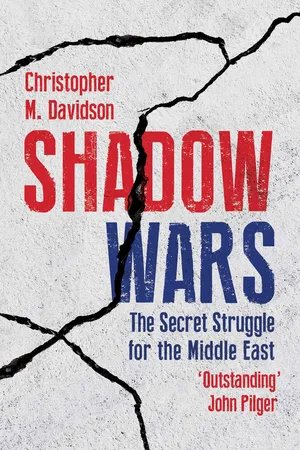
For more than a century successive US and UK governments have sought to thwart nationalist, socialist and pro-democracy movements in the Middle East. Through the Cold War, the ‘War on Terror’ and the present era defined by the Islamic State, the Western powers have repeatedly manipulated the region’s most powerful actors to ensure the security of their own interests and, in doing so, have given rise to religious politics, sectarian war, bloody counter-revolutions and now one of the most brutal incarnations of Islamic extremism ever seen.
This is the utterly compelling, systematic dissection of Western interference in the Middle East. Christopher Davidson exposes the dark side of our foreign policy – dragging many disturbing facts out into the light for the first time. Most shocking for us today is his assertion that US intelligence agencies continue to regard the Islamic State, like al-Qaeda before it, as a strategic but volatile asset to be wielded against their enemies. Provocative, alarming and unrelenting, Shadow Wars demands to be read – now.
Frequently asked questions
Yes, you can cancel anytime from the Subscription tab in your account settings on the Perlego website. Your subscription will stay active until the end of your current billing period. Learn how to cancel your subscription.
No, books cannot be downloaded as external files, such as PDFs, for use outside of Perlego. However, you can download books within the Perlego app for offline reading on mobile or tablet. Learn more here.
Perlego offers two plans: Essential and Complete
- Essential is ideal for learners and professionals who enjoy exploring a wide range of subjects. Access the Essential Library with 800,000+ trusted titles and best-sellers across business, personal growth, and the humanities. Includes unlimited reading time and Standard Read Aloud voice.
- Complete: Perfect for advanced learners and researchers needing full, unrestricted access. Unlock 1.4M+ books across hundreds of subjects, including academic and specialized titles. The Complete Plan also includes advanced features like Premium Read Aloud and Research Assistant.
We are an online textbook subscription service, where you can get access to an entire online library for less than the price of a single book per month. With over 1 million books across 1000+ topics, weâve got you covered! Learn more here.
Look out for the read-aloud symbol on your next book to see if you can listen to it. The read-aloud tool reads text aloud for you, highlighting the text as it is being read. You can pause it, speed it up and slow it down. Learn more here.
Yes! You can use the Perlego app on both iOS or Android devices to read anytime, anywhere â even offline. Perfect for commutes or when youâre on the go.
Please note we cannot support devices running on iOS 13 and Android 7 or earlier. Learn more about using the app.
Yes, you can access Shadow Wars by Christopher Davidson in PDF and/or ePUB format, as well as other popular books in History & Middle Eastern History. We have over one million books available in our catalogue for you to explore.
Information
1
COUNTER-REVOLUTION â A PATTERN EMERGES
LESSONS FROM THE PAST â NOTHING IS NEW
Named after their mascot, King James II, the Jacobite nobles of Britain and Ireland are often touted as good early examples of âcounter-revolutionariesâ.1 Seeking the restoration of James and his Catholic House of Stuart, their goal was the reversal of the âGlorious Revolutionâ of 1688 that led to the coronation of Jamesâ Protestant son-in-law.2 Also intending for James to resume the âdivine right of kingsâ and continue efforts to weaken parliament, their plan was to realign the country with the Pope, in Rome, and the King of France. Put simply, the Jacobites were backing an old, absolutist regime buttressed by distant powers and underpinned by conservative religious forces that sought to roll back political freedoms and return Britain to a more medieval system of rule.3
But fast-forwarding to the late eighteenth century, it was the intensifying resistance to the French Revolution of 1789 that started to give a taste of how displaced European ancien rĂ©gimes would really begin to fight back against both progressive forces and mass uprisings. In Paris itself, the âThermidorian Reactionâ of 1794 â named after the new revolutionary calendarâs warm summer month of Thermidor â saw the forcible ousting of Maximilien Robespierre and other leading politicians from the National Convention, the first French parliament to be elected by universal male suffrage.4 Outlawed, hunted down, and then executed, Robespierre and the proponents of the new revolutionary constitution gave way to a reactionary regime which set about creating a dual-chamber English-style parliament in an effort to protect the interests of the wealthy and powerful.5
In parallel, the nascent revolutionary republic came under attack in the countryside too, with a full-scale rebellion in Franceâs western VendĂ©e province blamed on exiled noblemen and a clergy that sought to spark peasant unrest and dissuade parishioners from joining the national army.6 With another clear alliance in place between sidelined aristocrats and traditional religious powers, Antoine-François Momoro â the originator of the phrase âLibertĂ©, ĂgalitĂ©, FraternitĂ©â â described how âcriminal priests, taking advantage of the credulity of the inhabitants of the country, remained hidden behind a screen, as did the former nobles who crowded into the region from the four corners of France; they waited for the favourable moment to appear and put themselves at the head of the rebellious peasants.â7
Meanwhile, as the effects of the Thermidorian and VendĂ©e counter-revolutions began to reverberate beyond Franceâs borders, any hope of spreading new political ideas or â as they have been described â âradical republican agitationsâ was being firmly nipped in the bud back in Britain. Severe legal repression and the banning of influential texts such as Thomas Paineâs Rights of Man was soon followed by the looting and burning of houses belonging to âradicals and dissentersâ. England had become a country âcovered with a network of barracksâ, with restive industrial areas âtreated almost as a conquered country in the hands of an army of occupationâ.8
In Catholic Italy, as it was for the VendĂ©e nobles and Jacobites before them, the Vatican became an important ally for those opposed to a new republic that sought to bring democracy to Naples and rekindle the ideals of the regionâs ancient Greek colony of Parthenope.9 With priests, bishops, and even cardinals mobilizing peasants, and with the help of a British naval blockade, a branch of the old ruling Bourbon dynasty was violently restored and an absolutist âKingdom of Naplesâ re-established in 1799.10 For the first four weeks of his return, King Ferdinand IV kept his headquarters offshore as a guest of British rear admiral Horatio Nelson on HMS Foudroyant, and it was from there that he set about ordering the executions of over a hundred political prisoners including poets, scientists, and constitution-writers. Complete with public beheadings, an era of debilitating censorship and the suppression of all political movements duly began.11
Attempting much the same strategy, the Spanish âCarlistsâ who fought for the installation of another Bourbon, Carlos V, were backed by both displaced feudal landowners and the Pope in their efforts to reinstate the divine right of kings on the Iberian peninsula. Finally attacking in 1833, their forces may not have been successful, but they did much to weaken a fledgling Spanish state which, twenty years earlier, had introduced arguably the most modern and liberal constitution in the world, complete with land reform laws, universal male suffrage, and guarantees for freedom of the press.12
Despite the many setbacks and the hardening of counter-revolutionary fronts, the people of Europe were nonetheless still on the move, and by 1848 the âSpring of Nationsâ or âSpringtime of the Peopleâ blossomed across the continent. Only days after Karl Marx and Friedrich Engels published their Communist Manifesto, euphoric crowds took to the streets of France to demand a new republic, while worried monarchs in Sweden, Denmark, and the Netherlands quickly made concessions as demonstrations swept through their cities.13 Seemingly unassailable, with a mass popular mandate, the new French government introduced sweeping new employment rules and other social reforms, along with restoring the original revolutionary goal of universal male suffrage. But in a careful manoeuvre, this time not co-opting religious forces and instead just claiming to ârestore orderâ, the old monarchists and other conservatives engineered the appointment of a military general as head of the new state, who in turn paved the way for the election of Louis-NapolĂ©on Bonaparte as president by the end of the year. As the strongman nephew of NapolĂ©on I, who had morphed France into an empire earlier in the century, Louis-NapolĂ©onâs security-focused strategies â Bonapartism â were enough to hold the spirit of 1848 in check. Within three years he and his supporters were then able to launch a âself-coupâ that abolished the National Assembly outright and initiated the second French Empire, with Louis crowned Emperor NapolĂ©on III.14
More than a thousand miles to the east, Russiaâs absolutist and corrupt Romanov dynasty was weathering repeated uprisings and even full-blown rebellions, but by the turn of the twentieth century its more than ninety million subjects were ripe for their own revolution.15 With the Marx-inspired Bolshevik or âMajorityâ faction of the Russian Social Democratic Party rising to the fore in the wake of Tsar Nicholas IIâs eventual ouster in 1917, the movement was poised to burst its Russian banks with a threat to âfurnish the new proletarian society in Russia with a suitable parallel environment in other European and extra-European countriesâ.16 The inevitable reaction across Europe, and indeed the world, is important to understand as it involved not only collaborations between worried royals and other old regimes, but also new states with supposedly progressive agendas but which were increasingly being underwritten by capitalist modes of production and were thus equally alarmed at the prospect of an international workers-led movement reaching their own territories. After all, the Bolsheviks had not only supplanted a tsar, but, as historian William Blum describes, had also displayed the âaudacity of overthrowing a capitalist-feudal system and proclaiming the first socialist state in the history of the worldâ. As such it became âa virus that had to be eradicatedâ.17
For it to succeed, any counter-revolutionary campaign therefore had to go far beyond the old methods of co-opting religion, reinvigorating aristocrats, or launching military coups. After all, the indigenous resistance, known as the âWhite Movementâ, was a poorly performing loose confederation of monarchists, non-socialist republicans, peasants, and even conscripts from Ukraine.18 Conducting pogroms against ancient Jewish communities and being rolled back on the battlefield, it stood no chance of winning on its own, but its potential usefulness had nevertheless caught the attention of the young British minister for war and air, Winston Churchill, whose stated aim was to âstrangle at birthâ the new Russian socialist republic.19
Forming a global coalition to back the White Movement, Churchill also sought to insert foreign troops into an increasingly chaotic and destabilizing âcivil warâ. Using the pretext of rescuing a stranded Czechoslovak legion in Russia, Britain and France requested help for their expeditionary forces from the similarly concerned United States, which duly dispatched five thousand soldiers to the northern coastline while a further eight thousand disembarked on the Pacific coastline near Vladivostok. With foreign counter-revolutionaries soon outnumbering actual Russians, troops from Canada, Australia, India, and Japan joined the fray, while Italy, Greece, Romania, and several other countries also eventually made a contribution.20
Disturbingly, Britain also sent officers to Central Asia to lead and recruit forces for a campaign by Turkmen tribes against secular Russia. Requiring that its âofficers should be accompanied, if possible, by persona qualified to conduct Muhammadan propaganda in favour of the alliesâ, Britain was knowingly entering into a relationship with an anti-Bolshevik force committed to founding âan Islamic emirate with sharia law courtsâ. Although the British-led Turkmen troops were officially withdrawn in 1919, camel caravans of weapons and supplies continued to flow to large numbers of these Islamic guerrilla fighters. Described by Moscow as basmachi or âbanditsâ, their religious-political campaign had by then spread to Tajik and Kazakh territories.21
Despite its size and the dozens of states involved, the massive alliance ultimately failed. Poor morale and wariness of another world war had seemingly combined with real fears of revolt in the backyards of the reactionary powers. The German revolution of 1918â19 may have failed to transfer power to Russian-style peopleâs assemblies, due to the violence of Freikorps nationalist militias and the hesitancy of the Social Democratic Party to exclude fully old elites, but as Leon Trotsky observed, âthe only reason the Austro-German military powers did not carry their attack upon Soviet Russia through to the end was that they felt behind their back the hot breath of the revolution.â Similarly, the French sailorsâ revolt in the Black Sea in 1919 undoubtedly obliged Paris to call off its attacks on Russia, while London withdrew its forces from northern Russia the same year due to pressure from British workersâ movements.22
The emergence of the Freikorps had, however, already heralded the birth of a new counter-revolutionary front across Europe. In Italyâs case the Bienno Rosso â a two-year-long âred movementâ that had begun in 1919 â was violently confronted by âblack shirtâ militias and eventually defeated in 1922 after the âMarch on Romeâ by Benito Mussoliniâs National Fascist Party. Having sparked workersâ strikes and promoted Moscow-like worker-led councils in both factories and the countryside, the Bienno Rosso had led to Italyâs trade union membership swelling to several hundred thousand, but with Mussolini in power its work was quickly undone, with a sort of corporate-friendly nationalism putting Italy on a very different path. Adopting many of the more popular ideas of the socialist and communist revolutionaries of the previous decade, and having clearly recognized the need for a new type of society, Mussolini had seemingly succeeded in creating a form of state-led capitalist organization with much tighter restrictions on labour and workersâ movements.23
LESSONS FROM THE PAST â THE PREVENTIVE COUNTER-REVOLUTIONS
Witnessing the ongoing rise of the fascists in the 1930s, the German theoretician Karl Korsch saw it as evidence of a âpreventive counter-revolutionâ and a âdangerous new international allianceâ. With the Russian Revolution and the resulting socialist republic as their doomsday scenario, Europeâs old ruling and business elites â or at least those that had survived the First World War â had quickly found common ground, however uncomfortable, with those who could not only summon nationalist mobs but could also safeguard at least some capitalist structures and, so it seemed, offer protection for the status quo. In this sense, fascism became a âcounter-revolution against a revolution that never took placeâ at a time when the common goal of most European heads of state â whether the elected leaders of Britain and France or the dictator of Italy â was to âcreate conditions which will make impossible any independent movement of the European working class for a long time to comeâ.24
Adolf Hitlerâs divisive policies were thus supported or appeased by many in London. Warning parliament in 1934 against condemning the National Socialist German Workersâ Party, former prime minister David Lloyd-George reasoned that Hitler and âthe Nazisâ were âdestined to be the most reliable bulwark against communism in Europeâ.25 In a 1936 interview with the Washington Post he went further, rationalizing that Hitlerâs attacks on trade unions and freedom of expression were justifiable on the grounds that Germans were an order-loving and âhighly disciplined peopleâ, and thus the situation could not be compared with anything in Britain or elsewhere.26 In a follow-up article in the Daily Express, h...
Table of contents
- Cover
- Title Page
- Contents
- Introduction
- 1 Counter-revolution â A Pattern Emerges
- 2 Cold War, Oil War â America Takes Over
- 3 The Road to al-Qaeda â The CIAâs Baby
- 4 Allied to Jihad â Useful Idiots
- 5 The Arab Spring â A System Threatened
- 6 Plan âAâ â Islamists Versus the Deep State
- 7 Plan âBâ â A Fake Arab Spring
- 8 Enter the Islamic State â A Phantom Menace
- 9 The Islamic State â A Strategic Asset
- 10 The Islamic State â A Gift That Keeps Giving
- Epilogue â Keeping the Wheel Turning
- Notes
- Index
- Copyright