Running the Rift
eBook - ePub

Running the Rift

  1. 384 pages
  2. English
  3. ePUB (mobile friendly)
  4. Available on iOS & Android
eBook - ePub

Running the Rift

About this book

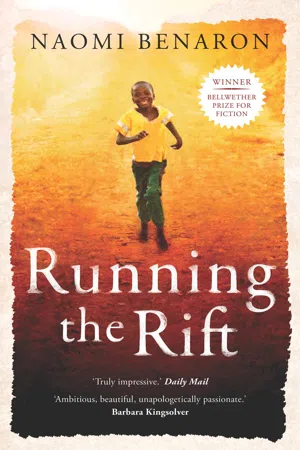
WINNER OF THE BELLWETHER PRIZE FOR FICTION SHORTLISTED FOR THE COMMONWEALTH WRITERS' PRIZE Jean Patrick dreams of running in the Olympics, and with gruelling training he soon beats a world qualifying time. But his chances of success are threatened by the ethnic tensions erupting all around him. When Hutu violence against Tutsis finally crescendos and his homeland Rwanda is wracked by unforgivable atrocities, Jean Patrick, a Tutsi, has no choice but to run for his life abandoning fatherland, family, and the woman he loves. Finding them again will be the race of his life.Following a decade in Rwanda's history through the eyes of one boy, Running the Rift is a wrenching tale of a people's collective trauma, of lives lost, and loves salvaged.
Frequently asked questions

Yes, you can cancel anytime from the Subscription tab in your account settings on the Perlego website. Your subscription will stay active until the end of your current billing period. Learn how to cancel your subscription.
No, books cannot be downloaded as external files, such as PDFs, for use outside of Perlego. However, you can download books within the Perlego app for offline reading on mobile or tablet. Learn more here.
Perlego offers two plans: Essential and Complete
  • Essential is ideal for learners and professionals who enjoy exploring a wide range of subjects. Access the Essential Library with 800,000+ trusted titles and best-sellers across business, personal growth, and the humanities. Includes unlimited reading time and Standard Read Aloud voice.
  • Complete: Perfect for advanced learners and researchers needing full, unrestricted access. Unlock 1.4M+ books across hundreds of subjects, including academic and specialized titles. The Complete Plan also includes advanced features like Premium Read Aloud and Research Assistant.
Both plans are available with monthly, semester, or annual billing cycles.
We are an online textbook subscription service, where you can get access to an entire online library for less than the price of a single book per month. With over 1 million books across 1000+ topics, we’ve got you covered! Learn more here.
Look out for the read-aloud symbol on your next book to see if you can listen to it. The read-aloud tool reads text aloud for you, highlighting the text as it is being read. You can pause it, speed it up and slow it down. Learn more here.
Yes! You can use the Perlego app on both iOS or Android devices to read anytime, anywhere — even offline. Perfect for commutes or when you’re on the go.
Please note we cannot support devices running on iOS 13 and Android 7 or earlier. Learn more about using the app.
Yes, you can access Running the Rift by Naomi Benaron in PDF and/or ePUB format, as well as other popular books in Literature & Literature General. We have over one million books available in our catalogue for you to explore.

Information

TEN
ON THE DAY OF National Championships, Jean Patrick felt strong and confident but, he had to admit, a little nervous. He put down his running magazine and flipped onto his back, head dangled over one side of the bed and feet over the other. He poked Daniel’s shin with a toe.
ā€œHow long to Kigali?ā€
ā€œThe same as when you asked me yesterday and last week and ten minutes ago—maybe six hours. I don’t think it will change.ā€
ā€œAren’t you going to class?ā€
ā€œThere’s nothing to do but review for exams,ā€ Daniel said. ā€œI’d rather wait with you.ā€
Jean Patrick peered out the window. ā€œDo you think Coach has a wife?ā€
ā€œCoach? A wife? Mama weh!ā€ Daniel roared. ā€œHe’s too mean.ā€
ā€œMaybe he had one and killed her.ā€
Daniel grabbed Jean Patrick’s jiggling thigh. ā€œBe still, eh? If this is what Championships does to you, maybe you shouldn’t go.ā€
Laughing, Jean Patrick pushed his hand away. ā€œWhy don’t you come with me?ā€
ā€œIf it was three weeks later, I would. Then you could come to my home and meet my mama and my sisters.ā€ Daniel aimed his finger at a noisy bird beyond the window. ā€œPapa could teach you to shoot.ā€
ā€œAye-yay. What do I need a gun for? Me, I fight with my legs.ā€
ā€œWhen Hutu Power gets guns, you better have one, too—and know how to use it.ā€
ā€œAlways your serious talk.ā€ Jean Patrick covered his ears. ā€œLet me rest now, eh?ā€ He threw his magazine at Daniel’s head, flipped back over, and closed his eyes.
JEAN PATRICK WAS still asleep when Coach burst in, jingling his keys.
ā€œReady?ā€ A camera hung from his neck. ā€œWe have a long drive.ā€
Jean Patrick pointed to his gym bag. His Nikes, now more rust than green, peeked from a side pocket.
Daniel grabbed him in a headlock. ā€œPretend I’m chasing you, and you’ll run fast.ā€
ā€œWhat? If you chase me, I can walk.ā€ Jean Patrick followed Coach out the door.
On the walkway, Coach stopped suddenly and pulled Jean Patrick into an empty classroom. ā€œStand beside the board,ā€ he said. Jean Patrick had a fleeting vision of an execution. Coach aimed the camera at him. Light flashed in his eyes as the shutter clicked.
ā€œIs that for the newspaper?ā€
Ignoring the question, Coach half jogged to the car. He pointed to something shiny on the seat. ā€œFor you.ā€
It was a tracksuit with GIHUNDWE in large letters on the jacket. Jean Patrick passed his hand over the slithery cloth. He slipped on the jacket, pleased with the crackly sound it made when he moved. He ran the zipper up and down, up and down. ā€œNow I am ready for the Olympics, eh?ā€
Coach squinted through the windshield. The engine sputtered and then whined into life. ā€œNot yet.ā€
EVERY POTHOLE SENT shock waves through Jean Patrick’s skull. Without room to stretch his legs, he fidgeted to find a comfortable position. Coach honked at farmers, cars that drove too slowly, trucks he roared past while navigating blind curves. In the valley below, a woman paused to wave. The laundry she spread over the shrubs formed a tapestry like bright flowers. The green dazzle of tea plantations disappeared from the rearview mirror, and the blue haze of Nyungwe Forest rose before them. Out of the forest’s shimmer, the first checkpoint appeared.
A bored-looking officer sauntered to the car. ā€œIndangamuntu,ā€ he said. A crumpled five-hundred-franc note from Mama fluttered to the floor when Jean Patrick took his identity card from his pocket. The officer peered at the picture and then at Jean Patrick. ā€œStep out.ā€ A second soldier opened Jean Patrick’s door and motioned to him. ā€œOpen the trunk,ā€ the officer said. While the soldier poked at bags and blankets, the officer studied their papers. ā€œWhat is your business, Mr. Rutembeza?ā€
ā€œWe’re going to National Track Championships in Kigali,ā€ Coach said. ā€œI’m this boy’s coach. Remember his name, Sergeant. He’s Rwanda’s finest. Our Olympic hopeful.ā€ His smile could have cut through stone.
The officer hooted, showing off several gold-capped teeth. Out of the corner of his eye, Jean Patrick saw the second soldier pocket Mama’s five-hundred-franc note.
ā€œYou can go now,ā€ the sergeant said. ā€œMake sure that Inyenzi wins. I’m going to place a bet on him.ā€
Coach started the car and accelerated slowly. The soldiers’ trailing laughter left a sour taste in Jean Patrick’s mouth.
ā€œSoon Rwanda will win the war,ā€ Coach said, rolling up his window with swift, certain strokes. ā€œAnd then this nonsense will be over.ā€ He looked intently at Jean Patrick. ā€œDon’t you ever wish for a Hutu card?ā€
Jean Patrick was sweating in his jacket, but he didn’t want to take it off. He closed his window, then opened it again. What was the proper answer to such a question?
ā€œYou’ll get malaria,ā€ Coach said, aiming a toothpick at Jean Patrick.
ā€œHow can I?ā€
ā€œFrom the wind.ā€ Coach popped the toothpick between his teeth. ā€œIsn’t that what villagers believe?ā€
ā€œI don’t know.ā€ Jean Patrick left the window down. ā€œThat soldier took my money,ā€ he said, focused on the blue-green river of scenery that rushed by. ā€œIt was all I had to buy food in Kigali.ā€
ā€œThis would never happen in Butare or Kigali. I’m known there. And never mind about the money; I can feed you.ā€ Coach attacked the horn and sped past an old farmer pushing a cart loaded with sorghum. ā€œNothing but bumpkins around this place.ā€ He rolled down his window and flung the toothpick in the farmer’s direction. In an instant of revelation, Jean Patrick saw that Coach, too, had been humiliated, and it was because of his shame that he turned on Jean Patrick, the old man, the countryside.
ā€œTHERE ARE TWO runners—and only two—I want you to pay attention to tomorrow,ā€ Coach said as they crested the hill. He smiled easily again, as if he had left all his anger on the farmer’s cart. ā€œThey’re on the Burundi national team. Stick to them like a tick—if you can.ā€
Jean Patrick ran his tongue over his chipped tooth. ā€œWhat about those Kigali boys?ā€
ā€œThey have a new coach to keep them in line.ā€ Coach smirked. ā€œHe’s Tutsi.ā€
Jean Patrick laughed, imagining Crooked Nose and his friends taking orders from a Tutsi. ā€œWhat about the running part? I haven’t raced against them in a while.ā€
ā€œYou’ve already shattered their times.ā€ Coach grinned. ā€œTomorrow you’ll be the best eight-hundred-meter runner in Rwanda. Ever.ā€ He was looking at Jean Patrick, taking a corner too fast. Until Jean Patrick shouted, he paid no attention to the branches set across the road to warn of an accident. Bark and leaves flew into the air, scraped against the skidding tires. They barely missed the truck sprawled on its side across the road, wheels still spinning, the wooden sides of the truck bed shattered.
Jean Patrick tried to look away, but he couldn’t. A dark stain spread on the asphalt. Already a crowd had gathered, some gesturing wildly, others collecting pieces of wood and spilled cargo. With a sigh of relief, he saw the barefoot truck driver stagger by the side of the road, arm held close to his body, hand dangling at an odd angle. A stream of curses poured from his mouth.
This is how it must have been with Papa, Jean Patrick thought. Trying to slow his runaway heart, he thought how life was decided by the most inconsequential decisions: a second here to get a drink, a minute there to stop and stretch your legs, and either you arrived at the turn at the same out-of-control moment as the truck, or you saw the branches and came to a stop, the catastrophe already in the past.
THE SUN HAD started its quick descent toward the horizon when they entered the sugarcane fields and marshes along the Nyabarongo River. Jean Patrick closed his window against the fetid, sulfurous air. Birds flitted in the papyrus and umunyeganyege. In the dusky light, the hills ringing Kigali were like flared pleats of a dancer’s skirt.
At the edge of town, Coach stopped at one of the many small kiosks by the roadside and bought two Fantas. The cold and the sweet went straight through Jean Patrick’s chipped tooth and into his eye. Coach chuckled, the tension gone from his face. ā€œYou look like you’ve never left your rugo before, staring like that.ā€
They were in the thick of Kigali traffic. A jumble of sound filled Jean Patrick’s ears: car horns, radios, shouts, and whistles. His nostrils burned with the odors of exhaust, charcoal, the stench of rotting garbage. But beyond the noise and the reek, there was also a sense of excitement that quickened his heart, and he marveled that Daniel had grown up with the pulse of such a place in his veins.
ā€œWE HAVE ARRIVED. Ɖcole Technique Officielle. Do you want to see the track?ā€ Coach honked, and a rheumy-eyed man opened the gates. He was thin and bent, like an ancient tree whose trunk no longer supported the weight of its branches.
Coach hooked Jean Patrick’s arm and guided him down the walkway. A group of girls coming from a classroom split and walked on either side of them. Jean Patrick called out a greeting, and they turned around and giggled.
The Burundi runners were the only ones on the track. They wore red, green, and white jerseys, Burundi’s colors, and on the back was the Burundi flag. They moved together with long, stretched-out strides, as if they had been fashioned from a single piece of clay and split into two. One was at least as tall as Jean Patrick; the other, shorter, a wiry bundle of muscles and bone. They talked as they ran, gesturing and laughing. Jean Patrick visualized running beside them. Comparing his pace to theirs, he didn’t think they would be that hard to beat. The first tease of victory tingled his lips, and he quickened his pace.
ā€œWhere are you going?ā€ Coach tightened his grip on Jean Patrick’s arm.
ā€œTo greet them.ā€
ā€œStay here and watch instead. Keep them guessing.ā€
ā€œWhat do you mean?ā€
ā€œPsychology. To you, they have become human, but to them you are still a mystery. Stay here and watch; learn their pace, their stride. Let them worry about you.ā€
ā€œBut I’ve never raced against them. How do they know about me?ā€
In the waning light, Coach followed their movements. ā€œNews of someone like you travels quickly. Trust me—they know.ā€
THE FIRST RUNNERS Jean Patrick saw in the morning were the Kigali boys. He sat on the bench to watch them warm up while he put on his shoes. His toes pressed against the tops, and he loosened the laces to make a little more room. Crooked Nose tapped his friend’s shoulder and pointed in Jean Patrick’s direction. Jean Patrick waved, and the boys laughed and turned away.
ā€œJean Patrick?ā€ The voice behind him made him jump. ā€œIt’s nice to finally meet you. We’ve heard a lot of talk.ā€ The Burundi runners held out their hands in greeting. It was the taller boy who spoke. ā€œI’m Gilbert.ā€ Sweat glistened on his nearly bald head.
ā€œAnd I’m Ndizeye. Come warm up with us.ā€
Jean Patrick settled into a comfortable jog between them, resisting the urge to test the boys by pushing the pace. They chatted about this and that, and Jean Patrick was surprised to learn how running was encouraged in Burundi—unlike in Rwanda, where you had to fight for every little scrap of recognition. For a moment he imagined leaving his life behind to start fresh in that country. He knew many Tutsi did.
When Jean Patrick returned to the bench, Coach was pacing. ā€œDid you forget what I told you? You just gave away your advantage.ā€ Jean Patrick retied his shoes with singular concentration. ā€œI want you this far from them in the prelims and semis—no more, no less.ā€ Coach held his hands shoulder wide in front of Jean Patrick’s face. ā€œDo you hear?ā€
ā€œWhat about the Kigali boys?ā€
ā€œCan you listen for once? The Kigali boys are not worth worrying about.ā€
Jean Patrick followed Gilbert and Ndizeye with his eyes. Caught in the sun’s dazzle, they looked like two swimmers gliding in the lake. ā€œWhat if they’re not near me?ā€
ā€œDon’t vex. They’ll be there.ā€
NONE OF THE Kigali boys were in Jean Patrick’s heat for the semi. As the Burundi runners rounded the first turn and came out of their lanes, they closed at his heels; Coach had been right about that. By the back straight, only the three of them remained in the lead pack.
Jean Patrick had been too wound up to eat, and the trip had left his muscles stiff and cramped. In the prelims, he felt unbalanced—feet slapping, timing slightly off—but now that he ran with Gilbert and Ndizeye, his legs cranked like a perfectly turning gear. They passed the start line together and headed for the final lap, Jean Patrick slowly increasing his lead. The Burundi runners melted into a single shadow behind him. His last acceleration went unanswered.
ā€œI can beat those guys,ā€ Jean Patrick said, sitting down on the bench. ā€œDid you see my last kick? I felt great, like I wasn’t even working.ā€ His foot drummed a war beat. ā€œAnd I ran a personal best by—how much?ā€
ā€œHalf a second.ā€ Coach handed him a bottle of water, his face set in his usual mask. ā€œIn the final, I want you behind them. Breathe down their necks. Make them lose stride. Don’t pass before the last two meters. Then turn it loose.ā€ He flashed his smirk-smile. ā€œIf you are able.ā€
ā€œEh? Coach, I can break them. Let me run free.ā€
ā€œYou’re not understanding me. This time, do as I say.ā€ He rubbed out Jean Patrick’s calf. ā€œThere is more at stake here than you can know.ā€ From Coach’s expression, Jean Patrick understood he was not to ask any further questions.
JEAN PATRICK HAD lane five for the final, the Burundi runners on either side. Crooked Nose and one other Kigali boy remained, staggered to the outside. Jean Patrick’s nervous energy boiled over, and he false-started, committing to motion before the sound of the blocks. Crooked Nose jeered. Taking a deep breath, Jean Patrick walked in a circle, shook out his legs, resumed the set position: body cocked, weight balanced. The starter banged the blocks, and he drove off the line. By the time he rose to his full, upright stride, Gilbert and Ndizeye were halfway through the turn. He sprinted furiously to catch them, but his step was too short or too long or too choppy—he couldn’t tell which. He was used to people at his back, not the other way around. His Nikes squeezed his feet until all he felt was the pulse inside his toes.
Th...

Table of contents

  1. Cover
  2. Title page
  3. Copyright page
  4. Dedication page
  5. Epigraph page
  6. Contents
  7. BOOK ONE
  8. ONE
  9. TWO
  10. THREE
  11. FOUR
  12. FIVE
  13. SIX
  14. SEVEN
  15. EIGHT
  16. NINE
  17. TEN
  18. ELEVEN
  19. TWELVE
  20. THIRTEEN
  21. BOOK TWO
  22. FOURTEEN
  23. FIFTEEN
  24. SIXTEEN
  25. SEVENTEEN
  26. EIGHTEEN
  27. NINETEEN
  28. TWENTY
  29. TWENTY-ONE
  30. TWENTY-TWO
  31. TWENTY-THREE
  32. BOOK THREE
  33. TWENTY-FOUR
  34. TWENTY-FIVE
  35. TWENTY-SIX
  36. TWENTY-SEVEN
  37. BOOK FOUR
  38. TWENTY-EIGHT
  39. TWENTY-NINE
  40. BOOK FIVE
  41. THIRTY
  42. THIRTY-ONE
  43. THIRTY-TWO
  44. ACKNOWLEDGMENTS
  45. About the Author