Sudan
eBook - ePub

Sudan

Race, Religion, and Violence

  1. 256 pages
  2. English
  3. ePUB (mobile friendly)
  4. Available on iOS & Android
eBook - ePub

Sudan

Race, Religion, and Violence

About this book

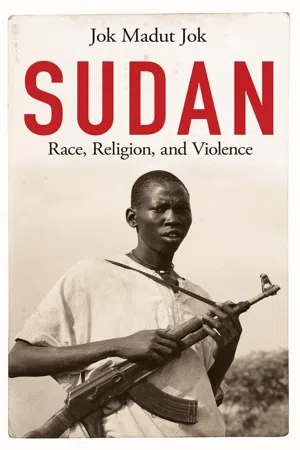
Sudan has been in the headlines for all the wrong reasons. After decades of civil war, rebel uprisings and power struggles, in 2011 it gave birth to the world’s newest country – South Sudan. But it’s not been an easy transition, and the secession that was meant to pave the path to peace, has plunged the region into further chaos.

In this updated edition of his ground-breaking investigation, Jok Madut Jok delves deep into Sudan’s culture and history, isolating the factors that continue to cause its fractured national identity. With moving first-hand testimonies, Jok provides a decisive critique of a region in turmoil, and addresses what must be done to break the tragic cycle of racism, poverty and brutality that grips Sudan and South Sudan.
Frequently asked questions

Yes, you can cancel anytime from the Subscription tab in your account settings on the Perlego website. Your subscription will stay active until the end of your current billing period. Learn how to cancel your subscription.
At the moment all of our mobile-responsive ePub books are available to download via the app. Most of our PDFs are also available to download and we're working on making the final remaining ones downloadable now. Learn more here.
Perlego offers two plans: Essential and Complete
  • Essential is ideal for learners and professionals who enjoy exploring a wide range of subjects. Access the Essential Library with 800,000+ trusted titles and best-sellers across business, personal growth, and the humanities. Includes unlimited reading time and Standard Read Aloud voice.
  • Complete: Perfect for advanced learners and researchers needing full, unrestricted access. Unlock 1.4M+ books across hundreds of subjects, including academic and specialized titles. The Complete Plan also includes advanced features like Premium Read Aloud and Research Assistant.
Both plans are available with monthly, semester, or annual billing cycles.
We are an online textbook subscription service, where you can get access to an entire online library for less than the price of a single book per month. With over 1 million books across 1000+ topics, we’ve got you covered! Learn more here.
Look out for the read-aloud symbol on your next book to see if you can listen to it. The read-aloud tool reads text aloud for you, highlighting the text as it is being read. You can pause it, speed it up and slow it down. Learn more here.
Yes! You can use the Perlego app on both iOS or Android devices to read anytime, anywhere — even offline. Perfect for commutes or when you’re on the go.
Please note we cannot support devices running on iOS 13 and Android 7 or earlier. Learn more about using the app.
Yes, you can access Sudan by Jok Madut Jok in PDF and/or ePUB format, as well as other popular books in History & African History. We have over one million books available in our catalogue for you to explore.

Information

1
THE MILITARY–ISLAMIC COMPLEX AND THE NORTH–SOUTH DIVIDE
Studies of political Islam60 in many countries claim that increasing numbers of young people, especially the very poor and the silenced among them, have been flocking to radical Islam as a result of their anger at the systems of misrule that have impoverished their countries (Manji, 2004; Burgat, 2003; Lewis, 2003; Ayubi, 1993).61 It has been said that in countries such as Algeria and Egypt, Muslim militants choose the way of terror as the best approach in their attempts to change governments that restrict the political space and are averse to democratic political opposition. Finding themselves without a forum in which to openly engage the authorities, they fall into the hands of radical Muslim politicians who have a political ax to grind with these autocratic regimes, who are often good allies of the economically advanced Western democratic countries (Tibi, 2002; Beinin and Stork, 1996). In other words, the ‘terrorist’ acts that target Western countries are really an extension of the opposition to local undemocratic regimes within the Muslim world (Lewis, 2003).62 It is argued that while some Muslim leaders with radical religious ideology may seize on these young militants, recruit them into Jihad and deploy them for whatever causes these leaders may champion, it is possible that these militants target the West primarily as an extension of their opposition to their local governments and not necessarily because they hate the West. Even if they were to express hatred toward the West, they would do so because of what they see as duplicitous Western pol-icies that allege democracy but continue to give support to undemocratic governments in the Islamic world (Gerges, 1999). Young Muslim militants see the fact that governments in the Islamic world, especially in the Arab Middle East, are good allies of the Western democracies as evidence of hypocrisy on the side of both types of government: how could Western democratic governments support undemocratic regimes in the Muslim world, and how could a self-respecting Muslim government form alliances with the immoral Western governments? (Gerges, 1999; Pipes, 2002, 2003).63
This characterization of militant Islam may fit the predominant pattern in the world today, but it is incorrect with regard to Sudan. Sudanese militant Muslims who are active within Sudan are not necessarily pitted against the state. As the case of the National Islamic Front under Hassan al-Turabi has shown, the phenomenon is one in which very well-educated, politically well-placed and socially well-to-do elite manipulate the poor for their own political ends within the state (al-Affendi, 1991). They capitalize on religious sentiments to explain away their own failure and blame Western countries for their country’s economic problems. The geopolitics of the Cold War era aside, when Nimeiri switched from Communism, which had kept him in power and kept Soviet support flowing in, to Islamic fundamentalism,64 he did so in response to pressures from Islamist leaders like Hassan al-Turabi, at one time a dean of the faculty of law at the leading national university and Sudan’s Attorney General, by no means a poor politically marginalized man.
Undoubtedly the goals of militant Islam are as much about the propagation of the faith as they are political, but like all things religious, it is difficult to know with certainty, beyond what my respondents say in the interviews and do in their daily lives, what the motives of those who champion political Islam and radicalism are. However, many Sudanese appear to believe that although the Islamists in Sudan stress strict and literal adherence to the basic Islamic principles, i.e. the real meaning and aspirations of Islamic fundamentalism, they are simply interested in using Islam as a vehicle for access to and control of the government rather than genuine devotion and commitment to a return to the sacred fundamentals of Islamic belief. It is equally common to hear Sudanese people insisting that the Islamists in power only pretend to behave more strictly according to Islamic teaching, while actually engaging clandestinely in un-Islamic behavior. Sudanese Islamists have been popularly referred to as Tujjar al-Deen, or ‘merchants of religion.’ Of course, in the politically charged environment of Sudan, people will always argue over issues of morality and the Sudanese Muslims, like followers of other faiths, bitterly disagree on matters relating to the role of religion in politics and governance. What cannot be denied is that the radical ideologies held by some of them in their drive to create a unified Islamic state have polarized the Sudanese people over religion and have resulted in a hierarchical society where Muslims are favored by the state system. Rather than uniting Sudan, this has driven the country to the brink of disintegration. This chapter will examine the politics and poetics of the transition from a secular constitution to an Islamic theocratic regime and describe the causes of this transformation. The chapter also deals with the many Sudanese jokes, songs, and political satire that have become common among the Sudanese as an informal way of criticizing opportunistic political leaders who oscillate between secular or socialist ideologies to market capitalist orientation to becoming Imams (an Islamic scholar or spiritual leader) according to the demands of international geopolitics. To do so, it draws on ethnographic, oral history, archival, and journalistic sources, with a view to uncovering the attitudes of Sudanese people towards their political leaders, i.e. how the Sudanese scrutinize the leaders’ claims of piety despite well-known recent histories that indicate otherwise. In what follows, I will argue that the rise of political militant Islam occurred within a political grouping that was already fairly radical and as a product of a confrontation between an ill-educated Islamist military class and the more organized, student-based militant groups; and that although the end goal for this Islamic extremism was partly to achieve unity of the nation by suffusing the country’s population with a uniform cultural worldview, the policies of Arabization and Islamization actually became ever more divisive and destructive to the very thing they were intended to build.
Under the Ottoman Empire when Sudan was called the Turco-Egyptian Sudan, or the Turkiyya as it is popularly known within Sudan (1821–1881/5), the country was a country in name only as the southern region (one-third of the country) was considered a mere field from which slaves were harvested (Collins, 1971, 1992). The south was not effectively controlled by the government nor did it benefit from state services, a situation which endures to this day. This meant that the populations occupying what later came to be known as the ‘southern region,’ when the country was finally ruled as one, had many reasons for wanting to be separate from such a polity. In addition to the bitter and negative encounters between the state and the people of the south, there has never really been a historical oneness between the people of the south and those living in the north. Although there are differences among the various ethnic nationalities within the south, there is a larger degree of cultural, linguistic, and kin affinities between them than one would find between southern and northern groups. Geographical proximity between north and south has not translated into cordial relations and a series of antagonistic encounters meant one side (the north) constantly attempted to assert its over-lordship and the other (the south) was thus reduced to a state of self-defense (Majak, 1990). Of all the occasions of encounter, slave raiding and enslavement were probably the most damaging of the relationships between the people of the two regions.65
Under British colonial rule the country became known as the Anglo-Egyptian Sudan (1898–1956). The seeds of the current challenges to its territorial integrity, planted in the previous era, were nurtured by various colonial policies which wavered between attempts to govern it as a single polity on the one hand and ruling the south as a separate entity on the other.66 Finally, during the post-colonial period (1956–present), Sudan has passed through so many contested evolutionary stages that its continued existence to this day as a unified nation state, especially the fact that the south remains in union with the north, is almost a miracle. Like most sub-Saharan post-colonial African states that are plagued by subcultures of violence fueled by attempts to assert a unified national character, Sudan has suffered from a crisis of national identity as the government has toyed with the promotion of an Arab and Islamic disposition while trying to portray the country as Afro-Arab. The state, and its Arab ruling elite, attempts to strike a balance between appeasing the multitude of non-Arab groups within its borders and fitting into the wider black Africa for diplomatic purposes while continuing its racial and religious project. Such a project is indicated by the imposition of Arabic as the national language and the expansion of state sponsorship of Islamic-based social programs.67 It has also tried to achieve this while it worked on converting everyone to a national outlook designed by the elite, which sparked what became a brutal contest. The first civil war in post-colonial Sudan, borne of this contestation of the character of the nation, started in 1955 and lasted for seventeen years, and was a direct reaction to the process of decolonization that had sought to replace British colonialism with another form of colonialism – Arab nationalism. It was also a result of the long history of the slave trade and slavery that had left a residue in the collective psyche of the Sudanese communities from which the slaves were taken (Jok, 2001; Johnson, 2003). The second round began in 1983 and continued unabated well into 2005: we will return to this latest round of war in the pages to come.
THE FIRST WAR: A BRIEF BACKGROUND
At the time of independence, there were two significant developments in Sudan which overshadowed the immediate nationalist euphoria that had prevailed at least within the north when colonialism ended in 1956. The first was the mutiny of southern soldiers in the Equatorial corps at Torit a few months before independence, in protest at arrangements that were being made about the future of a post-colonial Sudan. The soldiers had heard rumors that the new Arab soldiers who had come to replace the British and Egyptian officers of the Anglo-Egyptian Condominium were to form the local army in the south and southern soldiers were to be transferred to the north. As most south Sudanese did not want to remain in the Sudanese polity, but wanted the British to set up two separate schedules for independence of two countries, the southern soldiers objected to such a transfer. The mutiny and the government’s response to it were to escalate gradually into what became the first North–South civil war, which lasted seventeen years.68 The second, the event that robbed the Sudanese of the euphoria of independence, was the 1958 military coup led by Ibrahim Abbud, which ended what was considered a promising though fledgling participatory democratic process in the north. The ascent of Abbud to power led to a heavy-handed military dictatorship for the next six years before it too was ended in a popular uprising in Khartoum in October 1964. The dominant policy of his dictatorship was that he sought the most brutal means to curb the dissent in the south and maintain the territorial unity of Sudan at all cost. This was the first time since the ending of the slave trade that a Sudanese government had unleashed such brute force in an effort to bring the multitudes of nationalities into the fold of the state. Even the British colonial authorities, arguably the only real government whose actual presence had been felt by the people in the peripheries and who were thought to be ruthless in their ‘pacification’ policies,69 were considered by southerners to be even-handed in comparison to Abbud’s regime. Much of this violence, although a purely military campaign to defeat a breakaway group, was pitched in religious terms, but was actually a type of political-military ambition with religious overtones which were used to justify the atrocities as sanctioned by Islam, since they were committed in the name of defending a Muslim state. In other words, if the Sudanese version of Islam did not allow separation of religion and state and that defending the nation was in essence a defense of the faith, then the suggestion that Islam was against violence was an absurd assertion since the state, by its very nature, was not only very violent but also monopolized the use of violence. There were undoubtedly many disagreements among northerners between the supporters of the government’s use of violence and those objecting to such politicization of Islam.*
The latter believed that Islam, at its core, was a religious faith and that putting it to such military and political uses risked portraying Islam as a political or military institution rather than a code of ethics intended to guide individual conduct. An Islamic military–political complex prevailed nevertheless. Of course, as I will show in later chapters, even the horrendous level of state violence under Abbud was to be surpassed in later years as each successive government proved more violent in its approach to dissent than its predecessors.
The increased application of force against critics of the regime, whether they were individuals such as the various leaders of the sectarian parties in northern Sudan such as the Umma Party, the National Unionist Party, or groups as was the case with the southern rebellion, became the order of the day under Abbud. His government became best known for its brutal murder of chiefs and heads of clans, setting groups against one another, promoting some groups at the expense of others and imprisonment of political opponents. The actions of Abbud’s regime gave rise to the racial and ethnic cleavages that would tear apart the fabric of relative coexistence that had been characteristic of Sudan’s ethnic relations five decades later. This level of violence was meant to inflict fear so that ideas of a possible breakaway would be abandoned, the more so because conflicting northern and southern opinions on the status of the south had become increasingly intense. Southerners thought that the outgoing colonial authorities had guaranteed a gradual but eventual secession for the south, or at least a federal system with the rights to self-determination: northerners believed that no such provisions were made in the processes that led to independence. From the very beginning of the independent period most, if not all, northern politicians saw the southern preference for the federal system as a step toward an eventual total secession. Political leaders regarded the south as a source of wealth for the development of the north – a rationale reminiscent of the earlier times when the south was a source of slaves, ivory, timber and other resources – and could not allow its secession. It was at this time that Sudan was described as the next ‘breadbasket of the Arab world.’70
Letters to the outgoing colonial authorities and speeches by the nationalist leaders in the north make it clear that the justification for continued unity was that of the old slave masters: unity must be maintained in the interests of the south.71 In the years leading up to independence northerners, who were better organized as a political force and better equipped by colonial education, were deeply concerned that the British were planning to give the south a separate status that could lead eventually to southern self-government, and were keen to thwart this plan. Thus southerners were excluded from the constitutional processes and agreements between the pro-independence northern Sudanese nationalists and the British regarding self-government for Sudan. Not a single southern Sudanese leader took part in the negotiations and the agreements leading to independence, and consequently all issues that concerned the south were decided without southern participation. In the first two years after independence, all northern political parties were intent upon suppressing any southern calls for self-government or federalism. Although the situation for the leading southern politicians and their constituencies who wanted more out of independence than the government was willing to concede worsened under Abbud, an atmosphere in which a military solution to achieve the submission of southerners was preferred had been particularly characteristic of the pre-independence government of the National Unionist Party under Ismail al-Azhari and the post-independence government of the Umma Party. Both of these civilian governments feared that southern disappointment might lead to even stronger sentiments favoring self-determination. This was one of the main reasons why Abbud’s military coup – which differed in essence from that of later coups by Nimeiri and al-Bashir – succeeded. The ruling Umma Party handed over power to the army in 1958 in the belief that the army had better policies and capacities for suppression of the rebellion in the south than a political party. Giving power to a military officer meant that the army could act as a mere figurehead while the real power remained with the politicians. It was also useful that any failure at this crucial hour could be blamed on someone other than the political leaders, who were always wary about losing the south during their time in power, as it would almost certainly stain the party’s image in the north forever and jeopardize their future electability. The other reason for the handover of the government to Abbud was that the civilian government lacked the resolve to deal with the issues facing the nation at that time due to the intense competition for political influence that had been going on prior to independence. The political parties that had emerged at this time were typically divided in three ways, each following a religious sect – one of several Sufi orders or Tariqa as these are known in Sudan. The main ones were the Mahdiyya (of the al-Mahdi family), the Mirghaniyya (of the Mirghani family) and the amalgamation of other parties such as the Islamic Movement for Liberation, which had an association with Egypt’s Muslim Brotherhood,72 and the Al-Ashiqqa Party73 which wanted to unite Sudan with Egypt. Realizing that they might lose power to rival Tariqas, the Umma Party of the Mahdi’s family opted for a military regime that they hoped might function under their directives while they worked to regain their footing.
General Ibrahim Abbud immediately went to work to prove just what th...

Table of contents

  1. Cover
  2. Halftitle
  3. Title Page
  4. Copyright Page
  5. Contents
  6. Acknowledgements
  7. Abbreviations
  8. Preface to Second Edition
  9. Introduction
  10. 1. THE MILITARY–ISLAMIC COMPLEX AND THE NORTH–SOUTH DIVIDE
  11. 2. RACE, RELIGION AND THE POLITICS OF REGIONAL NATIONALISM
  12. 3. ARABISM, ISLAMISM AND THE RESOURCE WARS IN DARFUR
  13. 4. ISLAMIC MILITANCY, MEMORY OF THE CONFLICT AND STATE ILLEGITIMACY
  14. 5. A DEADLY COMBINATION: Militant Islam and Oil Production
  15. 6. INSURGENCY AND MILITARIZATION OF SOCIETY
  16. 7. SUDAN AND THE REST OF THE WORLD: The Search for Peace and Security
  17. 8. CONCLUSION: Which Way Sudan?
  18. POSTSCRIPT TO THE FIRST EDITION
  19. NOTES
  20. BIBLIOGRAPHY
  21. APPENDIX: MAPS
  22. INDEX