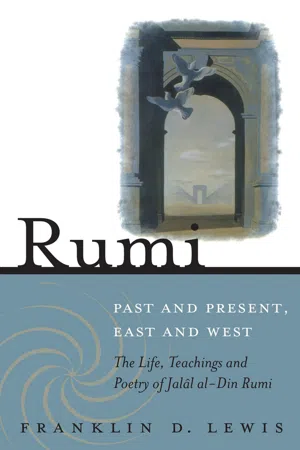
Rumi - Past and Present, East and West
eBook - ePub

Rumi - Past and Present, East and West

The Life, Teachings, and Poetry of Jalâl al-Din Rumi

  1. 712 pages
  2. English
  3. ePUB (mobile friendly)
  4. Available on iOS & Android
eBook - ePub

Rumi - Past and Present, East and West

The Life, Teachings, and Poetry of Jalâl al-Din Rumi

About this book

The definitive study of the world's bestselling poet Drawing on a vast array of sources, from writings of the poet himself to the latest scholarly literature, this new anniversary edition of the award-winning work examines the background, the legacy, and the continuing significance of Jalâl al-Din Rumi, today's bestselling poet in the United States. With new translations of over fifty of Rumi's poems and including never before seen prose, this landmark study celebrates the astounding appeal of Rumi, still as strong as ever, 800 years after his birth.
Frequently asked questions

Yes, you can cancel anytime from the Subscription tab in your account settings on the Perlego website. Your subscription will stay active until the end of your current billing period. Learn how to cancel your subscription.
No, books cannot be downloaded as external files, such as PDFs, for use outside of Perlego. However, you can download books within the Perlego app for offline reading on mobile or tablet. Learn more here.
Perlego offers two plans: Essential and Complete
  • Essential is ideal for learners and professionals who enjoy exploring a wide range of subjects. Access the Essential Library with 800,000+ trusted titles and best-sellers across business, personal growth, and the humanities. Includes unlimited reading time and Standard Read Aloud voice.
  • Complete: Perfect for advanced learners and researchers needing full, unrestricted access. Unlock 1.4M+ books across hundreds of subjects, including academic and specialized titles. The Complete Plan also includes advanced features like Premium Read Aloud and Research Assistant.
Both plans are available with monthly, semester, or annual billing cycles.
We are an online textbook subscription service, where you can get access to an entire online library for less than the price of a single book per month. With over 1 million books across 1000+ topics, we’ve got you covered! Learn more here.
Look out for the read-aloud symbol on your next book to see if you can listen to it. The read-aloud tool reads text aloud for you, highlighting the text as it is being read. You can pause it, speed it up and slow it down. Learn more here.
Yes! You can use the Perlego app on both iOS or Android devices to read anytime, anywhere — even offline. Perfect for commutes or when you’re on the go.
Please note we cannot support devices running on iOS 13 and Android 7 or earlier. Learn more about using the app.
Yes, you can access Rumi - Past and Present, East and West by Franklin D. Lewis in PDF and/or ePUB format. We have over one million books available in our catalogue for you to explore.

Information

PART I

Image

RUMI’S FATHERS IN SPIRIT

1

Bahâ al-Din Valad:
The King of Clerics

I obliterated myself, stripping myself of all forms so that I could see God. I told myself I would obliterate God and strip God of all forms to see God and attain His blessings more immediately. I chanted “God” and my consciousness joined to God and I saw God, in the guise of His Godhead and the attributes of perfection. I saw that as regards His essence and attributes, how and why are inadmissible questions. The world of God is something other than this, I reflected, for His realm is not the realm of phenomena and perishability. No, when I see His meta-propositional [bi-chun, literally “howless”] essence and attributes, I see that forms and modes and dimensions all dangle from His holiness like leaves and blossoms, and I know that God and His attributes are something other than these, which they merely bring into existence but do not resemble. When my consciousness is busied with God, I move beyond the world of existence and decomposition and have my being not in space or in a place, but I wander through the world beyond modality (bi-chun) and look. (Bah 1:169)
I was saying: “O God, I am in love with You and seeking for You. Wherever will I see You? In the world, beyond the world?”
God moved me with the thought that the four walls of your body and the space that contains you are aware of you and live through you, but do not see you. Though they do not see you, neither from within nor from without, yet every atom of you is filled with the evidences of you. Likewise, you will not see Me within or without the world, but the atoms of the world all have something of Me – change, transformation, heat, cold. Your atoms thrive through Me and find joy in Me. How could you not see Me?
So I thought, “O God, then all creatures see you to the extent that your evidences flow through them.” (Bah 1:212–13) These entries from Bahâ al-Din’s spiritual diaries reveal the mystical concerns which preoccupied him. They also show how much Rumi’s thinking owes to his father, born in about 1152 in Khorasan, the homeland of classical Iranian Sufism, probably in the area around Balkh and Termez, near the modern border of Afghanistan and Tajikistan.

THE FACTS OF LIFE

In an informal sermon or discussion with his disciples, Mohammad Bahâ al-Din-e Valad mentions that on the first day of the month of fasting, Ramadan, about six hundred some years after the Prophet Mohammad’s migration to Medina, he was about to turn fifty-five years-old (Bah 1:354). He would have measured this in lunar years, according to the Islamic calendar; if we subtract fifty-five lunar years from 1 Ramadan 600, corresponding to May 3, 1204 in the Julian calendar, this would take us to 1 Ramadan 545, corresponding to December 22, 1150. The passage in question seems susceptible of two different interpretations, depending on which manuscript one reads. At least one manuscript reads “in the year 600 I reflected that ...” (... senne-ye settameɔ a va andishidam). Other manuscripts, however, are less precise about the date and say that “six hundred and a few odd years after the Hegira of Mohammad I heard ...” (senne-ye settameɔ a va and shenidam). Assuming this latter reading is correct, we cannot place Bahâ al-Din’s birth in late December 1150 or early January 1151, but a few years later, probably around November of 1152 or 1153.
What was it that Bahâ al-Din had heard or was thinking about at this time? That he would live only ten more years, more or less, to the age of sixty-five, if he were fortunate, since this was a lifespan only the strong and hearty (mardomân-e qavi va jasim tan) could expect (Bah 1:354), whereas Bahâ al-Din suffered from various ailments (Bah 2:1, 44, etc.). Bahâ al-Din became preoccupied with how best to occupy the ten remaining years, or as he calculates, 3,600 days which he estimated might round out his natural span of life. He concludes, as one might expect of a preacher, that his time – which he should count a blessing – would best be spent in the mention of God and obedience to His commands (Bah 1:354–5).
As it happens, Bahâ al-Din survived for about another quarter century, with the final twenty years or so of his life proving far more eventful than the first sixty. When Bahâ al-Din recalled the meditation on mortality which preoccupied him on the eve of his fifty-fifth birthday, his wife was perhaps pregnant with or already suckling his second son. This son, Mohammad Jalâl al-Din, born on September 30, 1207, was to become one of the greatest mystical poets in human history (so thought his translator, R.A. Nicholson, and Bausani, among others). When little Jalâl al-Din was born, Bahâ al-Din must have been just shy of sixty. And when this boy had not yet reached his teen years, Bahâ al-Din pulled up roots and moved his family all the way from Central Asia to Central Anatolia. By 1231, when Bahâ-e Valad finally passed away, he had managed to attract a circle of disciples around him in a seminary in Konya, in the land of Rum (the name which the Muslims gave to Asia Minor, and which today we know as Turkey), where he groomed the young man Jalâl al-Din Rumi to take his place as teacher and preacher at the head of this circle.

SOURCES FOR AND STUDIES OF BAHÂ AL-DIN’S LIFE

A good deal of factual and anecdotal information about the life of Bahâ al-Din-e Valad can be gleaned from his own journal, entitled Macâref, meaning mystical “Intimations”. Jalâl al-Din Rumi, Bahâ al-Din’s son, provides a meager detail or two in his Discourses, collected in Ketâb-e fihe mâ fih, literally “the book which contains what it contains,” an odd title suggestive of a hodge-podge, connoting something like “For what it’s worth.” Bahâ al-Din’s grandson, Sultan Valad, gives us a soft-focus portrait in his verse history of the family, known both as Ebtedâ nâme, “The Book of Beginnings,” and as the Valad nâme, or Masnavi-ye Valadi, which conveys the dual meaning “The Filial Book” and “The Book of the Valads.” Though it claims to relate factual information, it appears incorrect on some points of fact and concerns itself more with events transpiring on the spiritual plane than on the historico-physical plane. Two separate chronicles written at a greater remove by Sepahsâlâr and Aflâki, disciples of the mystical order which formed around the family and its shrine, give us much more detail. These chronicles – Sepahsâlâr’s Resale (“Treatise”) and Aflâki’s Manâqeb al-cârefin (“Acts of the Gnostics”) – reflect the legendary anecdotes circulating about one hundred years after Bahâ al-Din’s death and must be digested with a healthy dose of salt.
Scholarly treatments of the life of Bahâ al-Din began with an article by Hellmut Ritter which introduced manuscripts of a work by Bahâ al-Din entitled Macâref that had been uncovered in collections in Turkey by the time of the Second World War.1 Badic al-Zamân Foruzânfar subsequently located several further manuscripts, on the basis of which he published an edition of the Macâref in 1955. In 1959 Foruzânfar added a second volume to this after coming across yet another manuscript of the Macâref which contained a hitherto unknown portion of the text. Working from this, A.J. Arberry provided an English translation of twenty of the several hundred discourses of Bahâ al-Din’s Macâref.2 Hellmut Ritter provided a brief synopsis of Bahâ al-Din’s life in an article for the Encyclopaedia of Islam, and these details were summarized once again in 1989 in the Encyclopaedia Iranica.3 Carefully analyzing a wide variety of sources, principally Bahâ al-Din’s own work, the Swiss scholar Fritz Meier produced a superb study of the life and teachings in his 1989 book Bahāɔ-i Walad: Grundzüge seines Lebens und seiner Mystik, the definitive statement on Bahâ al-Din. The account of Bahâ al-Din given here relies heavily upon Meier.

BAHÂ AL-DIN’S PARENTAGE

Bahâ al-Din’s father was Hosayn Khatibi, a Muslim preacher and scholar traditionally believed to have lived in Balkh. Balkh is today a small town just west of Mazâr-e Sharif in Afghanistan, but from the tenth through the twelfth centuries it was a flourishing center of Islamic culture under first Samanid, then Ghaznavid, and finally Seljuk rule. The prosperous city, protected by a wall, supported several bazaars, including a garden and the “Lovers’ Market” (Bâzâr-e câsheqân), built by the famous Sultan Mahmud of Ghazna. As in most Persian and Central Asian cities, the houses in Balkh were built of clay. An ancient settlement whose populace had been Zoroastrian and then Buddhist before the city was destroyed in the Arab invasions, Balkh also harbored a centuries-old Jewish quarter which persisted into the Islamic period alongside the dominant Muslims.
A century before the birth of Bahâ al-Din the Seljuks wrested control of Balkh and its environs from the Ghaznavids, and a great college (the Nezâmiye) was built there with the encouragement of the famous vizier Nezâm al-Molk (assassinated 1092). About the time of Bahâ al-Din’s birth, however, the Seljuks lost control of the area and during the subsequent century the city went into decline. First came the occupation of 1152 by the Ghurid conqueror cAlâ al-Din Hosayn (nicknamed Jahânsuz, the World-Burner), then the sacking of the city by Oghuz tribesmen. In 1198 rule of Balkh transferred from the Qarakhitây back to the Ghurid prince of Bâmiân, Bahâ al-Din Sâm. Seven years later, the Shah of Khwârazm, cAlâ al-Din Mohammad b. Takesh (r. 1200–1220), seized the city, and it was during his reign that Bahâ al-Din eventually fled from Khorasan. The great Mongol hordes of Genghis Khan destroyed Balkh in the spring of 1221, a blow from which it never really recovered. It is said that the Mongols massacred thousands of the 200,000 some inhabitants who lived in Balkh at this time.4
Bahâ al-Din’s father, Hosayn, had been a religious scholar with a bent for asceticism, occupied like his own father before him, Ahmad, with the family profession of preacher (khatib). Of the four canonical schools of Sunni Islam, the family adhered to the relatively liberal Hanafi rite. Hosayn-e Khatibi enjoyed such renown in his youth – so says Aflâki with characteristic exaggeration – that Razi al-Din Nayshâpuri and other famous scholars came to study with him (Af 9; for the legends about Bahâ al-Din, see below, “The Mythical Bahâ al-Din”). Another report indicates that Bahâ al-Din’s grandfather, Ahmad al-Khatibi, was born to Ferdows Khâtun, a daughter of the reputed Hanafite jurist and author Shams al-Aɔemma Abu Bakr of Sarakhs, who died circa 1088 (Af 75; FB 6 n. 4; Mei 74 n. 17). This is far from implausible and, if true, would tend to suggest that Ahmad al-Khatibi had studied under Shams al-Aɔ emma. Prior to that the family could supposedly trace its roots back to Isfahan.
We do not learn the name of Bahâ al-Din’s mother in the sources, only that he referred to her as “Mama” (Mâmi), and that she lived in to the 1200s. Bahâ al-Din also confirms that he answered to the nickname Valad (son), which may suggest that he was an only son, especially since we have no other information about siblings (Bah 2:45). Bahâ al-Din does not give a full portrait of his mother, but she appears on several occasions in a nagging role, disturbing his concentration or his writing, causing him grief (e.g., Bah 1:30, 317; 2:107), or even throwing temper tantrums and cursing in front of others, such that Bahâ al-Din felt mildly anxious about his reputation (Bah 2:62). However, to some degree Bahâ al-Din and his mother must have shared philosophical or religious conversation (Bah 1:177ff.).

BAHÂ AL-DIN’S WIVES AND CHILDREN

Islamic law permits marriage to as many as four wives at a time. We do not know how many marriages Bahâ al-Din contracted simultaneously, but he does name several women, paramount among them for our purposes, Moɔ mene Khâtun, the mother of Rumi, who accompanied him on the journey westward, but died in Lârende (modern Karaman), before reaching Konya. The Macâref speaks of a certain Bibi cAlavi, which Zarrinkub (ZrP 61) identifies as a nickname for Moɔ mene Khâtun, but whom Meier (Mei 427) takes for a separate wife. Bahâ al-Din elsewhere speaks unabashedly of his sexual desire for the daughter of the Qâzi Sharaf (Bah 1:327–8), whom we may assume to be another wife. He also speaks frankly about his desire for coitus with a certain Tarkân (Bah 2:175), which may be the name of a fourth wife or perhaps a title or nickname for one of the previously mentioned wives. Though Bahâ al-Din was an ascetic by temperament and tried to control his passions (e.g. Bah 1:352), he did not share the Christian and Manichaean loathing for the physical world. Instead, Bahâ al-Din’s view reflected an Islamic attitude toward sexuality, one that acknowledges the power of our sexual appetites and seeks to appease them within a strictly regulated framework that preserves social stability. Bahâ relates that one morning when staring into the oven in a spiritual meditation on the...

Table of contents

  1. Cover
  2. Title
  3. Copyright
  4. Contents
  5. Foreword
  6. Preface
  7. Acknowledgments (2003)
  8. Notes on Transliteration
  9. INTRODUCTION
  10. PART I RUMI’S FATHERS IN SPIRIT
  11. PART II RUMI’S CHILDREN AND BRETHREN IN SPIRIT
  12. PART III THE TEXTS AND THE TEACHINGS
  13. PART IV RUMI AND THE MEVLEVIS IN THE MUSLIM WORLD
  14. PART V RUMI IN THE WEST, RUMI AROUND THE WORLD
  15. EPILOGUE: THE FRUIT OF TRANSLATION
  16. Maps
  17. References: Abbreviations for Frequently Cited Sources
  18. Notes
  19. Index