eBook - ePub
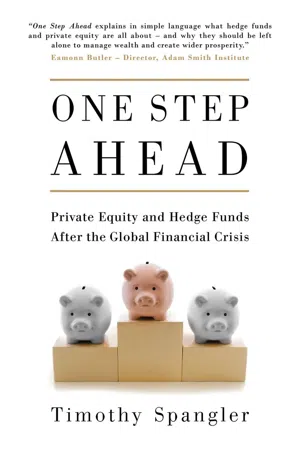
One Step Ahead
Private Equity and Hedge Funds After the Global Financial Crisis
- 416 pages
- English
- ePUB (mobile friendly)
- Available on iOS & Android
eBook - ePub
About this book
A jargon-free guide to how investment funds operate and have broken free of the financial crises to grow and prosper
In One Step Ahead, Timothy Spangler – author of the award-winning Forbes.com blog “Law of the Market” – provides a compelling account of how flexible and entrepreneurial investment firms can prosper in a volatile and rapidly changing financial world.
From the Occupy Movement to the purchase of well-known household brands by private equity firms, Spangler investigates how the structures of alternative investment funds enable them to adapt and react nimbly and effectively to today’s shifting economic and financial landscape. Unpicking the debates and putting disputes in context, Spangler answers the difficult questions:
One Step Ahead is the essential, jargon-free guide to understanding how private equity and hedge funds drive financial markets and how they have become vital wealth creation vehicles for both private and public investors in the global economy.
In One Step Ahead, Timothy Spangler – author of the award-winning Forbes.com blog “Law of the Market” – provides a compelling account of how flexible and entrepreneurial investment firms can prosper in a volatile and rapidly changing financial world.
From the Occupy Movement to the purchase of well-known household brands by private equity firms, Spangler investigates how the structures of alternative investment funds enable them to adapt and react nimbly and effectively to today’s shifting economic and financial landscape. Unpicking the debates and putting disputes in context, Spangler answers the difficult questions:
- Are new regulations sufficient to prevent another global financial crash?
- Have regulators got to grips with the institutional failings that allowed Bernie Madoff to fleece investors?
- Instead of a hedge fund problem or even a private equity problem do we simply have a public pension plan problem?
One Step Ahead is the essential, jargon-free guide to understanding how private equity and hedge funds drive financial markets and how they have become vital wealth creation vehicles for both private and public investors in the global economy.
Frequently asked questions
Yes, you can cancel anytime from the Subscription tab in your account settings on the Perlego website. Your subscription will stay active until the end of your current billing period. Learn how to cancel your subscription.
At the moment all of our mobile-responsive ePub books are available to download via the app. Most of our PDFs are also available to download and we're working on making the final remaining ones downloadable now. Learn more here.
Perlego offers two plans: Essential and Complete
- Essential is ideal for learners and professionals who enjoy exploring a wide range of subjects. Access the Essential Library with 800,000+ trusted titles and best-sellers across business, personal growth, and the humanities. Includes unlimited reading time and Standard Read Aloud voice.
- Complete: Perfect for advanced learners and researchers needing full, unrestricted access. Unlock 1.4M+ books across hundreds of subjects, including academic and specialized titles. The Complete Plan also includes advanced features like Premium Read Aloud and Research Assistant.
We are an online textbook subscription service, where you can get access to an entire online library for less than the price of a single book per month. With over 1 million books across 1000+ topics, weâve got you covered! Learn more here.
Look out for the read-aloud symbol on your next book to see if you can listen to it. The read-aloud tool reads text aloud for you, highlighting the text as it is being read. You can pause it, speed it up and slow it down. Learn more here.
Yes! You can use the Perlego app on both iOS or Android devices to read anytime, anywhere â even offline. Perfect for commutes or when youâre on the go.
Please note we cannot support devices running on iOS 13 and Android 7 or earlier. Learn more about using the app.
Yes, you can access One Step Ahead by Timothy Spangler in PDF and/or ePUB format, as well as other popular books in Business & Business General. We have over one million books available in our catalogue for you to explore.
Information
PART ONE
WHAT WE TALK ABOUT WHEN WE TALK ABOUT PRIVATE EQUITY AND HEDGE FUNDS
1: THE POINTY END OF CAPITALISM
A Short Introduction to Private Equity and Hedge Funds Without Charts or Graphs
Hedge funds, private equity funds and other kinds of investment vehicles help to dispose risk and add liquidity.
Timothy F. Geithner, President of the Federal Reserve Bank of New York, October 18, 2005
Youâve seen very, very dramatic enforcement actions already by the enforcement authorities across the US government, and Iâm sure youâre going to see more to come. You should stay tuned for that.
Timothy F. Geithner, US Secretary of Treasury, October 14, 2011
Perhaps no single building in the world is as much a monument to the rise of private equity and hedge funds as 9 West 57th Street in New York.
Home to private equity giants (KKR & Co. LP and Apollo Global Management LLC), rising stars (Silver Lake Partners) and start-ups (Lightyear Capital), as well as leading hedge fund managers (Och-Ziff Capital Management Group LLC), this office tower provides an enviable home to many of the most successful practitioners of alternative investing, or at least those willing to pay $200 a square foot for the privilege.
Owned by real estate tycoon Sheldon Solow, and identifiable at some distance at street level by the iconic red â9â located in front of the building, the office tower block has an impressive history. So high-profile is the building and its tenants that when a power outage occurred and the elevators failed, The New York Times quickly reported about âprivate equity deal makersâ who were âforced to hoof it up as many as twenty flights of stairs â twenty flights!â
On a cool autumn afternoon, midtown Manhattan looks and feels significantly different from the historic home of American financial capitalism that is located further south in the downtown area surrounding Wall Street. Just a short walk from Park Avenue and the traditional homes of New Yorkâs aristocracy, the tenants of 9 West 57th Street clearly donât need to be in New York. Many of them could just as easily be operating from offices in Greenwich, Connecticut or a designer loft in Tribeca. They could be staring at Bloomberg screens or reviewing portfolio company spreadsheets on a yacht floating just off a picturesque beach in the Seychelles or at their ski chalet in Corchaval.
Unlike the older parts of the financial industry that grew up adjacent to, or in ready walking distance from, a stock exchange or a central bank, private equity and hedge funds have found their footing and taken their rightful place in the current financial hierarchy at a time when technology has freed them from both physical locations and the need for âsafety in numbers.â Perhaps that is part of the reason why a growing number of people in positions of influence and power have begun to express concerns about these new financial entrepreneurs. Perhaps their short histories and small, discreet offices, which seem slightly out of place when compared with their ability to influence events in the financial markets, cause a certain amount of unease.
When you are standing in front of a building housing a bulge-bracket investment bank, such as Merrill Lynch, Morgan Stanley or Goldman Sachs, or a financial powerhouse, such as Citibank, JP Morgan, UBS or Deutsche Bank, you know very clearly whose headquarters you are loitering in front of, with a double skinny latte in your hand. Regardless of whether you happen to be in New York, London, Frankfurt, Tokyo or Hong Kong, these firms are very keen to let you know, in no uncertain terms, âHere we are!â
The indifference of private equity and hedge fund firms to public acknowledgement and popularity, at least until very recently, is strikingly different. In the face of this aloofness, in part driven by regulatory restrictions and the exclusively non-retail nature of their investors, these funds must now answer mounting questions about who they are and what it is that they actually do.
To begin at the beginning, a fund is an answer to a question.
This question will typically involve how to connect people with talent, but insufficient money, with people with money, but insufficient talent, in order to allow the former to make investments on behalf of the latter. Simple enough. Whether the fund in question is a mutual fund for retail investors, a retirement fund for employees of a particular company or government department, a film fund looking to finance a slate of motion pictures, or a real estate fund planning to buy apartment buildings for university students, the same basic commercial logic applies. And it applies to private equity and hedge funds just as well.
In an ideal world, each investor who desired the services of a particular investment adviser would have enough money to entice this adviser to take his or her money and manage it subject to individually negotiated parameters, customized to fit the investorâs particular needs. The investment objective and remuneration for such an account would be determined based on the requirements of both parties. This, however, is not an ideal world.
Many investors, unfortunately, lack the sums of money required to meet typical account size minimums set by established and proven investment advisers, which can start at $25 million. Funds, therefore, are created as a means to aggregate these individual sums of money into a single pool, which can be managed efficiently and effectively. Each investor in the fund is entitled to a portion of the proceeds from the fund in proportion to the amount of money they initially contributed, less any expenses and fees provided to the fund manager.
Through a fund, the professional services of an investment adviser can be provided to a large number of prospective clients, so long as all agree that they are pursuing similar investment objectives. In order to provide these services, an intermediary vehicle is placed between an investment manager, on the one hand, and a group of potentially disparate participants, on the otherhand. The vehicle serves both as a means of pooling the investorsâ money and as a single client for the investment adviser.
The use of funds provides access for the individuals and institutions with smaller sums to invest to investment advisers who would not otherwise be commercially motivated to take them on as clients. Additionally, these vehicles provide investment advisers with administrative efficiencies where multiple clients wish to retain the firm to provide substantially similar services.
It is probably worthwhile making a few observations about the modern private equity and hedge fund industries before going into too much more detail about how these funds are structured and operated. Because of their private nature, there are no generally accessible central repositories for information on these funds. This has historically made rigorous analysis about the size, number and activities of private equity and hedge funds more difficult to conduct, at least when compared to the wealth of publicly reported information available on banks, insurance companies, brokerage houses and other financial firms. As a result, for those eager to uncover a little more information about these funds and their managers, the best sources of data are often either trade associations or private commercial firms who have been able to accumulate enough information upon which to make reasonable estimates.
In the case of private equity funds, it is estimated that close to $3 trillion dollars are invested in these funds, with just over 60 percent of new funds launched by managers based in the United States (50 percent) and the United Kingdom (11 percent). In the case of hedge funds, it is estimated that there are approximately 6,800 hedge funds in existence, managing over $2 trillion in assets. The majority of hedge fund managers are based in the United States, with the United Kingdom being the next largest country. Current estimates show continued growth for both asset classes.
Clearly these are significant industries, which have grown up quickly in the last few decades. Perhaps most surprising is the relatively small amount of independent research and academic work that has been attempted on these funds, at least until very recently. One might be forgiven for expecting that these industries would have been the focus of extensive research and analysis by leading experts and research universities around the world. In reality, academics have shown surprisingly little interest in uncovering the truth behind the rumors and accusations and public relations banter that surround private equity and hedge funds. As a result, the debate has largely been left to partisans.
Are private equity and hedge funds âmysteriousâ and âcontroversialâ? Are they âinherently evil?â
Periodically, stories bubble up in the mainstream press that paint these funds in a poor light. Unfortunately, both critics and champions of alternative funds attempt to reduce complex financial transactions into simple language. In doing so, important details are inevitably lost and the search for meaningful insights is thwarted.
A quick perusal of recent newspaper headlines makes it clear that hedge funds are squarely on the radar of a wider cross-section of society than ever before. They present hedge funds as an opportunity (âGood at Chess? A Hedge Fund May Want to Hire Youâ or âPitching the Hedge Fund Mastersâ) or a threat (âBig British Hedge Fund Takes Aim at the Statesâ), as a potential force for good (âHedge Fund Chief Takes Major Role in Philanthropyâ) or a potential force for evil (âHedge Fund Manager Gets 60 Years for Fraudâ), or simply as an odd source of humor and diversion (âHedge Fund Hippiesâ).
But what does an actual, real life hedge fund really do?
Hedge funds have been described as âmutual funds on steroids.â This is not an entirely unhelpful first impression. If mutual funds take risks on what stocks will go up and currency exchange rates will go down, hedge funds take very, very big risks. Unsurprisingly, the individuals taking these risks are celebrated and admired when their bets pay off. The roll call of great hedge fund managers includes many names that are becoming more familiar to casual readers of mainstream newspapers and magazines: Arthur Samberg, Paul Tudor Jones, Philip Falcone, Steven Cohen and Paul Singer.
Are hedge fund managers really the smartest people around? This is an alluring, but obviously quite futile, question. Regardless of whether they are or arenât, they are still human. They are capable of making mistakes, and many do. Interestingly, like professional athletes, often the heights reached early in a career will not be seen again as the years go by.
Each year, many new hedge funds are launched in the hope of attaining the success and recognition of the giants in the industry. In 2012, for example, new start-up hedge funds came to market focusing on a diverse range of investment strategies, including FMG Mongolia Fund (emerging markets), Context BH Partners LP (equity long/short), Citizen Entertainment Fund Ltd (fixed income), Ancora Merger Arbitrage Fund LP (merger arbitrage) and 36 South Black Eyrar Fund (volatility trading). There are now even firms which are dedicated solely to identifying new managers and backing them in their early days with significant early investments. Known as âseeders,â firms such as IMQubator and Reservoir Capital have had great success at picking the next generation of star hedge fund managers. Notably, IMQubator is ultimately backed by APG, the Dutch pension fund, a significant institutional investor.
In addition to single-strategy hedge funds that may invest in Japanese equities or high-yield bonds of technology companies, there are also funds whose sole purpose is to invest in other funds. Known as funds of funds, firms such as Grosvenor Capital Management, Lyxor Asset Management, K2 Advisors, Pacific Alternative Asset Management Company and Financial Risk Management have received billions of dollars from investors in order to assemble diversified portfolios of underlying hedge funds. Their clients simply need to write a single check to gain access to a collection of funds selected and overseen by their teams of experts. Taking the first step toward including hedge funds in your multibillion investment portfolio couldnât be easier for the institutional investor with the courage and wherewithal to embrace alternative investments. Or so it would seem at first.
The actual term âhedge fundâ is notoriously difficult to define with any precision.
In part, this is due to the derogatory manner in which the phrase is now often used. At its broadest, âhedge fundâ can refer to all unregulated investment vehicles not otherwise categorizable as âprivate equity fundsâ or âreal estate funds.â An overly narrow definition might settle on those funds that engage in highly leveraged trading strategies which utilize short selling or complex derivatives. Neither approach is particularly helpful for the informed layperson eager to learn more about their motivations and activities.
It would be more useful, perhaps, to simply describe certain of their key features and establish a working definition from there. Hedge funds constitute private pools of capital, with investors meeting certain net worth or sophistication requirements. Unregulated by the US Securities and Exchange Commission (SEC), the UK Financial Conduct Authority (FCA) or other relevant regulators, hedge funds are not subject to the limitations and restrictions imposed on their public fund brethren, such as retail mutual funds in the United States or authorized unit trusts in the United Kingdom.
Hedge funds generally invest in publicly traded securities and derivative instruments based on such securities. The strategies followed by these funds can be categorized in a number of ways. One possible set of groupings would include: âlong/short,â which combines long positions with short sales; âevent driven,â which seeks to identify the likelihood of certain corporate transactions; ârelative value,â which seeks to exploit pricing discrepancies that arise between securities; and âtactical trading,â which identifies and follows macro-economic and other trends in various markets. Importantly, new strategies are being conceived of every day, as bright young men and women discover unique trading opportunities that arise from the dayâs headlines.
A few generalizations can also be made about the economics of a hedge fund. It is common for these funds to charge a performance fee, based on the success they have pursuing their investment strategy, in addition to an asset-based management fee, based on the amount of money provided by investors. Also, the capacity constraints imposed by certain investment strategies mean a limit may exist on how much capital can be employed by a particular hedge fund without negatively impacting its returns and, thereby, the lucrative performance fee accruing to the fund manager.
Structurally, hedge funds may be set up either onshore (i.e. in the market in which the investors are located) or offshore (i.e. in a different market). They make use of either tax transparent entities, such as limited partnerships, or tax exempt entities, such as companies established in jurisdictions where broad tax derogations are possible. The most common offshore jurisdiction is no doubt the Cayman Islands, located in the warm waters of the Caribbean. Hedge funds are typically open-ended. This means that they issue and redeem units or shares directly with investors on a regular basis, based on the net asset value of the units or shares on a particular day. The mutual funds and unit trusts sold to Uncle Edgar and Aunt Edna are also open-ended, allowing retail investors to move money in and out when needed. By contrast, the units or shares of closed-ended funds (such as a private equity fund) are not eligible for interim liquidity. As a result, they must either be held until liquidation or traded from investor to investor in secondary transactions.
Currently (and for the foreseeable future) the primary investor market for hedge funds is the United States, consisting of US tax-exempt investors, such as public and private pension funds and university endowments, and US high net worth investors. However, the significant growth in United Kingdom and European-based fund managers over the past fifteen years has meant that structuring hedge funds has become an increasingly multi-national endeavor.
Alfred Winslow Jones is widely acknowledged as having established the first hedge fund in 1949. Unlike the Abner Doubleday myth that shrouds the origin of baseball, the American national pastime, there are actually reliable contemporaneous reports of Jonesâs investment venture and how he sought to differentiate himself from the other money managers plying their trade in the United States in those early, post-War years. Over the intervening decades, the universe of hedge funds has expanded far beyond the relatively straightforward long/short equity strategy Jones pursued. Now the term âhedge fundâ is casually used to encompass any strategy that seeks to generate positive returns irrespective of rises and falls in the securities markets.
A frustrating feature of hedge funds for many would-be investors is the lack of transparency with regard to a fundâs actual holdings. Investors rarely receive position-level information about a fundâs portfolio. Fund managers are very concerned that this information could be used by third parties to trade against their fund and harm its performance over time. Often, the profits captured by hedge funds can be based on small price differentials that could evaporate before they have fully completed their trading.
A growing trend in the market, however, is for hedge fund managers to provide significant institutional investors and funds of funds with limited, but meaningful, information about the fundâs holdings. This information can be provided in an aggregated manner, by sector, geography or currency, rather than a complete listing of each stock, bond or derivative held. In this way, concerns about âtrading againstâ the fund can be addressed, while still providing useful metrics to concerned investors about their risk exposure. This tiering of transparency is steadily becoming a feature of market practice, as individual investors remain willing to accept significantly lower disclosure as the price for access to hedge funds. Institutional investors, on the other hand, have fiduciary duties that they owe to their ultimate beneficiaries. These duties require them to seek and obtain increased transparency in order to allow them to fulfill their own legal obligations. An institutional investor who fails to take adequate steps to oversee the managers with whom they entrust their money could find themselves facing costly (and embarrassing) litigation from their beneficiaries, whose interests they were charged with protecting.
Perhaps unfairly, hedge funds are often associated in the mainstream press and in popular imagination with fraud and other criminal activities. Little is reported about most funds most of the time, but when a significant loss occurs, or rumors of fraud begin to circulate, the financial pages regularly fill up with scandalous stories. As a result, itâs easy to envision the managers of many of these funds as pantomime villains, who are simply waiting for their chance to rob their helpless investors blind when the right opportunities arise.
In fact, the actual cases of such frauds have been relatively few, both in absolute and relative numbers. Even where no criminal malfeasance occurs, however, investors in hedge funds can suffer catastrophic losses where comprehensive risk management systems are lacking and unforeseen market developments expose weaknesses in the construction of the portfolio and its risk exposure. The global financial crisis provided us with many examples of these.
As a result, the most successful investors will always be actively considering and re-considering which funds to invest in and how much money to entrust with each one. Investor preferences and prejudices have a surprisingly large impact on which managers survive and thrive and which managers eventually withdraw from the market. The preferences and prejudices of investors have been a significant driver in determining the shape and scope of todayâs hedge fund industry. In order to fully understand the nature and operation of these funds, a full understanding of the motivation of these investors must be developed. Absent that, the concerned layperson is only evaluating half the picture.
Since the global financial crisis, it has been particularly hard to be a small hedge fund.
Many of those brave investors who eventually re-entered the market after the dramatic events of 2008â09, when over 1,000 hedge funds closed and many more reneged on their promise to give investors their money back, still shy away from all but the largest hedge funds. Those intrepid souls who are now willi...
Table of contents
- CoverÂ
- Praise for One Step Ahead
- Title
- Copyright
- Dedication
- ContentsÂ
- Foreword
- Prologue
- Part One: What We Talk About When We Talk About Private Equity and Hedge Funds
- Part Two: One Step Ahead of the Market, One Step Ahead of the Law
- Part Three: The Futureâs So Bright âŚ
- Epilogue
- About the Author
- Index