This book is available to read until 28th November, 2025
- 208 pages
- English
- ePUB (mobile friendly)
- Available on iOS & Android
eBook - ePub
Available until 28 Nov |Learn more
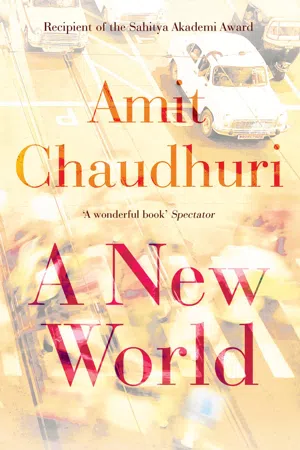
A New World
About this book
A year after his divorce, Jayojit Chatterjee, an economics professor in the American Midwest, travels home to Calcutta with his young son, Bonny, to spend the summer holidays with his parents. Jayojit is no more accustomed to spending time alone with Bonny–who lives with his mother in California–than he is with the Admiral and his wife, whose daily rhythms have become so synchronized as to become completely foreign to their son. Together, the unlikely foursome struggles to pass the protracted hours of summer, each in his or her own way mourning Jayojit’s failed marriage. Written with depth and tenderness, A New World goes right to the heart of a family, making vividly alive their hopes, desires and regrets.
Frequently asked questions
Yes, you can cancel anytime from the Subscription tab in your account settings on the Perlego website. Your subscription will stay active until the end of your current billing period. Learn how to cancel your subscription.
No, books cannot be downloaded as external files, such as PDFs, for use outside of Perlego. However, you can download books within the Perlego app for offline reading on mobile or tablet. Learn more here.
Perlego offers two plans: Essential and Complete
- Essential is ideal for learners and professionals who enjoy exploring a wide range of subjects. Access the Essential Library with 800,000+ trusted titles and best-sellers across business, personal growth, and the humanities. Includes unlimited reading time and Standard Read Aloud voice.
- Complete: Perfect for advanced learners and researchers needing full, unrestricted access. Unlock 1.4M+ books across hundreds of subjects, including academic and specialized titles. The Complete Plan also includes advanced features like Premium Read Aloud and Research Assistant.
We are an online textbook subscription service, where you can get access to an entire online library for less than the price of a single book per month. With over 1 million books across 1000+ topics, we’ve got you covered! Learn more here.
Look out for the read-aloud symbol on your next book to see if you can listen to it. The read-aloud tool reads text aloud for you, highlighting the text as it is being read. You can pause it, speed it up and slow it down. Learn more here.
Yes! You can use the Perlego app on both iOS or Android devices to read anytime, anywhere — even offline. Perfect for commutes or when you’re on the go.
Please note we cannot support devices running on iOS 13 and Android 7 or earlier. Learn more about using the app.
Please note we cannot support devices running on iOS 13 and Android 7 or earlier. Learn more about using the app.
Yes, you can access A New World by Amit Chaudhuri in PDF and/or ePUB format, as well as other popular books in Literature & Literature General. We have over one million books available in our catalogue for you to explore.
Information
He had come back in April, the aftermath of the lawsuit and court proceedings in two countries still fresh, the voices echoing behind him. But he felt robust.
‘Here,’ he said to the taxi driver that day in April—it was a Tuesday—when he arrived. His son was staring out of the window, as if a taxi were the most natural place to be in, apparently unaffected by its rusting window-edges and its noise. It was eleven o’clock in the morning; it should be ten o’clock now the previous night in America.
‘Stop here,’ said Jayojit to the taxi driver. ‘Kitna hua?’ he asked.
Vikram—that was his son’s name, his maternal grandfather’s choice—said, ‘Are we here, baba?’
Though they spoke to each other in English, both Jayojit and his wife (ex-wife now? but she had still not married the man she was living with) had decided to retain, as far as their son was concerned, the Bengali appellations for mother and father: ‘ma’ and ‘baba’. Ironical, thought Jayojit—he thought about these questions more and more these days; indeed, he could often hear himself thinking—that we did not think to teach him, at least in practice, the other things that surround those words in our culture. He himself had learnt those meanings from the lives of his parents. It was curious how often he returned to his childhood and growing up these days, involuntarily, to their apparently random and natural sequence.
‘Seventy-five rupees,’ said the driver, turning his head and smiling; the man hadn’t shaved for a few days. It was as if the taxi were his home and he had long not stepped out of it.
‘Seventy-five rupees,’ repeated Jayojit with a chuckle, while the driver smiled with a strange but recognizable demureness; the coyness of a struggler taking something extra from a person he considers well-to-do. Jayojit knew, from glancing at the numbers that had appeared on the meter, that he was paying more than he was supposed to, but he silently rummaged the new rupee notes in his wallet; he had changed fifty dollars at the airport.
‘Yes, Bonny, we’re here,’ he proclaimed cheerfully to his son; Bonny was his pet name, given him by Jayojit’s mother, a strange Western affectation from the old days, to call children names like these—though his mother was not westernized. The boy, his pale face red with the heat, with one or two darker streaks—evidence of the journey, of plane seats, uncomfortable positions, attempts to sleep—on his cheeks, was looking quietly at the gates. A sound, oddly lazy but determined, of a plank of wood being hit again and again, could be heard. The watchman at the gates of the multi-storeyed building and the indolent, shabby chauffeurs of the private cars, lounging in the shade, their backs leaning against their cars’ bonnets, seemed to be intent on watching the occupants of the taxi and listening to that sound.
‘E lo,’ said Jayojit, handing the driver the money, who took it and began to count the notes. Experimentally pulling the lever that opened the door, he said to his son, ‘Bonny, that’s the way to do it.’
They had come with one heavy suitcase and a large shoulder bag slung around Jayojit’s neck; in one hand he was carrying an Apple laptop and a one-litre bottle of Chivas Regal in a dutyfree bag. The boy was wearing a bright-blue t-shirt and shorts, and on his back there was a kind of rucksack; he walked with the mournful loping air of a miniature expeditioner. The two or three part-time maidservants who always sat by the entrance steps looked at the two arrivers casually; it was as if they were used to the sight of huge itineraries, arrivals, and departures, and it no longer disturbed the monotony and fixedness of their lives. A faint smell of stale clothes and hair-oil came from them. Jayojit was a big man, five feet eleven, and fair-complexioned and still handsome in a bullish way; he was wearing a red t-shirt and off-white trousers on which the creases showed, and two Bangladesh Biman boarding cards stuck out from his shirt pocket.
The flat was on the fourth floor, number 14; a long corridor led to it, and then became a kind of verandah before it and its neighbouring flat. The nameplate on the door said ‘Ananda Chatterjee’. He pressed the doorbell, which was really a buzzer with a prolonged droning sound which he associated with an immemorial middle-class constrictedness; and his son stood facing the door, staring at the one-inch ledge at the bottom. It was Jayojit’s mother who opened the door; immediately, upon opening it, her face, a rainbow of late morning light and shadows, of tiredness and alacrity, lit up with a smile, and she said: ‘You’ve come, Joy!’
‘Yes, ma,’ he said jovially, and bent his big body to touch, in one of the awkward but anachronistic gestures that defined this family, her feet.
‘You’ve put on weight, have you,’ she said. ‘There, let it be.’ Then looking at Vikram she smiled, widening her mouth, so that her teeth showed, and said: ‘Esho shona,’ and then, remembering he might want her to speak in English, ‘Come to thamma.’ For the first time Vikram smiled.
Admiral Chatterjee was sitting inside on the sofa—a heart condition and diabetes had made him slow; but he was a big man too. He looked like a sailor, his longish grey hair and beard suggesting voyages, deck-parties, and a sea breeze; a painting by a minor artist, bought many years ago for five hundred rupees, hung behind him.
‘How was the trip, Joy?’ he boomed as he got to his feet. ‘All right?’
They—Jayojit and his father—communicated, except for a few words and sentences, in English, establishing a rapport, a bluff friendship, which excluded the tenderness of the mother-son relationship—the latter finding expression in the mother’s homely, slightly irritating Bengali, and talk centred round questions such as whether her son was hungry, or whether he had had a bath.
‘Bloody taxi driver took extra money from me,’ said Jayojit with a large smile, and then bent to touch his father’s feet. ‘Pranam karo, Bonny,’ he said. The boy, who had been slipping off his rucksack so he might put it on a chair, interrupted himself, turned to walk gravely but obediently, with a light-footed sneaker-tread, towards his grandfather, to touch his feet.
‘Let it be, let it be, dadu,’ said the grandfather, who always seemed a little uncomfortable with others, whatever the situation. To his wife he said, ‘Ruby, give the child something to eat!’
It was not easy to be intimate or relaxed with the Admiral. He was one of those men who, after Independence, had inherited the colonial’s authority and position, his club cuisine and table manners, his board meetings and discipline; all along he had bullied his wife for not being as much a memsahib as he was a sahib. She had adored and feared him, of course, and paled beside him. Only before two things had he become strangely Bengali and native. The first was his in-laws; in those days when his wife and he still quarrelled and his in-laws were alive, his wife, crying softly, would pack her things and go away for a week to her parents’ house; and he would be left dumbstruck, unable to say anything. The second was his grandson—Vikram; Bonny. He could not reconcile himself to the fact that the boy had to tag along part of the year with Jayojit, and then go back to his mother, who was living elsewhere on the vast American map, with someone else. He could not comprehend the loneliness of the child, or why the loneliness needed to exist. Yet, in spite of this, and in spite of the fact that the old India had changed, and he himself had grown somewhat decrepit, the official air still hung around him, like a presentiment.
Jayojit’s mother disappeared into the kitchen, while Vikram said pleadingly to his father, not very loud:
‘Baba, I’m not hungry!’ There was a faint American broadening in the child’s vowels.
‘Baba, he’s right—we’ve been eating constantly on the plane— eating and sitting. Our body-clock’s gone completely awry!’
‘Have a bath, then, you two,’ said Jayojit’s father.
The heat had just begun to become intolerable—it was the middle of April. Outside, birds cried continuously, sharp, clear, obstinate cries. Shadows of windows and façades had settled everywhere upon parapets and bannisters.
‘What we need,’ said Jayojit, ‘is a glass of water. Of course,’ a look of exaggerated caution appeared on his face, ‘as long as the water is boiled.’
‘You’ve never drunk anything but boiled water since you were a child,’ remonstrated his mother gently, returning with two glasses whose sides had already misted over. ‘And you know your father always drinks boiled water.’
‘Still, it’s always good to check when you’re back!’ said Jayojit, and drank the water urgently. ‘You know one could get dehydrated sitting on a plane for so long!’ he said, putting down the glass. ‘These old glasses,’ he murmured, looking at the glass quizzically.
Vikram drank some of the water slowly and then stopped as if he could drink no more, and his grandmother said, ‘Enough, shona?’ The boy nodded seriously and gave her the glass, which she accepted as if it were a gift, with a smile.
‘But tell me, Joy,’ said his father, visibly irked and hot, ‘what made you take Bangladesh Biman of all airlines? Surely there are other, better airlines coming from America? I can’t believe that the best option is coming with all those Bangladeshis all the way from New York!’
‘Baba,’ said Jayojit, ‘the truth is there are a lot of airlines coming to Calcutta, all of them from third-rate East European countries— Rumanian, Yugoslav, Aeroflot of the defunct Soviet Union. KLM, Thai—I couldn’t get seats. Air India—if I have to tolerate rudeness, I’d rather it wasn’t from air hostesses who’ve got their jobs because of some reservation quota. At least in Bangladesh Biman, which doesn’t follow a single international regulation and isn’t even a member of the IATA, you have all these placid East Bengalis all around you, speaking to each other in dialect. Baba, I realized, sitting on that plane, why Bangladesh is the way it is: they’re all happy, and their marriages are working! Look at what happened to the Hindus who left.’ His own parents were of East Bengali origin, the father coming from a landowning family in Chittagong, the mother from Mymensingh. Apparently a few distant relatives had stayed on in the ancestral houses; a small businessman, a teacher—they were rarely in touch with them. ‘Besides, baba,’ chuckled Jayojit, ‘the tickets are less expensive.’
‘They’re certainly less expensive from here!’ agreed the father, looking very concerned behind the beard, but in a way that suggested he was enjoying himself. ‘Every week tens of middle-class Bengalis who’ve been saving up all their lives queue up in the airport to travel by Bangladesh Biman—to visit their son or daughter in England, or to travel: you know the Bengali weakness for “bhraman”? Last week your Ranjit mesho and Dolly mashi, you remember them’—he looked reflective—‘took a Biman flight to London.’ The light glinted on his spectacles.
Jayojit pictured the couple in the check-in section of Calcutta airport, with its minuscule international air traffic and the rude officials behind the counters, Ranjit mesho and Dolly mashi, confused but not unhappy, with their suitcases, he looking like what he was, an executive whose career had begun well but not taken off, but who still believed in the system, happy to be going abroad, no matter that it was by Bangladesh Biman, and Dolly mashi, always in a printed sari, saving her good saris for who knows which day, accompanied by the same two suitcases they must always use when travelling.
‘And the tickets are affordable—21,000 rupees,’ said the Admiral in a strangely hurt way. ‘If you can tolerate Dhaka!’ No reference was made to the fact that they had planned themselves to travel by Biman to America before the divorce had taken place; the unspoken reference to that possibility hung in the air like something that did not need to be said.
‘How are their children, that reminds me?’ asked Jayojit, pursuing a normal conversation. ‘Indra and what’s her name?’
‘Oh, they’re all right,’ said his father, a little disgusted, as if they couldn’t possibly be anything but ‘all right’. ‘One in England and one in America … Indra is a scientist.’
‘Always thought he would be.’
Vikram was in the balcony, looking at the potted plants which were placed half in sunlight and half in shadow; geometric shadows from the grille fell on the wall and the floor, giving a kind of visual relief; in his hand he held a small unfinished carton of pure orange juice he had taken out of his rucksack, whose dregs he sipped contentedly through a bent plastic straw whenever he stood still.
‘But Bonny liked the Bangladesh Biman chicken curry!’ said Jayojit. ‘Didn’t you, Bonny?’
The boy turned to look back, in surprise. Then, as if the words had reached him an instant late, he nodded.
Now Jayojit’s mother emerged again and said to Vikram:
‘Come on, we are going to have nice Bengali fish for lunch. So let us have bath now.’
‘All right, tamma,’ said the boy, stepping out of the shade of the verandah into the drawing room.
He was her elder son’s only child—her only grandchild, born seven years ago. Last year he had written her a letter beginning, ‘Dear thamma …’, and it should have been an occasio...
Table of contents
- Cover
- Title
- Copyright
- Dedication
- A New World