
- 336 pages
- English
- ePUB (mobile friendly)
- Available on iOS & Android
eBook - ePub
About this book
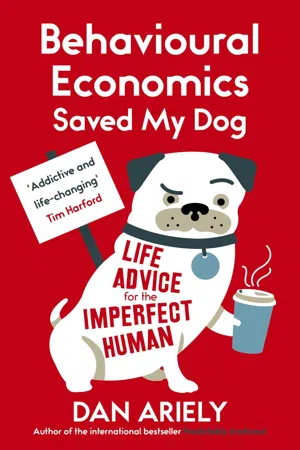
Internationally bestselling author Dan Ariely brings his unique perspective to bear on a maelstrom of life’s problems – from how to deal with a Christmas card list that’s fast becoming unmanageable to whether or not you should have children.
Ariely changed the way we view ourselves, how we think and how we act, with his book Predictably Irrational. In his immensely popular Wall Street Journal advice column, where readers “Ask Ariely” for his help with various dilemmas, he provides a logical view on the seemingly illogical, shedding light on the most curious minutiae of human behaviour.
With a helping hand from legendary New Yorker cartoonist William Haefeli, Ariely’s new book will make you laugh at the ridiculous aspects of our daily existence just as you gain a new perspective on how to handle the inevitable challenges that life brings us all.
Ariely changed the way we view ourselves, how we think and how we act, with his book Predictably Irrational. In his immensely popular Wall Street Journal advice column, where readers “Ask Ariely” for his help with various dilemmas, he provides a logical view on the seemingly illogical, shedding light on the most curious minutiae of human behaviour.
With a helping hand from legendary New Yorker cartoonist William Haefeli, Ariely’s new book will make you laugh at the ridiculous aspects of our daily existence just as you gain a new perspective on how to handle the inevitable challenges that life brings us all.
Frequently asked questions
Yes, you can cancel anytime from the Subscription tab in your account settings on the Perlego website. Your subscription will stay active until the end of your current billing period. Learn how to cancel your subscription.
No, books cannot be downloaded as external files, such as PDFs, for use outside of Perlego. However, you can download books within the Perlego app for offline reading on mobile or tablet. Learn more here.
Perlego offers two plans: Essential and Complete
- Essential is ideal for learners and professionals who enjoy exploring a wide range of subjects. Access the Essential Library with 800,000+ trusted titles and best-sellers across business, personal growth, and the humanities. Includes unlimited reading time and Standard Read Aloud voice.
- Complete: Perfect for advanced learners and researchers needing full, unrestricted access. Unlock 1.4M+ books across hundreds of subjects, including academic and specialized titles. The Complete Plan also includes advanced features like Premium Read Aloud and Research Assistant.
We are an online textbook subscription service, where you can get access to an entire online library for less than the price of a single book per month. With over 1 million books across 1000+ topics, weāve got you covered! Learn more here.
Look out for the read-aloud symbol on your next book to see if you can listen to it. The read-aloud tool reads text aloud for you, highlighting the text as it is being read. You can pause it, speed it up and slow it down. Learn more here.
Yes! You can use the Perlego app on both iOS or Android devices to read anytime, anywhere ā even offline. Perfect for commutes or when youāre on the go.
Please note we cannot support devices running on iOS 13 and Android 7 or earlier. Learn more about using the app.
Yes, you can access Behavioural Economics Saved My Dog by Dan Ariely in PDF and/or ePUB format, as well as other popular books in Psychology & Business General. We have over one million books available in our catalogue for you to explore.
Information
ON ESCALATION OF COMMITMENTS
Dear Dan,
Every year, when Christmas comes, I feel obliged to send Christmas cards to everyone I know, and every year, the number of cards I send gets larger and larger. It is now officially getting out of hand. Can I switch to sending cards only to my really close friends?
ā HOLLY
A few years ago I was ordained by the Church of Spiritual Humanism, so I feel that I am in the position to tell you that it is perfectly fine for you to send cards only to your good friends. As a social scientist, I donāt think anyone left off the list will be offended and many of them might not even notice. Taking this step will also reduce their feeling of obligation to send you a card next yearāso in the process you are also helping them with the same problem. And if you really want to eliminate the Christmas-card frenzy, there is always Judaism.
Friends, Expectations, Happiness
ON THE ART AND JOY OF SAYING NO

āAnd once theyād finished everything on their to-do lists, they lived happily ever after.ā
Dear Dan,
Iāve recently been promoted, and I now receive all sorts of requests for things that have little to do with my love for my job. I recognize the importance of helping out colleagues and the organization as a whole, but these other activities are taking up too much of my time and making it impossible for me to do my job. How can I set my priorities better?
ā FRANCESCA
Ah yesāthe perils of success. Promotions usually sound good, but once we get them, we often realize that they come with extra demands and annoyances. (Oddly, we donāt seem to remember this lesson from promotion to promotion, so each time weāre surprised when we discover these extra costs.)
Back to your question. Hereās what I suspect your new life looks like: every day, nice colleagues who you want to help ask you to do something for them. On top of that, the request is usually for some time that is far into the futureāsay a month from now. You look at your calendar and it looks rather empty, so you say to yourself, āSince Iām mostly free a month from now, how can I say no?ā But this is wrong. Your future is not really going to be free; the details are just not yet filled in. When the day arrives, you will have all kinds of things to do and your plate will be overflowingāeven without the extra demands of this request. And at that point you will wish that you hadnāt said yes.
This is a very common problem, and I would like to propose three simple tools that can help you better stick to your desired priorities.
First, every time a request comes in, ask yourself what you would do if it was for next week. Framed this way, you would look at your schedule and work out if you would cancel some of your other obligations to make room for this new request. If you would cancel some things in order to make time, go ahead and accept. But, if you would not prioritize it over your other obligations, just say no.
As a second tool: when you receive a request, imagine that you look at your calendar to see if you can comply and you discover that you are fully booked that day without the ability to switch anything aroundāmaybe you are out of the office. Now, try to gauge your emotional reaction to this news. If you feel sad, you should go ahead and accept the request. On the other hand, if you feel relieved that you canāt do it, turn it down.
Finally, practise using one of the most beautiful words in English: ācancel-elation,ā the glee we feel when something is cancelled. To use this tool, imagine that you accepted this particular request but it later got cancelled. If you can taste joy, you just experienced cancel-elation and you have your answer.
Workplace, Decisions, Long-Term Thinking
ON NETFLIX DISSATISFACTION

āIf you had ten eggs in a basket and two fell out and broke, how sad would you be?ā
Dear Dan,
I am a longtime Netflix user. Recently, Netflix removed about 1,800 movies from its offering, while adding a few very good ones. I know I probably would have never watched any of those 1,800 movies but I am still upset about this and I am seriously considering leaving Netflix. Why do I feel this way?
ā KRISTEN
As a movie fan myself, I appreciate your conundrum. The basic principle behind this emotional reaction to the elimination of these movies is loss aversion. Loss aversion is one of the most basic and well-understood principles in social science. The basic finding is that losing something has a stronger emotional impact than gaining something of the same value. Going back to Netflix, the implication is that having movies taken away from your account is perceived as a loss and because of that, it feels much more painful. The impact of loss aversion could be so strong that losing the not-so-great movies can still be more upsetting than the joy of getting movies that are objectively better.
One other implication of loss aversion is that while old Netflix users, such as yourself, will view the new collection of movies on Netflix in a somewhat negative and loss-aversive way, new users who just see the new set of movies without the experience of having anything taken away from them will view the updated offering in a much more positive way.
With this in mind, my suggestion is that you try to think about Netflix more like a museumāas a service that provides you not with particular movies but with an optimal, curated variety of entertainment. With museums, we donāt think about ourselves as owning any of the art, so we arenāt upset when the exhibits change. My guess is that if you manage to reframe your perspective this way, you will enjoy Netflix to a larger degree.
Entertainment, Loss Aversion, Value
ON DIETING

āIām not eating. Iām self-medicating.ā
Dear Dan,
This is probably a very common question, as everyone seems to be on a diet at some point. The question is: why do we let the immediate pleasure of eating overwhelm our long-term considerations? Why do we sabotage our health over and over? And how can we tame our desire to eat and overeat?
ā DAFNA
As you pointed out, dieting basically goes against our inherent nature. Itās often the case that we have fantastic ideals about our future selves. What we will do, what we will not do, what decisions we will make, and what decisions we will not make. But when it comes to our everyday decisions, often the short-term considerations prevail and our long-term hopes and wishes get left behind (sometimes they even move to the attic). When weāre not hungry and someone asks us how many desserts we will eat over the next month, we might think that we will have one or maybe two at the most. However, when weāre at a restaurant and the waiter places the dessert menu (or even worse, the dessert tray) in front of us and we see our favourite dessert listed as an option, we get a very different idea about the importance of having dessert right now. We see the triple chocolate cake, and our priorities change. In behavioural economics, we call this āpresent-focus bias.ā
On top of that, a diet is really a difficult thing to stick toāmuch more difficult than quitting smoking, for example. Why? Because with smoking, we are either smokers or nonsmokers. With dieting, we canāt easily separate ourselves into eaters and noneaters. We have to eat, and so the question becomes: what do we eat and when exactly do we stop? And because there are no clear-cut stopping rules, it becomes very hard to stick to any particular diet.
So what can we do about this problem? The simplest approach is to realize the extent of this challenge, and try hard from the beginning to avoid exposing ourselves to the types of foods that are detrimental to our diet. If we have no cake at home, weāll probably eat much less cake. And if we replace that cake with fresh carrots, weāll eat carrots because theyāre available. Maybe we can decide that dessert is just unacceptable. Or maybe that we can have dessert only on Sundays. Another useful and relatively simple rule is not to let any soft drinks and boxed snacks into our homes. Such an approach, of applying strict, religious-type rules to dieting, can be very useful. By adopting such rules we will be able to better recognize at any point if we are sticking to our long-term plans or not, and this should help us reinforce our desired behaviour.
Dieting, Self-Control, Rules
ON FORGOTTEN AND FORGIVEN LOANS
Dear Dan,
Many years ago a friend of mine asked me to lend her a substantial amount of money. At the time I was happy to help her, but it has been years since I lent her the money, she has never mentioned it, and the shadow of this exchange is clouding our relationship. What should I do? Should I say something?
ā MARIEL
Because youāre the one who did her a favour and loaned her the money, you probably think that she is the one with the obligation to bring up the topic. This might be true from a moral perspective, but the problem is that once you lent her the money, you shifted the power in your relationship, and this asymmetry is making it m...
Table of contents
- Cover
- Title
- Copyright
- Contents
- Introduction
- Based on the āAsk Arielyā column in The Wall Street Journal
- New Questions and Advice