The sensational follow-up to the bestselling Can a Robot be Human
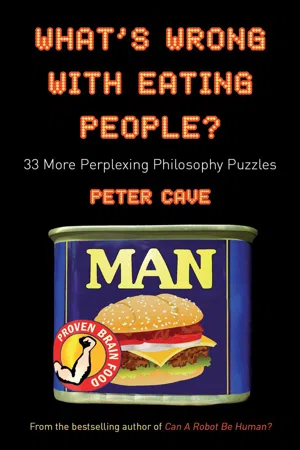
In this stunning sequel to last Christmas' bestselling surprise hit, "Can a Robot be Human?", Peter Cave once again engages the reader in a romp through the best bits of philosophical thought. With the aid of tall stories, jokes, common sense and bizarre insights, Cave tackles some of life's most important questions and introduces the puzzles that will keep you pondering throughout the night. From encounters with bears (ethical dilemmas) to talking turkeys (the problem of induction), Cave storms through philosophy's classic conundrums with rapier wit and wisdom. Illustrated with quirky cartoons throughout, "What's Wrong With Eating People?" leaves no stone unturned, covering a smorgasbord of topics including logic, ethics, art and politics. It will provide a perfect gift for anyone who puzzles about the world!
Frequently asked questions
Yes, you can cancel anytime from the Subscription tab in your account settings on the Perlego website. Your subscription will stay active until the end of your current billing period. Learn how to cancel your subscription.
No, books cannot be downloaded as external files, such as PDFs, for use outside of Perlego. However, you can download books within the Perlego app for offline reading on mobile or tablet. Learn more here.
Perlego offers two plans: Essential and Complete
Essential is ideal for learners and professionals who enjoy exploring a wide range of subjects. Access the Essential Library with 800,000+ trusted titles and best-sellers across business, personal growth, and the humanities. Includes unlimited reading time and Standard Read Aloud voice.
Complete: Perfect for advanced learners and researchers needing full, unrestricted access. Unlock 1.4M+ books across hundreds of subjects, including academic and specialized titles. The Complete Plan also includes advanced features like Premium Read Aloud and Research Assistant.
Both plans are available with monthly, semester, or annual billing cycles.
We are an online textbook subscription service, where you can get access to an entire online library for less than the price of a single book per month. With over 1 million books across 1000+ topics, weāve got you covered! Learn more here.
Look out for the read-aloud symbol on your next book to see if you can listen to it. The read-aloud tool reads text aloud for you, highlighting the text as it is being read. You can pause it, speed it up and slow it down. Learn more here.
Yes! You can use the Perlego app on both iOS or Android devices to read anytime, anywhere ā even offline. Perfect for commutes or when youāre on the go. Please note we cannot support devices running on iOS 13 and Android 7 or earlier. Learn more about using the app.
Yes, you can access What's Wrong with Eating People? by Peter Cave in PDF and/or ePUB format, as well as other popular books in Philosophy & Philosophy History & Theory. We have over one million books available in our catalogue for you to explore.
ON THINKING TOO MUCH: HOW NOT TO WIN A PRINCESSāS HAND
Cast ourselves into a kingdom, a kingdom ruled by the king and queen, a kingdom with jesters, princes, and princesses, with dragons, dreams, and damsels in distress. In our kingdom, there is a beautiful princess, the king and queenās daughter; yet there is stalemate: which young man should gain the princessās hand? The king wants his daughter to marry Prince Clever, who is indeed clever, though neither exactly handsome nor strong nor possessing a princeās charm. The queen backs a rival, Prince Not So Clever, who is assuredly not so clever, yet is handsome, manly, and charming. Both young men are enchanted by the princess. And the princessās love concerning the young men? Well, she wisely lets it be known she could love either; she does not want to make enemies of her father or mother. Such is love in those days ā and such is parental authority.
āWe must set the suitors a task,ā declares the queen, āto see who displays the greatest devotion to our daughter.ā
āWhat a good idea,ā agrees the king. āLet it be a mathematical puzzle and one that ā¦ā
āOf course not,ā insists the queen, knowing Prince Not So Clever would fail any such test. āThey must slay a dragon. The first suitor to return with a dragon suitably slain shall have our daughterās hand.ā
Now, that is not as impossible a task as it may sound; this is a kingdom with convenient dragons ready to be slain. Our princes, though, lack eagerness toward the proposal ā after all, dragon-slaying is hard work and can be quite a heated affair ā but, if it has to be done, it would be worth the effort for the princessās hand. The king is very unhappy at the proposal; his preferred candidate would be highly unlikely to win.
The king and queen argue until the princess pipes up. āLet it be that one of the men needs only to intend to slay a dragon, while the other must actually slay a dragon.ā At this, Prince Clever quickly bags the āintention onlyā option, thinking that would obviously be so much easier than all the messy effort of slaying. Prince Not So Clever sighs, accepting that his slow-wittedness means that he will have to do the slaying.
āThis is pointless and silly,ā thunders the queen, then muttering, āPrince Not So Clever is bound to lose ā intending, which is all Prince Clever has to do, is so much easier than actually doing.ā Yet the princess kicks her, politely of course, silencing her ā such is daughterly authority in those days.
And so, it is decided that the winner of the princessās hand will be the one who completes his task first, be it the intending only, sincerely of course, or the actual slaying, starting at sunrise tomorrow. Before readers ask, the king and queen have a court mind-reader who can easily read minds for sincere intentions. If this worries readers, we pop into the kingdom future brain scanners that readily detect psychological states such as intentions. Now, the question is:
Who is more likely to win the princessās hand?
The puzzle centres on rationality and affects our everyday lives. In our question, we have added the caveat of āmore likelyā as protection from readers who rightly note that we have said nothing about how strong the local dragons are, exactly how clever the suitors are, whether they remember the task next morning, and so on. Assuming all is straightforward, other than the taleās oddness, the answer, as readers may have guessed, is that Prince Not So Clever wins. He gets on with his task, slays the dragon, and marries the princess. What goes wrong for Prince Clever?
Prince Clever was, of course, eager to accept the condition whereby merely intending was sufficient to win the princessās hand. As the queen thought, merely intending to do something seems so much easier than actually doing. Indeed, we may well sincerely intend to perform feats, yet fail. Prince Clever mused upon this point.
āI need only to intend to slay a dragon,ā he reflected. āThe actual slaying is hard work; so it would be silly to do any slaying, once that, at sunrise, I have already intended to slay ⦠Ah, but that means that I would not be sincerely intending to slay after all ā if I know that I wonāt then bother to slay.ā
Prince Clever thought more. āAh well, Iād better slay the dragon after all,ā he reflected miserably, but then hesitated. āHold on, that would be crazy, for I donāt need to do that, once I have had my sincere sunrise intention to slay. Yet as I am aware of that, once again I should have failed to have formed the required sincere intention. Okay, I had better go and slay ā but hold on ā¦ā
And so Prince Cleverās reasoning looped round and round ā and as the sun rose he still found himself unable to form a sincere intention. Whenever he said āI intendā, trying to mean it, his reason reminded him that he would not need to do what he intended ā and he would have good reason not to do it, when the time came. Of course, Prince Not So Clever lacked all such quandaries; he went out and slew the dragon. Mind you, it was a little dragon.
And so it was that Prince Not So Clever married the princess. The princess pretended surprise, while within she smiled wisely. Such was princessesā wisdom in those days.
*Ā Ā Ā Ā Ā *Ā Ā Ā Ā Ā *
Had the mere āintentionā requirement also been given to Prince Not So Clever, he would still have won. Being not so clever, he would not have become enmeshed in the clever reasoning of Prince Clever. The puzzle arises because, at times, it is rational to commit ourselves to doing something that, later on, it will be irrational to do. When we reflect on this, we see how rationally we should lose the motivation to do the irrational, once that ālater onā comes, thus undermining our commitment now to performing the task in question.
Had Prince Clever been cleverer, maybe he could have persuaded himself that the requirement was that he really did have to slay the dragon rather than merely intend to slay: he would have been better off having that false belief. Or perhaps he could have committed himself to behaving irrationally in the future.
The general puzzle here concerns binding ourselves over the future. Prince Clever needed to bind himself to carrying out his intention, blocking his ears from reasonās nagging little voice, reminding him that he would not need to do the slaying, if only he could intend to slay. In more everyday scenarios, things are a little different. Reason may tell us that we should arrange circumstances to prevent ourselves from yielding to future temptations; yet paradoxically we may know that, when faced with those temptations, we shall see things differently and fully favour succumbing.
There is the ancient Greek tale according to which Odysseus knew that, unrestrained, he would yield to the sirens when he heard their melodious and beguiling song. Hence, he told his sailors to bind him to the mast and stop their ears with beeswax, ensuring that they would not hear his orders to be released, when tempted by the song. Thus it was that, paradoxically, Odysseus intentionally prevented himself from doing what he would later want to do.
These days we rarely encounter sirens seeking to sing us to the grave. We may, though, somewhat more prosaically, be aware that, as the evening draws on, we are likely to eat too many chocolates or drink too much wine; so we deliberately avoid buying these goods of delight on the way home. Yet we know that we shall soon be regretting that earlier decision. Did our past selves, so to speak, have a right to bind us to this sober, chocolate-less evening?
And as we puzzle that question, we may more urgently puzzle whether the local supermarket is still open ā or whether, hold on ⦠Isnāt there some whisky tucked away upstairs?
3. A PILL FOR EVERYTHING?
17. GOD, CHOCOLATE, AND NEWCOMB: TAKE THE BOX?
20. HOW TO GAIN WHATEVER YOU WANT
6. āHI, IāM SIR ISAAC NEWTON ā DONāT MENTION THE APPLESā
Ethics
2
ON THE RUN: ALLāS FAIR WITH BEARS?
Here are two explorers. Let them be Penelope Pessimist and Ophelia Optimist. They are exploring some mountainous regions, when they become suddenly aware of a bear in the distance, a bear big and hungry and intent upon feeding ā feeding upon them. The bear heads in their direction, picking up speed, anticipating a tasty explorer breakfast.
āWeād better run for it,ā urges Ophelia Optimist.
āWhatās the point?ā sighs Penelope Pessimist in despair at the bear. āThereās no way we can outrun a bear.ā
āNo need to do that,ā smirks Ophelia Optimist. āNo need for us to outrun the bear ā just for me to outrun you.ā And with that, she was off.
* * *
What are we morally allowed to do to save our lives? Assuming the bear needs to breakfast on only one, either could sacrifice herself. But does morality demand such self-sacrifice? And who should do the sacrificing? Before readers ask, let us assume that both women know that they cannot overpower the bear. Running is the only answer. In such circumstances, looking after oneself seems, at the very least, morally permissible.
Let us delete Opheliaās smirk. Both explorers recognize the tragedy of their plight. They recognize that it would be beyond the call of morality for Ophelia to have to sacrifice herself ā or, indeed, for Penelope to do so. They both race away from the bear, not knowing who is faster or more skilled at twists and turns; they are letting fortune determine which one escapes ā and which one dies.
The outcome, though, could be certain. They may know that Ophelia is the faster runner and will escape; so Penelope will provide the bearās breakfast. If so, then Ophelia is letting the weaker, Penelope, go to the wall ā more accurately, to the bearās digestion. Yet that is no good reason for Ophelia to sacrifice herself. After all, were she to make such a sacrifice, we could wonder why Penelope ought not to be sacrificing herself instead. And what value exists in their both yielding to the bear? They are not lovers who cannot live without each other.
Let us modify the tale: the only way one can be sure of escape is by tripping up the other. We probably think that doing that would be morally wrong. Maybe it is unfair; it is unfair for one woman deliberately to interfere with the other. Yet how is it fair in the first place that one woman runs faster than the other?
Is it morally permissible for you to save your life, if an innocent individualās death results?
We swim in murky waters here. Let us focus. Consider only cases in which the life of solely one innocent person is lost through saving your own life. To avoid complexities of families, lifespan, and so on, we assume that the individuals involved have similar responsibilities and potential for happiness and contributions to society.
Here are some different scenarios to test what we sense is permissible. Suppose that Ophelia and Penelope are in a queue, Ophe...
Table of contents
Cover
About the Author
Title Page
Copyright
Dedication
Contents
Preface
Acknowledgements
1. On thinking too much: how not to win a princessās hand
2. On the run: allās fair with bears?
3. A pill for everything?
4. In no time at all
5. Man with pulley: waving or drowning?
6. āHi, Iām Sir Isaac Newton ā donāt mention the applesā
7. Should we save the jerboa?
8. When one makes two: dressing up
9. The life model: beauty, burglars, and beholders
10. An offer you can only refuse
11. Slothful Sloth speaks: āWhat will be, will beā
12. āWomen and men are equalā ā really?
13. Humpty Dumpty advises Ms Turkey
14. Man or sheep?
15. ⦠and the living is easy
16. āMy beloved is mineā or āThe trouble with football is the other teamā
17. God, chocolate, and Newcomb: take the box?
18. The brain
19. Whatās wrong with eating people? or even Whoās for dinner?
20. How to gain whatever you want
21. āI am the greatestā or āThere aināt no Sanity Clausā
22. Veils of woe: beats and peeping Toms too
23. Paintings, within and without
24. The unobtainable: when āyesā means ānoā
25. Past caring?
26. Beauty awake
27. The greatest miracle?
28. Cocktails, rivers, and Sir John Cutlerās stockings