
- 256 pages
- English
- ePUB (mobile friendly)
- Available on iOS & Android
eBook - ePub
About this book
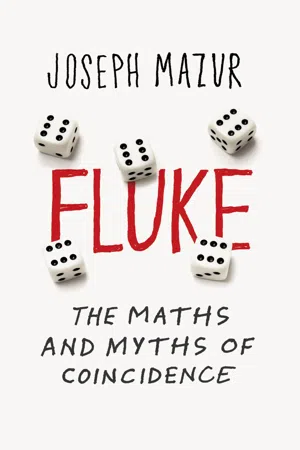
What are the chances?! This exclamation greets the scarcely believable coincidence – you’re picked up by the same taxi driver several years and thousands of miles apart or, in a second-hand bookshop far from home, you find your own childhood copy of Winnie-the-Pooh on the shelf. But the unlikely is more probable than you think. Against every fibre of common sense, the fact is that it’s quite likely that some squirrel, somewhere, will be struck by lightning as it crosses the road.
The chaos and unpredictability of our lives is an illusion. There is a rational order to the universe, and it’s called mathematics. Fluke is a fascinating investigation into the true nature of chance, a must-read for maths enthusiasts and avid storytellers alike, it tears down the veil of improbability to reveal the wonderfully possible.
Frequently asked questions
Yes, you can cancel anytime from the Subscription tab in your account settings on the Perlego website. Your subscription will stay active until the end of your current billing period. Learn how to cancel your subscription.
No, books cannot be downloaded as external files, such as PDFs, for use outside of Perlego. However, you can download books within the Perlego app for offline reading on mobile or tablet. Learn more here.
Perlego offers two plans: Essential and Complete
- Essential is ideal for learners and professionals who enjoy exploring a wide range of subjects. Access the Essential Library with 800,000+ trusted titles and best-sellers across business, personal growth, and the humanities. Includes unlimited reading time and Standard Read Aloud voice.
- Complete: Perfect for advanced learners and researchers needing full, unrestricted access. Unlock 1.4M+ books across hundreds of subjects, including academic and specialized titles. The Complete Plan also includes advanced features like Premium Read Aloud and Research Assistant.
We are an online textbook subscription service, where you can get access to an entire online library for less than the price of a single book per month. With over 1 million books across 1000+ topics, we’ve got you covered! Learn more here.
Look out for the read-aloud symbol on your next book to see if you can listen to it. The read-aloud tool reads text aloud for you, highlighting the text as it is being read. You can pause it, speed it up and slow it down. Learn more here.
Yes! You can use the Perlego app on both iOS or Android devices to read anytime, anywhere — even offline. Perfect for commutes or when you’re on the go.
Please note we cannot support devices running on iOS 13 and Android 7 or earlier. Learn more about using the app.
Yes, you can access Fluke by Joseph Mazur in PDF and/or ePUB format, as well as other popular books in Matemáticas & Matemáticas general. We have over one million books available in our catalogue for you to explore.
Information
Topic
MatemáticasSubtopic
Matemáticas general PART 1
The Stories
Coincidence
It starts as true story,
first wondrous, and rare,
then colossal collisions
of galactic affair
strikes with so much surprise,
we’re confused between thoughts
that it might be just fluke
we believe in a lot,
and what if it’s not.
—J. M.
LIFE IS FILLED with expectancies, to-dos, and benign pleasures, but bewildering encounters and phantasmagorical stories give the blisses of being alive. Here is a browsing of just a few accounts of how our world is both enormous and small, and of how we come to distinguish flukes from coincidences. We shall return to these stories in Part 3, after we have some machinery to illuminate their hidden quantitative elements.
Chapter 1
Exceptional Moments
REMEMBER THAT TIME when you were leisurely strolling along a street in a foreign city, Paris or Mumbai perhaps, and bumped into an old friend you had not seen in a long time? That old friend that you bumped into: what was he doing there in your place and time? Or remember that moment when you wished for something and it happened just as you wished? Or the fluke of hard luck you had when everything went wrong during your holiday because of unfortunate timing? Or that time when you were astonished to meet someone who shared your birthdate? They were times when you must have had a sudden feeling of synchronicity that shrank the universe, an illuminating transformation that magnified your place in the cosmos. You felt part of an enlarged and centred circle of humanity with just a few persons—or perhaps just you—at that centre.
Did you ever pick up a phone to call someone you hadn’t called in a year and, before dialling, hear the person on the line? It happened to me in 1969. Thinking about it, it seems more likely to happen than not. After all, a whole year had gone by—365 days when it didn’t happen. Add to that the number of days the year before, another year when it didn’t happen. And add to that the number of days from then to now. It never happened again. Now we are talking about a serious amount of time when the coincidence did not happen.
Imagine this story. You are sitting in a café in Agios Nikolaos on the island of Crete, when you hear a familiar laugh at a table in a nearby café. You turn to look at the person, a man. You cannot believe that he is your own brother. But there he is, unmistakably your own brother. He turns towards you and he is as surprised as you. It happened to me in 1968. Neither one of us knew that the other was not back home in New York or Boston.
Or imagine this. You are browsing used books in a book shop far from home when you come across a book you remember from your childhood. You open it and find your own inscription. It is a copy of Moby Dick with your own name on the inside cover and your own marginal markings throughout the book. It was a book you had at university. It happened to a friend who told me that he was browsing the shelves of a used book shop in Dubuque, Iowa, a city he had never been to before.1
In 1976 my wife, my two children, and I had been touring through Scotland, when on one snowy day our Vauxhall car broke down in the small town of Penicuik. A mechanic at the only garage in town told us that the problem was our alternator, and that it would be three days before he could replace it. We headed to the nearest pub, hoping to spend the night. The publican was a man of few words, but when we told him that we were from America, he livened up to proudly say, “Next week we will have someone from America coming to sing. You probably know her. I don’t know her name, but there is a poster downstairs.” He brought us to a large poster announcing a stovies night2 concert by Margaret MacArthur.
“Margaret MacArthur!” my wife and I exclaimed simultaneously. “She is our neighbour. We know her very well!”
The publican nodded, and with blank countenance muttered, “Thought you would.”
America is truly a small country.
There are moments when we are struck by magnificent coincidences. They are the foci of nature’s web of associations because, especially in the solitude of this digital age, we want to fit into the intimidating world with a sense of self, an identity, a purpose, and a feeling that some parts of our lives have destinies. Daunted by the chilling vastness of the forever-expanding universe in an endless space and time, it is reassuring to know that we are more connected than we think, or that the universe lines up for us.
With any coincidence story is the question of whether there is something in the universe that perturbed time and place enough to trigger the coincidence and conceal its cause. Some people have questioned whether there are metaphysical connections. Some say that there is oneness in this universe, an energy that we cannot be aware of, a force that changes our patterns of behaviour, a knowing something that we do not know.
Causality is the Western way of interpreting the meaning of events. Nineteenth-century Western causality had a strict classical physics view that the laws of nature govern the movement and interaction of all observable objects. If the variables of the present state are precisely known, then the future is completely predictable. In other words, any predictions of the future are tied to whatever we can know of the past and present. However, by the early twentieth century, with the invention of quantum mechanics, Western philosophy took a radical shift of viewpoint: observable objects are driven by non-observable events of the quantum world, governed by simple, wondrous rules. One such rule claims there are no roads not taken. Every particle is ordered to follow not just one path, but also every possible path with a probability that depends on the path. Predictability, in that quantum mechanics point of view, is limited to probabilities that an object will be somewhere on each path and in a particular state. In other words, careful observation of exactly what happened in the past only gives us uncertain probabilities of what might happen in the future.
Of course, there is always the question of what causes one person to choose a path forwards. We are not talking about the mechanical path of an object. Why did you, dear reader, choose to read this far into this book? You have free will that has almost nothing to do with classical physics, or the path of observable objects, or the new physics. The coincidences of this book are related to decisions that people make, roads taken and those not. Human decisions are a matter of free will, where neither relativity nor quantum mechanics come into play, although there are always other strong external influences. We decide on a path. Someone else decides on a path. Then, bam! The paths meet, and we have no apparent cause. The problem with apparentness is that it requires an observable object travelling on an observable path. So, unless there are brain-wave connections between distinct individuals, free will trumps all quantum influences.
There is also the Eastern way, however. The Chinese, for instance, have their Tao, in which opposites cancel out to make the whole and total picture. In it the nothingness is also part of the whole. A block of stone can become a sculpture defined by the remaining stone and the stone that has been carved away. It is surely a different way of thinking. And still the Tao belief is certainly different from any theology that looks at the world as if everything in the world, from cells of organisms to subatomic particles of minerals, is prearranged from the time of creation, and laws governing causality can be broken only if ratified by God’s will. The Taoist believes that coincidences are in the sympathy of all things, and for that reason all events in the world stand in one relationship beyond any causality and any appearances. In other words, there are no flukes. But that same Taoist also believes that underneath there is a hidden rationality. The revered Tao Te Ching, now some 2,500 years old, tells us:
Heaven’s net is wonderfully vast and enveloping;
Though wide-meshed, nothing slips through.3
Just as all parts of a whole work in harmony to complement one another, so, too, all events in the world stand in one meaningful relationship with the whole, which is in central “meaningful” control.
Walt Whitman also told us that we have some connection to the All, and that there is a moral purpose and intention that we are forced to follow unconsciously. He put it this way:
As within the purposes of the Cosmos, and vivifying all meteorology, and all the congeries of the mineral, vegetable and animal worlds—all the physical growth and development of man, and all the history of the race in politics, religions, wars, &c., there is a moral purpose, a visible or invisible intention, certainly underlying all . . . something that fully satisfies . . . That something is the All, and the idea of All, with the accompanying idea of eternity, and of itself, the soul, buoyant, indestructible, sailing space forever, visiting every region, as a ship the sea.4
Chapter 2
The Girl from Petrovka and
Other Benign Coincidences
What connection can there have been between many people in the innumerable histories of this world, who, from opposite sides of great gulfs, have, nevertheless, been very curiously brought together!
—CHARLES DICKENS, Bleak House1
IF YOU LEAVE your house, a great many encounters and happenings are possible. The probability of each may be small, but when we group them together and ask for the probability that at least one of them will happen, the likelihood goes up. These stories are just ten of many that effectively represent ten characteristic classes. They will be analyzed in Part 3.
Story 1: The Girl from Petrovka
Class: Lost, unlikely to be found, objects accidentally found by someone deliberately looking for them
One of the most celebrated coincidence stories involves actor Anthony Hopkins. After being cast to play the part of Kostya in a movie version of The Girl from Petrovka, Hopkins spent some time searching for the novel in book shops near London’s Leicester Square Underground station. Unsuccessful in his search and about to return home, he noticed a book lying on one of the benches of the same Underground station. It was not just a copy of The Girl from Petrovka, but the lost copy belonging to its author, George Feifer.
It is a truly bewildered story. I should be forced to concede that this one would be so foreign to any reasonable theory of the frequency of coincidences that I should have to congratulate the story for escaping any explanation. But in truth it does not escape analysis. George Feifer told me the true story himself: he had used a copy of the American edition of The Girl from Petrovka to highlight words that required British translations for the UK publication of his book. He submitted his translations to the British publisher and checked them on the copy plates. One day he met a friend in Hyde Park Square and gave the friend his marked-up American edition. In a daze of the moment, the friend put the book on top of his car and, late for an afternoon meeting with a girl, speedily drove off. On seeing Feifer on the movie set, Hopkins told Feifer that he found the book at an Underground station. I wrote to Hopkins for his side of the story. Predictably, he never replied.
Story 2: Jack Frost and Other Stories
Class: Unexpectedly found familiar personal objects not searched for
A comparable story involves writer Anne Parrish. According to the original telling (a story very different from the many floating through cyberspace), while in Paris, after attending Mass at Notre-Dame and visiting the bird market on a sunny June Sunday in 1929, Anne and her husband, industrialist Charles Albert Corliss, stopped at Les Deux Magots for lunch. Leaving Charles alone with his wine, she strolled the bookstalls along the walls of the Seine. It was not unusual for her to spend hours rummaging rows of books on long tables. On that day, she found Helen Wood’s Jack Frost and Other Stories. After a short haggle with the bookseller, she paid one franc, ran to her husband who was still sitting with his wine, excitedly put the book in his hands, and told him that it was one of her favourite books when she was a child. He slowly turned the pages. After a few moments of silence, he handed the book back to her opened at the flyleaf where pencilled “in an ung...
Table of contents
- Cover
- Title
- Copyright
- Contents
- Introduction
- PART 1: THE STORIES
- PART 2: THE MATHEMATICS
- PART 3: THE ANALYSIS
- PART 4: THE HEAD-SCRATCHERS
- Epilogue
- Notes
- Acknowledgements
- Index