
- 192 pages
- English
- ePUB (mobile friendly)
- Available on iOS & Android
eBook - ePub
About this book
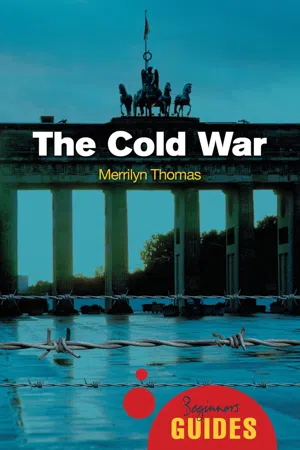
How the modern world was shaped by super power rivalry through deception and propaganda This guide exposes the reality behind the war between capitalism and communism, two ideologies divided by the Iron Curtain. New revelations show that what was once regarded as simply a struggle between good and evil was in fact a far more complex affair. Merrilyn Thomas peels back the layers of deception and intrigue and offers a penetrating assessment of the legacy of instability that continues today.
Frequently asked questions
Yes, you can cancel anytime from the Subscription tab in your account settings on the Perlego website. Your subscription will stay active until the end of your current billing period. Learn how to cancel your subscription.
No, books cannot be downloaded as external files, such as PDFs, for use outside of Perlego. However, you can download books within the Perlego app for offline reading on mobile or tablet. Learn more here.
Perlego offers two plans: Essential and Complete
- Essential is ideal for learners and professionals who enjoy exploring a wide range of subjects. Access the Essential Library with 800,000+ trusted titles and best-sellers across business, personal growth, and the humanities. Includes unlimited reading time and Standard Read Aloud voice.
- Complete: Perfect for advanced learners and researchers needing full, unrestricted access. Unlock 1.4M+ books across hundreds of subjects, including academic and specialized titles. The Complete Plan also includes advanced features like Premium Read Aloud and Research Assistant.
We are an online textbook subscription service, where you can get access to an entire online library for less than the price of a single book per month. With over 1 million books across 1000+ topics, weâve got you covered! Learn more here.
Look out for the read-aloud symbol on your next book to see if you can listen to it. The read-aloud tool reads text aloud for you, highlighting the text as it is being read. You can pause it, speed it up and slow it down. Learn more here.
Yes! You can use the Perlego app on both iOS or Android devices to read anytime, anywhere â even offline. Perfect for commutes or when youâre on the go.
Please note we cannot support devices running on iOS 13 and Android 7 or earlier. Learn more about using the app.
Yes, you can access The Cold War by Merrilyn Thomas in PDF and/or ePUB format, as well as other popular books in History & 20th Century History. We have over one million books available in our catalogue for you to explore.
Information
1
Communism and capitalism
Throughout the centuries the human condition has exercised the worldâs thinkers. Philosophers and philanthropists have sought to find ways of creating a better society. During the twentieth century, the ideal which dominated much of the world was of a society where all were free and equal, where no one was oppressed, and where everyone had everything they needed. It is possible to criticise this ideal as being hopelessly utopian but it does not appear to bear the hallmark of wickedness. Yet much of the last century was spent in a global struggle between those who purported to be the advocates of such an ideal and those who saw the doctrine behind it not only as a threat to existence but frequently as an evil. The utopian world was the world of communism; an integral part of the ideal was the annihilation of capitalism, the economic system which governs most of the globe, albeit somewhat shakily.
Communism, whether in theory or practice, dominates the history of the twentieth century. Its story is one not only of revolutions, wars and persecution but also of idealism and crusade. Human baseness and brutality mingle with heroism and sacrifice. During the 1930s, for example, thousands joined the International Brigades and went to their deaths in Spain in a civil war which was not their own because they believed in the cause. Thousands more perished during the same decade as a result of Stalinâs purges.
Based on the nineteenth-century writings of the German philosopher Karl Marx, communismâs first national power base was Russia. During the Russian Revolution of 1917, the monarchy was overthrown and a communist state established under Leninâs leadership. The USSR (Union of Soviet Socialist Republics) emerged from Imperial Russia in 1922. Russiaâs new revolutionary leaders faced hostility from Europe and the USA from the outset. They supported the counter-revolutionary forces, known as the White Russians. Winston Churchill in particular, at that time British Secretary of State for War, was vehemently opposed to Lenin and his comrades, known as the Bolsheviks, and advocated strong action against them. A Franco-British force landed in the Russian Arctic port of Murmansk in 1918 and occupied it for about two years. Civil war between the Whites and the Red Army lasted for nearly three years in the regions around Russiaâs borders. Britain recognised the Soviet regime in 1924; the USA did not do so until 1933. America warned that the Bolsheviks were a threat to social order in nearly every European country.
When, in 1918, the worldâs leaders met in Paris to draw up peace terms at the end of the First World War, it was the threat of Bolshevism spreading from the east rather than the fate of defeated Germany which was uppermost in many minds. Despite the fact that Russia had fought with Britain, France and the USA against Germany, Lenin and his comrades were excluded from the peace conference which devoted much of its time to devising ways either of destroying his revolution or preventing its spread.1
Three empires had collapsed by the end of the First World War â Russian, Turkish and AustroâHungarian. With the map of Europe in tatters, one solution to the communist threat was to establish a cordon sanitaire of small independent nations in Eastern Europe, to isolate communism from capitalism. The new states were formed from the imperial remnants. But three decades later, as the Soviet army swept across Europe in the final months of the war against Hitler, these vulnerable nations fell under Russian influence. By 1945, they looked more like bridgeheads for communism than protection against the red peril. The Russian army stopped at the Elbe. The Iron Curtain descended roughly along that line.
As the century progressed, communism spread from Europe to all corners of the globe. China, the most populous nation in the world, became a communist state. Many other Asian nations followed suit. Latin American and African leaders declared themselves to be communist, although Lenin might not have recognised them as such. In addition, communist parties were established and sometimes flourished in almost every country in the world, including Western European countries. Yet, come the millennium, the communist experiment seemed to be over. During the 1990s, communist states collapsed like a pack of cards, a mere handful remaining to fly the ragged red flag by the end of the century.
Surely the big question about communism is what went wrong. Why did it fail? How was it that a humanistic doctrine became a Stalinist or Maoist tyranny?
Communism: the great fantasy
Many millions of words have been written in attempts to explain Marxism and communism since Marx first penned his brief Manifesto of the Communist Party in 1848.2 Many millions have died fighting in the name of Marxism or communism. A significant number of these adherents have been killed, not by the opposition, but by others also claiming to be true Marxists or communists. So what is this creed which gripped and divided the world during the twentieth century and which remains, for some, a tyrannical abuse of humankind and, for others, the ultimate ideal?
There are two things that most commentators seem to have agreed upon over the decades: Marxism is not the same as communism, and Marxism itself is a matter of interpretation. âThere is scarcely any question relating to the interpretation of Marxism that is not a matter of disputeâ, according to one of the worldâs foremost experts on Marxism, the Polish Ă©migrĂ© historian Leszek Kolakowski. His three-volume work on Marxism, in which he endeavoured to record the âprincipal controversiesâ, is regarded as one of the most influential books of the second half of the twentieth century.3 His oft quoted conclusion was that Marxism was âthe greatest fantasyâ of the century. âIt was a dream offering the prospect of a society of perfect unity, in which all human aspirations would be fulfilled and all values reconciled.â4
For those coming new to Marxism, the best introduction is a reading of the philosopherâs own words on the subject contained in his brief Manifesto. First published in 1848, a time of revolution throughout Europe, it was a rallying cry to the dispossessed. Marx, the son of a prosperous middle class Jewish family, was banned from Germany and France because of his subversive activities and finally settled in London.5 Much of what Marx wrote in his Manifesto has a contemporary ring. He foresaw the rise of the global economy. Indeed, for him it had already happened. The industrial revolution, the huge increase in trade resulting from colonisation and the resulting rise of the bourgeoisie had all served to create world markets and an international conformity. They had also created the proletariat and the bourgeoisie whose only bond, according to Marx, was the ânaked self-interestâ of the bourgeoisie, owners of the capital with which the proletariat was exploited. But the bourgeoisie also sowed the seeds of its own destruction. Ultimately it would be destroyed by the working class that it had created.
The concept of inevitability in history is a crucial factor in Marxist theory. Marx claimed to have formulated a scientific theory by which man could know the future course of events. It was not possible to say, for example, when the revolution of the proletariat would happen, but it was possible to know that it inevitably would. This rigid belief in the eventual demise of capitalism made zealots of committed communists. Even in the direst of circumstances, the certainty of victory gave them strength. Communism, for some, resembled a religious faith with the added virtue that it could be scientifically proven. One theory to explain the collapse of communism is that, for a variety of reasons, this absolute belief weakened during the 1980s until there was no longer anything left to fight for.6
The distinguishing feature of communism, according to Marx, was the abolition of private property. Marx realised that this radical move was likely to meet stiff opposition, not just from the bourgeoisie at whom it was aimed but also from peasant farmers and small traders. He dealt with the problem in his Manifesto arguing that there was no need to destroy the latter type of property because it was in any case being destroyed by industrial development. âCommunism deprives no man of the power to appropriate the products of society; all that it does is to deprive him of the power to subjugate the labour of others by means of such appropriationâ, Marx claimed.7
Marxism provided the âideological traditionâ on which communism was based.8 Communism itself came in many forms. There was Marxism, Marxism-Leninism, Stalinism, and Maoism, to name but a few variations. Chinese Marxism, for example, wove Confucian philosophy into its tapestry during the twentieth century. In the twenty-first century it has also adopted its own version of capitalism. Latin American Marxists tended to focus on the economic exploitation of their countries by foreign powers rather than the home-grown bourgeoisie.
And then there is socialism. It is necessary, according to Marx, to go through a transitional stage between capitalism and communism and that stage is known as socialism. Communism is a higher form of socialism. During the transitional stage, the means of production are gathered into the hands of the state but the capitalist system continues. Some socialist parties never go beyond this stage. Many countries, as for example Sweden, practise a successful form of socialist welfare combined with capitalism. The use of the word âsocialistâ to describe a political party or a government can be confusing as it can mean both one operating within the capitalist system or one which is on the road to communism. Many communist countries claimed to be âsocialistâ and the word appeared in the official name of the Soviet Union.
Essentially, the Marxist proposition that the âhistory of all hitherto existing society is the history of class struggleâ and that the proletariat would inevitably take control throughout the world was central to communist dogma.9 Once the proletariat had taken over, various measures would need to be introduced, Marx decreed. All âinstruments of productionâ would be placed in the hands of the state and all capital removed from the bourgeoisie. Initially the reorganisation of society would demand some âdespoticâ measures, but once all production had been concentrated in the hands of the nation, public power would lose its political character. The state itself would wither away. For, as Marx put it: âIn place of the old bourgeois society, with its classes and class antagonisms, we shall have an association, in which the free development of each is the condition for the free development of all.â10
Marxâs recipe for post-revolutionary society was followed on the whole by communist regimes. The problem was things did not follow the pattern that Marx had predicted. For example, those living under communism during the twentieth century found it more difficult to resolve the issue of private property than Marx had anticipated. Small farmers proved particularly resilient to the idea of losing their land. In many countries sweeping land reforms had to be watered down to prevent starvation. Even the East German leader, Walter Ulbricht, a committed communist and considered by many to be ultra Stalinist, dared to introduce economic reforms in the 1960s which borrowed from capitalism. Faced with the all too visible economic miracle of West Germany, Ulbricht saw that it was necessary to make his workersâ and peasantsâ state a more attractive place in which to live if his citizens were not to abandon the country for the bright lights of capitalism.11 His heretical proposals, which spoke of profit and markets, were short lived, doomed to failure under pressure from the rigid orthodoxy of the Kremlin. Attempts by other Soviet bloc countries to liberalise their failing economies suffered similar fates.
Most importantly, the state did not wither away as Marx had predicted; it tended to become increasingly powerful and all-pervading. Kolakowski is not alone in asking how it was that this âidea which began in Promethean humanism ... culminated in the monstrous tyranny of Stalin.â One of the answers is that Marx was wrong to think that once private property had been removed, âhuman interest would cease to be in conflictâ.
Other commentators have taken a more critical view of Marxism. The historian Richard Pipes, a US presidential adviser during the 1980s, sees no good in Marxism at all. His bald assessment is that âCommunism was not a good idea that went wrong; it was a bad ideaâ. Acquisitiveness is a powerful human characteristic. Communism could not refashion human nature. That is why it had to resort to coercion and violence in order to make people give up their private property. Communism, in Pipesâ view, âis a pseudoscience converted into a pseudoreligion and embodied in an inflexible political regimeâ.12 The only solution to the worldâs problems is the free market; in other words, capitalism.
Capitalism: the consumersâ creed
Capitalism is not, on the whole, a rallying cry. Passions can be raised by demands for âfreedomâ or âdemocracyâ. Not many have taken to the streets on behalf of capitalism. And yet it is capitalism which has routed Marxâs cry â âWorking men of all countries, unite!â13
Perhaps the simplest way of differentiating capitalism from communism is to ask the question: who or what rules? The short answer for communism is the proletariat; the short answer for capitalism is the market. One of the first to expound on the concept of the free market was the Scottish political economist Adam Smith in the eighteenth century. He was an advocate of free trade at a time when, in Britain, the movement of goods was strictly regulated. His study of the development of industry and commerce in Europe, The Wealth of Nations, is regarded as a classic. In it, Smith argued that, if people were set free to better themselves, it would in fact benefit the whole of society.
At the start of the twentieth century, the German political economist, Max Weber, attempted to capture the essence of capitalism in his book, The Protestant Ethic and the Spirit of Capitalism. Weber argued that the desire to accumulate wealth in order to acquire that which it can buy was an age old human ambition and not related to the concept of capitalism. What makes capitalism as practised in the West different is that the aim is to acquire wealth in order to invest it and in turn produce more wealth. This goal has its roots in the Protestant faith, Weber said. Those who use their money to buy fast cars and lavish lifestyles would not, according to Weber, be capitalists. Those who invest their money to expand their businesses, would be. In his words:
Unlimited greed for gain is not in the least identical with capitalism, and is still less its spirit. Capitalism may even be identical with the restraint, or at least a rational tempering, of this irrational impulse. But capitalism is identical with the pursuit of profit, and forever renewed profit, by means of continuous, rational, capitalistic enterprise. For it must be so: in a wholly capitalistic order of society, an individual capitalistic enterprise which did not take advantage of its opportunities for profit-making would be doomed to extinction.14
About forty years later, an Austrian political scientist, Joseph Schumpeter, attempted to tackle the vexed question of capitalism. His study, Capitalism, Socialism and Democracy, which examined the relationship between the political system of democracy and the economic systems of socialism and capitalism, opened up a new debate.15 Writing during the Second World War and with the memory of the Great Depression still strong, Schumpeter argued that socialism and democracy were not incompatible and that capitalism would eventually give way to socialism.
Looked at from the perspective of the twenty-first century, Schumpeter seems to have been wrong. With the ending of the Cold War, not only was capitalism victorious but also a consensus was established that capitalism and democracy are inextricably linked. According to a study conducted in the early part of the 1990s, in which a number of leading scholars re-examined Schumpeterâs arguments, this link was forged at the end of the Cold War.16 The contributors to the study were asked to examine the validity of the per...
Table of contents
- Cover
- Title page
- Copyright page
- Dedication page
- Contents
- Introduction
- 1 Communism and capitalism
- 2 Propaganda, plots and bombs
- 3 The freeze: from the Second World War to the division of Europe
- 4 The thaw: détente in Europe
- 5 Confrontation: the end of the Cold War in Europe
- 6 Cuba and Latin America
- 7 Asia
- 8 The Middle East
- 9 Africa
- Conclusion: echoes of the Cold War
- Chronology
- Notes
- Bibliography
- Index