- 184 pages
- English
- ePUB (mobile friendly)
- Available on iOS & Android
eBook - ePub
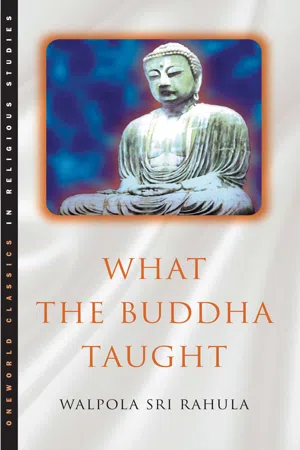
What the Buddha Taught
About this book
'By far the best introduction to Buddhism available.' R. F. Gombrich, Boden Professor of Sanskrit, University of Oxford
Long regarded as one of the best introductions to Buddhism, What the Buddha Taught draws on the actual words spoken by the Buddha to give a lucid and accurate account of the fundamental principles of Buddhist doctrine. Richly supported by extracts from the ancient texts, Walpola Rahula gives clear and direct explanations of Buddhism’s essential teachings, including:
This clear and informative guide draws on the words spoken by the Buddha to convey the true nature of Buddhist wisdom. It also features an illustrative section of texts from the Suttas and the Dhammapada, a glossary of Buddhist terms and an up-to-date bibliography.
Long regarded as one of the best introductions to Buddhism, What the Buddha Taught draws on the actual words spoken by the Buddha to give a lucid and accurate account of the fundamental principles of Buddhist doctrine. Richly supported by extracts from the ancient texts, Walpola Rahula gives clear and direct explanations of Buddhism’s essential teachings, including:
- The Buddhist attitude of mind
- The Four Noble Truths
- The Noble Eightfold Path
- Meditation and mental development
- What the Buddha taught and the world today
This clear and informative guide draws on the words spoken by the Buddha to convey the true nature of Buddhist wisdom. It also features an illustrative section of texts from the Suttas and the Dhammapada, a glossary of Buddhist terms and an up-to-date bibliography.
Frequently asked questions
Yes, you can cancel anytime from the Subscription tab in your account settings on the Perlego website. Your subscription will stay active until the end of your current billing period. Learn how to cancel your subscription.
No, books cannot be downloaded as external files, such as PDFs, for use outside of Perlego. However, you can download books within the Perlego app for offline reading on mobile or tablet. Learn more here.
Perlego offers two plans: Essential and Complete
- Essential is ideal for learners and professionals who enjoy exploring a wide range of subjects. Access the Essential Library with 800,000+ trusted titles and best-sellers across business, personal growth, and the humanities. Includes unlimited reading time and Standard Read Aloud voice.
- Complete: Perfect for advanced learners and researchers needing full, unrestricted access. Unlock 1.4M+ books across hundreds of subjects, including academic and specialized titles. The Complete Plan also includes advanced features like Premium Read Aloud and Research Assistant.
We are an online textbook subscription service, where you can get access to an entire online library for less than the price of a single book per month. With over 1 million books across 1000+ topics, weāve got you covered! Learn more here.
Look out for the read-aloud symbol on your next book to see if you can listen to it. The read-aloud tool reads text aloud for you, highlighting the text as it is being read. You can pause it, speed it up and slow it down. Learn more here.
Yes! You can use the Perlego app on both iOS or Android devices to read anytime, anywhere ā even offline. Perfect for commutes or when youāre on the go.
Please note we cannot support devices running on iOS 13 and Android 7 or earlier. Learn more about using the app.
Yes, you can access What the Buddha Taught by Walpola Rahula in PDF and/or ePUB format, as well as other popular books in Theology & Religion & Asian Religions. We have over one million books available in our catalogue for you to explore.
Information
Topic
Theology & ReligionSubtopic
Asian ReligionsCHAPTER I
THE BUDDHIST ATTITUDE OF MIND
Among the founders of religions the Buddha (if we are permitted to call him the founder of a religion in the popular sense of the term) was the only teacher who did not claim to be other than a human being, pure and simple. Other teachers were either God, or his incarnations in different forms, or inspired by him. The Buddha was not only a human being; he claimed no inspiration from any god or external power either. He attributed all his realization, attainments and achievements to human endeavour and human intelligence. A man and only a man can become a Buddha. Every man has within himself the potentiality of becoming a Buddha, if he so wills it and endeavours. We can call the Buddha a man par excellence. He was so perfect in his āhuman-nessā that he came to be regarded later in popular religion almost as āsuper-humanā.
Manās position, according to Buddhism, is supreme. Man is his own master, and there is no higher being or power that sits in judgment over his destiny.
āOne is oneās own refuge, who else could be the refuge?ā1 said the Buddha. He admonished his disciples to ābe a refuge to themselvesā, and never to seek refuge in or help from anybody else.2 He taught, encouraged and stimulated each person to develop himself and to work out his own emancipation, for man has the power to liberate himself from all bondage through his own personal effort and intelligence. The Buddha says: āYou should do your work, for the TathÄgatas3 only teach the way.ā4 If the Buddha is to be called a āsaviourā at all, it is only in the sense that he discovered and showed the Path to Liberation, NirvÄna. But we must tread the Path ourselves.
It is on this principle of individual responsibility that the Buddha allows freedom to his disciples. In the MahÄparinibbÄna-sutta the Buddha says that he never thought of controlling the Sangha (Order of Monks)5, nor did he want the Sangha to depend on him. He said that there was no esoteric doctrine in his teaching, nothing hidden in the āclosed-fist of the teacherā (Äcariya-mutthi), or to put it in other words, there never was anything āup his sleeveā.6
The freedom of thought allowed by the Buddha is unheard of elsewhere in the history of religions. This freedom is necessary because, according to the Buddha, manās emancipation depends on his own realization of Truth, and not on the benevolent grace of a god or any external power as a reward for his obedient good behaviour.
The Buddha once visited a small town called Kesaputta in the kingdom of Kosala. The inhabitants of this town were known by the common name KÄlÄma. When they heard that the Buddha was in their town, the KÄlÄmas paid him a visit, and told him:
āSir, there are some recluses and brÄhmaį¹as who visit Kesaputta. They explain and illumine only their own doctrines, and despise, condemn and spurn othersā doctrines. Then come other recluses and brÄhmaį¹as, and they, too, in their turn, explain and illumine only their own doctrines, and despise, condemn and spurn othersā doctrines. But, for us, Sir, we have always doubt and perplexity as to who among these venerable recluses and brÄhmaį¹as spoke the truth, and who spoke falsehood.ā
Then the Buddha gave them this advice, unique in the history of religions:
āYes, KÄlÄmas, it is proper that you have doubt, that you have perplexity, for a doubt has arisen in a matter which is doubtful. Now, look you KÄlÄmas, do not be led by reports, or tradition, or hearsay. Be not led by the authority of religious texts, nor by mere logic or inference, nor by considering appearances, nor by the delight in speculative opinions, nor by seeming possibilities, nor by the idea: āthis is our teacherā. But, O KÄlÄmas, when you know for yourselves that certain things are unwholesome (akusala), and wrong, and bad, then give them up . . . And when you know for yourselves that certain things are wholesome (kusala) and good, then accept them and follow them.ā7
The Buddha went even further. He told the bhikkhus that a disciple should examine even the TathÄgata (Buddha) himself, so that he (the disciple) might be fully convinced of the true value of the teacher whom he followed.8
According to the Buddhaās teaching, doubt (vicikicchÄ) is one of the five Hindrances (nivaraį¹a)9 to the clear understanding of Truth and to spiritual progress (or for that matter to any progress). Doubt, however, is not a āsinā, because there are no articles of faith in Buddhism. In fact there is no āsinā in Buddhism, as sin is understood in some religions. The root of all evil is ignorance (avijjÄ) and false views (micchÄ diṣṣhi). It is an undeniable fact that as long as there is doubt, perplexity, wavering, no progress is possible. It is also equally undeniable that there must be doubt as long as one does not understand or see clearly. But in order to progress further it is absolutely necessary to get rid of doubt. To get rid of doubt one has to see clearly.
There is no point in saying that one should not doubt or one should believe. Just to say āI believeā does not mean that you understand and see. When a student works on a mathematical problem, he comes to a stage beyond which he does not know how to proceed, and where he is in doubt and perplexity. As long as he has this doubt, he cannot proceed. If he wants to proceed, he must resolve this doubt. And there are ways of resolving that doubt. Just to say āI believeā, or āI do not doubtā will certainly not solve the problem. To force oneself to believe and to accept a thing without understanding is political, and not spiritual or intellectual.
The Buddha was always eager to dispel doubt. Even just a few minutes before his death, he requested his disciples several times to ask him if they had any doubts about his teaching, and not to feel sorry later that they could not clear those doubts. But the disciples were silent. What he said then was touching: āIf it is through respect for the Teacher that you do not ask anything, let even one of you inform his friendā (i.e., let one tell his friend so that the latter may ask the question on the otherās behalf).10
Not only the freedom of thought, but also the tolerance allowed by the Buddha is astonishing to the student of the history of religions. Once in NÄlandÄ a prominent and wealthy householder named UpÄli, a well-known lay disciple of Nigaį¹į¹£ha NÄtaputta (Jaina MahÄvira), was expressly sent by MahÄvira himself to meet the Buddha and defeat him in argument on certain points in the theory of Karma, because the Buddhaās views on the subject were different from those of MahÄvira.11 Quite contrary to expectations, UpÄli, at the end of the discussion, was convinced that the views of the Buddha were right and those of his master were wrong. So he begged the Buddha to accept him as one of his lay disciples (UpÄsaka). But the Buddha asked him to reconsider it, and not to be in a hurry, for āconsidering carefully is good for well-known men like youā. When UpÄli expressed his desire again, the Buddha requested him to continue to respect and support his old religious teachers as he used to.12
In the third century B.C., the great Buddhist Emperor Asoka of India, following this noble example of tolerance and understanding, honoured and supported all other religions in his vast empire. In one of his Edicts carved on rock, the original of which one may read even today, the Emperor declared:
āOne should not honour only oneās own religion and condemn the religions of others, but one should honour othersā religions for this or that reason. So doing, one helps oneās own religion to grow and renders service to the religions of others too. In acting otherwise one digs the grave of oneās own religion and also does harm to other religions. Whosoever honours his own religion and condemns other religions, does so indeed through devotion to his own religion, thinking āI will glorify my own religionā. But on the contrary, in so doing he injures his own religion more gravely. So concord is good: Let all listen, and be willing to listen to the doctrines professed by othersā.13
We should add here that this spirit of sympathetic understanding should be applied today not only in the matter of religious doctrine, but elsewhere as well.
This spirit of tolerance and understanding has been from the beginning one of the most cherished ideals of Buddhist culture and civilization. That is why there is not a single example of persecution or the shedding of a drop of blood in converting people to Buddhism, or in its propagation during its long history of 2500 years. It spread peacefully all over the continent of Asia, having more than 500 million adherents today. Violence in any form, under any pretext whatsoever, is absolutely against the teaching of the Buddha.
The question has often been asked: Is Buddhism a religion or a philosophy? It does not matter what you call it. Buddhism remains what it is whatever label you may put on it. The label is immaterial. Even the label āBuddhismā which we give to the teaching of the Buddha is of little importance. The name one gives it is inessential.
Whatās in a name? That which we call a rose,
By any other name would smell as sweet.
In the same way Truth needs no label: it is neither Buddhist, Christian, Hindu nor Moslem. It is not the monopoly of anybody. Sectarian labels are a hindrance to the independent understanding of Truth, and they produce harmful prejudices in menās minds.
This is true not only in intellectual and spiritual matters, but also in human relations. When, for instance, we meet a man, we do not look on him as a human being, but we put a label on him, such as English, French, German, American, or Jew, and regard him with all the prejudices associated with that label in our mind. Yet he may be completely free from those attributes which we have put on him.
People are so fond of discriminative labels that they even go to the length of putting them on human qualities and emotions common to all. So they talk of different ābrandsā of charity, as for example, of Buddhist charity or Christian charity, and look down upon othe...
Table of contents
- Cover
- Title
- Copyright
- Contents
- List of Illustrations
- Foreword
- Preface
- The Buddha
- Chapter I ā The Buddhist Attitude of Mind
- Chapter II ā The First Noble Truth: Dukkha
- Chapter III ā The Second Noble Truth: Samudaya:
- Chapter IV ā The Third Noble Truth: Nirodha:
- Chapter V ā The Fourth Noble Truth: Magga: āThe Pathā
- Chapter VI ā The Doctrine of No-Soul: Anatta
- Chapter VII ā āMeditationā or Mental Culture:
- Chapter VIII ā What the Buddha Taught and the World Today
- Selected Texts
- Abbreviations
- Selected Bibliography
- Glossary
- Index