In the Kingdom of Ice
eBook - ePub

In the Kingdom of Ice

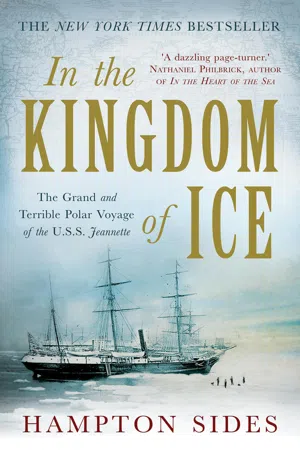
The Grand and Terrible Polar Voyage of the USS Jeannette

  1. 999 pages
  2. English
  3. ePUB (mobile friendly)
  4. Available on iOS & Android
eBook - ePub

In the Kingdom of Ice

The Grand and Terrible Polar Voyage of the USS Jeannette

About this book

A harrowing tale of courage and sacrifice at the limits of human endurance

‘A stirring story… a brilliant exposition of narrative non-fiction: moving, harrowing, as gripping as any well-paced thriller.’ The Times

The age of exploration was drawing to a close, yet the mystery of the North Pole remained. Contemporaries described the pole as the ‘unattainable object of our dreams’, and the urge to fill in this last great blank space on the map grew irresistible. In 1879 the USS Jeannette set sail from San Francisco to cheering crowds and amid a frenzy of publicity. The ship and its crew, captained by the heroic George De Long, were destined for the uncharted waters of the Arctic.

But it wasn’t long before the Jeannette was trapped in crushing pack ice. Amid the rush of water and the shrieks of breaking wooden boards, the crew found themselves marooned a thousand miles north of Siberia with only the barest supplies, facing a seemingly impossible trek across endless ice. Battling everything from snow blindness and polar bears to ferocious storms and frosty labyrinths, the expedition fought madness and starvation as they desperately strove for survival.
Frequently asked questions

Yes, you can cancel anytime from the Subscription tab in your account settings on the Perlego website. Your subscription will stay active until the end of your current billing period. Learn how to cancel your subscription.
No, books cannot be downloaded as external files, such as PDFs, for use outside of Perlego. However, you can download books within the Perlego app for offline reading on mobile or tablet. Learn more here.
Perlego offers two plans: Essential and Complete
  • Essential is ideal for learners and professionals who enjoy exploring a wide range of subjects. Access the Essential Library with 800,000+ trusted titles and best-sellers across business, personal growth, and the humanities. Includes unlimited reading time and Standard Read Aloud voice.
  • Complete: Perfect for advanced learners and researchers needing full, unrestricted access. Unlock 1.4M+ books across hundreds of subjects, including academic and specialized titles. The Complete Plan also includes advanced features like Premium Read Aloud and Research Assistant.
Both plans are available with monthly, semester, or annual billing cycles.
We are an online textbook subscription service, where you can get access to an entire online library for less than the price of a single book per month. With over 1 million books across 1000+ topics, we’ve got you covered! Learn more here.
Look out for the read-aloud symbol on your next book to see if you can listen to it. The read-aloud tool reads text aloud for you, highlighting the text as it is being read. You can pause it, speed it up and slow it down. Learn more here.
Yes! You can use the Perlego app on both iOS or Android devices to read anytime, anywhere — even offline. Perfect for commutes or when you’re on the go.
Please note we cannot support devices running on iOS 13 and Android 7 or earlier. Learn more about using the app.
Yes, you can access In the Kingdom of Ice by Hampton Sides in PDF and/or ePUB format, as well as other popular books in History & Historical Biographies. We have over one million books available in our catalogue for you to explore.

Information

Image
Image

1 ¡ A SHOCKING SABBATH CARNIVAL OF DEATH

Close to midnight on the evening of Sunday, November 8, 1874, as the early edition of the next day’s New York Herald was being born, the gaslit building at the corner of Broadway and Ann Street bustled. The telegraph machines hammered away, the press platens churned, the setting room clinked with the frenetic rearranging of movable metal type, the copy editors clamored for last-minute changes—and outside, in the cool autumn air, the crews of deliverymen pulled up to the freight docks with their dray horses and wagons, waiting to load the hemp-tied bundles and carry them to every precinct of the slumbering city.
Following routine, the night editor had the draft edition of the paper brought up to the publisher for his approval. This was no mean feat: The proprietor of the New York Herald could be a tyrannical micromanager, and he wielded his blue pencil like a bowie knife, often scribbling barely legible comments that trailed along the margins and then off the page. After his usual wine-drenched dinner at Delmonico’s, he would return to his office to drink pots of coffee and torment his staff until the paper was finally put to bed. The editors dreaded his tirades and expected him to demand, well into the wee hours, that they rip up the entire layout and start over again.
JAMES GORDON BENNETT JR. was a tall, thin, regal man of thirty-two years with a trim mustache and fine tapering hands. His blue-gray eyes seemed cold and imperious, yet they also carried glints of mischief. He wore impeccable French suits and dress shoes of supple Italian leather. To facilitate his long, if erratic, work hours, he kept a bed in his penthouse office, where he liked to snatch an early-morning nap.
By most reckonings, Bennett was the third-richest man in New York City, with an assured annual income just behind those of William B. Astor and Cornelius Vanderbilt. Bennett was not only the publisher but also the editor in chief and sole owner of the Herald, probably the largest and most influential newspaper in the world. He had inherited the paper from his father, James Gordon Bennett Sr. The Herald had a reputation for being as entertaining as it was informative, its pages suffused with its owner’s sly sense of humor. But its pages were also packed with news; Bennett outspent all other papers to get the latest reports via telegraph and the transatlantic cable. For the newspaper’s longer feature stories, Bennett did whatever was necessary to acquire the talents of the biggest names in American letters—writers like Mark Twain, Stephen Crane, and Walt Whitman.
Bennett was also one of New York’s more flamboyant bachelors, known for affairs with burlesque stars and drunken sprees in Newport. He was a member of the Union Club and an avid sportsman. Eight years earlier, he had won the first transatlantic yacht race. He would play an instrumental role in bringing the sport of polo to the United States, as well as competitive bicycling and competitive ballooning. In 1871, at the age of twenty-nine, Bennett had become the youngest commodore in the history of the New York Yacht Club—a post he still held.
The Commodore, as everyone called Bennett, was known for racing fleet horses as well as sleek boats. Late at night, sometimes fueled with brandy, he would take out his four-in-hand carriage and careen wild-eyed down the moonlit turnpikes around Manhattan. Alert bystanders tended to be both puzzled and shocked by these nocturnal escapades, for Bennett nearly always raced in the nude.
JAMES GORDON BENNETT’S most original contribution to modern journalism could be found in his notion that a newspaper should not merely report stories; it should create them. Editors should not only cover the news, he felt; they should orchestrate large-scale public dramas that stir emotions and get people talking. As one historian of American journalism later put it, Bennett had the “ability to seize upon dormant situations and bring them to life.” It was Bennett who, in 1870, had sent Henry Stanley to find the missionary-explorer David Livingstone in remote Africa. Never mind that Livingstone had not exactly needed finding. The dispatches Stanley had sent back to the Herald in 1872 had caused an international sensation—one that Bennett was forever seeking to re-create.
Critics scoffed that these exclusives were merely “stunts,” and perhaps they were. But Bennett had a conviction that a first-rate reporter, if turned loose on the world to pursue some human mystery or solve some geographical puzzle, would invariably come back with interesting stories that would sell papers and extend knowledge at the same time. Bennett was willing to spend profligately to get these kinds of articles into his paper on a routine basis. His paper was many things, but it was rarely dull.
Now, on this early November morning, the Herald’s night editor must have been cringing as he had the still-warm draft of the first edition sent to his mercurial boss. The Herald contained a lead story that, if executed properly, was guaranteed to cause the kind of stir Gordon Bennett delighted in. It was one of the most incredible and tragic news exclusives that had ever run in the Herald’s pages. The story was headlined “A Shocking Sabbath Carnival of Death.”
The Commodore scanned the paper and began to take in the horrifying details: Late that Sunday afternoon, right around closing time at the zoo in the middle of Central Park, a rhinoceros had managed to escape from its cage. It had then rampaged through the grounds, killing one of its keepers—goring him almost beyond recognition. Other zookeepers, who had been in the midst of feeding the animals, had rushed to the scene, and somehow in the confusion, a succession of carnivorous beasts—including a polar bear, a panther, a Numidian lion, several hyenas, and a Bengal tiger—had slipped from their pens. What happened next made for difficult reading. The animals, some of which had first attacked each other, had then turned on nearby pedestrians who happened to be strolling through Central Park. People had been trampled, mauled, dismembered—and worse.
The Herald reporters had diligently captured every detail: How the panther was seen crouching over a man’s body, “gnawing horribly at his head.” How the African lioness, after “saturating herself in the blood” of several victims, had been shot by a party of Swedish immigrants. How the rhino had killed a seamstress named Annie Thomas and had then run north, only to stumble to its death in the bowels of a deep sewer excavation. How the polar bear had maimed and killed two men before tramping off toward Central Park’s upper reservoir. How, at Bellevue Hospital, the doctors were “kept busy dressing the fearful wounds” and found it “necessary to perform a number of amputations . . . One young girl is said to have died under the knife.”
At press time, many of the escaped animals were still at large, prompting Mayor William Havemeyer to issue a proclamation that called for a rigid curfew until “the peril” had subsided. “The hospitals are full of the wounded,” the Herald reported. “The park, from end to end, is marked with injury, and in its artificial forests the wild beasts lurk, to pounce at any moment on the unwary pedestrians.”
Bennett did not break out his blue pencil. For once, he had no changes to suggest. He is said to have leaned back among his pillows and “groaned” at this remarkable story.
THE HERALD REPORT was written in an even tone. Its authors had peppered it with intimate details and filled the roster of victims with the names of real, in some cases quite prominent, New Yorkers. But the story was entirely a hoax. With Bennett’s enthusiastic encouragement, the editors had concocted the tale to demonstrate that the city had no evacuation plan in the event of a large-scale emergency—and also to point out that many of the cages at the Central Park Zoo were flimsy and in bad need of repair. The outmoded Central Park menagerie, the editors later noted, was a far cry from the state-of-the-art zoo at the Jardin des Plantes in Paris. It was time for New York City to rise to the level of a world-class city, and for the nation, whose one hundredth birthday was approaching in just over a year and a half, to have at least one world-class park to display the planet’s wildest creatures.
Lest anyone say that the Herald had deceived its readers, the editors had covered their bases. Anyone who’d read “A Shocking Sabbath Carnival of Death” to its end (buried discreetly in the back pages) would have found the following disclaimer: “Of course, the entire story given above is a pure fabrication. Not one word of it is true.” Still, the paper contended, the city fathers had devoted no thought to what might happen in an authentic emergency. “How is New York prepared to meet such a catastrophe?” the Herald asked. “From causes quite as insignificant the greatest calamities of history have sprung.”
Bennett knew from experience that very few New Yorkers would bother to read the article all the way to its conclusion, and he was right. That morning, as the usual clouds of anthracite coal fumes began to rise over the stirring city, people turned to their morning papers—and were plunged in chaos and confusion. Alarmed citizens made for the city’s piers in hopes of escaping by small boat or ferry. Many thousands of people, heeding the mayor’s “proclamation,” stayed inside all day, awaiting word that the crisis had passed. Still others loaded their rifles and marched into the park to hunt for rogue animals.
It should have been immediately apparent to even the most naĂŻve reader that the piece was a spoof. But this was a more credulous era, a time before radio and telephones and rapid transit, when city dwellers got their information mainly from the papers and often found it hard to tease rumor from truth.
Later editions took the story even further. Now the Herald reported that the governor of New York himself, a Civil War hero named John Adams Dix, had marched into the streets and shot the Bengal tiger as a personal trophy. A much-expanded list detailed other animals that had escaped from the zoo, including a tapir, an anaconda, a wallaby, a gazelle, two capuchin monkeys, a white-haired porcupine, and four Syrian sheep. A grizzly bear had entered the St. Thomas Church on Fifth Avenue, and there, in the center aisle, it “sprang upon the shoulders of an aged lady, and buried his fangs in her neck.”
The editors of rival newspapers were thoroughly perplexed. It was not the first time the Herald had scooped them, but why had their reporters failed to glean even an inkling of this obviously momentous event? The city editor of the New York Times stormed over to police headquarters on Mulberry Street to scold the department for feeding the story to the Herald while ignoring his esteemed paper. Even some staffers of the Herald fell for the prank: One of Bennett’s most celebrated war correspondents, who apparently had not gotten the memo, showed up at the office that morning armed with two big revolvers, ready to prowl the streets.
Predictably, Bennett’s rivals excoriated the Herald for its irresponsible conduct—and for spreading widespread panic that could have resulted in loss of life. A Times editorial observed, “No such carefully prepared story could appear without the consent of the proprietor or editor—supposing that this strange newspaper has an editor, which seems rather a violent stretch of the imagination.”
Such expressions of righteous indignation fell on deaf ears. The Wild Animal Hoax, as it came to be affectionately known, only brought more readers to the Herald. It seemed to solidify the notion that Bennett had his finger on the pulse of his city—and that his daily journal had a sense of fun. “The incident helped rather than hurt the paper,” one historian of New York journalism later noted. “It had given the town something to talk about and jarred it as it had never been jarred before. The public seemed to like the joke.”
Bennett was enormously pleased with the whole affair—it still ranks as one of the great newspaper hoaxes of all time. The story even managed to accomplish its ostensible goal: The zoo’s cages were, in fact, repaired.
True, it was not nearly as sensational a success as Stanley’s finding Livingstone. Bennett would have to keep looking for an encore to that lucrative saga. His reporters were out in the field, in every corner of the globe, hunting down the next blockbuster story. He had correspondents in Australia, in Africa, in China. They were covering the debauchery of faded European royals, the high jinks of Wall Street, and the gunslinging of the Wild West. They were wandering throughout the Reconstruction South, too, reporting on all its colorful frauds.
The direction that most interested Gordon Bennett, though, was north. He sensed that the greatest mysteries lay in that direction, under the midnight sun. The fur-cloaked men who ventured into the Arctic had become national idols—the aviators, the astronauts, the knights-errant of their day. People couldn’t get enough of them. They were a special breed of scientist-adventurer, Bennett felt, their quest informed by a kind of dark romance and a desperate chivalry. Bennett, who took reckless risks in his own sporting life, expected his reporters to do the same while pursuing their assignments. In this heroic age of exploration, the Commodore was adamant that his best correspondents should head for the ice zones to follow the gallant and obsessive characters who now were aiming for the ultimate grail.

2 ¡ NE PLUS ULTRA

The North Pole. The top of the world. The acme, the apogee, the apex. It was a magnetic region but also a magnetic idea. It loomed as a public fixation and a planetary enigma—as alluring and unknown as the surface of Venus or Mars. The North Pole was both a physical place and a geographer’s abstraction, a pinpointable location where curved lines met on the map. It was a spot on the globe where, if you could stand there, any direction you headed in would be, by definition, south. It was a place of perpetual darkness for one half of the year and perpetual sunlight for the other. There, in a sense, chronology stood still, for at the pole all the time zones of the world converged.
These things the experts understood, or at least believed they understood. But nearly everything else about the pole—whether i...

Table of contents

  1. Cover
  2. Title
  3. Copyright
  4. Contents
  5. The Company of the USS Jeannette
  6. Prologue: Baptism by Ice
  7. Part One: A Great Blank Space
  8. Part Two: The National Genius
  9. Part Three: A Glorious Country to Learn Patience In
  10. Part Four: We Are Not Yet Daunted
  11. Part Five: The End of Creation
  12. Part Six: The Whisper of the Stars
  13. Epilogue: As Long as I Have Ice to Stand On
  14. Photos
  15. Acknowledgments
  16. Notes
  17. Selected Bibliography
  18. Photo Credits