Averroes
eBook - ePub

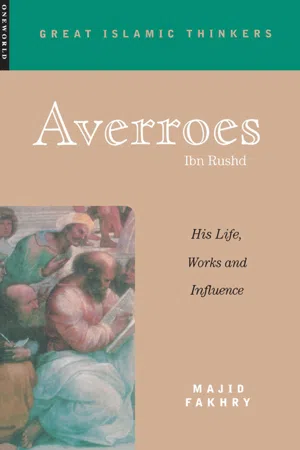
Averroes

His Life, Work and Influence

  1. 208 pages
  2. English
  3. ePUB (mobile friendly)
  4. Available on iOS & Android
eBook - ePub

Averroes

His Life, Work and Influence

About this book

This stimulating book covers all area of the twelfth century Muslim philosopher's life from his transmission of Aristotelian thought to the Western world, to his conflict with the Ash'arite theologians.
Frequently asked questions

Yes, you can cancel anytime from the Subscription tab in your account settings on the Perlego website. Your subscription will stay active until the end of your current billing period. Learn how to cancel your subscription.
No, books cannot be downloaded as external files, such as PDFs, for use outside of Perlego. However, you can download books within the Perlego app for offline reading on mobile or tablet. Learn more here.
Perlego offers two plans: Essential and Complete
  • Essential is ideal for learners and professionals who enjoy exploring a wide range of subjects. Access the Essential Library with 800,000+ trusted titles and best-sellers across business, personal growth, and the humanities. Includes unlimited reading time and Standard Read Aloud voice.
  • Complete: Perfect for advanced learners and researchers needing full, unrestricted access. Unlock 1.4M+ books across hundreds of subjects, including academic and specialized titles. The Complete Plan also includes advanced features like Premium Read Aloud and Research Assistant.
Both plans are available with monthly, semester, or annual billing cycles.
We are an online textbook subscription service, where you can get access to an entire online library for less than the price of a single book per month. With over 1 million books across 1000+ topics, we’ve got you covered! Learn more here.
Look out for the read-aloud symbol on your next book to see if you can listen to it. The read-aloud tool reads text aloud for you, highlighting the text as it is being read. You can pause it, speed it up and slow it down. Learn more here.
Yes! You can use the Perlego app on both iOS or Android devices to read anytime, anywhere — even offline. Perfect for commutes or when you’re on the go.
Please note we cannot support devices running on iOS 13 and Android 7 or earlier. Learn more about using the app.
Yes, you can access Averroes by Majid Fakhry in PDF and/or ePUB format, as well as other popular books in Philosophy & Philosopher Biographies. We have over one million books available in our catalogue for you to explore.

1

Life and Works

According to his leading biographers, including al-Marākushi (d. 1224), Ibn al-Abbār (d. 1260), Ibn Abī Uaybi’ah (d. 1270) and al-Anāri (d. 1288), Averroes was born in Cordova, Spain, in 1126, into a prominent family of religious (Māliki) judges and statesmen, and in the manner of his father and grandfather, who served as Māliki judges of Cordova, the young Averroes studied jurisprudence, Arabic, letters (adab), theology (kalām), philosophy and medicine at the hands of a number of teachers whose names are sometimes mentioned by his biographers. Thus, of his medical teachers, Abu Ja’far Hārūn and Abū Marwān Ibn Jurbul of Valencia are mentioned by name, but his closest medical associate was the famous Abū Bakr Ibn Zuhr, who died in 1162. None of Averroes’ philosophy teachers are mentioned by name, but he appears to have been influenced by Avempace, who was responsible for introducing the study of Aristotle into al-Andalus, as we have seen, and for whom Averroes had the highest regard. He was, in addition, a close friend of Ibn ufayl, who served as physician royal of the caliph, Abū Ya’qūlb Yusūf, who appears to have been genuinely interested in philosophy. Ibn ufayl’s ‘illuminationist’ (Ishrāqi) or mystical sympathies cannot have appealed much to Averroes, who was highly critical of the Ishrāqi tendencies of Avicenna and the Sufi tendencies of al-Ghazālī, whose thought was at the heart of Ibn ufayl’s philosophical outlook. However, Averroes’ association with Ibn ufayl proved very fruitful in determining the direction of his philosophical output; since it was Ibn ufayl who introduced him to the caliph in 1169, commending him “for his acumen, his sound instinct and his attachment to the art (of philosophy).” Whereupon, we are told by the historian al-Marākushi, the caliph addressed to him the question: “What do the philosophers believe regarding heaven? Is it eternal or created in time (hādith)?” In response, Averroes, thoroughly taken aback, denied that he was “engaged in the study of philosophy.” To allay his fears, the caliph then proceeded to expound the views of Plato, Aristotle and the other philosophers on this question, as well as the objections of Muslim scholars to these views. “I found in him [i.e. the caliph] a profuseness of learning I did not suspect in specialists in that field,” Averroes later told one of his disciples.1
It was chiefly as a result of this encounter of the philosopher and the prince that Averroes’ philosophical career was launched. For that prince, an avid reader of Aristotle, had complained to Ibn ufayl about “the obscurity of Aristotle’s idiom or that of his translators” and expressed the wish that he might attempt an interpretation of the philosopher’s works for his use. Already advanced in years, Ibn ufayl excused himself and recommended Averroes, whose talents he greatly admired, as we have seen. From that time on, Averroes’ career as the Commentator began, since his earliest Aristotelian works, the paraphrases of the Parts of Animals, the Generation of Animals and the Parva Naturalia (al-iss wa’l Masūs) were written in the same year, 1169.
When Abū Yusūf Ya’qūb, nicknamed al-Manūr, succeeeded his father in 1184, Averroes continued to enjoy the same royal patronage; but in 1195, probably in response to public pressure instigated by the Māliki jurists, who were averse to the study of philosophy and the ‘ancient sciences,’ the fortunes of Averroes took an adverse turn. According to other accounts given by Averroes’ biographers, a variety of charges appear to have been leveled at the philosopher. Thus, Ibn Abī Uaybi‘ah attributed his disgrace to his reference to al-Manūr, in the Book of Animals, as the ‘king of the Berbers’ (al-barbar), which could also be construed in Arabic as the Barbarians. Al-Ansāri attributes it to his statement elsewhere, in connection with the People of ‘Ād and the wind which destroyed them, as mentioned in Qu’ran 54:19: “Indeed, the existence of the People of ‘Ād is uncertain; what then of the news of their destruction” by that wind?2 Finally, al-Marākushi attributes Averroes’ disgrace to his reference to Venus as one of the Gods.3
The writings of Averroes covered a greater variety of subjects, philosophical, medical, juridical and linguistic than those of any of his predecessors in the East. However, by far the largest part of his output consisted of commentaries or paraphrases of all the works of Aristotle, with the exception of the Politics, for which he substituted the Republic of Plato. The commentaries are usually divided into large (tafsīr), intermediate (sharh) and short, i.e. paraphrase or epitomes (jawāmi’). It is noteworthy that the only works of Aristotle on which Averroes wrote all three types of commentaries or paraphrases are the Physics, the Metaphysics, De Anima, De Coelo and Analytica Posteriora. In addition, he wrote commentaries on De Intellectu of Alexander of Aphrodisias, the Metaphysics of Nicolaus of Damascus, the Isagoge of Porphyry and the Almajest of Ptolemy.
To these commentaries or paraphrases should be added a series of original philosophical writings, some of which have survived in Arabic, Hebrew or Latin. They include treatises On the Intellect, On the Syllogism, On Conjunction with the Active Intellect, On Time, On the Heavenly Sphere and On the Motion of the Sphere. A number of polemical treatises, some of which have also survived, include an Essay on al-Fārābī’s Approach to Logic, as Compared to that of Aristotle, Metaphysical Questions Dealt with in the Book of Healing (al-Shifā’) by Ibn Sīnā and a Rebuttal of Ibn Sīnā’s Classification of Existing Entities into Possible Absolutely, Possible in Themselves but Necessary by Another and Necessary in Themselves.4
Averroes’ theological works consist of a trilogy, which begins with the Incoherence of the Incoherence (Tahāfut al-Tahāfut) (1180), a rebuttal of al-Ghazālī’s own Incoherence of the Philosophers (Tahāfut al-Falāsifah), the Decisive Treatise on the Relation of Philosophy and Religion (
image
asi al-Maqāt
) (1178) and the Exposition of the Methods of Proof (al-Kashf ‘an Manāhij al-Adillah) (1179), to which should be added a short Appendix (amimah) on the nature of God’s knowledge, and a lost tract, entitled That Which the Peripatetics and the Theologians of our Religion (al-Mutakallimun) Believe with Respect to the Manner of the World’s Existence is Close in Meaning
His juridical writings include a Prolegomena, al-Mustasfa (Gist of Furisprudence) and the Primer of the Discretionary Scholar (Bidāyat al-Mujtahid) (1168), which has survived.
In medicine, as already mentioned in the Introduction, Averroes’ major medical treatise is al-Kulliyāt (1162), known in Latin translation as Colliget, to which should be added short tracts On Fever, On the Humours, On Theriac, plus a long list of summaries or paraphrases of Galen’s medical treatises and, finally, a commentary on Avicenna’s medical poem al-Urjūzah (1179–80). These works will be discussed in a later chapter.
The list closes with a grammatical and a linguistic treatise, neither of which has survived.
  1.   Al-Marākushi, al-Mu’jib, pp. 174 f.
  2.   Rénan, Averroés, Appendix, pp. 444, 452.
  3.   Al-Marākushi, al-Mu‘jib, p. 175.
  4.   For a list of the commentaries, see Wolfson, “Revised Plan for the Publication of a Corpus Commentariorum Averrois in Aristotelem,” pp. 90 f. Cf. Rénan, Averroés, pp. 58 f. Cf. also Ibn Abi Usaybi’ah, ‘Uyūn al-Anbā, pp. 23 f.

2

Averroes and the Muslim Neoplatonists

Rehabilitation of Aristotle

In his attempt to rehabilitate Aristotle, Averroes begins by mounting a sustained attack against the Muslim Neoplatonists, led by al-Fārābī and Avicenna, on the double charge that they either distorted or misunderstood his teaching. Although Averroes does not mention it explicitly, those philosophers had been misled by the peculiar historical circumstance that Aristotle’s teaching had been confused with that of Plotinus, sometimes referred to in the Arabic sources as the Greek Sage (al-Shaykh al-Yunāni), as well as that of Proclus, the last great Greek exponent of Neoplatonism. In the case of the former, a paraphrase of the last three books of his Enneads, due probably to his disciple and editor, Porphyry of Tyre, was translated into Arabic by ‘Abd al-Masīh Ibn Nā‘imah al-Himsi (d. 835), under the rubric of Āthulugia Aristotālis, Theologia Aristotelis, or Kitāb al-Rubūbiyah (the Book of Divinity). In the case of the latter, excerpts from his Elements of Theology were translated into Arabic in the tenth century, as Fi’l Khayr al-Ma, (on the Pure Good), known in Latin translation as Liber de causis, and wrongly attributed to Aristotle, too.1
Of the two pseudo-Aristotelian treatises, the former was by far the most influential in shaping the thinking of the Muslim Neoplatonists, and it is significant that almost all the early philosophers, from al-Kindī to al-Fārābī and Avicenna, accepted it without question as a genuine work of Aristotle. Even philosophers as late as al-Shirāzi (d. 1641) continue to refer to it as an Aristotelian treatise and quote it extensively in that spirit. Nowhere, as far as I am aware, does Averroes himself refer to either of these alleged Aristotelian treatises, due to an instinctive suspicion, perhaps, that these two works were spurious.
In his critique of Muslim Neoplatonism, Averroes begins by taking al-Fārābī to task, for his misguided attempt to bring Plato and Aristotle together, in his well-known treatise, the Reconciliation of Two Sages (al-Fam‘), which appears to have some relation to a lost treatise of Porphyry of Tyre, mentioned in the Suidas, Lexicon II. In the Epitome of the Metaphysics, Averroes argues that Aristotle diverged from his master on a variety of points, the most important of which being the latter’s view of universals (or Ideas). According to this view, Ideas subsist in a world of their own, known for that reason as the World of Ideas. The existence of those Ideas, according to Aristotle, cannot be demonstrated and is not, at any rate, very helpful in explaining the particulars of sense or even proving their existence. The arguments of the Platonists in support of their view of the nature or status of the Ideas, according to Averroes, are not convincing and are in fact reducible to “poetic and enigmatic discourses used in teaching the general public,” rather than the learned.2 Significantly enough, Averroes does not dwell in his extant works on any of the other arguments advanced by al-Fārābī in his attempt to reconcile the two masters, such as his contention that Plato and Aristotle were at one in their view that the world is created in time, their respective theories of vision, the survival of the soul after death, the nature of ethical traits and so on.
Averroes was equally critical of al-Fārābī’s approach to logic, as compared with that of Aristotle, as shown by his already-mentioned logical tract, which is lost, and another tract which had a more specific intent; namely, al-Farābī’s divergence from Aristotle in his Kitāb al-Burhan (the Book of Demonstration), or paraphrase of Aristotle’s Analytica Posteriora. In his extant logical works, Averroes often disputes al-Fārābī’s interpretation of Aristotle’s logic, as will appear in a later chapter, and from the already-mentioned treatise criticizing al-Fārābī’s approach to logic, as distinct from Aristotle’s approach.3

Critique of Avicennian Emanationism

More wide-ranging is Averroes’ critique of Avicenna, with whose name Islamic Neoplatonism was identified in the Middle Ages in both East and West. He asserts, in this context, that the theory of emanation, which forms the cornerstone of Neoplatonism, is “something which the old company (al-qawm) ...

Table of contents

  1. Cover
  2. Title
  3. Copyright
  4. Contents
  5. Preface
  6. Introduction
  7. 1. Life and works
  8. 2. Averroes and the Muslim Neoplatonists
  9. 3. The critique of Ash’arite theology (kalām)
  10. 4. Logic and theory of knowledge
  11. 5. The physical structure of the universe
  12. 6. The soul and its faculties
  13. 7. God and the creation of the world
  14. 8. Ethics and politics
  15. 9. Averroes as jurist and physician
  16. 10. Averroes and the Latin West
  17. 11. Averroes and Aquinas
  18. Conclusion
  19. Select Bibliography
  20. Index