How to Make a Zombie
eBook - ePub

How to Make a Zombie

The Real Life (and Death) Science of Reanimation and Mind Control

  1. 256 pages
  2. English
  3. ePUB (mobile friendly)
  4. Available on iOS & Android
eBook - ePub

How to Make a Zombie

The Real Life (and Death) Science of Reanimation and Mind Control

About this book

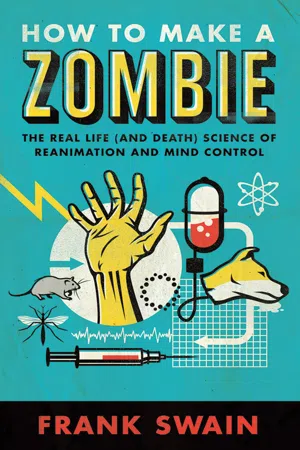
Join a notorious pop science punk as he investigates real zombie reports from around the world. It's terrifying!The search for the means to control the bodies and minds of our fellow humans has been underway for millennia, from the sleep-inducing honeycombs that felled Pompey's army to the Voodoo potions of Haiti. Now, Frank Swain, the force behind Science Punk, has joined the quest, digging up genuine zombie research: • dog heads brought back to life without their bodies• secret agents dosing targets with zombie drugs• parasites that push their hosts to suicide or sex changes• the elixir of life hidden in an eighteenth-century paintingThis mind-bending and entertaining excavation of incredible science is unlike anything you've read before.
Frequently asked questions

Yes, you can cancel anytime from the Subscription tab in your account settings on the Perlego website. Your subscription will stay active until the end of your current billing period. Learn how to cancel your subscription.
No, books cannot be downloaded as external files, such as PDFs, for use outside of Perlego. However, you can download books within the Perlego app for offline reading on mobile or tablet. Learn more here.
Perlego offers two plans: Essential and Complete
  • Essential is ideal for learners and professionals who enjoy exploring a wide range of subjects. Access the Essential Library with 800,000+ trusted titles and best-sellers across business, personal growth, and the humanities. Includes unlimited reading time and Standard Read Aloud voice.
  • Complete: Perfect for advanced learners and researchers needing full, unrestricted access. Unlock 1.4M+ books across hundreds of subjects, including academic and specialized titles. The Complete Plan also includes advanced features like Premium Read Aloud and Research Assistant.
Both plans are available with monthly, semester, or annual billing cycles.
We are an online textbook subscription service, where you can get access to an entire online library for less than the price of a single book per month. With over 1 million books across 1000+ topics, we’ve got you covered! Learn more here.
Look out for the read-aloud symbol on your next book to see if you can listen to it. The read-aloud tool reads text aloud for you, highlighting the text as it is being read. You can pause it, speed it up and slow it down. Learn more here.
Yes! You can use the Perlego app on both iOS or Android devices to read anytime, anywhere — even offline. Perfect for commutes or when you’re on the go.
Please note we cannot support devices running on iOS 13 and Android 7 or earlier. Learn more about using the app.
Yes, you can access How to Make a Zombie by Frank Swain in PDF and/or ePUB format, as well as other popular books in Ciencias biológicas & Ciencias en general. We have over one million books available in our catalogue for you to explore.

1

Dead Men Working the Fields

No one dared stop them, for they were corpses walking in the sunlight.
William Seabrook, The Magic Island (1929)
1_Haiti-Getty-50668834.webp
So you want to make a zombie? Well then, we best start at the beginning. The zombie first shuffled its way into the global consciousness in 1889, not all that long ago. It was then that Harper’s Magazine correspondent Lafcadio Hearn ventured on an extended holiday to unearth the truth surrounding rumours that the walking dead haunted the islands of the Caribbean.
Hearn was no hack. He was an accomplished and respected journalist who’d spent a decade in New Orleans chronicling the city’s people and unique cultural life. He was not shy of penning hard-nosed editorials on crime, corruption and politics. But he also had a flair for imagery, a taste for the exotic and a keen interest in folklore he was an amateur anthropologist in many ways, and a romantic. As he explored the islands, he found himself in strange territory, where even the darkness seemed to be alive:
Night in all countries brings with it vaguenesses and illusions which terrify certain imaginations;but in the tropics it produces effects peculiarly impressive and peculiarly sinister. Shapes of vegetation that startle even while the sun shines upon them assume, after his setting, a grimness,a grotesquery,a suggestiveness for which there is no name… In the North a tree is simply a tree;here it is a personality that makes itself felt; it has a vague physiognomy, an indefinable Me. From the high woods, as the moon mounts, fantastic darknesses descend into the roads,black distortions, mockeries, bad dreams,an endless procession of goblins. Least startling are the shadows flung down by the various forms of palm, because instantly recognizable;yet these take the semblance of giant fingers opening and closing over the way, or a black crawling of unutterable spiders…
The local residents were not afraid of such physical darkness the terrors that haunted them were found in the spiritual darkness of witchcraft, Hearn said.
In Martinique, Hearn rented a room in a small mountain cottage from an elderly woman and employed the landlady’s son Yébé as his guide. The previous night, the woman’s daughter Adou had refused to go via a cemetery on an errand, claiming that the dead would have prevented her from leaving the graveyard if she had entered it. Hearn was intrigued. Were these dead people the zombies he had heard about? No, Adou replied, the moun-mo could not leave the graveyard except on the night of All Souls, when they travelled home. A zombie, by comparison, could appear anywhere, at any time. Adou’s usually cheerful face fell into a sombre expression. She had never seen a zombie, she whispered to Hearn, and she didn’t want to either. Asked to describe a zombie, she answered vaguely that a zombie was one that made disorder at night; a zombie was a fourteen-foot-tall woman appearing in your bedroom; a giant dog that crept into your house.
Sensing that Hearn was unsatisfied with these answers, Adou called to her mother, who was preparing the evening meal over a charcoal stove outside. Hearn put the question to the older woman: what is a zombie? It was a three-legged horse passing you in the road, the old woman replied. If you were to walk along the high road at night, and see a great fire that receded into the distance as you approached it: the zombies made those. These were mauvai difé evil fires and unwary travellers who followed them, mistaking the light for that of a nearby village, fell into deadly chasms. Even in the middle of the day, those wandering the deserted boulevards in the townships might come face-to-face with a zombie.
Suddenly Adou remembered the story of Baidaux, a harmless simpleton, which she recounted for Hearn. Baidaux lived in St Pierre with his sister, who looked after him. One day Baidaux abruptly told his sister: “I have a child, ah, you never saw it!” The sister ignored his foolish talk, but Baidaux persisted. Every day for months, for years, he told her the same thing, no matter how much his sister shouted at him to stop. Then one evening Baidaux left the house and returned at midnight leading a small black child by the hand. “Every day I have been telling you I had a child, you would not believe me,” he told his sister, “Very well, look at him!” She looked, and saw that the child was growing taller and taller, right before her eyes. She threw open the shutters and screamed to her neighbours for help. The towering child turned to Baidaux and told him, “You are lucky that you are mad!” When the neighbours came running in, they found nothing; the zombie had vanished. This, Adou insisted to Hearn, was the absolute truthCe zhistouè veritabe!” Though Hearn collected many tales of this sort from island villagers, he never observed a zombie in real life.1
At the time of Hearn’s writing, New Orleans was known as the “Gateway to the Tropics”, and that sense of ‘otherness’ only increased the further one travelled into the Caribbean. Haiti, in particular, possessed a horrifying and intoxicating hold on white America, a slice of Old Africa laid at its feet, a land that conjured up spectres of violence, magic and mystery. Haiti was a fiercely independent nation whose slave inhabitants had risen up in 1804 and overthrown their French masters, and repelled several subsequent colonial efforts. That independence was sorely curtailed in 1915 when civil unrest jeopardized American business interests in particular, those of the Haitian-American Sugar Company (Hasco) and threatened to usher in an anti-US government. The US invaded Haiti and established an occupation that would last until 1934, with enduring consequences for the country and its people.
Culturally, even that most powerful of Western settlers, Christianity, has had limited success in Haiti. Though the Catholic Church was adopted as the national religion in the 1804 constitution, no amount of milk poured into the cultural mélange by zealous missionaries could cover the spice of the indigenous Taínos and imported African gods, and in the centuries before the revolt, a new religion, Vodou, had arisen.2 Haitian Vodou was a mix of spiritual rites and traditions, just as the country’s population was a mix of the indigenous Taínos people, the slaves brought over in their millions from Africa, and their European colonizers and captors. Vodou grafted together elements of the native Taínos beliefs with those of the Fon and Ewe people of West Africa and Roman Catholicism. But it was also more than a religion, encompassing a complex system of narratives, deities and practices that varied from village to village. Indeed, it is said that Haiti remains “80 percent Catholic, 100 percent Vodou”.
Under the tenets of Vodou a person is composed of several parts, an amalgam of human matter as complex as the religion itself. Above all, there is the z’etoile, or guiding star, the celestial body that steers a person’s fortunes. The corps cadavre is literally the physical body, while the nanm is the spirit of the living flesh, the vitalist energy that prevents a body from decaying in that bothersome way that dead things will. The soul too is made up of parts. There is the gwo-bon anj (great good angel), the animating principle of the human, the will that motivates us in our actions; also the ti-bon anj (little good angel), which embodies our memories and awareness. A bokor, or sorcerer, may be able to capture the ti-bon anj soon after a person’s death, before it has strayed too far from the body, or else draw it from a person with magic, leaving the victim apparently dead. The ti-bon anj is imprisoned in an earthenware jar, which becomes the zombie astral, while the body it leaves behind a physical entity that is living but has no will of its own is the zombie cadavre.
It’s no wonder that Hearn had trouble understanding what a zombie was.

Pursuit of the flesh

Despite Hearn’s purposeful globetrotting, he never managed to meet a real-life zombie. That honour fell instead to the colourful American writer and explorer William Seabrook, a member of the ‘Lost Generation’ of artists living in postwar Paris. “Lusty, restless, red-haired” Seabrook was an inimitable character whose incredible life was reflected in the incredible stories he wired home to Vanity Fair and Reader’s Digest magazines. Seabrook spent his life indulging in every act his body could tolerate. An alcoholic and an abusive partner, he had a penchant for sadism, and it was said that he never travelled without a trusty case full of whips and chains.3 Around the same time the US was invading Haiti, Seabrook volunteered for the French military, and was gassed at Verdun, earning himself a Croix de guerre for his heroism.
Like Hearn, Seabrook was attracted to the sensational, and travelled to West Africa to live with the Guere tribe whose members practised cannibalism, purportedly to write a book on the subject. He was frustrated by the tribal chief’s inability to describe the taste of human flesh, and refused to publish his book without securing this essential detail. When he arrived back at his base in Paris, he bribed a mortuary attendant to supply him with a sample of the elusive fare. Arriving at a friend’s house, he asked the cook to prepare several dishes from the strange meat, claiming it was a rare type of wild game. “The roast, from which I cut and ate a central slice, was tender,” he later wrote, “and in colour, texture, smell as well as taste, strengthened my certainty that of all the meats we habitually know, veal is the one meat to which this meat is accurately comparable.”
The adventurer’s fascinations settled on the occult after the notorious English divine Aleister Crowley visited Seabrook’s farm in 1919. The men drank, smoke and exchanged stories, particularly about witchcraft, over the course of a week. Seabrook was bitten by an insatiable thirst for all things related to the dark arts, and he toured the world tracking down samples of witchcraft. The zombie in particular intrigued him. He felt that it was a creature that, unlike vampires and werewolves, appeared to have no parallel in Western culture. “The zombie, they say, is a soulless human corpse, still dead, but taken from the grave and endowed by sorcery with a mechanical semblance of life,” he wrote. “It is a dead body which is made to walk and act and move as if it were alive.” Seabrook couldn’t wait to meet one in the flesh.
In 1928, he set off for Haiti to investigate reports of black magic there, and to see if the dead really did walk the Earth. One night during his sojourn, Seabrook and his guide, Constant Polynice, sat watching the full moon rise and discussing the demons and monsters that haunted Haiti. Polynice was a countryman but not a peasant, and though familiar with the superstitions of Haiti’s populace, he was not a credulous man; he viewed these stories of demons and monsters as simply that stories. Seabrook asked his guide what he made of the tales of the walking dead that circulated around the island. Polynice’s face darkened. With consternation, the Haitian replied, “I assure you that this of which you now speak is not a matter of superstition. Alas, these things and other evil practices connected with the dead exist. They exist to an extent that you whites do not dream of, even though evidences are everywhere under your eyes.” Why else, Polynice asked, would even the poorest farmers build masonry tombs to house their dead, other than to protect their loved ones from this awful fate? He himself had built a family tomb next to the busy Grand Source road, so that passers-by would spot anyone trying to break into it. Even then, when his brother died, Polynice watched over the tomb for four nights, shotgun in hand, until he was sure that the body was beyond the reach of any sorcerer.
Zombies, Polynice said, were forced to work the plantations, dressed in rags. They walked with a shuffling gait, their eyes glazed over, their stare vacant like that of cattle. The zombies no longer recognized their own names, or even their own existence. Only by feeding them salt or meat could the terrible spell controlling them be broken. If salt or meat touched their lips, they would realize what they had become and flee to their graves, clawing at the dirt and crawling into their tombs, where they would find a second, final death.
Polynice recounted a well-known case, about the legendary figure of Ti Joseph, who in the spring of 1918 arrived with a tattered troupe of labourers at the Hasco offices. The company occupied a clattering, bustling industrial complex sprawled across the eastern edges of Port-au-Prince; it was filled with freight cars and machinery and its chimney belched out a column of dark smoke that towered over the area. To supply the refinery, Hasco operated several sugar cane plantations, which had produced a bumper crop that year. To reap the full profits of the bounty, the corporation’s management offered a bonus to all new hands who registered at their offices. From far and wide, small bands of men and women came seeking work.
When Joseph’s entourage arrived at the Hasco complex, they stood catatonic, and not a soul replied when asked their names. They were simple people from the highlands of Morne-au-Diable, a remote part of the island, Joseph explained, and the noise of the factory scared them. They would work best if stationed deep in the plantation, away from the noise as well as other workers. Joseph was granted a gangmaster’s licence and led his people to their work in the fields. But rumours swirled that he had asked to have the group separated from the others for fear that someone would recognize a long-dead family member amongst his crew. During the day, these “zombies” toiled in the plantation; at night, they were fed a plain porridge, c...

Table of contents

  1. Prologue • Recipe for a Zombie
  2. 1 • Dead Men Working the Fields
  3. 2 • Time for a Revival
  4. 3 • Mickey Finn and Other Thugs
  5. 4 • Remote / Control
  6. 5 • The Ghoulish Nanny
  7. 6 • Army of Bloodsuckers
  8. 7 • The human harvest
  9. Epilogue • Here and now