British Muslim Converts
eBook - ePub

British Muslim Converts

Choosing Alternative Lives

  1. 288 pages
  2. English
  3. ePUB (mobile friendly)
  4. Available on iOS & Android
eBook - ePub

British Muslim Converts

Choosing Alternative Lives

About this book

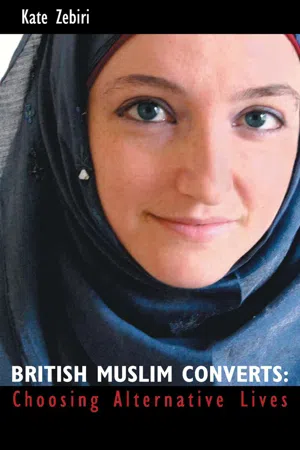
Indispensable for anyone trying to understand Islam in the West When the Western mass-media talk of conversion to Islam, we are bombarded with accounts of vulnerable people brainwashed into a culture of extremism. However, in reality, the vast majority who convert are well-educated, and doing so as the result of a long-considered and heartfelt decision. What is more, their numbers are multiplying. The only exploration of this unique group in British society, this well-argued and powerful book investigates the fascinating contribution that Western converts to Islam are making to Islamic thought.
Frequently asked questions

Yes, you can cancel anytime from the Subscription tab in your account settings on the Perlego website. Your subscription will stay active until the end of your current billing period. Learn how to cancel your subscription.
No, books cannot be downloaded as external files, such as PDFs, for use outside of Perlego. However, you can download books within the Perlego app for offline reading on mobile or tablet. Learn more here.
Perlego offers two plans: Essential and Complete
  • Essential is ideal for learners and professionals who enjoy exploring a wide range of subjects. Access the Essential Library with 800,000+ trusted titles and best-sellers across business, personal growth, and the humanities. Includes unlimited reading time and Standard Read Aloud voice.
  • Complete: Perfect for advanced learners and researchers needing full, unrestricted access. Unlock 1.4M+ books across hundreds of subjects, including academic and specialized titles. The Complete Plan also includes advanced features like Premium Read Aloud and Research Assistant.
Both plans are available with monthly, semester, or annual billing cycles.
We are an online textbook subscription service, where you can get access to an entire online library for less than the price of a single book per month. With over 1 million books across 1000+ topics, we’ve got you covered! Learn more here.
Look out for the read-aloud symbol on your next book to see if you can listen to it. The read-aloud tool reads text aloud for you, highlighting the text as it is being read. You can pause it, speed it up and slow it down. Learn more here.
Yes! You can use the Perlego app on both iOS or Android devices to read anytime, anywhere — even offline. Perfect for commutes or when you’re on the go.
Please note we cannot support devices running on iOS 13 and Android 7 or earlier. Learn more about using the app.
Yes, you can access British Muslim Converts by Kate Zebiri in PDF and/or ePUB format, as well as other popular books in Theology & Religion & Islamic Theology. We have over one million books available in our catalogue for you to explore.

Chapter 1

Converts in the British context

This chapter attempts to situate converts in the British context, initially by giving a brief history and overview of the Muslim presence in Britain, paying particular attention to factors of relevance to this study such as changing patterns of identity among young Muslims and the impact of key issues such as the Rushdie Affair, 9/11 and the Iraq war. It goes on to give a brief history of conversion to Islam with particular reference to Britain, followed by a comparative look at second- and third-generation Muslims on the one hand, and converts to Islam on the other, which will serve to clarify the ways in which the latter are distinctive. Finally, it will provide a social and demographic profile of British converts, including their Islamic affiliation, and will incorporate details of my interview sample.

MUSLIMS IN BRITAIN

Contrary to early expectations, Muslims in Western Europe appear to be resisting prevalent trends of secularization; by and large they have not assimilated, or disowned their religious identity. While some young Muslims have adopted secular identities,1 others are evolving new ways of expressing their Muslim or Islamic identity. The Muslim presence in Western Europe poses challenges for both Muslims and Europeans; while the onus of adaptation falls on the former, as a minority, many have suggested that European countries also need to adapt – to recognize and accommodate the new, permanent, indigenous Muslim populations, and to allow some place for religion in the public sphere.2 However, in Britain as elsewhere, many people feel threatened by the idea of a politicized religious identity, some of them beating a retreat to a classical liberal distinction between the public and the private spheres (with religion belonging to the latter).3 The events of 11 September 2001, and more recently the London tube bombings of July 2005, have had far-reaching consequences for British Muslims, who feel pressurized and under scrutiny in a way that they have not done in the past, whilst issues of loyalty, belonging and citizenship have been thrown into sharp relief.
Religious practice and affiliation in Britain as a whole appears to be decreasing. There has been a steady decline in membership of mainstream churches over the past century, although some of the smaller independent churches have grown.4 Recent surveys have shown that less than half of British people believe in life after death,5 and according to the 2001 census, only 8% of the UK adult population are regular church attenders.6 New Religious Movements (NRMs) have enjoyed some popularity in recent decades but involvement is often casual and intermittent, and there are no reliable figures.7 A diffuse spirituality in the form of aspects of New Age beliefs has entered the mainstream with the popularization of such diverse things as horoscopes, martial arts, meditation and life-coaching. Brown suggests that those who have grown up since the 1960s are more interested in general ethical issues, such as the environment, gender issues and racial equality, than in religion per se.8
Figures from the 2001 census (the first to include a question on religious affiliation) show that Muslims number almost 1.6 million (the true figure may be nearer to 2 million due to under-enumeration), making Islam the second largest religion in Britain, with Muslims constituting 2.7% of the population.9 The majority of British Muslims (about two-thirds) are of South Asian origin, while most of the rest are of Arab (especially Egyptian, Iraqi, Moroccan and Yemeni), Turkish (including Turkish Cypriot) and Somali origin.10 Muslims have the youngest age structure of all religious groups, with 52% being under twenty-five, compared to a national figure of 31%. Possibly 10% of British Muslims are Shi‘i (though figures are hard to come by);11 within Sunnism, the main sectarian groups are the Deobandis and the Barelwis, both of which originated on the Indian subcontinent. These two groups have a long history of conflict which has spilled over into the UK (for example in disputes over control of mosques), but it should be borne in mind that both groups are amorphous and inwardly diverse. The distribution of Muslims in Britain is uneven, with almost half living in or around London, while most of the rest live in the West Midlands, Yorkshire and Greater Manchester. Outside London, most Muslims are from the subcontinent, while the London Muslim population is highly diverse, including not just South Asians but also Arabs, Africans, Eastern Europeans, Iranians and other Asians.
As with any religious group, there are variations in levels of commitment among Muslims. However, there is evidence to suggest that Islamic belonging is important even to non-practising Muslims. The 2001 census showed that for England and Wales, less than 0.5% of people of Pakistani or Bangladeshi descent (the vast majority of whom are Muslim) claim to have no religion, compared to 15% of the population as a whole. According to the Fourth National Survey on Ethnic Minorities (1993–4), religion was the most prominent factor in the self-descriptions of South Asians; 90% said that religion was important to them, compared with 13% of white Britons. Two-thirds of Muslims said that they attend the mosque at least once a week, and two-thirds of young Muslims (aged sixteen to twenty-four) of Pakistani and Bangladeshi extraction said that religion was important to how they conducted their lives, as compared with only 5% of whites and 20% of Afro-Caribbeans in the same age-group.12 Modood, the principal researcher in this survey, found that even Muslims who were not strongly religious saw religion in terms of public policy and not just private life.13
Muslims are more established and integrated in Britain than in many other European countries because they were mostly given rights of citizenship and political participation as soon as they arrived, and because migration was generally earlier. There has been a significant Muslim presence in Britain for some five decades now.14 Although the earliest Muslim communities in Britain date back to the eighteenth century, the first mass migration began in the late 1950s, and consisted mainly of single men from rural areas of the Indian subcontinent (also from Cyprus, the West Indies and Africa) who came for economic reasons, to undertake manual labour with the idea of returning to their countries of origin when they retired, if not before. Levels of religious practice among these single men were generally low, but with the arrival of their wives and children in the 1960s (prompted by the prospect of restrictive legislation), this changed. In particular there was a concern to pass on religio-cultural traditions to the children, and organizations and institutions were rapidly established to provide for worship, education and other community needs. From the 1970s onwards there have been waves of political refugees from places such as Somalia, Iran, Bosnia, Kosovo, Afghanistan and some Arab states, as a result of political upheavals in these countries.15
Muslims are among the most disadvantaged groups in Britain, with neglect and racism undoubtedly playing a part in this. Those of Bangladeshi or Pakistani origin in particular score badly on all the socio-economic indicators including employment and wage levels, housing, female participation in the labour force and, to a lesser extent, education.16 Muslims are overrepresented in the prison population (almost 10%), but underrepresented in key areas including the police force, the judiciary, the civil service and the media.17 The figures show a higher than average birth rate among Muslims and a younger than average age distribution, as mentioned above. There have however been some modest advances in recent years. There is now a handful of Muslims in both the Lower and Upper Houses of Parliament, the first Muslim MP having been elected to the Commons in 1997. In the same year the first voluntary-aided Muslim schools were given government funding after prolonged campaigning, but only seven such schools had come into being at the time of writing in late 2006. Despite being underprivileged in many areas, South Asian Muslims have a strong record of political participation and involvement in the main political parties, especially Labour, and research has shown that they are more likely to vote than other British citizens.18 For the majority, political participation is seen as the most effective way of having some influence on British society; a minority, however, including the fringe group al-Muhajiroun, promote an isolationist strategy of non-participation, urging fellow Muslims not to vote on the grounds that the whole system is unIslamic.
There has been a proliferation of mosques and Muslim organizations in recent decades. These often have some sectarian affiliation or transnational links to Muslim states, but increasingly there are also indigenous organizations, including separate women’s networks such as Al-Nisa and the Muslim Women’s Helpline. Some of the more recently established organizations such as the Muslim Association of Britain and the Islamic Society of Britain have emphasized interaction with British society, and the values shared by Muslims and non-Muslims. The most successful attempt to create a national umbrella organization has been the Muslim Council of Britain (MCB), established in 1996, which has made some progress in terms of gaining access to government and influencing policy. It has over three hundred associate members but some groups have declined to join, notably Shi‘i- and Barelwi-affiliated groups, and some Muslims resent what they see as the MCB’s attempt to be seen as representing British Muslims in general.19 Also of significance has been the growth of an indigenous Muslim media, with publications like Q-News, The Muslim News, The Muslim Weekly and emel creating a new space for critical discussion and treatment of Islamic issues, and also for the exploration of a new British Muslim identity.20 The rise of the internet has had a major impact on Muslims in Bri...

Table of contents

  1. Cover
  2. Title
  3. Copyright
  4. Contents
  5. Acknowledgements
  6. Introduction
  7. 1. Converts in the British context
  8. 2. The ‘double marginality’ of converts
  9. 3. A new identity?
  10. 4. Society and politics
  11. 5. Women and men
  12. Conclusion
  13. Glossary of Arabic and Islamic terms
  14. Bibliography
  15. Index