
- 384 pages
- English
- ePUB (mobile friendly)
- Available on iOS & Android
eBook - ePub
About this book
A BBC History magazine Book of the Year and an amazon.com Best Book of the Month
As religion divided sixteenth-century Europe, an extraordinary group of women rose to power. They governed nations while kings fought in foreign lands. They ruled on behalf of nephews, brothers and sons. They negotiated peace between their warring nations. For decades, they ran Europe. Small wonder that it was in this century that the queen became the most powerful piece on the chessboard.
From mother to daughter and mentor to protégée, Sarah Gristwood follows the passage of power from Isabella of Castile and Anne de Beaujeu through Anne Boleyn – the woman who tipped England into religious reform – and on to Elizabeth I and Jeanne d’Albret, heroine of the Protestant Reformation. Unravelling a gripping historical narrative, Gristwood reveals the stories of the queens who had, until now, been overshadowed by kings.
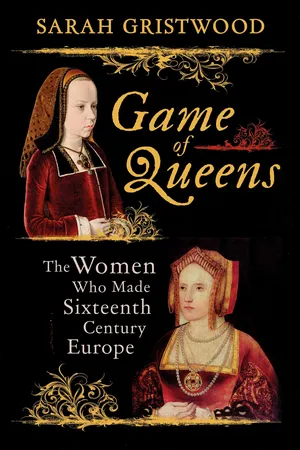
As religion divided sixteenth-century Europe, an extraordinary group of women rose to power. They governed nations while kings fought in foreign lands. They ruled on behalf of nephews, brothers and sons. They negotiated peace between their warring nations. For decades, they ran Europe. Small wonder that it was in this century that the queen became the most powerful piece on the chessboard.
From mother to daughter and mentor to protégée, Sarah Gristwood follows the passage of power from Isabella of Castile and Anne de Beaujeu through Anne Boleyn – the woman who tipped England into religious reform – and on to Elizabeth I and Jeanne d’Albret, heroine of the Protestant Reformation. Unravelling a gripping historical narrative, Gristwood reveals the stories of the queens who had, until now, been overshadowed by kings.
Frequently asked questions
Yes, you can cancel anytime from the Subscription tab in your account settings on the Perlego website. Your subscription will stay active until the end of your current billing period. Learn how to cancel your subscription.
No, books cannot be downloaded as external files, such as PDFs, for use outside of Perlego. However, you can download books within the Perlego app for offline reading on mobile or tablet. Learn more here.
Perlego offers two plans: Essential and Complete
- Essential is ideal for learners and professionals who enjoy exploring a wide range of subjects. Access the Essential Library with 800,000+ trusted titles and best-sellers across business, personal growth, and the humanities. Includes unlimited reading time and Standard Read Aloud voice.
- Complete: Perfect for advanced learners and researchers needing full, unrestricted access. Unlock 1.4M+ books across hundreds of subjects, including academic and specialized titles. The Complete Plan also includes advanced features like Premium Read Aloud and Research Assistant.
We are an online textbook subscription service, where you can get access to an entire online library for less than the price of a single book per month. With over 1 million books across 1000+ topics, we’ve got you covered! Learn more here.
Look out for the read-aloud symbol on your next book to see if you can listen to it. The read-aloud tool reads text aloud for you, highlighting the text as it is being read. You can pause it, speed it up and slow it down. Learn more here.
Yes! You can use the Perlego app on both iOS or Android devices to read anytime, anywhere — even offline. Perfect for commutes or when you’re on the go.
Please note we cannot support devices running on iOS 13 and Android 7 or earlier. Learn more about using the app.
Yes, you can access Game of Queens by Sarah Gristwood in PDF and/or ePUB format, as well as other popular books in History & Social Science Biographies. We have over one million books available in our catalogue for you to explore.
Information
PART I
1474–1513
‘Since you have given women letters and continence and magnanimity and temperance, I only marvel that you would not also have them govern cities, make laws and lead armies . . .’
The Magnifico replies, also laughing:
‘Perhaps even that would not be amiss . . . Do you not believe that there are many to be found who would know how to govern cities and armies as well as men do? But I have not laid these duties on them, because I am fashioning a Court Lady, not a Queen.’
The Book of the Courtier, Baldassare Castiglione 1528
1
Entrance
The Netherlands, 1513
The girl who arrived at the court of the Netherlands in the summer of 1513 was a courtier’s daughter, bred to know the steps of the dangerous courtly dance; a life where assets were exchanged for attendance, where favour was won by flattery. She knew how the pageantry of a Christmas masque could spell a message, how a family’s fortune could rise or fall on a ruler’s whim and that in the great chess game of European politics, even she might have a part to play.
No one, of course, had yet any idea just how great a part that would be.
She arrived as the latest of the eighteen maids of honour waiting on Margaret of Austria, the Regent of the Netherlands. At just twelve years old, she had been handed over to a stranger (one of the regent’s esquires) and escorted from her manor house home in the Weald of Kent, in England, to make the rare journey across the sea. She would have been keyed up to a pitch of excitement, but scared, too, surely. Perhaps no arrival in her life, not even her arrival at the Tower of London more than twenty years later, would be quite as alienating as this one.
Twelve years old; or about that, anyway. We do not know the date of Anne Boleyn’s birth with certainty. We deduce it, in fact, partly from the knowledge that she came to Margaret of Austria’s court in 1513 and that twelve was the youngest age at which a girl would normally take up such duties.
‘I find her so bright and pleasant for her young age that I am more beholden to you for sending her to me than you are to me’, Margaret wrote to Anne’s father. The tribute meant the more for the fact that Margaret had herself served a European-wide political apprenticeship unparalleled even in the sixteenth century. At thirty-three, after six years ruling the Netherlands on behalf of her father Maximilian and his grandson, her nephew Charles, she was a figure of international authority. To follow the early career of Margaret of Austria is to read a Who’s Who of sixteenth-century Europe. And Margaret would come to play a significant role in the lives of two of the most controversial queens in English history.
‘Whatever you do, place yourself in the service of a lady who is well regarded, who is constant and who has good judgement’, one of Margaret’s mentors, the French governor Anne de Beaujeu, had advised in a manual of instruction for her daughter. If Anne Boleyn were to learn the lesson that a woman could advance ideas, exercise authority and control her own destiny, she could hardly have fallen into better hands.
The controversial German scholar Cornelius Agrippa dedicated On the Nobility and Excellence of the Feminine Sex to Margaret of Austria. Agrippa said the differences between men and women were merely physical: ‘the woman hath that same mind that a man hath, the same reason and speech, she goeth to the same end of blissfulness, where shall be no exception of kind’, and that the only reason women were subordinate was lack of education and masculine ill-will.
In schoolgirl French – French being the chosen language of Margaret of Austria’s court – Anne Boleyn wrote to her father of her determination to make the most of her opportunities. She wrote with distinctly idiosyncratic grammar and spelling (she would strive, she wrote in that letter, to learn to speak French well ‘and also spell’) but under a tutor’s eye. Margaret’s court might be a centre both of power and of pleasure but it was also Europe’s finest seminary. The French diplomat, Lancelot de Carles, later described how the young Anne ‘listened carefully to honourable ladies, setting herself to bend all her endeavour to imitate them to perfection and made such good use of her wits that in no time at all she had command of the language’.
Portraits of the woman Anne Boleyn met in 1513 display a subtle mixture of messages. Since the end of her third and last marriage, Margaret of Austria had made a point of having herself painted always in a widow’s coif, with only the white of the headdress and the sleeves of her costume relieving the inky black. At first sight, no more sombre figure could be imagined. But appearances can be deceptive. To appear as a widow was on the surface a statement of self-abnegation, almost of weakness, a plea for pity. But in fact it allowed a woman both moral and practical authority; the only role that allowed her to operate independently, as neither child nor chattel.
In heraldry, black was the colour of trustworthiness, or ‘loyaute’. Margaret of Austria had a name for reliability but one Italian visitor noted that as well as ‘a great and truly imperial presence’, she had ‘a certain most pleasing way of laughing’. Black fabric, which needed much expensive dye and labour to produce its depth of colour, was the luxury material of the sixteenth century. And in the portrait, now in Vienna, the pale fur on Margaret’s sleeves is costly ermine. The court to which Anne Boleyn had come, whether at the summer palace of Veure (La Veuren), or at Margaret’s main base of Mechelen, was a place of culture and luxury. Among the illustrated books Anne Boleyn could have seen in Margaret’s library was the already-famous Trés Riches Heures du Duc de Berry (a legacy from Margaret’s last husband), as well as newer books decked with flowers in the margins. Anne would later exchange notes with Henry VIII in the margins of just such a book.
Erasmus was just one of the artists and thinkers Margaret of Austria welcomed to Mechelen. Outwardly large, but by palace standards an unostentatious, brick-built house, Margaret’s home was a place where devotional works jostled Renaissance nudes. A mappa mundi that Van Eyck had made for her great-grandfather, Philip the Good, sat beside more recent acquisitions. One was what Margaret’s inventories describe as ‘Ung grant tableau’ (a large picture) ‘qu’on appelle, Hernoul-le-fin’; what is now called the Arnolfini portrait. This had, said her inventories of 1516, ‘been given to Madame by Don Diego’. Don Diego de Guevara, a Spaniard who had come into the service of Margaret’s family, was another courtier with a young female relation to place in the ducal household and the Arnolfini portrait (‘fort exquis’, exquisite, as one of Margaret’s later inventories describes it) may have been a token of his gratitude and a sign of just how highly these places were sought.
Mechelen’s walls were hung with blue and yellow damask, with green taffeta, or with Margaret’s legendary collection of the tapestries for which the Netherlands was famous. Later, after the conquistador Cortés returned from Mexico, Margaret’s collection included Montezuma’s feather cloak, Aztec mosaic masks and a stuffed bird of paradise. As a northern pioneer of the kind of cabinet of curiosities beloved of Italian patrons, she employed a curator and two assistants to look after her collection.
Those in charge of young girls, Anne de Beaujeu wrote, should:
make sure they serve God, hear the Mass every day, observe the Hours and other devotions, pray for their sins, go to confession and frequently give alms. And to console them and enliven their youth and the better to maintain their love for you, you must sometimes let them frolic, sing, dance and amuse themselves happily but honestly, without groping, hitting, or quarrelling.1
A fille d’honneur had no specific duties, which makes it all the likelier that Anne would have witnessed and perhaps participated in Margaret of Austria’s pleasures. Margaret kept close by her a paintbox, covered in purple velvet and disguised as a book, which she herself used frequently. Music was another important recreation. Her choir was legendary and she herself was a notable keyboard performer and composer of songs. The masses, motets and chansons in her music books were by the composers Anne herself later favoured when her interest in music formed a bond with Henry VIII.
Margaret also played chess for recreation, with sets of chalcedony and jasper, and silver and gilt. (Her godmother, Margaret of York, who owned Mechelen before her, had kept volumes on chess in the study she hung with violet taffeta.) But Margaret of Austria played the same game also on a wider stage, as, in the years ahead, would Anne Boleyn.
The thriving, merchant-led community of the Netherlands had a tradition of social mobility. The Arnolfini portrait features not an aristocratic but an aspirational merchant couple. This too, perhaps, was not without its effect on Anne. The Boleyns themselves, you might say, were an example of English social mobility. Not that Anne came from such humble stock as has often been claimed. There was merchant money in the Boleyn family but it was Anne’s great-grandfather who had made the family fortune and become Lord Mayor of London. In the go-getting Tudor age many great families had connections closer than hers with trade. Anne was better-born than two of Henry’s other wives; her mother was a scion of the mighty Howard family, eldest daughter of the Earl of Surrey, later Duke of Norfolk and her father, Thomas, had a connection to the Irish earldom of Ormonde and his mother was heiress to half the Ormonde fortune.
But Thomas’s career in royal service began as a comparatively impecunious young man on the make. He rose rapidly, however. He was present when Katherine of Aragon was married to Henry VII’s heir in 1501 and was one of the escort that took the king’s eldest daughter Margaret Tudor to marry the King of Scots in 1503. By the time Henry VIII came to the throne in 1509 Thomas Boleyn was in his early thirties, perhaps a little too old to be one of the king’s close cronies but as an accomplished man at the joust, as well as a linguist and a clever courtier, the sort of man Henry was glad to have about him.
In 1512 Thomas was sent on his first diplomatic mission, to the court of Margaret of Austria. Anne Boleyn’s appointment there was proof of how well, in the course of a ten-month stay, the two had got on. There is a record of them shaking hands on a bet that they could advance in their negotiations in ten days, both wagering different types of horse: her Spanish courser against his hobby. In her letter to Thomas about Anne’s progress Margaret told him that if the young girl went on as well as she was doing, then ‘on your return the two of us will need no intermediary other than she’.
Beyond a general, faintly sexualised, reference to her cosmopolitan gloss and Frenchified ways, Anne’s early experience abroad does not perhaps feature as strongly as it should in our understanding of her. She is more usually placed against a background of Hever, the lovely fortified manor house in the Weald of Kent bought and remodelled by her great-grandfather and inherited by her father Thomas in 1505. Hever is where she spent most of her childhood. There – preparing to go abroad for what was always likely to be a stay of years – she would have walked around the ravishing springtime orchards and gardens, taking, with an intelligent adolescent’s intensity, a last look.
But though Mechelen too, under Margaret’s rule, had fine gardens aplenty, the contemporary image of court life dwelt on the snares and tares amid the plants. The Tudor rising classes both feared and needed the court. It was the only place where real secular preferment might be won but also the place where any slip of tongue or tactics, any overweening ambition or misplaced allegiance, could be, quite literally, fatal. This was the world into which Anne Boleyn was sent by her relations, aimed like any missile.
On the one hand she was there as her family’s agent and ambassador, as surely as her father was England’s. O...
Table of contents
- Cover
- Half Title Page
- Title Page
- Dedication
- Contents
- Illustration Credits
- Game of Queens: Who’s Who
- Maps
- Chronology
- Preface
- Author’s Note
- PART I: 1474–1513
- 1 Entrance
- 2 ‘Lessons for my Daughter’
- 3 Youthful experience
- 4 ‘Fate is very cruel to women’
- 5 Princess Brides
- 6 Repositioning
- 7 ‘False imputations’
- 8 Flodden
- PART II: 1514–1521
- 9 Wheel of Fortune
- 10 ‘a splendid New Year’s gift’
- 11 ‘One of the lowest-brought ladies’
- 12 ‘inestimable and praiseworthy services’
- 13 The Field of Cloth of Gold
- 14 Repercussions
- PART III: 1522–1536
- 15 ‘Wild for to hold’
- 16 Pavia
- 17 ‘a true, loyal mistress and friend’
- 18 New pieces on the board
- 19 ‘ladies might well come forward’
- 20 The Ladies’ Peace
- 21 Exits and entrances
- 22 ‘Thus it will be’
- 23 ‘a native-born Frenchwoman’
- 24 ‘inclined towards the Gospel’
- 25 ‘to doubt the end’
- PART IV: 1537–1553
- 26 Daughters in jeopardy
- 27 Pawns and princesses
- 28 New winds
- 29 Accommodations
- 30 ‘device for the succession’
- PART V: 1553–1560
- 31 ‘Herculean daring’
- 32 ‘not one year of rest’
- 33 Sisters and rivals
- 34 ‘if God is with us’
- 35 ‘maidenly estate’
- 36 Trouble in Scotland
- PART VI: 1560–1572
- 37 ‘Rancour and division’
- 38 ‘Two Queens in One Isle’
- 39 Challenge and conciliation
- 40 ‘Majesty and love do not sit well together’
- 41 ‘daughter of debate’
- 42 The Massacre of St Bartholomew’s Day
- PART VII: 1572 onwards
- 43 Turning points
- 44 Prise
- Postscript
- Plate Section
- A note on sources
- Acknowledgements
- Notes
- Imprint page