The War and the Death of News
eBook - ePub

The War and the Death of News

Reflections of a Grade B Reporter

  1. 400 pages
  2. English
  3. ePUB (mobile friendly)
  4. Available on iOS & Android
eBook - ePub

The War and the Death of News

Reflections of a Grade B Reporter

About this book

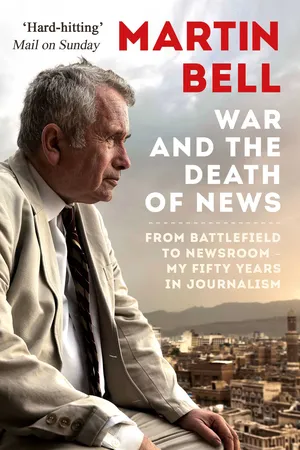
Martin Bell has stood in war zones as both a soldier and a journalist. From Vietnam to Bosnia to Iraq, he has witnessed first-hand the dramatic changes in how conflicts are fought and how they are reported. He has seen the truth degraded in the name of balance and good taste – grief and pain censored so the viewers are not disturbed.

In an age of international terror, where journalists themselves have become targets, more and more reports are issued from the sidelines. The dominance of social media has ushered in a post-truth world: Twitter rumours and unverifiable videos abound, and TV news seeks to entertain rather than inform.

In this compelling account, one of the outstanding journalists of our time provides a moving, personal account of war and issues an impassioned call to put the substance back in our news.
Frequently asked questions

Yes, you can cancel anytime from the Subscription tab in your account settings on the Perlego website. Your subscription will stay active until the end of your current billing period. Learn how to cancel your subscription.
At the moment all of our mobile-responsive ePub books are available to download via the app. Most of our PDFs are also available to download and we're working on making the final remaining ones downloadable now. Learn more here.
Perlego offers two plans: Essential and Complete
  • Essential is ideal for learners and professionals who enjoy exploring a wide range of subjects. Access the Essential Library with 800,000+ trusted titles and best-sellers across business, personal growth, and the humanities. Includes unlimited reading time and Standard Read Aloud voice.
  • Complete: Perfect for advanced learners and researchers needing full, unrestricted access. Unlock 1.4M+ books across hundreds of subjects, including academic and specialized titles. The Complete Plan also includes advanced features like Premium Read Aloud and Research Assistant.
Both plans are available with monthly, semester, or annual billing cycles.
We are an online textbook subscription service, where you can get access to an entire online library for less than the price of a single book per month. With over 1 million books across 1000+ topics, we’ve got you covered! Learn more here.
Look out for the read-aloud symbol on your next book to see if you can listen to it. The read-aloud tool reads text aloud for you, highlighting the text as it is being read. You can pause it, speed it up and slow it down. Learn more here.
Yes! You can use the Perlego app on both iOS or Android devices to read anytime, anywhere — even offline. Perfect for commutes or when you’re on the go.
Please note we cannot support devices running on iOS 13 and Android 7 or earlier. Learn more about using the app.
Yes, you can access The War and the Death of News by Martin Bell in PDF and/or ePUB format, as well as other popular books in Politics & International Relations & Journalist Biographies. We have over one million books available in our catalogue for you to explore.
1. Once a Soldier
The family was military on my mother’s side and literary on my father’s. It included a brigadier, a director of music of the Band of the Life Guards, the news editor of the London Observer and the founder of The Times crossword puzzle.
The two strands connected in the Second World War. My uncle the Brigadier, who was a German-speaker in military intelligence, assured us that the flat lands of Suffolk would be squarely in the path of the German Panzer divisions in the event of an invasion, which he thought likely. We therefore left as evacuees to Grayrigg in Westmorland, remote from the war and beyond the reach of Panzers and Luftwaffe. We sometimes forget what a close run thing that was. My father Adrian Bell, the crossword puzzle king, was also an accomplished author who wrote with a battered old typewriter and an even older quill pen. His first book, Corduroy, was a widely read celebration of farming in Suffolk before its mechanisation, which he lamented. Many soldiers carried the paperback Penguin version to the war in their kitbags as a reminder of the England that they thought they were fighting for, although it was already vanishing when he wrote about it and his book was in a sense its epitaph. Whatever else they left behind they kept Corduroy, even on the march from Dunkirk to a German prison camp. He kept in the drawer of an oak chest an envelope full of postcards and letters marked Kriegsgefangenenpost from British POWs in Germany, and others from Italy and even Singapore. His book about farming in Westmorland, Sunrise to Sunset, was translated into German. After his death in 1980, Harry Hespe, a former POW in Changi Jail, wrote to me that he had learned whole passages of Corduroy by heart. My father lifted his spirits: ‘Nightly his writings transported me in memory from a bug-ridden prison cell to the cool English countryside.’
We returned to Suffolk when the threat of invasion receded slightly. My father, who was not a military man (too young for one war, too old for the other), joined a group called the Land Defence Volunteers, a predecessor of Dad’s Army. He recalled later that they had practised standing beside barricades of farm wagons brandishing pitchforks and shotguns, preparing to delay the Germans long enough for their families to escape. They were also instructed to look out for German paratroopers. ‘To cope with these,’ wrote a company commander in Lavenham, ‘we defend our villages and have our patrols out just before daylight and after daylight.’ Defensive lines were established between concrete blockhouses that are still standing but overgrown. The railway line was to be blocked by iron struts provided by the Royal Engineers.
The officers were the landowners and the other ranks the farm labourers. My father was a bit of both: his Brick Kiln Farm near Beccles was 89 acres of heavy clay and he worked it hard. Enlisted in the Land Defence Volunteers and armed with his shotgun, he dissociated himself from a group of country writers with pro-German sympathies. These included Henry Williamson, author of Tarka the Otter, who was briefly arrested and interned. Like many others, Williamson never recovered from his experiences in the trenches in the Great War of 1914–18. He had witnessed the Christmas truce of 1914 and held an unshakeable belief in Anglo-German friendship. Another was Rolf Gardiner, founder of a group called Kinship in Husbandry and father of the conductor John Eliot Gardiner.
My own part in the war effort, as an eight-year-old, was to look out for spies, to admire the searchlights over the airfields – Suffolk and Norfolk were like a great aircraft carrier for the US Air Force – and (without telling anyone) to search the fields and ditches for unexploded munitions.
German pilots turning back from bombing raids over the Midlands used to lighten their loads by dumping them on the open spaces of East Anglia. The roadside trees had metal notices nailed to them warning us of the danger of butterfly bombs, cluster munitions that would disperse as they fell, scattering bomblets across the fields. Fortunately I never found any. The abolition of cluster bombs and anti-personnel mines was among my later causes as an MP.
One of our neighbours was Field Marshal Sir Claude Auchinleck, former commander of the Eighth Army in North Africa and (after the fall of Tobruk and his dismissal by Churchill) the Indian Army. The Auk, as we called him, was also the man who, together with General Bill Slim, turned around the fortunes of the ‘forgotten’ Fourteenth Army from defeat to victory in Burma. He was not only among the best of the generals but one of the few who never wrote his memoirs; he quietly retired to live with his sister in Beccles. He and my father and a mysterious ‘Count Baxendale’ who lived in the same street were drinking companions in the Cambridge Inn, where their host was the one-legged landlord Harry Young. All they had in common was a fondness for each other’s company and for Harry’s beer. My father was a master of unconsidered trifles: he could pluck an idea from a conversation and turn it into an eight hundred word meditation for his weekly column in the Eastern Daily Press. Whenever I eavesdropped, the discussions at the Cambridge were not about the Auk’s extraordinary past, but about the river, the weather and traffic congestion in the Waveney Valley. My father was a practical mystic who ploughed his fields, and dreamed his dreams as he did so: when asked about his politics, he said, ‘I am on the side of those who cultivate their gardens.’ The Auk had a flagpole beside his house in Northgate, and every morning he raised the family flag, which looked remarkably like one of my father’s crossword puzzles. When the Field Marshal was in India, one of the units under his command was the 2nd Battalion of the Suffolk Regiment, which he greatly admired. This was the Regiment that I joined in 1957.
It was not done out of enthusiasm for soldiering. These were the years of National Service and I had no choice in the matter. So overnight I became Private 23398941 Bell M of the Suffolk Regiment. I completed the ten weeks of basic training at Gibraltar Barracks in Bury St Edmunds. The massive red brick Keep, which is all that remains of it now, housed the offices of the Officer Commanding and the Adjutant, the Quartermaster’s store, the guard room and the coal store. The coal was painted white for a reason. If any of it was pilfered, the Quartermaster Sergeant would know immediately.
I had never been shouted at before, and it seemed that anyone with the badge of authority on his sleeve had the right to shout at me and did so regularly, not only on the parade ground, but wherever he could find me. There would be no escape until demob. The first of many warlords in my life was Jack Gingell, Regimental Sergeant Major of the regiment’s 1st Battalion, who served in Palestine, Cyprus and later Bury St Edmunds. He had a voice like a megaphone and the ground shook when he drilled on it. Even the officers were terrified of him. They were a somewhat mixed bunch. The Commanding Officer, Lieutenant Colonel Bertie Bevan, was like Captain Mainwaring minus the social skills. I looked back on army life, without nostalgia, as the proliferation of all things uncivilised. When I was demobbed, the certificate of discharge signed by his successor, Lieutenant Colonel Malcolm Dewar, described my military conduct as ‘very good’. The RSM would have taken issue with that. I still have nightmares about him.
From October 1957 to May 1959 I was an OR (other rank) in the Battalion in Cyprus, having spectacularly fallen short of becoming an officer when I failed the intelligence test, not just once but twice. It was clear to the presiding Brigadier in Westbury, and even to me, that I was just not officer material. It was the first of life’s fences that I fell at and did me no end of good. I started as a private soldier and rose eventually to the rank of Acting Sergeant, complete with its trappings of silver-topped pace-stick and red sash, in the campaign to defeat the rebels of EOKA.
Cyprus had been acquired by Britain from Turkey as a protectorate in 1878. It later became a colony and slept in the sun until April 1955, when the insurgents of EOKA, the National Organisation of Cypriot Fighters, staged an armed uprising against their British rulers. The population was eighteen per cent Turkish and we in the Suffolks spent much of our time putting down riots in the Turkish quarter of Nicosia. The counter-insurgency campaign ultimately failed, although when we sailed away from Limassol on the troopship Dilwara in May 1959, under the cover of a constitutional agreement, we were congratulated by the Governor and led to believe that we had contributed to a lasting settlement. But it was the best education that I ever had.
The first lesson was about fieldcraft, which is the art of staying alive in dangerous places. I had no idea at the time how useful it would be in a career that started in the ditches of Vietnam and ended in the trenches of Bosnia. It makes quite a difference in a war zone to go into it knowing the uses of dead ground, and which kinds of cover will stop a high velocity bullet and which will not. It is the application of common sense to life-threatening situations. Map-reading can come in handy too. So can battlefield first aid. The gifted film-maker Tim Hetherington, creator of Restrepo, the documentary masterpiece about Afghanistan that I introduced in the West End in December 2010, died in Libya six months later because he had no one with him who knew how to bind up a wound.
War-zone reporting required fieldcraft plus: never enter no man’s land, never cease asking minefield questions, always have an escape route open, agree among yourselves what risks to take and not to take – and when you have done the business get the hell out as fast as you can. I knew some who lingered too long and who paid with their lives. Or, in the worst case, others paid for them, as happened most tragically in Afghanistan. Soldiers do not enjoy having to risk their lives by rescuing journalists from scrapes that they have got themselves into.
Having been a soldier was useful too in the Gulf in 1991, when the Army adopted the practice of embedding, which meant going to war with the press alongside them in the order of battle. I already knew such basics as that a soldier in the Parachute Regiment is called a ‘Tom’ (as in Thomas Atkins). I did not have to ask the difference between direct and indirect fire, a battalion and a brigade, a colonel and a lieutenant colonel, or an armoured personnel carrier and a tank. I was at least semi-trained. My intrepid cameraman at the time, and later in Bosnia, was Nigel Bateson, who had seen active service with the South African Army in Namibia. He too could relate to soldiers, having been one. One of his techniques was to tell them how ugly they were (he was no beauty himself). So we started off on the front foot.
Lesson two was about people. I had led too sheltered a life till then. Soldiering in general and the RSM in particular shook me up and brought me face to face with the real world. It taught me too that leadership is not about giving orders: it is about earning trust and respect. I applied this many years later in Sarajevo, where I ran the BBC team like an infantry section, of which I as an ex-corporal was only the nominal leader. There were only four of us, the correspondent myself, the cameraman Nigel, the videotape editor Carl and the interpreter Anamarija who called herself, with reason, our ‘wicked witch’. We worked together and were totally dependent on each other, as if it was a matter of life and death, which it sometimes was. I would even say that we loved each other. I loved the mountainous South African as much as the beautiful Croat. The Army teaches togetherness. It does not believe in ‘jacking’, which means wandering off and doing your own thing. You succeed together or you fail together. The same applies to television. In spite of the pressures, or perhaps because of them, we had the time of our lives. It was not in any of the training manuals like Staff Duties in the Field, but the Army taught me about teamwork. You become firm friends with people in wartime who, in peacetime, you would cross the street to avoid. A French radio reporter in Sarajevo, Paul Marchand, had a sign on the back of his battered old soft-skinned car that said: ‘Don’t shoot, you will waste your bullets – I’m immortal!’ Sadly, it did not work for him. He was wounded during the war and took his own life after it.
Lesson three was that the British Army has an ingrained suspicion of charismatic officers. Lieutenant Colonel Arthur Campbell of the Suffolk Regiment was not only an outstanding soldier but an established author. Someone who knew him well observed: ‘Larger-than-life characters like Arthur do not come along very often.’ He had written a lightly fictionalised account of the British campaign in Malaya in the 1950s, Jungle Green, which was an instant best-seller. He was then commissioned by Field Marshal Sir John Harding, Governor of Cyprus, to write a book about the Cyprus campaign, which Harding thought he was winning. Campbell did so in six months. By the time he had finished it Harding had been replaced by a diplomat, Sir Hugh Foot, who ordered the total suppression of the book on the grounds that it would impede a settlement. It was called Flaming Cassock (an unflattering reference to the Greek Cypriot leader Archbishop Makarios) and lay in limbo under lock and key until I finally obtained it under the Freedom of Information Act in 2014. After an incident that had nothing to do with his soldiering, Arthur Campbell was let go at the rank of full colonel. A similar fate happened more than thirty years later to Lieutenant Colonel Bob Stewart, Commanding Officer of the 1st Battalion the Cheshire Regiment in Bosnia. He spoke his mind too freely and appeared too much on television (my fault entirely). He too left the Army and started anew. He is now the Conservative MP for Beckenham, resting on a comfortable majority. And he does not have to deal with brigadiers and generals, or Balkan warlords, but only with his party’s Deputy Chief Whip whom he cheerfully ignores. Officers who make waves make enemies, and are rewarded with early retirement. It is the ticks-in-the-boxes types who rise to the top and end up with frock coats and knighthoods and peerages.
Lesson four was that hammers don’t build houses: the indiscriminate use of force not only fails to deliver the results expected of it, but actually defeats its own purposes. In Cyprus an army of thirty-five thousand men trained in counter-insurgency, including myself, failed to put down a force of no more than two hundred lightly armed rebels, most of them hiding in caves and mine-shafts, and many of them escapees from British custody. Even our prisons were porous. Some of the most dangerous EOKA fighters had escaped from Kyrenia Castle by knotting sheets together and climbing down them. We soldiers did not fail through lack of effort. We did all that we were ordered to and more; the problem was that the strategy was mistaken and the orders were dumb. We cordoned and searched the villages comprehensively: it was called ‘village-bashing’. We benighted the towns with our curfews. We paralysed the transport system with our roadblocks. We imposed collective punishments on whole communities. In July 1958 we held the entire island under lockdown for forty-eight hours for the big push, which was supposed to deliver victory, called Operation Matchbox. We interned more than three thousand Greek Cypriots of military age and some who were younger. All we achieved was to alienate the people we were trying to win over and to recruit for our enemy. Even as a thoughtless young soldier I described it in one of my letters home as ‘armed repression’. We were fighting...

Table of contents

  1. Cover
  2. PRAISE FOR MARTIN BELL AND WAR AND THE DEATH OF NEWS
  3. Title Page
  4. Dedication
  5. Contents
  6. Introduction
  7. 1. Once a Soldier
  8. 2. Geunyeli
  9. 3. Undertones of War
  10. 4. Lessons of Vietnam
  11. 5. Victor’s Justice
  12. 6. The Something Must Be Done Club
  13. 7. The Violent Screen
  14. 8. Never Wrong for Long
  15. 9. The Age of the Embed
  16. 10. The Language of War
  17. 11. ‘Trust Me . . . I’m a Journalist’
  18. 12. ‘Totally Unsuited to Politics . . .’
  19. 13. No Man’s Land
  20. 14. Terrorism and Jihad
  21. 15. Iraq – the Reckoning
  22. 16. Observations
  23. 17. golden rules of TV News
  24. 18. The Death of News
  25. Endnotes
  26. Inserts
  27. Imprint Page