Polished Mirror
eBook - ePub

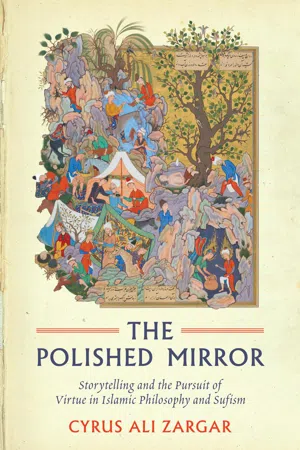
Polished Mirror

Storytelling and the Pursuit of Virtue in Islamic Philosophy and Sufism

  1. 352 pages
  2. English
  3. ePUB (mobile friendly)
  4. Available on iOS & Android
eBook - ePub

Polished Mirror

Storytelling and the Pursuit of Virtue in Islamic Philosophy and Sufism

About this book

Islamic philosophy and Sufism evolved as distinct yet interweaving strands of Islamic thought and practice. Despite differences, they have shared a concern with the perfection of the soul through the development of character. In The Polished Mirror, Cyrus Ali Zargar studies the ways in which, through teaching and storytelling, pre-modern Muslims lived, negotiated, and cultivated virtues. Examining the writings of philosophers, ascetics, poets, and saints, he locates virtue ethics within a dynamic moral tradition.Innovative, engaging, and approachable, this work – the first in the English language to explore Islamic ethics in the fascinating context of narrative – will be a valuable resource for both students and scholars.
Frequently asked questions

Yes, you can cancel anytime from the Subscription tab in your account settings on the Perlego website. Your subscription will stay active until the end of your current billing period. Learn how to cancel your subscription.
No, books cannot be downloaded as external files, such as PDFs, for use outside of Perlego. However, you can download books within the Perlego app for offline reading on mobile or tablet. Learn more here.
Perlego offers two plans: Essential and Complete
  • Essential is ideal for learners and professionals who enjoy exploring a wide range of subjects. Access the Essential Library with 800,000+ trusted titles and best-sellers across business, personal growth, and the humanities. Includes unlimited reading time and Standard Read Aloud voice.
  • Complete: Perfect for advanced learners and researchers needing full, unrestricted access. Unlock 1.4M+ books across hundreds of subjects, including academic and specialized titles. The Complete Plan also includes advanced features like Premium Read Aloud and Research Assistant.
Both plans are available with monthly, semester, or annual billing cycles.
We are an online textbook subscription service, where you can get access to an entire online library for less than the price of a single book per month. With over 1 million books across 1000+ topics, we’ve got you covered! Learn more here.
Look out for the read-aloud symbol on your next book to see if you can listen to it. The read-aloud tool reads text aloud for you, highlighting the text as it is being read. You can pause it, speed it up and slow it down. Learn more here.
Yes! You can use the Perlego app on both iOS or Android devices to read anytime, anywhere — even offline. Perfect for commutes or when you’re on the go.
Please note we cannot support devices running on iOS 13 and Android 7 or earlier. Learn more about using the app.
Yes, you can access Polished Mirror by Cyrus Ali Zargar in PDF and/or ePUB format, as well as other popular books in Theology & Religion & Ethics & Religion. We have over one million books available in our catalogue for you to explore.

Information

PART ONE

Islamic Philosophy

Chapter One

The Humors (al-akhlā) and Character Traits (al-akhlāq) According to the Brethren of Purity

For those of you who, like me, spend time imagining the inner workings of real secret societies, the Brethren of Purity and Friends of Loyalty (Ikhwān al-afāʾ wa Khullān al-Wafāʾ) provide much food for thought. The Brethren hid their identities (or the identity of one person posing as many) so carefully that, even after a thousand years, scholars of Islamic intellectual history remain uncertain of their identities. Further kindling the sense of intrigue surrounding the Brethren is their interest in the esoteric sciences, especially magic.1 The idea of secrecy is important when thinking about the ethical dimension of their writings. For the Brethren, knowledge is premised on a sense of worthiness, an elitism that assumes that not everyone has the proper balance of virtues or even the capability for such a balance. Thus, the esoteric or hidden sciences—medicine, alchemy, astrology, and the science of talismans (and magic)—must remain hidden.2 Moreover, related to these sciences is a hierarchical view of the universe. Medicine brings the body’s humors into balance, so that it resembles higher, more balanced forms of being, such as planets. In alchemy, base metals become transubstantiated into a higher one, gold, also by balancing the properties of those metals—cold and wet, versus hot and dry. Astrology and the science of talismans (which often involves the astrological significance of symbols and letters) both presume that the higher, celestial realm directly affects human life. In other words, as the Brethren clarify in their twelfth epistle, all substances in the sublunary realm—whether meteorological, mineral, plant, or animal—become subject to internal incongruity and decay, and must strive for balance.3 Alchemy and ethics both aim at using the principle of balance to convert lower substances, base metals and lower souls, respectively, to the highest, most balanced ones, namely, gold and the intellect.
Ethics, then, as a balancing of human character traits, is a type of alchemical transubstantiation. It aims at human perfection. In fact, the human being’s centermost quality is perfectibility. Human potential outstrips the potential of other creatures, in large part because the human being as presented by the Brethren encompasses the entire universe of perfection—if only the human being endeavors to do so. The human, for the Brethren, is a microcosm. Rather, more accurately, the cosmos is a “macranthrope,” a human of astronomical proportions, as they explain in their sixteenth epistle.4 Thus, ethics allows each human to put the universe back in order, albeit one’s own internal universe, namely, the human self. Fraternities such as that of the Brethren were focused on giving life to this perfection-making process, not only for the individual, but for a larger group of people, indeed anyone who might join them in their vision of the self and the universe. The political side to their approach, namely, that love and friendship might take the place of power and coercion, was based on the idea that humans can live in a natural, harmonious way, like the planets, as opposed to the ruthless way of tyrants, a vicious method of rule beneath even predatory beasts. Because the Brethren were interested in a universal human, they were interested in universal knowledge, which helps explain the vast range of topics they cover. Because of that range of topics, statements about ethics and the cultivation of virtues (like their statements on astrology) appear scattered throughout their writings, placed in the context of other sciences. It is probably on account of the encyclopedic nature of their writings that the Brethren were so widely read, since they were not the authorities of their age in philosophy or the natural sciences.5
So, who were they? While there is no consensus, the Brethren were most likely bureaucrats in the city of Basra, Iraq, living in the latter half of the tenth century, probably adhering to Ismāʿīlī (Ismaʿili) Shiʿism. Ismaʿili Shiʿism, like other branches of Shiʿism, maintains an alternate model of leadership than the Sunni caliphate, arguing that a living, just, and often infallible imam should be at the helm of the Muslim community. The Brethren’s imam, an unidentified hidden imam whom they probably considered the promised deliverer of humanity (al-mahdī), is the voice of one of the epistles of the Brethren (the forty-eighth). In this epistle he encourages adherence to the contemplative, philosophical Shiʿism the Brethren espouse throughout.6 The other epistles are said to have been authored by Zayd ibn Rifāʿa, Abū Sulaymān Muammad ibn Maʿshar al-Bustī “al-Maqdisī,” Abū al-asan ʿAlī ibn Hārūn al-Zanjānī, Abū Amad al-Mihrajānī “al-Nahrajūrī,” Abū al-asan al-ʿAwfī, and Abū Muammad ibn Abī al-Baghl.7 This assumes that all of the epistles were indeed composed in the 960s or 970s, yet compelling evidence suggests that parts existed before this date, as early as a century before.8
The fifty-one epistles of the Brethren, which might have been fifty or even fifty-two, initiated the reader (addressed as “brother” throughout) into their worldview, a Neoplatonic and yet also Qurʾanic and Shiʿi perspective on the universe.9 Indeed, the Brethren were not reticent about their mission to propagate their doctrines, nor about the success of their recruitment. They spread their epistles and carefully recruited suitable converts, including princes and other high-ranking officials who secretly aligned with them.10 It is difficult to measure the range of influence of these epistles, simply because passages are frequently taken or summarized without credit, referenced but not cited often because of controversy surrounding the epistles and the Ismaʿilism of their authors. In fact, the Sunni caliph al-Mustanjid (r. 1160–70) supposedly had the epistles incinerated in full view of the people of Baghdad.11
Influences on the Brethren span Greek, Christian, Jewish, Indian, and Islamic sources, as discussed by Ian Richard Netton in Muslim Neoplatonists. In terms of the discussion below, Greek influences are especially relevant. The idea that the number “four” represents balance (and hence justice) relates directly to the Pythagorean notion that reality is constructed according to numerical relationships. Indeed, the Brethren directly refer to, and even quote, the Gold...

Table of contents

  1. Cover
  2. Title Page
  3. Dedication
  4. Contents
  5. List of Illustrations
  6. Introduction
  7. Part One: Islamic Philosophy
  8. Part Two: Sufism
  9. Conclusion: A Brief Case for Relevance
  10. Acknowledgments
  11. Bibliography
  12. Index
  13. Copyright