Hormonal
eBook - ePub

Hormonal

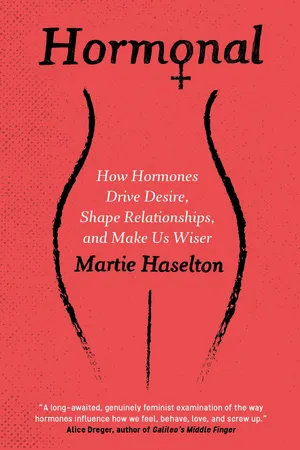
How Hormones Drive Desire, Shape Relationships, and Make Us Wiser

  1. English
  2. ePUB (mobile friendly)
  3. Available on iOS & Android
eBook - ePub

Hormonal

How Hormones Drive Desire, Shape Relationships, and Make Us Wiser

About this book

Provocative, ground-breaking and entertaining, the world’s leading expert on sexuality and the ovulation cycle reveals the hidden intelligence of hormones.

In this paradigm-shifting book, Martie Haselton explains how hormonal intelligence works - both its strengths and its weaknesses - and shows women how to track and understand their desires, fears and perceptions with a radical new understanding of the biological processes that profoundly influence our behaviour. Rigorously researched, entertaining and empowering, Hormonal offers women deep new insights into their bodies, brains and relationships, and will encourage women everywhere to embrace the genius of female biology.
Frequently asked questions

Yes, you can cancel anytime from the Subscription tab in your account settings on the Perlego website. Your subscription will stay active until the end of your current billing period. Learn how to cancel your subscription.
No, books cannot be downloaded as external files, such as PDFs, for use outside of Perlego. However, you can download books within the Perlego app for offline reading on mobile or tablet. Learn more here.
Perlego offers two plans: Essential and Complete
  • Essential is ideal for learners and professionals who enjoy exploring a wide range of subjects. Access the Essential Library with 800,000+ trusted titles and best-sellers across business, personal growth, and the humanities. Includes unlimited reading time and Standard Read Aloud voice.
  • Complete: Perfect for advanced learners and researchers needing full, unrestricted access. Unlock 1.4M+ books across hundreds of subjects, including academic and specialized titles. The Complete Plan also includes advanced features like Premium Read Aloud and Research Assistant.
Both plans are available with monthly, semester, or annual billing cycles.
We are an online textbook subscription service, where you can get access to an entire online library for less than the price of a single book per month. With over 1 million books across 1000+ topics, we’ve got you covered! Learn more here.
Look out for the read-aloud symbol on your next book to see if you can listen to it. The read-aloud tool reads text aloud for you, highlighting the text as it is being read. You can pause it, speed it up and slow it down. Learn more here.
Yes! You can use the Perlego app on both iOS or Android devices to read anytime, anywhere — even offline. Perfect for commutes or when you’re on the go.
Please note we cannot support devices running on iOS 13 and Android 7 or earlier. Learn more about using the app.
Yes, you can access Hormonal by Martie Haselton in PDF and/or ePUB format, as well as other popular books in Medicine & Anatomy. We have over one million books available in our catalogue for you to explore.

Information

Subtopic
Anatomy
1
The Trouble with Hormones
“DON’T ASK HOLLY FOR a raise today; she’ll eat you alive.” Why’s that? She’s hormonal. “She’s happy with everything one minute, but then she gets so upset the next.” She’s hormonal. “Whoa, she’s coming on to everything with a pulse.” She’s hormonal.
Difficult female … baby machine … crazy lady … red-hot momma … ice queen … bitch on wheels.
No matter how modern and progressive an age we may live in (or think we live in), all those female stereotypes are still very much alive today. They most certainly didn’t vanish in the last century as women entered the workforce in record numbers, rising to leadership positions in virtually every field and eventually overtaking the number of males who graduate from American colleges and universities.1
But those aren’t just ordinary stereotypes, because they have a biological component that sets them apart from the other tired notions like damsel in distress. Those perceptions of women — as well as many others that crop up in everyday situations at work, at home, at school — spring from one central idea: that female hormones control female behavior, as in She’s hormonal.
She’s hormonal — her monthly fluctuating levels of estrogen and other female reproductive hormones are making her act this way. But that’s not a very catchy thing to say.
Here’s the truth: Perhaps she is hormonal, but all humans, male and female, have hormonal cycles. (No one would ever say that a man is hormonal, at least not with the same negative connotations, even though testosterone levels have a daily up-and-down cycle, not a monthly one.) It might be only a tad more decorous than “she’s on the rag,” but women seem to own the “hormonal” label.
Here’s the problem: Explaining female behavior — particularly behavior that is seen as overly aggressive, unbalanced, or somehow out of character for that girl or woman — by attributing it to sex hormones is a gross and damaging oversimplification. In essence, it says that females have little to no control over their actions because they are governed by their biology. But that dumbed-down interpretation overshadows something valuable, important, and life changing for both women and men.
In fact, women’s hormone cycles embody half a billion years of evolutionary wisdom. While hormones most definitely influence female behavior — I am writing a whole book about it, after all — there is a hidden intelligence embedded in the female fertility cycle: an ancient knowledge that women can use to make the best decisions in their modern lives. Behind the everyday behavior that some interpret as simply “hormonal,” there is a biochemical process that has helped females — billions across thousands of species — choose mates, avoid rape, compete with female rivals, fight for resources, and produce offspring with fit genes and good prospects. To master these challenges, female brains evolved to conspire with their hormones rather than be corrupted by them.
Hormones are a crucial reason we’ve survived and thrived.
Biology Is Not Destiny (but It Is Political)
As a scientist and as a feminist, I’ve learned that any discussion of female hormones and the role they play in a woman’s behavior can be rough terrain to negotiate, even in circles of like-minded thinkers. At first this took me by surprise — I thought everyone would want to have the benefit of this knowledge, especially women. We’re entitled to understand how our bodies and minds work and why. But I’ve come to see that the facts get cherry-picked, then lost in a volatile mix of sexual politics. Misinformed sexists still find a way to twist the truth and use biological differences as a hurdle too high for women to clear. Feminists rightly don’t want that to happen. And because of this dynamic, it becomes difficult to untangle myth from reality.
Take, for example, a highly controversial CNN story from the 2012 election year, when hormones themselves seemingly went to the polls. Two weeks before the election, the network published a story on its website reporting that according to a soon-to-be-released study,2 during ovulation (when fertility is highest), single women favored President Barack Obama and his policies over those of Governor Mitt Romney. The story explained the researchers’ findings this way: “When women are ovulating, they ‘feel sexier,’ and therefore lean more toward liberal attitudes on abortion and marriage equality.”3 Meanwhile, married women or those in committed relationships tilted toward the more conservative Romney, said the story.
The backlash was fast and furious, thanks to rapid-fire blogs and Internet news. “CNN thinks crazy ladies vote with their vaginas,” wrote Jezebel’s Katie Baker. “Hot for Obama, but Only When This Smug Married Is Not Ovulating,” was the headline for Kate Clancy’s response on Scientific American’s website. “This is exactly the nightmare image of Women Rampaging Through the Polls Judging Candidates by the Strength of Chin that has so bedeviled female candidates for so long,” wrote the Washington Post’s Alexandra Petri. CNN took down the story within a few days, the reporter was mocked, and the lead author of the study was overwhelmed with hate mail.
The CNN retraction was seen as a victory for women, a mark of their political progress and a world away from 1970s politics, when a prominent political figure declared that women’s “raging hormonal influences” disqualified them from leadership positions. Dr. Edgar Berman was a member of the Democratic National Party’s Committee on National Priorities and a top adviser to Vice President Hubert Humphrey, as well as his personal physician. In 1970, when a female member of Congress suggested that women’s rights be given top priority within the party, Berman’s negative response was dismissive and downright Victorian. He cited the menstrual cycle and menopause as reasons why women would never achieve equality.
“If you had an investment in a bank,” he explained, “you wouldn’t want the president of your bank making a loan under these raging hormonal influences at that particular period.” He went on. “Suppose we had a President in the White House, a menopausal woman president who had to make the decision of the Bay of Pigs, which of course was a bad one, or the Russian contretemps with Cuba at the time?” Berman essentially implied that a moody female leader of the free world would pick up the red telephone in the Oval Office and bitch out the Kremlin, triggering a nuclear holocaust. (It’s after the 2016 presidential election as I write this — oh, the irony.)
There is some evidence that Berman, a staunch Democrat who advocated for women’s issues like daycare and easier access to birth control, was trying to move the discussion along to issues like Vietnam and was making an attempt at humor, but if so, his listening skills were way off and his comedic timing was truly lousy. This was a crucial moment for the women’s movement, when its leaders were trying to call attention to issues like equal pay and create support for the Equal Rights Amendment. Along comes Berman, who delivers a punch line that feeds right into the sexist notions of a woman’s place being in the home. The Mary Tyler Moore Show, featuring career-minded Mary Richards, debuted in 1970, the same year Berman declared women too hormonal. But the beauty queens on The Miss America Pageant were still pulling in more viewers than Mary, and Samantha of Bewitched, for all her pluckiness, spent a lot of time cleaning the house (like a mortal).
Even without the Internet, it didn’t take long for Berman’s comments to go public, and within a few months he resigned from his committee position. Not only were his politics questioned, but so was his scientific knowledge. “To talk about ‘raging hormonal influences’ is nonsense, or at least a gross overstatement,” said Harvard endocrinologist Dr. Sidney Ingbar, voicing a professional opinion that would be echoed by others. “Anyone who speaks with authority,” added psychiatrist Dr. Leon J. Epstein of the University of California, “stands on a firm foundation of prejudice or unsupported conviction.”4
Unlike CNN, however, Berman did not retract his statements and in fact he dug in his heels. Defending his comments later on, he wrote, “No physician (and most women) could possibly deny that during certain periods in the life span of many women there is stress and emotional disturbance over and beyond that occasioned by the average male. I stated that all things being equal during these periods of strain, I personally valued the male judgment in crucial decisions…. I cannot and shall not retract a scientific truth.”5
Of course, there is no “scientific truth” behind Dr. Berman’s comments. But he was voicing a commonly held belief about women that had persisted for generations, even centuries — that female hormones were messy and problematic, something that needed to be “fixed.” Menstruation and menopause were considered embarrassing topics, and women weren’t being given much information about their bodies by the medical community. There was “the curse,” there was “the change,” and in between there were the shadowy topics of sex, pregnancy, and childbirth.
But right around the same time that Berman made these outrageous claims, a group of women had gathered in Boston. They had just published a 193-page stapled booklet on women’s reproductive health: graphic talk on sexuality, pregnancy and childbirth, abortion, and other then-taboo topics. Now they were revising their humble but daring newsprint publication into what would become the first edition of Our Bodies, Ourselves, the blockbuster women’s health bible that changed the landscape by putting self-knowledge about the female body — and the power that came with it — directly into the hands of women.6
We’ve come a long way, baby. Still, it’s worth remembering how much further we need to travel. Don’t forget what then presidential candidate Donald Trump said in 2015 when he complained about a female journalist who pressed him hard on his derogatory descriptions of women; he implied that she did so because she had “blood coming out of her wherever.”
In other words, forty-five years later, she’s still hormonal.
The Vicious Cycle (of Hormones)
It’s not just male bias that has stopped us from diving right into the good stuff about hormones and female behavior. Sometimes, it’s women themselves who throw up the biggest barriers — including women who have dedicated themselves to achieving equality between men and women in the workplace.
As soon as we acknowledge a difference between the sexes, the thinking goes, we lose ground in the battle and will never be treated like equals. Instead we’ll be seen as weak, vulnerable, incapable. A pregnant woman will be viewed as hearing the hormone-triggered call of motherhood and won’t want to come back to work — don’t bother promoting her. An older woman in menopause won’t be able to give 100 percent because her sleepless, hot flash–filled nights and forgetful female brain will impact her work performance, plus she’ll be really difficult to deal with some days. Don’t bother promoting her, either.
An artist I know recently ran right up against this line of thinking, but in a rather surprising way. Though her work was designed to empower women, she suddenly found herself being put in her place — by other feminists. When asked by friends at a dinner party what she was working on, she described her latest project: an online art installation called The Invisible Month,7 a visually whimsical presentation of how estrogen and progesterone levels affect female behavior, organized around the twenty-eight-day hormonal cycle and using a flower metaphor — budding, flowering, and wilting.
For instance, if a visitor clicked on an icon for “The Budding Phase,” she would see general information about estrogen and progesterone levels as well as statements (with citations from scientific literature) like this: “Estrogen creeps higher this first week and a sense of well-being increases. Mood is elevated, sleep is level. Women experience clarity of thinking, superb ability to concentrate.” If a visitor clicked later in the cycle, say, “The Flowering Phase,” she might see something like this: “Women are more receptive to men now. During the ovulatory part of their cycle, women were more likely to give their phone number to random male strangers who approached them in a park.” (Though the reality here is that he would have to be a very handsome stranger.) Or, in “The Wilting Phase”: “Menstrual migraines reduce work productivity.”
“What you’re saying,” said one friend with alarm, “is that women don’t have free will.” Added another, “That’s right! What if your project gets into the wrong hands of, say, the Goldman Sachs CEO, who is persuaded that women can’t be in leadership roles?” Another person added, “You’re basically saying that if a woman says no, just ask her in two weeks to get a yes.” And the criticism kept coming. She was stunned at their response. These were all successful, educated, and forward-thinking individuals, but they seemed to be telling her to shut it down, to keep this information under wraps so that she wouldn’t set women back.
Her initial mission had been simple. “I created the work as a public service work,” she explained, as a way to help women — and men — see how an internal process has an external impact.8 As an artist, she says, that concept of internal/external has long captured her imagination. With The Invisible Month, she was creating art, and at the same time she was sharing information that she thought other women would want to have and would embrace. But to her friends, she was opening a Pandora’s box of sexual politics.
I know the feeling.
Tossing Out the Biological Baby with the Sexist Bathwater
When I first began researching the hormonal cycle, my field of social science was firmly grounded in the idea that we humans, with our big, handsome brains and opposable thumbs, were mightily different from our friends in the animal kingdom. Though of course we’d acknowledged some vital evolutionary links, we drew the line when it came to our minds, our desires, and our sexual behavior. We had sex when we wanted to — not when nature told us to. The other mammals were at the mercy of their hormones, all in the name of reproduction. Squirrels ran around and acted insane, then jumped on each other. We exchanged phone numbers.
You could say that my research is about seeing the animal in the human, something I’ve done my entire career. Making that animal-human connection is not always popular in certain academic circles or within some branches of science, where the thinking is that we humans are culturally advanced beings, with complex intellects and emotions interwoven with free will. For hundreds of years, countless scientists have labored to establish the very real differences between the human and the animal. Entire fields of study, and society itself, are built around the concept that human nature is what makes us special, different, better. If we do something, we do it for our own reasons — not because we’re at the mercy of some chemical reaction triggered by sex hormones. We operate out of elegant human nature, not base animal instincts.
But the discoveries from my lab suggest that fertile women seek out the most attractive men — just as it happens among female and male primates, hamsters, and many species in between. (I discuss this research in depth in Chapter 5.) I’d studied hormones and relationships in animals, noting a pattern of behavior across the species that was impossible to ignore: Very simply put, when females — monkeys, rats, cats, dogs, and others — are most likely to conceive during their hormonal cycles, they consistently behave in ways that seem designed to attract males who offer the promise of especially fit offspring — “fit” meaning that they would have been better able to survive or reproduce in ancestral environments. Obviously the manifestation varies from species to species, but I couldn’t accept that humans were entirely exempt from this predictable physical phenomenon.
Women are able to conceive for only a few days a month, making human fertility somewhat fragile and fleeting. Why wouldn’t we have a way of making the best sexual decisions at this crucial time? Beginning in 2006, I started publishing research...

Table of contents

  1. Cover
  2. Title
  3. Contents
  4. Introduction: The New Darwinian Feminism
  5. 1. The Trouble with Hormones
  6. 2. Heat Seekers
  7. 3. Around the Moon in Twenty-Eight Days
  8. 4. The Evolution of Desire
  9. 5. Mate Shopping
  10. 6. The (Not Quite) Undercover Ovulator
  11. 7. Maidens to Matriarchs
  12. 8. Hormonal Intelligence
  13. Acknowledgments
  14. Notes
  15. Index
  16. Copyright