Oneiron
eBook - ePub

Oneiron

  1. 384 pages
  2. English
  3. ePUB (mobile friendly)
  4. Available on iOS & Android
eBook - ePub

About this book

‘This book is stunning, phenomenal, wow.’ Cecelia Ahern, author of P.S. I Love You

WINNER OF THE FINLANDIA PRIZE

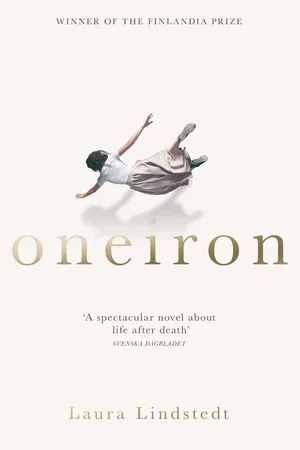
Seven women meet in a white, undefined space seconds after their deaths

Time, as we understand it, has ceased to exist, and all bodily sensations have disappeared. None of the women can remember what happened to them, where they are, or how they got there. They don’t know each other. In turn they try to remember, to piece together the fragments of their lives, their identities, their lost loves, and to pinpoint the moment they left their former lives behind.

Deftly playing with genres from essay to poetry, Oneiron is an astonishing work that explores the question of what follows death and delves deep into the lives and experiences of seven unforgettable women.
Frequently asked questions

Yes, you can cancel anytime from the Subscription tab in your account settings on the Perlego website. Your subscription will stay active until the end of your current billing period. Learn how to cancel your subscription.
At the moment all of our mobile-responsive ePub books are available to download via the app. Most of our PDFs are also available to download and we're working on making the final remaining ones downloadable now. Learn more here.
Perlego offers two plans: Essential and Complete
  • Essential is ideal for learners and professionals who enjoy exploring a wide range of subjects. Access the Essential Library with 800,000+ trusted titles and best-sellers across business, personal growth, and the humanities. Includes unlimited reading time and Standard Read Aloud voice.
  • Complete: Perfect for advanced learners and researchers needing full, unrestricted access. Unlock 1.4M+ books across hundreds of subjects, including academic and specialized titles. The Complete Plan also includes advanced features like Premium Read Aloud and Research Assistant.
Both plans are available with monthly, semester, or annual billing cycles.
We are an online textbook subscription service, where you can get access to an entire online library for less than the price of a single book per month. With over 1 million books across 1000+ topics, we’ve got you covered! Learn more here.
Look out for the read-aloud symbol on your next book to see if you can listen to it. The read-aloud tool reads text aloud for you, highlighting the text as it is being read. You can pause it, speed it up and slow it down. Learn more here.
Yes! You can use the Perlego app on both iOS or Android devices to read anytime, anywhere — even offline. Perfect for commutes or when you’re on the go.
Please note we cannot support devices running on iOS 13 and Android 7 or earlier. Learn more about using the app.
Yes, you can access Oneiron by Laura Lindstedt, Owen Witesman in PDF and/or ePUB format, as well as other popular books in Literature & Literature General. We have over one million books available in our catalogue for you to explore.

Information

I

When I am not, what will there be? Nothing.
But where shall I be when I am no more?
Leo Tolstoy, The Death of Ivan Ilyich

DANSE MACABRE

Imagine you are partially blind. Minus eleven diopters. Imagine a dark exam room at an optometrist’s office. You’re sitting in a comfortable leather chair, afraid you’ll lose your sight entirely. You’ve carefully placed your old glasses on the table. The plastic rims, electric-blue ten years ago, are scuffed now. You repaired one arm with tape, which you painted blue with permanent marker. For years you’ve preferred seeing poorly to discovering the true state of your vision. You’ve pushed away the idea of going to the optometrist the same way other people put off going to the dentist. You know those people. Their breath smells, and they know it. They always speak in a slight mumble, tilting their mouth down and away. They take a step back whenever someone comes too close. But what you’ve put off is this vision exam. Every year you’ve acted more strangely, more absent-mindedly—that’s your excuse. As soon as something resembling a human appears on the horizon, you lower your gaze to the street, just in case. Your friends play along with the game. “How’s that castle in the sky coming?” “Yoo-hoo, anyone home in there?” They wave their hands in front of your eyes as if wiping snow from the windshield of a car. You laugh and tell them what’s weighing on your mind this time. Of course you’re lying. At least a bit. You fabricate more details than necessary. You don’t want to remember that reality isn’t a fog. It isn’t a shared twilight we all fumble through. Reality has terrible clarity. You don’t want to admit that you are seen but you do not see, not now, perhaps not ever again. You’re terrified. You fear that the world will run out of lens strengths, Coke-bottle glasses, and minuses. That the next time they’ll hand you a white cane, encourage you to get a guide dog, a set of talking bathroom-scales, stickers for your computer keyboard . . . But don’t think of these things now. Focus on imagining the dimexam room, the back half of the dim room, the white chart on a white, illuminated wall. It’s the old-fashioned kind of chart nowhere has any more. The chart has “E”s pointing in four directions. Letters you can’t see now.
The optometrist begins loading lenses into the device resting on the bridge of your nose. Minus eleven diopters, and you see as you do through your glasses. Poorly, murkily at best, but just enough that you can get by. You can only clearly make out the top row of “E”s—the final letter on the following line gives you trouble. Your heart pounds with terror, but let it pound. Focus your thoughts on this brief moment, this blink of an eye, because this is the moment you must be able to imagine. The optometrist adding sharpness to your gaze, one lens at a time.
Move your eyes to the tiny, ant-sized letters on the bottom edge. Things start to happen when you stop being afraid and let time slow down. No lenses are necessary any more, for the desired clarity has been achieved: the tiny creatures have begun to move. They wriggle and tremble and jerk like black pieces of string on an excessively clean floor. Like when you were a child. Don’t you remember? You stared at that piece of string hanging from the arm of a chair, head full of blood, eyes heavy with pressure. Then the black snake began to dance. It had its very own rhythm, unfailingly repeating its pattern. That was the magic of your eyes, the magic of your retinas.
Now you’re sitting in a comfortable, plush chair where the feeling of heaviness completely disappears. A movie is starting, and the screen is full of light even before the film has begun to roll. But this time more than light fills the screen, because something is stuck to the film gate. Bits of fuzz that vibrate in the air from the fan. You count them to pass the time. There are six in all. Hairs from the projectionist’s knuckles? Are they hairs? But don’t think of men right now. Stare at the bright white screen and the six pieces of fuzz. They’ve moved close enough now that you have to believe: a woman, each and every one. And they aren’t thin bits of fuzz any more, except one of them, the one in the middle, who remains terribly skinny. She walks a little ahead of the others, pulling the rest behind like the leader of a wedge of cranes. An enormous, auburn cloud of curls bounces as she takes nimble, swaying steps through the air on nothing. Behind her walk five women, two to the left, three to the right. They tread the air as if treading water, with some effort, except one who appears to dance.
The women are easy to tell apart. The one to the left has enormous, swinging breasts that barely fit in her magenta polo shirt even though four of the five buttons hang undone. The breasts belong to a sturdy brown-skinned woman, whose face is blank just now, lacking any expression. Next to her traipses a mound of stomach, a blond, pregnant woman dressed in a black shirt and turquoise trousers. She exudes health and wealth. She is wrinkle-free, stain resistant, and Top Quality.
To the right of the emaciated woman with the curls strides an overweight matron, with smeared make-up wearing a knee-length sable fur coat. On one foot she wears a red woolen sock, on the other a heavy boot that extends to her knee. Next to her skips a tall, copper-brown beauty in a yellow dress with an enormous Afro. On the outside right, a little separated from the others, slinks a bald, shriveled woman in a poison-green hospital gown, looking like the most woebegone creature imaginable.
Six women walk toward you out of the white emptiness. You start, as if waking from a dream, turning around, looking to either side, up and down. But you see nothing to anchor your gaze, nothing beyond this peculiar company floating ever closer.
You feel faint. You feel your ears stopping up, your head ringing. Your legs give way. You fall into something. It isn’t soft and it isn’t hard. Not cold, not hot. You collapse into it as if resting in snow. You close your eyes and wait to wake up somewhere else. At the movies? Just before the end of Solaris? In that moment when the camera rises into the sky, revealing that Kris Kelvin’s homecoming is a dream, an island on the planet’s surface surrounded by a sea with no shore, when the clamorous music accompanying the final scene begins to surge, to penetrate your body chilled by a fitful sleep. Suddenly the music stops, and you stare in unbearable silence at the white screen and the black letters there:
Image
. You hear nothing but your own heart, which still pumps in time with the music.
Do you believe you’ll wake up that way again this time?
You hear sounds of movement and can’t bear not to peek. Instead of moviegoers rustling as they leave the theater, you see those women before you, those six beings who appeared from nothingness. They’ve fallen to their knees next to you and surround you on all sides.
Suddenly the leader, the one who’s all skin and bones, begins to tug the shoes from your feet. She pulls off your corduroy trousers and underwear, and bends your knees as she spreads your legs. Two of the women hold your ankles tight, and two grab your arms. The sad one with no hair has lifted your neck onto her knees and gently strokes your hair.
The thin woman shoves her head between your legs, and you do exactly what is best for you in this situation. You close your eyes again. You submit. You let it happen, because that’s all you can do. You feel the cool, soft tip of the tongue begin to dig into you. It seeks and finds your most sensitive spot. No evil is being done to you. The bony one seems to know how to satisfy a woman. She takes the hood of the clitoris between her lips and sucks out the tiny protuberance hiding beneath. The glans clitoridis. Or, if you please: the tongue of Cleite the warrior queen, the pink joy buzzer, the love button, the little man in the boat, the devil’s burning teat . . . This she energetically begins to lick, at once strongly and lightly, varying the rhythm with purpose, now pressing more, now brushing only gently.
You submit. You want nothing else.
How is it possible to think of pleasure? You can’t. Instead think of light. Bright, eyelid-penetrating light. You become part of the orange flame, the solar wind, the plasma flares, the throbbing coronal holes. Within you is the core of the universe, a mysterious generator, that divine nodule with its perfect minefield of eight thousand nerve endings that send fibers all the way to the spinal cord and central nervous system, all the way to the sun and the foundations of the universe.
Your body tenses, preparing for the wave beginning to form deep inside. The surge builds from small, tenuous pulses, radiating ripples to every part. In your toes and fingertips they turn, changing direction, washing back with a greater roar toward the center, shrinking to a single leaden point and diving in. One ring. Two rings. Three rings. Four. Each heavier than the last, each plunging deeper. Five. It almost makes you ache, that gathering—soon nothing more will fit, your body will no longer be able to keep them in. Six. Then comes the seventh ring. It dives so deep that it no longer touches you. It pushes through to a place with no return. Your body knows it. The tension in your muscles begins to release. You know this feeling of irrevocability, the precise feeling that makes pleasure cause dependency. The second before orgasm. The seventh ring, which pulls all the rings with it in a wave, launching them out of their hideaway one by one—opening, expanding, and finally exploding against your pelvic diaphragm.
The women have released their grip on you. They stare intently at your cringing face, your head resting in the bald woman’s lap, your mouth releasing a scream, your rising wail. You bathe in cold-hot sweat, your back arching. Your eyes are still closed, and that is good, because when you open them, nothing will be as it was. Believe me.
Agitated words fly all around, the ends of each sentence rising. Questions, in four languages. If only you could catch hold of even one of them, if only you could understand. Kto vy? Otkuda vy? Oh, how they wish the joy of understanding would spread across your face, the blissful experience of familiarity as you hear your mother tongue after this shock, this earth-shattering pleasure. De onde vocĂȘ vem? Quem Ă© vocĂȘ? They so hope for you to find a citizen of your land, a sister, a friend, a kindred spirit in their group. Qui ĂȘtes-vous? D’oĂč venez-vous? If only you would open your mouth and tell them what you know. Who you are, where you come from. That’s what they want to hear: where you come from and, above all, how you came. And why you’re here now too.
You open your eyes. The thin woman crouches between your legs, bony fingers removing hairs from her mouth. She wipes the small black curls on your knee like the tablecloth of a fine restaurant. Black curls? You look at your hands. They are the hands of a young girl. The nails are round, cut short, every other one painted black or white. You look at your bent legs. They’re smoother, and much, much more petite, and lighter. Blue veins shine through the skin, you’ve become so white. You lift your left leg. It rises easily. It’s so light and lithe you could easily swing it over your own head. Yes, you have the supple legs of a young girl. You lower your leg again, next to the other, and open your mouth, but nothing comes out.
Good morning, Sleeping Beauty, the thin woman says a little hoarsely, where do you come from? Her voice is powerful, and strangely low for such a frail body. She places both hands on your knees, spreading your legs a little and extending her neck toward you. Her voice rises, softening, becoming slightly more friendly, almost inquisitive. Who are you?
You say one single word. A name. You say it in the voice of a young girl shrill from crying. The voice that a lost child might use when a nice adult kneels and tries to help, offering to go together to find a lost mother in the crowd.
You say: Ul-ri-ke.
You pronounce each syllable in turn, with a tearful insistence that both demands and pleads. You practically beg. Sobbing, you tell them who you are.
You are Ulrike, and you are seventeen.
You don’t know where you’re coming from, but your home is in Austria. In Salzburg.

SHLOMITH PREPARES TO SHARE HER KNOWLEDGE
(FOR THE SIXTH TIME)

Ulrike was the last to arrive. As one might imagine, she was shocked by what had just been done to her, even though it was enormously pleasurable, or perhaps because of that. It was more pleasurable than anything anyone had ever done to her. Hanno couldn’t do anything like that. Hanno was Hanno. And now this grotesque woman had done it to her. Completely by surprise, by force, with the help of a large group, and still the experience hadn’t been the slightest bit unpleasant. This sort of thing can happen in a dream. In dreams you can end up in orgies, in wanton copulation with complete strangers. But now isn’t night, and Ulrike isn’t sleeping. She understands that, if only just. She looks at each of the women sitting around her, in a state of shock. She waits. She opens her mouth. She closes it again. And when no one sees fit to do anything, when no one makes the slightest move, when no one sees the need to spit out a single word, the feelings come. Rage first of all.
Ulrike sits up and wipes away the hair matted on her forehead. Her face hardens in Cleopatra-like hauteur: chin up, mouth tightly pursed, nostrils slightly flared, a demonic squint to her eyes.
And because Ulrike’s temperament is of the relatively volatile type, she hisses Scheiße! And it is meant for everyone. Scheiße! And it is meant especially for that skinny monstrosity sitting with legs crossed in front of her. The woman gazes sweetly at her, and Ulrike stares back. She has been violated. This she understands. She feels stupid. She feels like a complete idiot. The orgy doesn’t matter—anything can happen if you’re wild enough, and she is. With the right company and enough alcohol, she’s up for almost anything. The place and these women don’t matter—this is obviously some kind of Eyes Wide Shut thing, and maybe they used date-rape drugs. Maybe this is Candid Camera NC–17. But they made her cry, and that she does not intend to forgive. They made her tell her name, her age, and nearly her home address, although she never intends to go home again. Scheiße! she hisses, barely audibly, and continues her unabashed staring. She will not lower her gaze first. She will not lose this game.
The thin woman has seen this confusion many times before. Five times in fact. First there was she. She alone. Completely alone. Then came Polina the Windbag in her sable coat with one booted foot. Then the imponderable Rosa Imaculada, Crazy Rosa whom she could do without. Then Little Nina appeared from Marseilles with her belly sticking out, then Wlibgis from Holland, from Zwolle, ravaged by cancer, then proud Maimuna from Dakar, and finally beautiful Ulrike from the birthplace of Mozart. Angry, beautiful Ulrike. The youngest of all. Every bit as innocent as the recently arrived tend to be. The skinny woman stares at Ulrike’s face. She tries to record the image in her mind: the raised jaw, the forced hardness in her gaze, just now turning away. The girl’s bright violet-blue eyes begin to glance cautiously past her, finding the white, which is everywhere, which is nowhere. In her eyes, distress.
The thin woman has seen this. Many times she has been forced to speak, but so what? She almost prefers to speak. She is also speaking to herself, repeating over and over how things are, telling everything as best she can. When she speaks, everyone falls silent and listens. Everyone hears, once again, where they are, perhaps, right now. Hearing this is important. Just as taking communion can be important for some people, or lighting a cigar after a meal. For others it might be a weekly manicure, a pedicure, or a daily trim of the dry skin from their cuticles—each just as compulsive, perhaps a bit painful but undeniably pleasurable. So she will tell. She is happy to tell!
* * *
The thin woman remembers how it feels to wake up here. How it feels to open one’s eyes, to sit up, to touch the white beneath in disbelief. Is it land or frozen snow? It isn’t cold, and it isn’t hot. Plastic? Latex? Painted concrete? It isn’t hard, and it isn’t soft. She stood up, feeling excellent, empty, and numb in a good sort of way: the pain that had gnawed at her stomach and the staggering dizziness were wiped away. Of course she had managed exceedingly well with her pain and dizziness—she was a pain professional, after all. She was a hunger artist, after all. “No, no, and once again no”: that had been the doctors’ opinion about her last project. Secretly of course they hoped she would continue to the end. They wanted to see, even though they didn’t admit it, how the body and mind would function in controlled extremis. Officially they were obliged to warn her, practically to threaten her. Professionally they could do nothing more than demand that she interrupt the “test” and end her questionable experiment, “full stop”. This wasn’t the fi...

Table of contents

  1. Cover
  2. Title
  3. Contents
  4. I
  5. II
  6. ACKNOWLEDGMENTS
  7. REFERENCES
  8. PERMISSIONS
  9. OTHER IMPORTANT SOURCES
  10. Copyright