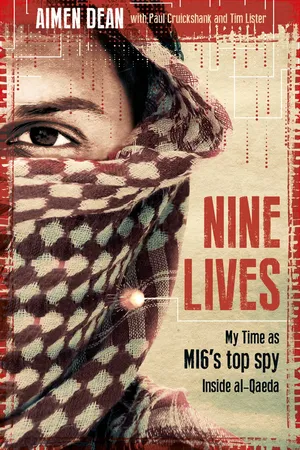
Nine Lives
eBook - ePub

Nine Lives

My Time As MI6's Top Spy Inside al-Qaeda

  1. 480 pages
  2. English
  3. ePUB (mobile friendly)
  4. Available on iOS & Android
eBook - ePub

Nine Lives

My Time As MI6's Top Spy Inside al-Qaeda

About this book

As one of al-Qaeda’s most respected bomb-makers, Aimen Dean rubbed shoulders with the mastermind of the 9/11 attacks and swore allegiance to Osama bin Laden.

As a double agent at the heart of al-Qaeda’s chemical weapons programme, he foiled attacks on civilians and saved countless lives, brushing with death so often that his handlers began to call him their spy with nine lives.

This is the story of how a young Muslim, determined to defend his faith, found himself fighting on the wrong side – and his fateful decision to work undercover for his sworn enemy. From the killing fields of Bosnia to the training camps of Afghanistan, from running money and equipment in Britain to dodging barrel bombs in Syria, we discover what life is like inside the global jihad, and what it will take to stop it once and for all.

Frequently asked questions

Yes, you can cancel anytime from the Subscription tab in your account settings on the Perlego website. Your subscription will stay active until the end of your current billing period. Learn how to cancel your subscription.
At the moment all of our mobile-responsive ePub books are available to download via the app. Most of our PDFs are also available to download and we're working on making the final remaining ones downloadable now. Learn more here.
Perlego offers two plans: Essential and Complete
  • Essential is ideal for learners and professionals who enjoy exploring a wide range of subjects. Access the Essential Library with 800,000+ trusted titles and best-sellers across business, personal growth, and the humanities. Includes unlimited reading time and Standard Read Aloud voice.
  • Complete: Perfect for advanced learners and researchers needing full, unrestricted access. Unlock 1.4M+ books across hundreds of subjects, including academic and specialized titles. The Complete Plan also includes advanced features like Premium Read Aloud and Research Assistant.
Both plans are available with monthly, semester, or annual billing cycles.
We are an online textbook subscription service, where you can get access to an entire online library for less than the price of a single book per month. With over 1 million books across 1000+ topics, we’ve got you covered! Learn more here.
Look out for the read-aloud symbol on your next book to see if you can listen to it. The read-aloud tool reads text aloud for you, highlighting the text as it is being read. You can pause it, speed it up and slow it down. Learn more here.
Yes! You can use the Perlego app on both iOS or Android devices to read anytime, anywhere — even offline. Perfect for commutes or when you’re on the go.
Please note we cannot support devices running on iOS 13 and Android 7 or earlier. Learn more about using the app.
Yes, you can access Nine Lives by Aimen Dean,Paul Cruickshank,Tim Lister in PDF and/or ePUB format. We have over one million books available in our catalogue for you to explore.

Information

My Seventh Life: Something Big
2001–2004
In June 2001, I received an unusual summons. At the time I was at al-Qaeda’s Tarnak Farms complex near the airport in Kandahar and was due to leave for the UK within days. The summons came from Abu Hafs al-Masri, bin Laden’s right-hand man, which made me distinctly uneasy. Did the leadership somehow suspect I was working for the British? I couldn’t imagine how, but ahead of the meeting I spent hours trying to work out whether and where I might have slipped up.
Al-Masri had a way of pursing his lips that only underscored his severity. One of the Egyptian group around bin Laden, he was not given to levity.
He was sitting behind a desk in a library that doubled as an office.
ā€˜When exactly are you travelling to England?’ he asked.
ā€˜In four days,’ I replied.
He did not invite me to sit down but stared at me for a few seconds in a way that turned my stomach.
ā€˜I want you to take a message to some of our brothers,’ he said. He spelled out the four names slowly and clearly, as if I was an imbecile.
ā€˜They must leave the country and come here before the end of August. Something big is going to happen and we expect the Americans to come to Afghanistan.’
I failed to find words to respond as I tried to take in the enormity of what he was suggesting.
ā€˜Do not be tempted to come back to fight alongside us here. Stay in England; do not leave your post. We will contact you.’
It was clear the meeting was over. It had lasted two minutes, but set my nerves jangling and sent my brain into overdrive. Why these four men? Why now? What was ā€˜something big’?
I was not stupid enough to ask. Al-Masri was obsessive about operational secrecy. He had literally drafted a ā€˜need-to-know’ policy and posted it prominently in the camps.
At least I was beyond suspicion; he would not hint at ā€˜something big’ unless he had complete confidence in me. It seemed that to al-Qaeda’s leadership my ability to travel, apparently unsuspected, continued to make me a precious commodity. On several occasions I had been given letters for al-Qaeda supporters then in the UK – letters expertly unsealed and resealed by MI6 before reaching their recipients. But this time the message was simple, verbal and direct: get out.*
I knew three of the four individuals well. One was Mohammed al-Madani, who had introduced me to Abu Qatada’s circle in London. The second was ā€˜Abu Hudhaifa al-Britani’,** who had been in Afghanistan and knew Abu Khabab and many others within al-Qaeda. The British intelligence services had Abu Hudhaifa under surveillance but were frustrated by his expert navigation of the line between militant free speech and explicit involvement in a terrorist organization. I knew just how closely he had been involved with al-Qaeda because I had seen him in the camps, but that was hardly admissible in court.
The third was Abu Walid al-Filistini, the Palestinian cleric close to Abu Qatada who had almost blocked me from applying for a British passport.*
The weather was muggy in London when I arrived five days later. At Heathrow I noticed the news stands were full of headlines about Tony Blair, who less than two weeks previously had been re-elected for a second term as prime minister. Within hours of arriving I was ensconced in another conference room with bad coffee and a car park view.
I told Alan and Richard of the cryptic message from Abu Hafs, and about his ominous phrase: ā€˜something big’.
ā€˜I don’t like the sound of that,’ said Richard. ā€˜Were there any other clues at all?’
ā€˜It was a two-minute conversation,’ I replied.
ā€˜Was anyone else in the camps talking about a big operation?’ Alan asked.
ā€˜No; like I said, the words came as a shock to me.’
ā€˜Go through it one more time,’ Richard said. ā€˜Every tiny detail, even if they don’t seem relevant right now.’
I repeated Abu Hafs’ instructions.
There were a few moments silence.
ā€˜We’ll see what else, if anything, is being picked up and of course raise this with our colleagues across the pond,’ Richard said, referring to the Americans. ā€˜In the meantime, go ahead and deliver the messages,’ Alan said as he closed his briefcase. ā€˜Obviously, it’s absolutely vital for us to know exactly how they react.’
I never found out. When I met Mohammed al-Madani, he curtly thanked me for the message and said he would tell the others.
There were other straws in the wind. I told them munitions and other equipment were being transported from the camps to secret locations in Afghanistan and possibly into Pakistan, but I had no idea why.*
I reminded MI6 that influential figures like al-Suri were arguing that a confrontation with the Western powers was inevitable – and that large-scale attacks, ideally with weapons of mass destruction, were necessary. The one man who might be able to deliver such weapons – Abu Khabab al-Masri – had relocated to a facility next door to al-Suri alongside the Qargha reservoir. I had seen them both at a sprawling Taliban base on a recent trip to the Afghan capital. Abu Khabab revealed that he had developed a final blueprint for the poison gas mubtakkar, one that could be built by someone with no more than basic training. Al-Suri had told me there was an urgent need of a fatwah permitting the use of such weapons.**
ā€˜Abu Khabab told me that Zawahiri and others in the al-Qaeda leadership were interested in the technology,’ I told Alan and Richard.**
ā€˜That’s not good,’ Alan said drily.
ā€˜No, it’s not good,’ I replied. ā€˜The only glimmer of hope is that he won’t hand it over to al-Qaeda for free. He’s always complaining to me about how al-Qaeda never paid him enough to train recruits.’
ā€˜It’s not much of a glimmer,’ Richard said. He doodled on a notepad for a few moments. ā€˜Is anyone missing from the camps?’ he asked.
I didn’t know – people were moving in and out all the time. The camps were like a luggage carousel. Bags are added and taken away, but there are always bags. Their body language suggested my handlers had also heard people were on the move. But I could hardly go back. Abu Hafs al-Masri had told me to stay put; to reappear without permission would be insubordination and might, my handlers believed, provoke suspicion.
It was already abundantly clear that al-Qaeda was ready to intensify its war against the West. The previous autumn it had carried out a suicide bomb attack on the USS Cole, a naval destroyer, as it was moored in Aden, killing seventeen American sailors. Then, in late June, the Arabic television channel MBC reported bin Laden’s ā€˜pleasure with al-Qaeda leaders who were saying that the next weeks ā€œwill witness important surprisesā€ and that US and Israeli interests will be targeted’.6
We all wondered about the magnitude of an event that would ā€˜bring the Americans to Afghanistan’. It suggested to us a plot of greater ambition than the bombing of the USS Cole*.
At lunchtime on 11 September 2001, I was walking along Oxford Street in London. It was a bright and breezy day, and central London was breathing again after the hordes of summer tourists.
A small crowd had gathered at a store window. It was a branch of Dixons, the electronics retailer. Curiosity slowed my pace, and, as I reached the store, a large television screen was playing on repeat an image of a plane hitting a skyscraper. Black smoke was billowing into the blue sky above.
ā€˜New York,’ said a man, glancing in my direction. It’s a strange thing about the British that they rarely talk to strangers unless provoked by a crisis – a snowstorm or road accident. ā€˜Seems like an airliner hit the World Trade Center,’ he continued.
This was no catastrophic accident – rather, the most spectacular act of terror in the modern era. I knew it instinctively, and I knew it was al-Qaeda.
Immediately, my thoughts returned to Kandahar and my brief encounter with Abu Hafs al-Masri. ā€˜Something big’. The vague, teasing phrase reverberated in my head.
In the preceding weeks, some of the best minds in British intelligence had tried to discern what ā€˜something big’ might be. I myself had repeatedly gone over the meeting with Abu Hafs with my handlers, until they had extracted every last drop of informat...

Table of contents

  1. Cover
  2. Title Page
  3. Contents
  4. Map: al-Qaeda’s bases and training camps
  5. Epigraph
  6. Note from the co-authors
  7. Prologue: A Wanted Man
  8. My First Life: The Unlit Candle
  9. My Second Life: Jalalabad and the Jungle
  10. My Third Life: The Pledge
  11. My Fourth Life: Escape from al-Qaeda
  12. My Fifth Life: Undercover
  13. My Sixth Life: Jihad for a New Millennium
  14. My Seventh Life: Something Big
  15. My Eighth Life:Ā Nicotine
  16. My Ninth Life: A Graveyard in Syria
  17. Reflections
  18. Cast of characters
  19. Acknowledgements
  20. Notes
  21. Index
  22. Copyright