
- 256 pages
- English
- ePUB (mobile friendly)
- Available on iOS & Android
eBook - ePub
City of Jasmine
About this book
A poignant story of three young adults trying to make a future for themselves in war-torn Damascus
Syria - a country at war. Amal, Hammoudi and Youssef are young and ambitious, the face of modern Syria. But when civil war tears through their homeland, they are left with a horrifying choice: risk death by staying in the country they love, or flee in search of a new life elsewhere?
From one of Germany's most talented literary voices comes this intricately woven story of brutality, loss, and how hope can shine through when darkness feels overwhelming.
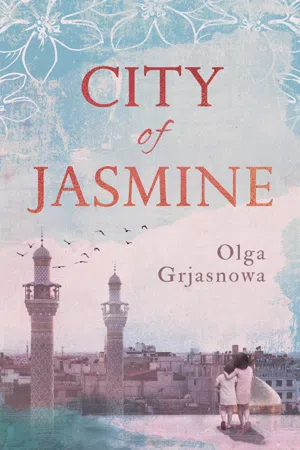
Syria - a country at war. Amal, Hammoudi and Youssef are young and ambitious, the face of modern Syria. But when civil war tears through their homeland, they are left with a horrifying choice: risk death by staying in the country they love, or flee in search of a new life elsewhere?
From one of Germany's most talented literary voices comes this intricately woven story of brutality, loss, and how hope can shine through when darkness feels overwhelming.
Frequently asked questions
Yes, you can cancel anytime from the Subscription tab in your account settings on the Perlego website. Your subscription will stay active until the end of your current billing period. Learn how to cancel your subscription.
No, books cannot be downloaded as external files, such as PDFs, for use outside of Perlego. However, you can download books within the Perlego app for offline reading on mobile or tablet. Learn more here.
Perlego offers two plans: Essential and Complete
- Essential is ideal for learners and professionals who enjoy exploring a wide range of subjects. Access the Essential Library with 800,000+ trusted titles and best-sellers across business, personal growth, and the humanities. Includes unlimited reading time and Standard Read Aloud voice.
- Complete: Perfect for advanced learners and researchers needing full, unrestricted access. Unlock 1.4M+ books across hundreds of subjects, including academic and specialized titles. The Complete Plan also includes advanced features like Premium Read Aloud and Research Assistant.
We are an online textbook subscription service, where you can get access to an entire online library for less than the price of a single book per month. With over 1 million books across 1000+ topics, weâve got you covered! Learn more here.
Look out for the read-aloud symbol on your next book to see if you can listen to it. The read-aloud tool reads text aloud for you, highlighting the text as it is being read. You can pause it, speed it up and slow it down. Learn more here.
Yes! You can use the Perlego app on both iOS or Android devices to read anytime, anywhere â even offline. Perfect for commutes or when youâre on the go.
Please note we cannot support devices running on iOS 13 and Android 7 or earlier. Learn more about using the app.
Yes, you can access City of Jasmine by Olga Grjasnowa, Katy Derbyshire in PDF and/or ePUB format, as well as other popular books in Literature & Literature General. We have over one million books available in our catalogue for you to explore.
Information
PART I
The first fields are already visible through the plane window, followed by an ocean of houses that vanishes again; then the wing slews upwards and the window reveals nothing but sky blue. The plane rights itself and Hammoudi sees a field scorched by the sun. The wheels hit the ground with a jolt.
Damascusâs international airport has barely changed since Hammoudiâs last visit. The border guards in the dilapidated cabins are as bad tempered as ever. They scrutinize his passport dourly and point out that it expires in a few daysâ time.
âThatâs why Iâm here,â says Hammoudi. A guard in a poorly fitting uniform shoos him away.
Hammoudi likes being in Syria, with certain reservations. All his life heâs been told thereâs no future here and he ought to emigrate to Canada, Australia or Europe after his degree, if not sooner. The life heâd lived in Syria had confirmed those reservations.
The luggage takes a long time to arrive. Several large families lose patience; children start whining; a gentleman with salt-and-pepper hair lights a cigarette and gets ticked off by security guards; cleaning women walk to and fro with their water pails, deliberately slow and not cleaning anything. When the light above the baggage carousel finally goes on, everyone crowds around the beginning of the conveyor belt and tries to secure a strategic position; two blond men with reddish beards speaking loud Swiss German win in the end. As the belt starts moving at last, a murmur goes up in the crowd. The luggage is quickly retrieved. Bags, suitcases, bundles, backpacks and boxes are heaved off, placed on luggage trolleys and pushed towards the exit with a sense of euphoria.
A crowd of people wait behind the barrier in Arrivals, looking out for friends and relatives and storming towards them as soon as the door to baggage reclaim opens even a crack. A police officer repeatedly warns them not to get too close to the door. Faces alternate in rapid succession between joy, curiosity and dismay. Children stand around clutching balloons, babies rub their tired eyes as fathers wave bouquets of flowers.
Hammoudi is welcomed by his own rowdy group, although he had actually intended to take a taxi straight to his hotel. Heâd like a little peace and quiet â two nights of sleeping alone, far away from Claire and from his family waiting for him in Deir ez-Zor. A brief time out, just for himself. Thatâs why he didnât tell his friends in Damascus his arrival time. They interpreted his silence as forgetfulness and simply looked up the landing time online. Now they wrap him in hugs and kiss him on the cheeks. Hammoudi is loaded into a car, complete with his heavy case full of gifts.
Although itâs outside his budget, Hammoudi has booked a room at the Four Seasons. It was only weeks ago that he completed his residency as a reconstructive surgeon in Paris with honours. Heâd spent five years working towards that moment and when it finally came it felt as though he was entitled to it. Then he applied to the cityâs three best hospitals and was soon invited to interviews at each one. Hammoudi was tall, slim, courteous and charming. His French was flawless. The decisive factor, though, was his perfect facial symmetry â he was just the man people trusted to have internalized established beauty norms. He quickly decided on the hospital that made him the best offer and immediately received a contract in the post. That evening, heâd celebrated by treating his girlfriend Claire to an expensive dinner with plenty of champagne. After that he booked a trip to Syria to renew his passport â a mere formality, but his residency permit in France depended on it, so he thought heâd take the opportunity for a short holiday.
The marble floors of the Four Seasons lobby glint with cleanliness and the copious flower arrangements exude a morbid scent. Two security men check Hammoudiâs papers, almost refusing to let him into the hotel because heâs not a foreigner. His friends are coming to pick him up again in two hours; he asked them to give him time for a nap and a shower.
His room is luxurious, the bed wide and firm, the sheets bright white and freshly pressed, the minibar well stocked and the furnishings in Damascene style. A voluminous bouquet on the side table at least smells better than the arrangements downstairs. Hammoudi runs a bath and dials Claireâs number.
That evening he goes out with his friends. A noisy group in their mid-thirties, women and men; some married, others already divorced or simply single, lesbians or in the kind of relationships that donât entail commitments. They tour the centre of Damascus, heading into bars, drinking arak, ordering small dishes, more arak and more food. They laugh, scream, bitch and argue. Theyâre louder than they used to be, trying to reforge the ties between them, to assure each other they havenât been forgotten, theyâre still good friends.
Hammoudi makes an effort to catch up on his friendsâ lives, to remember each of their partners, children and career updates, but his head is soon buzzing. He doesnât know that his old uni clique is only meeting up now because of him â theyâve drifted apart in the years of his absence.
At first theyâre all awkward, their interactions clumsy, but after a while they relax, not least due to the alcohol. They recall events from their younger days, juggling names of acquaintances, streets and places that Hammoudi barely remembers.
Damascus, too, is hardly recognizable to him. The city centre has been gentrified over the past five years â tiny grocery shops forced to close and the spaces reopened as Zara or Benetton; bakeries making way for cafĂ©s serving soy-milk cappuccinos at European prices; shops that once sold absolutely everything, from screwdrivers to petrol canisters, replaced by mobile phone stores.
As the next day breaks, Hammoudi collapses into his overpriced hotel bed and instantly falls asleep. Through the window, the curses of drunken night owls mingle with the muezzinâs call to morning prayers.
Amal tries to act the fear away. Sheâs spent her whole life studying the people around her: family, friends, lovers, complete strangers. She has memorized their facial expressions and gestures so as to reproduce them precisely on stage. She has learned characters, vocal pitches and emotions. Even as a tiny child not yet capable of speech, she imitated people. And yet it took her a long time to admit she wanted to be an actor. She thought she wasnât talented or pretty enough for the stage. She thought her hips were too wide, her nose too long and her voice not firm enough. Aside from that, her father always implied acting was not a profession for honourable women. Amal got a degree in English literature but books werenât enough for her, so one day she auditioned for the prestigious Institute of Dramatic Arts.
All that seems long ago now. Fear has settled in like a parasite building a nest inside her ribs. Amal knows exactly what might happen to her but she doesnât know when or whether it will come about, and itâs this uncertainty that makes her tremble. Too many people around her have been arrested or tortured or have simply disappeared, which amounts to the same thing.
Damascus is a noisy city, messy and hectic, overflowing with buses and taxis hooting, the yells of street vendors, the humming of the air conditioners on the outsides of houses, all mixed with the loud music streaming out of bars and car windows. In Damascus, a person can drown in history and its superlatives. Today, though, the city is submerged in uncanny silence. No traffic, no conversations, not even a whisper to be heard. The sky is decked in grey clouds.
Amal keeps looking over at the secret-service men, her body registering their every movement and sound. The curtain in a window of the house opposite twitches. An old woman is trying to peer around the heavy damask drapes as inconspicuously as possible, and at that moment Amal decides she never wants to hide behind a curtain again, not today, not tomorrow and not in forty yearsâ time; and the only way to achieve that is to stay put in this square, come what may.
The first demonstration took place two days ago. It was the first time since winter that the air had felt mild, almost warm. Amal and a few of her friends headed for the parliament building with A4 cardboard signs. Amalâs scarf was pulled down low over her face. They hadnât dared to take the placards out of their bags. At the end of the demonstration they avoided eye contact and dispersed as quickly as they could. They were ashamed to be running away in secrecy after a demonstration while people in other countries were setting themselves alight.
During the early days of the revolution, the optimists thought the global media and Al Jazeera would report on their demonstrations. They didnât think the international community would abandon them when they were only demanding of their state what it seemed the rest of the world wanted of it, too. No one was really thinking of toppling the regime â they merely wanted reforms. A few minor concessions.
People were sick and tired. Amal was tired, her brother was tired, her friends, her fellow students, acquaintances, strangers in the streets, the entire vulgar bohĂšme was sick and tired. They were sick and tired of the corruption, the secret servicesâ arbitrary decisions, their own powerlessness and permanent humiliation. They were sick and tired of all public libraries, airports, stadiums, universities, parks and even kindergartens being named after the Assads. They were sick and tired of their fathers, brothers and uncles mouldering in jails. They were sick and tired of the whole family having to chip in to buy the sons out of military service while the North American teenagers on cable TV were given cars by their parents and travelled the world. They were sick and tired of reciting âAssad for all eternityâ every morning at school and swearing to fight all Americans, Zionists and imperialists. They were sick and tired of memorizing Assad quotes in political-education classes and then filling in the gaps in the right order for their tests. They were sick and tired of being taught in military education to dismantle and reassemble a machine gun. They were sick and tired of being treated like animals. And above all they were sick and tired of not being allowed to say any of it out loud.
Amalâs generation is the first to know nothing other than the Assad clanâs totalitarian rule. Unlike their parents and grandparents, who well remember the endless putsches before Hafez al-Assad seized power, or the 1982 massacre of the Muslim Brothers in Hama, a clear signal from the government that it was not to be trifled with. Since then, the Assad regime has behaved like an establishment ordained by God. More than that, Bashar al-Assad is greater than God, or at least thatâs whatâs implied by his omnipresence and that of his father, brother, wife and three children â with portraits in even the furthest corner of the country, like scarecrows to frighten and dispel his subjects.
The next demonstration. Out of the corner of her eye, Amal spots the Alawi actor Fadwa Soliman, a woman sheâs long admired, and for a moment the sight reassures her. She takes a deep breath and wraps one hand around the other to stop the trembling. No one knows what will happen next. The regime might make an example of the demonstrators this time, arresting them all or using violence to break up the crowd.
After a long time, during which the demonstrators do nothing but stand together and watch the secret-service men, a small man in an oversized leather jacket leaves the group and heads for the nearest cafĂ©. Heâs one of the most high-profile artists in Syria. Amal and around twenty others tail after him like a throng of children, relieved to have evaded danger.
Al Rawda, meaning Garden of Eden, is a traditional Damascus cafĂ© serving alcohol and small dishes, frequented primarily by opposition activists, gays, lesbians, young lovers and petty criminals. The demonstrators gather in the garden, which sometimes does seem like a paradise, with its impressive marble arches and palm trees. They talk openly, albeit in extremely hypothetical form, about concessions by the regime, and they flirt more blatantly than ever. Having greeted everyone she knows, Amal goes to the toilet, runs cold water over her wrists, splashes her face and breathes deeply in and out. Her body shakes as the tension leaves her. Sheâs astounded that the demonstration went so calmly. Amal has never felt as though she belongs to a particular group but for the first time the thought of doing so doesnât unsettle her.
Hammoudiâs family celebrates his arrival in Deir ez-Zor with a huge party. The courtyard is full of uncles, aunts, cousins, nephews and nieces. He had forgotten how stressful a large family can be. The girls are wearing hairbands and frou-frou dresses, squealing as the boys chase them. Then they switch over, the boys running away and the girls pursuing them with even more squeals.
A giant table is set up in the middle of the courtyard, straining under the weight of all the food and drink. Hammoudiâs father has had a lamb slaughtered, stuffed with rice and nuts and then slowly roasted over the fire in the yard. His mother instructed the staff to spend several days preparing salads and starters, marinating seven kilos of kebab meat and various fish, stirring yoghurt and setting out huge trays of baklava and shaabiyat pastries.
Their game momentarily interrupted, a crowd of children mobs Hammoudi as he hands out the gifts he brought from France. His aunts load generous portions for all the guests onto delicate porcelain plates that Hammoudiâs mother imported from Japan. His grandparents have seven daughters and not a single son, something his aunts and his grandfather in particular consider a great blessing. He sent all his daughters to university and all seven of them chose medicine. Now they work in different fields but are still inseparable. Throughout his childhood summers, Hammoudi saw his aunts huddled together on the roof of their house, eating nuts and sweets as they gossiped about the neighbours.
Hammoudiâs cousin pours two fingers of clear liquid into each of their glasses, adds ice cubes and dilutes the alcohol with water, turning the drink milky white. The neighbours are there too, a couple whose son Mohammed, once a chubby boy, has grown into a lanky teenager who dreams of building bridges.
Hammoudi watches his brother talking excitedly to a...
Table of contents
- Cover
- Title Page
- Part I
- Part II
- Part III
- Acknowledgements
- Oneworld, Many Voices
- Oneworld Translated Fiction Programme
- Copyright