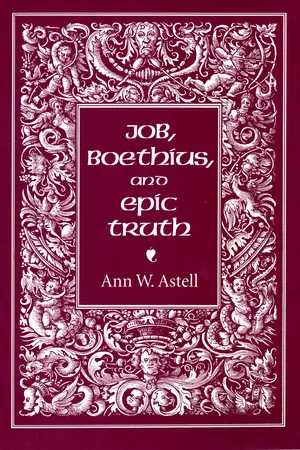
Calling into question the common assumption that the Middle Ages produced no secondary epics, Ann W. Astell here revises a key chapter in literary history. She examines the connections between the Book of Job and Boethius' s Consolation of Philosophy—texts closely associated with each other in the minds of medieval readers and writers—and demonstrates that these two works served as a conduit for the tradition of heroic poetry from antiquity through the Middle Ages and into the Renaissance. As she traces the complex influences of classical and biblical texts on vernacular literature, Astell offers provocative readings of works by Dante, Chaucer, Spenser, Malory, Milton, and many others. Astell looks at the relationship between the historical reception of the epic and successive imitative forms, showing how Boethius's Consolation and Johan biblical commentaries echo the allegorical treatment of" epic truth" in the poems of Homer and Virgil, and how in turn many works classified as "romance" take Job and Boethius as their models. She considers the influences of Job and Boethius on hagiographic romance, as exemplified by the stories of Eustace, Custance, and Griselda; on the amatory romances of Abelard and Heloise, Dante and Beatrice, and Troilus and Criseyde; and on the chivalric romances of Martin of Tours, Galahad, Lancelot, and Redcrosse. Finally, she explores an encyclopedic array of interpretations of Job and Boethius in Milton's Paradise Lost, Paradise Regained, and Samson Agonistes.
- 258 pages
- English
- ePUB (mobile friendly)
- Available on iOS & Android
eBook - ePub
Job, Boethius, and Epic Truth
About this book
Information
Index
Literature1 Allegories of Logos and Eros
Before we take up the central concern of this book—the Boethian and Joban mediation of the classical epic tradition in the Middle Ages and Renaissance—we need to recall some of the literary contexts in which Boethius wrote his sixth-century De consolatione philosophiae. As we have seen, Bernard Silvestris considered Boethius’ work to be an imitation of both Virgil’s Aeneid and Martianus Capella’s De nuptiis Philologiae et Mercurii, and thus the expression of a continuous Homeric tradition. All three works, he says, deal figuratively with the same thing.1 This chapter examines the historical basis for that critical judgment.
The bizarre combination in De nuptiis of weighty textbook material on the seven liberal arts with a fanciful, allegorical love story seems, to be sure, far removed from both Virgil’s Aeneid and Boethius’ Consolation. It does, however, call attention to two clearly marked lines of allegorical development in antiquity. As we shall see, both Boethius and Martianus, albeit in strikingly different ways, join these two lines. The first, emphasizing logos and the intellectual discovery of the causes of things, proceeds from Homer through Virgil, Macrobius, and Fulgentius. The second, emphasizing eros and the moral application of truth, also finds its origins in Homer, but proceeds through popular romance, both Greek and Roman.
Virgil and the Allegory of Logos
The Vitae Vergilianae and Virgil’s own remarks in Georgics 2.475–82 indicate that Virgil wanted to imitate Lucretius in writing a philosophical poem, a poem unveiling the causes of things.2 Despite Lucretius’ opening invocation of Venus as “Aeneadum genetrix,” the Aeneid is seldom read as Virgil’s response to De rerum natura.3 Although there are clear differences in form and content between the two, Lucretius’ poem offers a suggestive model for Virgil’s own philosophical rewriting of Homer. As we have already seen, Lucretius draws a strong parallel between Homer and Epicurus (De rerum natura 3.1037–44). Elsewhere Lucretius summarizes the action of the Iliad to show that historical events result accidentally from body and void (“eventa . . . corporis atque loci”) as first causes:
denique materies si rerum nulla fuisset
nec locus ac spatium, res in quo quaeque geruntur,
numquam Tyndaridis forma conflatus amore
ignis, Alexandri Phrygio sub pectore gliscens,
clara accendisset saevi certamina belli,
nec clam durateus Troianis Pergama partu
inflammasset equos nocturno Graiugenarum.
(De rerum natura 1.471–77, emphasis added)
[Again, if there had been no material for things, and no place and space in which each thing is done, no fire fanned to flame by love through the beauty of Tyndareus’ daughter, and glowing beneath the breast of Phrygian Alexander, would ever have set alight blazing battles of savage war; no wooden horse, unmarked by the sons of Troy, would ever have set Pergama in flames by its night-born brood of Grecians.] (pp. 40–41, emphasis added)
The imagery of the passage, which links in a causal chain the fire of love with the flames of war and the eventual burning of Troy, offers a prologue to the long philosophical discussion that follows, in which Lucretius refutes Heraclitus, Empedocles, and the Stoics, all of whom consider fire, not solid matter, to be the original substance of things: “primordia rerum / mollia” (1.753–54)4 Lucretius, in short, first envisions a Stoic reading of Homer, a reading that posits fire as the elemental beginning and end of the Trojan war, and then argues on behalf of the atomists for solid matter as antecedent to fire.
Lucretius’ imagined Stoic reading derives from Stoic allegoresis of the Iliad. As Cicero’s Balbus bears witness, Stoic theory deified the air lying between the sea and the sky, naming it Hera (later, Juno) because of its close connection with aether, the cosmic fire associated with Zeus (later, Jove), Hera’s brother and husband.5 The Stoics thus discovered behind Homer’s imagistic pantheon a true natural philosophy according to which, for instance, Hera’s cloud-covered copulation with Zeus on Mt. Ida (Il. 14.153–355; 15.1–84) encoded an elemental description of a springtime thunderstorm—air (Hera) coupling with fire (Zeus).6 Lucretius, however, goes beyond such sporadic exegesis, which served to explain problematic passages individually, in isolation from the Iliad as a whole, and gives to fire (and thus to Jove) ultimate causality for the whole action of Homer’s epic, unifying it from beginning to end.
The Stoic reading of Homer that Lucretius first posits and then rejects bears striking resemblance to Virgil’s own reading and rewriting of Homer. It is virtually a critical commonplace to recognize Stoic elements informing the Aeneid. The epic’s proem, which makes a wrathful Juno responsible for Aeneas’ sufferings, introduces a specifically Stoic concern (“secundum Stoicos dicit”) for, as Servius notes, the Epicureans pictured the gods as disinterested in human affairs: “nam Epicurei dicunt deos humana penitus non curare” (In Vergilii Aeneidos I.11).7 Aeneas’ piety (“pius Aeneas”) marks him as a Stoic hero, rendering his filial duty to his father and the gods; his paternal due to those entrusted to his care.8 Aeneas’ heroic action and suffering result from his free acceptance of his appointed destiny, and the combination of human virtue and divine affliction in his labores make the epic as a whole a Stoic exploration of the problem of evil in a providentially ordered universe. As Servius phrases the question: “If Aeneas is just, why does he suffer under the hatred of the gods?” (In Aen. I.10: “si iustus est Aeneas, cur odio deorum laborat?”).
Whereas Virgil’s Juno is the agent of disorder, personified opposition to destiny, and the source of storms and madness, Virgil’s Jupiter is, as Hainsworth phrases it, “an allegory of his historical determinism” who speaks “as if he were the mouthpiece of Fate.”9 “Jupiter’s will,” Servius writes, “is Fate” (In Aen. IV.614: “ ‘fata’ dicta, id est Iovis voluntas”). When Jupiter, in answer to Venus’ fears, declares Fate immovable (Aen. 1.257–58: “manent immota tuorum / fata”), he expresses the Stoic teaching (“dogma Stoicorum ostendit”) that Fate cannot be altered (In Aen. I.257: “nulla ratione posse fata mu-tari”).10 Elsewhere Servius treats the word “fata” as a past participle indicating what the gods have decreed: “ ‘fata’ modo participium est, hoc est, ‘quae dii loquuntur’ ” (In Aen. II.54)—words that the gods themselves must obey once they have been spoken. As Jupiter tells Venus: “necque me sententia vertit” (Aen. 1.260).11
Virgil couples this explicit treatment of Jupiter’s will as the fixed, necessary cause of things with imagery appropriate to Stoic cosmology. Jupiter makes his first appearance “aethere summo” (Aen. 1.223), in the upper, fiery air. The passage recalls the Stoic deification of aether as Jove, the primal, creative Fire that is the material origin of everything. According to this view, aether is both the world and its god (“mundus deus”), the animate force governing the mutation of its elements (air, water, earth).12 Virgil’s Anchises enunciates this Stoic dogma when he associates fiery energy and a heavenly origin with the seeds of things: “igneus est ollis vigor et caelestis origo / seminibus” (Aen. 6.730–31). Twice Virgil calls Jupiter “homi-num sator atque deorum” (Aen. 1.254, 11.725), the sower (“sator”) of gods and men, thus linking his paternity to the seeds of fire (“seminibus”), the warmth from the sky (“caldor e caelo”) that is, according to Zeno, the seed of animate creatures: “animalium semen ignis is qui anima ac mens.”13
Virgil’s strong association of Jupiter with both fate and fire allows him to rewrite Homer from the unified Stoic perspective Lucretius first suggested when he posited divine fire as the first and last cause of the Trojan war (De rerum natura 1.471–77). When Aeneas tells of his escape from burning Troy, he dwells upon his solitary encounter with Helen (Aen. 2.567–87).14 Filled with vengeful fire (2.575: “exar-sere ignes animo”), he almost kills her as the cause of Troy’s destruction (2.581: “Troia arserit igni”), but Venus herself intervenes to exculpate both Helen and Paris and blame instead the cruelty of the gods: “divum inclementia, divum” (2.602). Aeneas will learn this lesson over and over again as his own divine and fiery destiny casts him repeatedly, in relation to both Dido and Lavinia, in the role of another Paris.
When Aeneas speaks of the fall of Troy, Venus has already conspired with Cupid to girdle Dido with the flame of love (1.673: “cingere flamma”) and kindle fire in her very bones: “incendat regi-nam atque ossibus implicet ignem” (1.660). Ignorant of fate (1.299: “fati nescia”), Dido receives as a gift from Aeneas the dress and veil of Helen (1.650). When she finds herself responding to Aeneas as she had to her husband Sychaeus—“agnosco veteris vestigia flammae” (4.23)—she begs Jupiter to prevent her dishonor by using lightning to send her to the underworld: “pater omnipotens adigat me fulmine ad umbras” (4.25). That prayer gains an ironic answer when Jupiter’s own lightning flash during the storm occasions her pseudo-marriage to Aeneas in the cave: “fulsere ignes et conscius aether / conubiis” (4.167–68). Servius calls attention to lightning as Jupiter’s characteristic sign (In Aen. I.42, I.230) and, citing Varro, interprets the celestial fire (“fulsere ignes”) coupled with rain as a divine nuptial observance.15
Iarbas, however, protests that Jupiter’s avenging thunderbolts (4.209: “in nubibus ignes”) should not overlook Dido’s scandalous affair with Aeneas. Dido’s vow never to remarry, to remain faithful to her dead husband, makes her, in relation to Aeneas, another Helen; Aeneas, another Paris (4.215: “ille Paris cum semivio comitatu”). As once in Troy, the flames of love lead to battle and funeral fires as Dido, abandoned by Aeneas at Jupiter’s command, kills herself upon a pyre, after cursing the Dardanians and prophesying that one of her race will pursue them with firebrand and sword: “face . . . ferroque” (4.626). The departing Trojans see the walls of Carthage, like the walls of Troy, aflame: “moenia respiciens, quae iam infelicis Elissae / conlucent flammas” (5.3–4).16
Virgil’s language makes his protagonists the followers of the gods, drawn irresistibly into a preordained course. All their actions are fated, sequenced in a causal chain. Aeneas does not freely strive to gain Italy: “Italiam non sponte sequor” (4.361, emphasis added). The dead Dido fol...
Table of contents
- Preface
- Abbreviations
- Introduction
- 1. Allegories of Logos and Eros
- 2. Boethius and Epic Truth
- 3. Job and Heroic Virtue
- 4. Hagiographic Romance
- 5. Boethian Lovers
- 6. Ghostly Chivalry
- 7. The Miltonic Trilogy
- Conclusion
- Bibliography
- Index
Trusted by 375,005 students
Access to over 1.5 million titles for a fair monthly price.
Study more efficiently using our study tools.
Frequently asked questions
Yes, you can cancel anytime from the Subscription tab in your account settings on the Perlego website. Your subscription will stay active until the end of your current billing period. Learn how to cancel your subscription
No, books cannot be downloaded as external files, such as PDFs, for use outside of Perlego. However, you can download books within the Perlego app for offline reading on mobile or tablet. Learn how to download books offline
Perlego offers two plans: Essential and Complete
- Essential is ideal for learners and professionals who enjoy exploring a wide range of subjects. Access the Essential Library with 800,000+ trusted titles and best-sellers across business, personal growth, and the humanities. Includes unlimited reading time and Standard Read Aloud voice.
- Complete: Perfect for advanced learners and researchers needing full, unrestricted access. Unlock 1.5M+ books across hundreds of subjects, including academic and specialized titles. The Complete Plan also includes advanced features like Premium Read Aloud and Research Assistant.
We are an online textbook subscription service, where you can get access to an entire online library for less than the price of a single book per month. With over 1.5 million books across 990+ topics, we’ve got you covered! Learn about our mission
Look out for the read-aloud symbol on your next book to see if you can listen to it. The read-aloud tool reads text aloud for you, highlighting the text as it is being read. You can pause it, speed it up and slow it down. Learn more about Read Aloud
Yes! You can use the Perlego app on both iOS and Android devices to read anytime, anywhere — even offline. Perfect for commutes or when you’re on the go.
Please note we cannot support devices running on iOS 13 and Android 7 or earlier. Learn more about using the app
Please note we cannot support devices running on iOS 13 and Android 7 or earlier. Learn more about using the app
Yes, you can access Job, Boethius, and Epic Truth by Ann W. Astell in PDF and/or ePUB format, as well as other popular books in Literature & Medieval & Early Modern Literary Criticism. We have over 1.5 million books available in our catalogue for you to explore.