- 262 pages
- English
- ePUB (mobile friendly)
- Available on iOS & Android
eBook - ePub
About this book
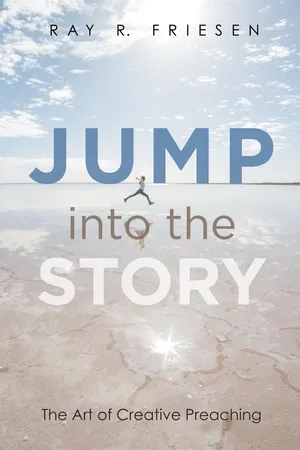
Preaching is a challenging, privileged, and awesome responsibility. As important as mining the text for its meaning and message and making connections to our twenty-first-century world is the responsibility to engage the imaginations of the people in the pews (or chairs). In this book, Ray Friesen--life-long preacher and retired pastor--has provided twenty examples of how to be creative and engage those imaginations. Most were written under the pressures of bi-vocational ministry (preaching forty times a year as half-time pastor and operating a mediation practice). They are offered to you, not as sermons for you to preach, but as examples of what is possible, even with all the other responsibilities you may have. Each sermon and type of creativity will create an opportunity to set your imagination and creativity free to engage the imaginations, hearts, and dreams of your parishioners.
Information
Topic
Theology & ReligionSubtopic
Christian ChurchChapter 1
Jump into the Story
It was a spring Tuesday or Wednesday morning and time to get working on Sunday’s sermon. I was using the lectionary that spring to guide my preaching and the text for Sunday was John 21:1–19 (Year C). I knew the story. I also knew I had a creative sermon on file, one I had preached several years ago (like maybe nine years ago) in a different congregation. However, thanks to the foibles of technology, the digital version of that sermon had been laid to rest in some cyberspace graveyard. I had a paper copy, but it was in a filing cabinet twenty minutes away and I wasn’t about to drive to our country church and back for a copy of that sermon.
I was going to have to write a new sermon. Somehow, a “here are three things you can learn from this story” sermon held no interest for me. I knew if I could barely get myself to write it, it would be tough for the congregation to listen to it.
I had, since the late nineties, heard live productions of Ted & Lee’s wildly funny and deeply profound presentations of Fish Eyes and Creation Chronicles.65 That same spring, I was reading Ted Swartz’s autobiography, Laugher is Sacred Space. A few days earlier, I had read a piece from the closing scene of Fish Eyes, the story from John 21. In it, Peter and Andrew, out fishing, are trying to understand what Jesus is shouting to them:
ANDREW: Caaaa . . . Caaa . . . Cashew. Nuts. Cashew nuts. Cashew nuts on the other side. Cashew nuts?
PETER: Cashew nuts?
ANDREW: Did you bring a snack?
PETER: No, I didn’t bring one.66
There’s more and it’s hilarious. I remember how hard I laughed when I saw the whole production in St. Louis back when the General Conference Mennonite Church and the Mennonite Church had a joint, binational conference there.
I knew I was no Ted & Lee, so I couldn’t be as funny as they were. But, ideas were starting to dance around. I could still do Peter and Andrew. But who would be my Andrew? I couldn’t think of any of the men in our congregation who would consent to join me Sunday morning, even if I wrote the script.
And then I had another idea. There was no male I could arm-twist into working with me, but . . . I knew a female who, according to God and the Bible was supposed to be my partner and helper in time of need. This was a time of need. Would she dare decline? And, besides, as my co-pastor at Emmaus, she had a professional duty to help me, didn’t she? How could she say no? Actually, I know how she can do that, but that is for another time. Fortunately she said “Yes.”
The possibilities were born. I couldn’t do Peter and Andrew, but I could do Peter and Martha. That meant I couldn’t set it, timewise, on the beach that morning. I would have to choose another time and possibly place. But that was no big deal. I could have Peter tell the story, and my fingers started dancing on the keyboard.
I was about two-thirds of the way through writing the piece when the phrase “jump into the story” popped into my mind. Wow! It was like fireworks went off in my imagination. Some might suggest they burned some of my circuits, but forget them. I was excited. I went back to what I had written and rewrote a few pieces to make the use of the phrase work throughout the sermon. It seemed like the perfect phrase to describe discipleship. Jump into the Jesus story. Jump into God’s story. It fit for me in so many ways.
Soon, I saw its larger implications. As a preacher, that is what I was called to do every week: jump into the story. Muck around in it sometimes. Be surprised by it often. Find my place and our congregation’s place in it week by week.
So that is how Jump into the Story, the sermon, came to be born and got written.
Jump into the Story
John 21:1–19
Third Sunday of Easter, Year C
Peter is sitting on the dock fishing, with rod & reel
MARTHA: (calls out from back of the church walking up the aisle) Hey Peter, try casting on the other side of the dock.
PETER: (as he turns toward the sound of the voice) Try casting on the . . . Martha! Martha! How the heck are you? (runs toward her and hugs her) So good to see you! You’re looking great.
MARTHA: Thanks. You are looking right well yourself, for an old man.
PETER: Hey, careful now. You got time to sit a bit? Of course you have time to sit. You can’t be by the Sea of Galilee and not have time to sit a bit. Here, let’s grab these deck chairs. Wow, this is quite something, you coming by. It’s been a while.
MARTHA: It has, for sure.
PETER: How you been?
MARTHA: Good. Good. And you?
PETER: Same. Good.
MARTHA: How come you are out here? I thought you had given up fishing, or fishing for fish at least.
PETER: Not given up. Just traded it in. But sometimes, when the stress and stuff get to me, I find coming out here for a while and catching a few fish is the best therapy around. This fishing for people sounds nice, but it is tough. You think a twenty-pound jack can put up a fight? You should try landing a one hundred fifty-pound Jewish convert. It’s like you need a massage every time you snag one. So, a few times a year, I come up here to sit back, catch a few fish, and relax, renew, and think back to those days. You know, I can go a whole afternoon without a nibble and it’s okay. Memories flood my mind and it’s like I’m back there, well, back here but back there again, reliving what were some pretty wonderful times.
MARTHA: I bet you have a lot of memories.
PETER: Oh boy, do I ever. And when you called out—you know, that was good, “try casting on the other side of the dock.” Really good. With your voice so low, almost like a man, it’s like in a moment I was back here, after Easter when Jesus told us to cast our nets on the other side of the boat.
MARTHA: Did you know it was him when he called out to you?
PETER: No, had no idea. Far as I could make out, it was some stranger.
MARTHA: But you listened to the stranger.
PETER: Yeah. On the Sea of Galilee, in the early morning, there are times the sun hits the water just right and reflects off the shiny scales of the fish just below the surface. You have to be at the right angle to see it, and so sometimes someone on shore can see the fish and you don’t notice them from the boat. So we cast our nets on the other side.
MARTHA: And caught some fish.
PETER: And caught some fish. You co...
Table of contents
- Title Page
- Acknowledgements
- Introduction
- Chapter 1: Jump into the Story
- Chapter 2: Jesus’s Autobiography
- Chapter 3: Same Text, Different Sermon
- Chapter 4: The Twelve Little Guys
- Chapter 5: Story Sermons
- Chapter 6: Ancient Writings and Twenty-First-Century Gurus
- Chapter 7: Sing Me a Song About Jesus
- Chapter 8: Movies and the Word
- Chapter 9: Advent
- Chapter 10: Christmas #1
- Chapter 11: Christmas #2
- Chapter 12: Christmas in the Community
- Chapter 13: Community Preaching
- Chapter 14: Easter and the Community
- Chapter 15: Funerals
- Chapter 16: Children’s Stories
- Chapter 17: Scripture Reading
- Chapter 18: Lent
- Chapter 19: Songs
- Chapter 20: Thanksgiving
- Appendix A: For Further Reading
- Appendix B: The Bible and the Word of Go
- Bibliography
Trusted by 375,005 students
Access to over 1.5 million titles for a fair monthly price.
Study more efficiently using our study tools.
Frequently asked questions
Yes, you can cancel anytime from the Subscription tab in your account settings on the Perlego website. Your subscription will stay active until the end of your current billing period. Learn how to cancel your subscription
No, books cannot be downloaded as external files, such as PDFs, for use outside of Perlego. However, you can download books within the Perlego app for offline reading on mobile or tablet. Learn how to download books offline
Perlego offers two plans: Essential and Complete
- Essential is ideal for learners and professionals who enjoy exploring a wide range of subjects. Access the Essential Library with 800,000+ trusted titles and best-sellers across business, personal growth, and the humanities. Includes unlimited reading time and Standard Read Aloud voice.
- Complete: Perfect for advanced learners and researchers needing full, unrestricted access. Unlock 1.5M+ books across hundreds of subjects, including academic and specialized titles. The Complete Plan also includes advanced features like Premium Read Aloud and Research Assistant.
We are an online textbook subscription service, where you can get access to an entire online library for less than the price of a single book per month. With over 1.5 million books across 990+ topics, we’ve got you covered! Learn about our mission
Look out for the read-aloud symbol on your next book to see if you can listen to it. The read-aloud tool reads text aloud for you, highlighting the text as it is being read. You can pause it, speed it up and slow it down. Learn more about Read Aloud
Yes! You can use the Perlego app on both iOS and Android devices to read anytime, anywhere — even offline. Perfect for commutes or when you’re on the go.
Please note we cannot support devices running on iOS 13 and Android 7 or earlier. Learn more about using the app
Please note we cannot support devices running on iOS 13 and Android 7 or earlier. Learn more about using the app
Yes, you can access Jump into the Story by Ray R. Friesen in PDF and/or ePUB format, as well as other popular books in Theology & Religion & Christian Church. We have over 1.5 million books available in our catalogue for you to explore.