eBook - ePub
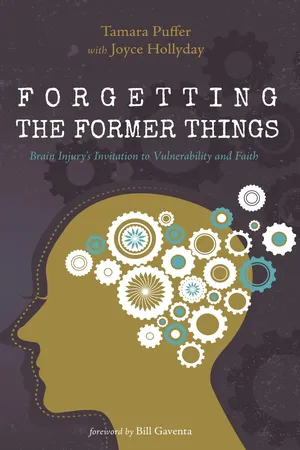
Forgetting the Former Things
Brain Injury’s Invitation to Vulnerability and Faith
- 132 pages
- English
- ePUB (mobile friendly)
- Available on iOS & Android
eBook - ePub
About this book
In August 1996 Tamara Puffer was a young, newly married violinist-turned-pastor serving a large suburban church. Her growing work with people living on Atlanta's streets was beginning to reshape her theology and her calling, but a serious car accident derailed her carefully planned career path. Forgetting the Former Things is a rare tapestry of first-person faith journey woven with gritty theological reflection and persistent hope. Puffer writes honestly, poignantly, and often humorously about her efforts to accept limitations and to reimagine her life under radically altered circumstances.
She finds solace in the stories of biblical women as she also wrestles with negative images of disability in Scripture. She embraces her self-described role as a "minister of vulnerability" in this troubling national moment--as jobs, healthcare, and affordable housing are evaporating for so many, as countless people feel terrorized by discrimination or the threat of deportation--boldly casting her lot with others whose marginalization cuts deeper. At a time when traumatic brain injury is in the national spotlight, and many families, churches, and communities seek deeper understanding, Tamara Puffer provides in these pages an insightful, inspiring, and much-needed gift.
Information
Topic
Theology & ReligionSubtopic
Religious Biographies1
Rupture
August 26, 1996. Monday morning. The alarm jolts me awake at 4:15. I reach over and turn it off, weary from the previous day’s worship and youth group responsibilities. Michael, my husband of three months, lies still. I wish I could stay beside him for a while longer on my day off, at least until the sun comes up. He has the luxury of sleeping while I make my way in the dark into downtown Atlanta.
Once I’m out the door, I always look forward to these early Monday mornings with the Open Door Community. It’s where Michael and I met fourteen months ago, when he was a resident volunteer and I showed up one day with my church youth group to help out with the soup kitchen. In the spirit of the Catholic Worker tradition of hospitality, the Open Door welcomes people off the streets into its life and, with a throng of volunteers, provides services including meals, showers, and clean clothes.
As always, one-eyed Ralph Dukes is waiting to greet me with his toothless smile, awake before everyone else to start the coffee. I turn on the heat to hard-boil twenty dozen eggs and stir a massive pot of grits on the industrial stove. Ralph removes huge trays of sliced oranges from the refrigerator. Before long, the kitchen fills up with an array of sleepy humanity. We load up the food, bowls, spoons, and mugs into a van and head toward Butler Street AME Church.
A couple hundred people are huddled in front of the church. Some of the men need a quick and hearty breakfast before standing among the crowds at the day-labor pools, hoping against hope to get chosen for a few hours of minimum-wage work. But most of the folks waiting have nowhere to go and nothing to do but wander the streets for rest of the day.
I think, as I often do on Monday mornings, of Jesus’ words recorded in the Gospel of Matthew: “Truly I tell you, just as you did it to one of the least of these who are members of my family, you did it to me” (Matt 25:40, NRSV). Jesus was speaking of feeding the hungry, clothing the poor, welcoming the stranger, visiting the sick and imprisoned—those deemed “least” in the eyes of the world but precious to him. He was telling his followers where to find him, who he claimed as family, and how to minister to his hurting sisters and brothers. His command of unconditional compassion has been turning my theology inside out.
As I ladle up the grits, I can’t help noting the dramatic contrast between the precarious lives filing before me and the members of the affluent suburban church where I serve as an associate pastor. Some of the folks from the streets drink or use illegal drugs to escape their pain. I know that some of the people in the church I serve also struggle with drugs and alcohol, but their financial situations usually allow them to keep these issues hidden. I wonder where some of the men and women from the Butler Street breakfast would be if they had been born to wealthier parents, or if they had other people in their lives that cared more about them. I recognize, uncomfortably, that my financial security, relational stability, and high degree of formal education mean that I have much more in common with the members of my church than these friends living on the streets.
Under the influence of Scripture, Michael, the Open Door, and my own questioning spirit, my understanding of Jesus is expanding. I yearn to know more deeply this One who lived his life on the margins, from birth in a stable to execution on a criminal’s cross. Who was this Jesus who proclaimed that he had come to “bring good news to the poor” (Luke 4:18); who befriended the outcasts and spurned those in power; who announced the coming of a new day with the words “Blessed are you who are poor, for yours is the kingdom of God” (Luke 6:20)? And how can I respond to the call that is growing in me to serve and learn from those who now make their home with him on the margins?
* * *
By 9 o’clock we’re back at the Open Door, with all the dishes washed and stacked in their cupboards. The rest of the day passes quietly and unremarkably at home. Michael and I grab a quick dinner and decide to drive to a nearby TCBY and treat ourselves to some frozen yogurt. On short jaunts like this we often bring our dog Abu, a playful Lhasa Apso mix with a fringe of gray fur over her eyes, but we agree to leave her at home this time.
My usual order at TCBY is a cup of chocolate yogurt swirled with white chocolate mousse. Between bites, sitting on the street-level ledge of a building on busy Roswell Road, I begin to share with Michael my hopes and fears about a phone interview coming up later in the week. It’s for an associate pastor position in a church where I would have more responsibility and serve people more in line with my calling to ministry among the marginalized.
I’ve already had one phone interview and am excited about the invitation to have a second. But I have misgivings. I wonder aloud how I would be able to come up with a sermon every week, when it takes me so long to write the two sermons a year I preach now. True to character, I’m already worrying about a job that I haven’t even been offered.
Encouraged that I’ve been invited for a second interview, Michael assures me that I preach well and that sermon preparation will get easier the more I do it. A fan of Heath Bar topping on whatever flavor yogurt he gets, he finishes up the last crunchy remnant, stands up to throw away his cup and napkin, and says, “I hope you get the job. But if you do, I’ll have to figure out what I’m going to do.”
Michael is a free-spirited kind of guy, which is one reason I was attracted to him. He worked as a successful accountant in Indiana before realizing that his life was feeling restricted and not as fulfilling as he wanted it to be. So in his late twenties, he dropped everything and moved to Cocoa Beach, Florida, to live by the ocean. There he met new friends and became active in a Catholic young-adult group that provided him with needed fellowship as he began seeking a new lifestyle and career.
He’s now working two very-part-time jobs. Our plan is for me to serve a church where I can develop my preaching, pastoral care, and urban ministry skills and at the same time support Michael while he pursues further education, perhaps a PhD in anthropology, which is a growing interest. We have a broad outline but lack the specifics.
Michael is driving as we leave the TCBY. Our car, recently purchased, has a manual transmission that I haven’t yet mastered. It’s rush hour, and Roswell Road is packed. As we near home, I remember a prescription I have waiting at the Drug Emporium and suggest that we pick it up.
Michael eases into the left-turn lane in the center of the road. A car, large and recognizable as a Cadillac, is approaching. But it’s far enough away that Michael decides he has time to make the turn. He puts our car into what he thinks is first gear and presses the gas pedal while letting up on the clutch.
The car lurches and then haltingly stutters forward. I scream as the Cadillac bears down, coming straight at me. The slam rattles every bone in my body, as the sound of crashing metal fills the early evening air. Then everything goes blank and silent.
***
I miss two weeks of my existence, kept in an induced coma in an Atlanta trauma hospital to guard against brain swelling. Although unable to fully comprehend it at the time, I wake up to a different life.
Slowly, over time, Michael, my family members, and friends unravel the details of the harrowing minutes, hours, and days after the accident. Michael remembers being startled back to consciousness by the sound of someone pounding on the car window. His hands were locked at the ten and two positions on the steering wheel. He called to me, “Hey, Tamara, wake up!” When I didn’t respond, he said to himself, Okay, I’ll let her sleep. But I’m going to get out of the car.
He opened the door and stepped out. Someone on the scene told him that his ear was bleeding and suggested that he take off his shirt and use it to put pressure there. Michael complied. And then he said, matter-of-factly, “You know, I’m tired. I’m going to lie down.” He stretched out on his back in the grass by the side of the road and lost consciousness again.
Members of the Emergency Medical Team brought him back. They began talking to him in gentle tones. “Okay, we’re going to move your head now.” “We’re putting a neck brace on you; it doesn’t mean that anything is wrong.” “Now we’re going to put you on the stretcher.” Though in other circumstances he might have judged their words excessive, in that moment he experienced them as comfort.
After they got Michael settled in an ambulance, a police officer approached and dropped a traffic ticket into his lap. Then the ambulance door slammed. That’s when understanding jolted Michael’s mind like a thunderbolt. He began praying fervently that I would be okay. As he was whisked off to nearby Northside Hospital, I was rushed unconscious to the trauma center at Dunwoody Medical Center.
We had no family in Atlanta, and Michael was concerned that the staff at Mount Vernon Presbyterian Church should know that I wasn’t going to be showing up for work the next day. He gave the name and phone number of my pastoral colleague as our emergency contact. Someone from the hospital called Carol Strickland and, lacking any contact information for my family in Kansas City, she tried to locate them.
Fortunately, my rather unusual last name made the task relatively easy. Carol called the first “Puffer” she came across in the phone book. The person who answered was my ninety-one-year-old grandfather, who suffered from dementia. Carol wisely chose not to share the news with him. On the second try, she reached my parents.
They caught the first flight from Kansas City to Atlanta the next morning. My sister Lori stayed behind to run the three family-owned transmission shops. My mother remembers sitting in the waiting room outside my ICU, talking Lori through fulfilling payroll. All their employees got paid on time.
Dad called Lori every day with updates. He always tries to put a positive spin on things, but my sister could hear the quiver in his voice when he spoke. A physician’s assistant at the hospital familiar with my case told Mom, “She isn’t going to make it.” A nurse friend sitting with my mother was livid at the insensitivity of the comment.
Michael, having sustained a fractured skull and a mild brain injury, spent five days at Northside Hospital. When Elizabeth Dede and Gladys Rustay from the Open Door Community paid a visit, he was lying on his back holding his head. They walked in the door and greeted him in unison, “Hey, Michael!” He lifted his head to look at them and promptly threw up. The nurse said sensitively, “Nausea is very common with brain trauma,” as she mopped up the mess.
Michael’s brother, Bob, drove up from Florida the day after the accident and stayed for a couple of days, visiting both of us in our respective hospitals. Michael’s mother drove from Indiana with his Aunt Loretta two days later and stayed for a week in our apartment. I still shudder to think about the state they found it in. Neither Michael nor I is terribly interested in housekeeping, and I imagine the two women discovered some work to do—though, graciously, they never mentioned it.
As I talked later to my family and friends about that time, I began to understand how terrifying all the uncertainty was for them. “If someone tries to tell you they know what will happen, they’re lying,” a physician said to Michael one day while he waited outside the ICU to visit me. There’s simply no way of knowing at that stage what will be recovered and what has been lost forever.
What Michael remembers most is being really, really tired. For several weeks he felt unable to function. He compa...
Table of contents
- Title Page
- Foreword
- Acknowledgments
- Introduction
- Chapter 1: Rupture
- Chapter 2: Rehabilitation
- Chapter 3: Solidarity
- Chapter 4: Wilderness
- Chapter 5: Hope
- Chapter 6: Broken
- Chapter 7: Forward
- Chapter 8: Crash
- Chapter 9: Vulnerability
- Chapter 10: Healing
- Bibliography
Trusted by 375,005 students
Access to over 1.5 million titles for a fair monthly price.
Study more efficiently using our study tools.
Frequently asked questions
Yes, you can cancel anytime from the Subscription tab in your account settings on the Perlego website. Your subscription will stay active until the end of your current billing period. Learn how to cancel your subscription
No, books cannot be downloaded as external files, such as PDFs, for use outside of Perlego. However, you can download books within the Perlego app for offline reading on mobile or tablet. Learn how to download books offline
Perlego offers two plans: Essential and Complete
- Essential is ideal for learners and professionals who enjoy exploring a wide range of subjects. Access the Essential Library with 800,000+ trusted titles and best-sellers across business, personal growth, and the humanities. Includes unlimited reading time and Standard Read Aloud voice.
- Complete: Perfect for advanced learners and researchers needing full, unrestricted access. Unlock 1.5M+ books across hundreds of subjects, including academic and specialized titles. The Complete Plan also includes advanced features like Premium Read Aloud and Research Assistant.
We are an online textbook subscription service, where you can get access to an entire online library for less than the price of a single book per month. With over 1.5 million books across 990+ topics, we’ve got you covered! Learn about our mission
Look out for the read-aloud symbol on your next book to see if you can listen to it. The read-aloud tool reads text aloud for you, highlighting the text as it is being read. You can pause it, speed it up and slow it down. Learn more about Read Aloud
Yes! You can use the Perlego app on both iOS and Android devices to read anytime, anywhere — even offline. Perfect for commutes or when you’re on the go.
Please note we cannot support devices running on iOS 13 and Android 7 or earlier. Learn more about using the app
Please note we cannot support devices running on iOS 13 and Android 7 or earlier. Learn more about using the app
Yes, you can access Forgetting the Former Things by Tamara Puffer in PDF and/or ePUB format, as well as other popular books in Theology & Religion & Religious Biographies. We have over 1.5 million books available in our catalogue for you to explore.