eBook - ePub
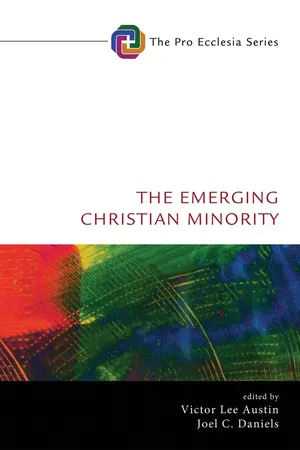
The Emerging Christian Minority
- 130 pages
- English
- ePUB (mobile friendly)
- Available on iOS & Android
eBook - ePub
The Emerging Christian Minority
About this book
An increase in secularization throughout the Western world has resulted in Christian communities finding themselves in a new context: emerging as a minority group. What does this changing landscape mean for existing Christian communities? Are there biblical or historical precedents for this situation? What should we expect in the future? These were the issues taken up by the speakers at the 2016 conference, "The Emerging Christian Minority," sponsored by the Center for Catholic and Evangelical Theology.
Contributors
David Novak
William T. Cavanaugh
Paige Hochschild
David Novak
Kathryn Schifferdecker
Anton Vrame
Joseph Small
Information
Topic
Theology & ReligionSubtopic
Christian Church1
Is It Good to Be Persecuted?
Is it good to be persecuted? No, it’s not. It is not good to be persecuted. It is bad to be persecuted.
I am tempted to stop there, but the editors of this volume who gave me the title for my paper would probably not be pleased. They clearly had more in mind than the simple question of whether or not being on the receiving end of persecution is a good thing. No sane person would say that being tortured and executed for one’s faith is positive. But one could make the argument that the church is stronger and better under persecution. The intensity and devotion of Polish and Irish Catholicism in the twentieth century is often attributed to the persecution of the church under the Communists and the British. It might not be a coincidence that Catholic practice in Ireland has taken a steep dive since the peace accord was signed on Good Friday in 1998. Likewise, the Catholic Church in Chile seems to have lost much of its sense of purpose now that it doesn’t have General Pinochet to kick it around anymore.
Even if one buys that argument on a purely sociological basis, however, there are few who would demand the return of human rights abuses so that the church could feel needed again. But there could be a sense, as Candida Moss puts it, that “In Christian terms, if you’re being persecuted, you must be doing something right.”1 Persecution, in these terms, is not something to be desired, either for its own sake or for some end such as strengthening the church, but when found it is an indicator that Christians have taken the high moral ground. The fact of being persecuted could then be worn as a badge of honor. Claiming to be persecuted could be used as evidence of the rightness of one’s cause, and therefore also as evidence of the depravity of one’s opponents. Claiming to be a victim of persecution could have the effect of galvanizing the church around a righteous cause, indeed the cause of Jesus Christ and the martyrs who also suffered persecution for righteousness’s sake. Persecution could also be a rallying point around which to draw outsiders to sympathize with the church’s plight.
There is a sense among many Christians today that Christians are not only rapidly becoming a minority in American society, but are becoming a persecuted minority. The campaign for religious liberty that the Catholic bishops and others have put forward is in many ways a response to this sense that the church is vulnerable to officially sanctioned interference and even persecution for sticking to its principles in a rapidly changing society. In the midst of the 2012 election campaign, Francis Cardinal George of Chicago repeated in print his famous off-the-cuff remark that he “expected to die in bed, my successor will die in prison, and his successor will die a martyr in the public square.” In the same column he wrote, “Secularism is communism’s better-scrubbed bedfellow,” and denounced “the anti-religious sentiment, much of it explicitly anti-Catholic, that has been growing in this country for several decades.”2
The rhetoric of Cardinal George and others has evoked a reaction not only among secularists but among some Christians who have criticized such language for its polarizing effects on our discourse. Candida Moss, formerly of Notre Dame and now professor of theology at the University of Birmingham in the United Kingdom, has gone further, and located a kind of persecution complex endemic to Christianity which she sees as responsible for coarsening our current political debates. Moss’s book The Myth of Persecution (2013) is a full-frontal attack on the way Christians have narrated the history of early Christian martyrdom. According to Moss, the tales of relentless Roman persecution of Christians are largely fabrications of the postmartyrdom period meant to lend legitimacy to orthodox Christian power. Although Moss is an academic, her book was published by a popular press, HarperOne, and it is aimed at and has found a general audience. The book is not just about the past, but about how the rhetoric of persecution has poisoned political and cultural debates in the present by allowing Christians to proclaim victim status and demonize opponents.
In this chapter, I will examine the rhetoric of persecution among Christians from two opposing points of view, that of Moss and that of the U. S. Catholic Bishops’ campaign for religious liberty. I will argue that both are seriously flawed, and for the same reason: neither can countenance the idea that there could be a fundamental tension between being an American and being a Christian. I will look at Moss’s book and the Bishops’ campaign in turn, and then at the end point toward a Christian theology of persecution.
Subsumed under the State
Although the target of Moss’s book is Christian rhetoric about persecution in the US, her book begins with a description of the 2011 bombing of a Coptic church in Egypt. In the aftermath, the dead were referred to by some as “martyrs.” Christian protestors in response targeted Muslim institutions. According to Moss, there is a direct causal link between these two facts: naming the victims as martyrs theologized the violence and enhanced the perception among Christians that they are engaged in a perpetual conflict of good versus evil: Christianity against the world. “Ironically, it is the belief that Christians are persecuted that empowered the protestors to attack others.”3
But clearly Christians are persecuted in Egypt, though we can agree that retaliatory violence is not good. Moss, however, does not want us to make such distinctions; she uses the Egypt example as evidence that claiming to be persecuted should be avoided because it leads to violence. “The rhetoric of persecution legitimates and condones retributive violence,”4 even, apparently, in places where the fact of persecution can hardly be denied. Moss then switches from Egypt to the United States, and argues that Christians’ claims of being persecuted are spurious, and that such claims lead to an unhealthy polarization of American public discourse. Such claims are, furthermore, not just a contemporary aberration, but are hardwired into Christian rhetoric by a false reading of Christian history invented largely in the fourth century. That reading of history—of which Eusebius is the main culprit—presents the early church as a church of martyrs heroically bearing up under relentless Roman persecution, and paints the rest of Christian history as the continuation of this brave resistance to the forces of evil. The church even came to see martyrdom in a positive light;5 according to Moss, in the early church, “the majority started to see the suffering of the innocent as a good thing.”6 This martyr complex continues to poison our public discourse:
The view that the history of Christianity is a history of unrelenting persecution persists in modern religious and political debate about what it means to be a Christian. It creates a world in which Christians are under attack; it endorses political warfare rather than encouraging political discourse; and it legitimizes seeing those who disagree with us as our enemies.7
Moss’s prime example of this type of rhetoric is a 2012 sermon given by Daniel Jenky, Catholic bishop of Peoria, Illinois, calling for heroic opposition to the Health and Human Services mandate requiring all employers—including Catholic institutions—to facilitate insurance coverage for contraception for their employees. Jenky infamously compared the Obama administration to those of Hitler and Stalin, and vowed that the church would resist persecution, as it always had. “For 2,000 years,” the bishop said, “the enemies of Christ have certainly tried their best.”8 Jenky cited the “terrible persecution” of the church under the R...
Table of contents
- Title Page
- List of contributors
- Preface
- Chapter 1: Is It Good to Be Persecuted?
- Chapter 2: St. Augustine on the Church as Sacrifice, Then and Now
- Chapter 3: To Be a Minority
- Chapter 4: A Tree Planted by Streams of Water: Scriptural Lessons on Hope
- Chapter 5: Professing the Faith in “A Secular Age”
- Chapter 6: Orthodoxy in America: A Minority That Came of Age
Trusted by 375,005 students
Access to over 1.5 million titles for a fair monthly price.
Study more efficiently using our study tools.
Frequently asked questions
Yes, you can cancel anytime from the Subscription tab in your account settings on the Perlego website. Your subscription will stay active until the end of your current billing period. Learn how to cancel your subscription
No, books cannot be downloaded as external files, such as PDFs, for use outside of Perlego. However, you can download books within the Perlego app for offline reading on mobile or tablet. Learn how to download books offline
Perlego offers two plans: Essential and Complete
- Essential is ideal for learners and professionals who enjoy exploring a wide range of subjects. Access the Essential Library with 800,000+ trusted titles and best-sellers across business, personal growth, and the humanities. Includes unlimited reading time and Standard Read Aloud voice.
- Complete: Perfect for advanced learners and researchers needing full, unrestricted access. Unlock 1.5M+ books across hundreds of subjects, including academic and specialized titles. The Complete Plan also includes advanced features like Premium Read Aloud and Research Assistant.
We are an online textbook subscription service, where you can get access to an entire online library for less than the price of a single book per month. With over 1.5 million books across 990+ topics, we’ve got you covered! Learn about our mission
Look out for the read-aloud symbol on your next book to see if you can listen to it. The read-aloud tool reads text aloud for you, highlighting the text as it is being read. You can pause it, speed it up and slow it down. Learn more about Read Aloud
Yes! You can use the Perlego app on both iOS and Android devices to read anytime, anywhere — even offline. Perfect for commutes or when you’re on the go.
Please note we cannot support devices running on iOS 13 and Android 7 or earlier. Learn more about using the app
Please note we cannot support devices running on iOS 13 and Android 7 or earlier. Learn more about using the app
Yes, you can access The Emerging Christian Minority by Victor Lee Austin, Joel C. Daniels, Victor Lee Austin,Joel C. Daniels in PDF and/or ePUB format, as well as other popular books in Theology & Religion & Christian Church. We have over 1.5 million books available in our catalogue for you to explore.