eBook - ePub
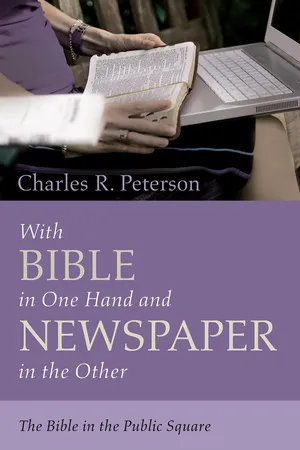
With Bible in One Hand and Newspaper in the Other
The Bible in the Public Square
- 204 pages
- English
- ePUB (mobile friendly)
- Available on iOS & Android
eBook - ePub
About this book
The famous theologian Karl Barth is known for his admonition that Christians should evaluate major news events in the light of the Bible rather than vice versa. This book reviews attempts at implementing Barth's principle in more than a hundred responses to newspaper editorial opinions over a decades-spanning period. In this exercise, five major theological themes frame the moral engagement of ten newsworthy subject categories. The analysis demonstrates how a biblically-based moral framing can define a center-left politically partisan stance as a guide or challenge to civil public dialogue.
A weakness of this venue is that space limitations of newspaper editorial pages allow little potential for achieving what Barth probably had in mind for an effective Christian witness. A different venue is therefore needed. Numerous barriers inhibit such dialogue within Christian congregations, including the stagnating polarization in US politics that has a parallel in most religious traditions. One can hope that the major role for a biblical witness to American culture has not become limited to that partial calling of the Old Testament prophets: warning of the negative historical judgments that risk coming to any society that fails to adequately attempt living out a reverential fear of God.
Information
Topic
Theology & ReligionSubtopic
Christian TheologyChapter 1
Introduction
Barth and Bonhoeffer
Most Christians know that Dietrich Bonhoeffer was a German theologian and pastor who publicly spoke out against Hitler as early as 1933, and they know that he was executed on Hitler’s orders a short time before the prison he was held in was liberated in 1945. I had a life-long interest in biblical theology and first learned of Bonhoeffer in college. His writings have had a strong influence on my interest in, and practice of, faith.
A short time after discovering Bonhoeffer I also learned about his friend, prominent Swiss theologian, Karl Barth. I didn’t read Barth as much as Bonhoeffer, but I came across his well- known advice to theological students: Christians should figuratively carry a Bible in one hand and newspaper in the other, but in relating the two, care should always be taken to interpret current events in the light of the Bible rather than the other way around.1 Barth had high regard for newspapers in his time, and he had reporters and journalists relatively high on his prayer lists. This discipline obviously requires searching for texts relevant to newsworthy topics.
This seemed like good theological advice, and I wondered if in formulating it, Barth might have been thinking about what had happened in Germany under Adolph Hitler. I found a likely answer in what he said about the Lutheran church in Germany under Hitler in the fourth chapter of his book, Dogmatics in Outline:
There must be translation, for example, into the language of the newspaper . . . Let us beware of remaining stuck where we are and refusing to advance into the world to meet worldly attitudes. For instance, in 1933 in Germany there was plenty of serious, profound, and living Christianity and confession—God be praised and thanked! But unfortunately, this confession remained imbedded in the language of the church and did not translate into the political attitude demanded at the time in which it would have become clear that the Evangelical Church had to say ‘No’ to National Socialism . . . It was not capable of that and the results are open to the day. Think what would have happened had the Evangelical Church at that time had expressed its church knowledge in the form of a worldly political attitude. A church not clear on having this duty would a priori betake itself to the graveyard . . . May every individual Christian be clear that so long as his faith is in a snail’s shell . . . he has not yet come to believe. 2
This Barth statement should be considered in the context of many statements by Bonhoeffer, such as the following question he posed in his unfinished book, Ethics: “Has the Church merely to gather up those whom the wheel has crushed or has she to prevent the wheel from crushing them?”3
Taken together, such statements by these two theologians can be reasonably interpreted to mean that Christians, either as individuals or collectively, should be in the business of dialogue in attempting to communicate the Bible’s relationship to major political issues, especially those with obvious moral dimensions. Consistent with the US Constitution, this doesn’t mean that pastors should endorse candidates, but the law shouldn’t prohibit conversation about issues separate from candidates. This could especially apply to adult forums and Bible studies. The haunting question ever since the tragedy of the Holocaust remains: Could a similar massive implosion of morality occur anywhere, anytime?
The Bible is Political
To expect a widespread practice of Bible–newspaper dialogue in Christian congregations seems unrealistic, but I unexpectedly had a rare opportunity to attempt such a discipline on my own. A few years after my wife and I retired to our lake home near Brainerd, Minnesota, some letters began to appear in the Brainerd Dispatch that were critical of the discussions that the Evangelical Lutheran Church in America (ELCA) was having on homosexuality. These criticisms of the ELCA were clustered just before and after the 2009 Church–wide Assembly that approved welcoming gay and lesbian persons into the church. Some of these opinions seriously misrepresented the process, which prompted me to write some rebuttal letters that the Dispatch published.
Not long after, the Affordable Care Act (ACA) was introduced and became prominent in the news and was debated on the editorial pages of the Dispatch. As a physician, I had a natural professional interest in health care delivery reform. In addition, from 2009 through 2012 there were several mass shootings in the US. This kept gun violence and possible tighter gun control in the news. I had served two years in the U.S Army medical corps during the Viet Nam war, I had also served on a jury in a gun store robbery–murder case, and like most medical specialties, the American College of Physicians had published position papers on gun control. Therefore, I submitted some opinions on these issues. This began a series of roughly monthly publications that evolved into a wider range of newsworthy subjects.
In 2012, the editor of the Dispatch asked me to serve a term as a community representative on its editorial board. Part of my role was to write some left-of-center opinions to constructively counter this editor’s conservative, partisan position. This was partly in order to demonstrate his commitment to have the newspaper represent both political sides while he could editorialize his. I saw this as a uniquely positive opportunity and accepted this position with the understanding that we would commit to write in a manner that would exemplify respectful dialogue. I continued to write about once a month after I left the position. Over an eight-year period, ninety–six of my letters and opinion–length submissions were published.
Some of my scientific perspectives on homosexuality and gun violence had been published in Minneapolis papers and theological journals back as far as the early 1990s. Partly to document that my interest in these issues did not start with my Dispatch experience, these opinions were added to my list. In all opinions, I had Barth’s perspective on biblical relevance always in mind, although a biblical perspective was explicit in about one-third of the opinions.
In recent decades, I read some books by theologian Marcus Borg, who was a professor in the philosophy department at Oregon State University where he taught Christian theology. In that setting of highly skeptical students, he pushed the traditional theological envelope in a number of ways, including biblical interpretation of a historical–metaphorical approach rather than literal-factual. Borg also promoted a non-violent political–activist application of biblical theology to current temporal issues. His last book, Convictions, has an entire chapter titled, “The Bible is Political.”4 Thus Barth, Bonhoeffer, and Borg came together to frame my theological thinking on contemporary moral issues.
Cheap Grace and Two-sphere Ethics
What seems conspicuously obvious, but little spoken of, is how strikingly rare Barth’s recommendation is openly followed in Christian congregations or promoted in seminaries. In an Internet web search, I found an ELCA Lutheran pastor’s “Behind the scenes of the sermon” blog titled, “Why it’s time to retire ‘The Bible in one hand, the newspaper in the other.’” His reasons were summarized under paragraph titles such as “Who reads newspapers anymore?” and, “Should preachers really be putting this much trust in the mainstream media”? This pastor blamed the press for his decision to not engage contemporary major issues. Such arguments are weak enough to suggest there are also other factors behind his dismissal of Barth’s advice.
A retired pastor that I know well told me that because he expressed his opposition to the Gulf war in a sermon, four prominent members of his congregation promptly left the congregation. Over the years, some other pastors, including college friends, made comments to me such as, “Last Sunday I felt like I preached like a false prophet.” These pastors thought that they should have used one of the lectionary texts to address an important problem facing the nation or community. But they were inhibited for “political” reasons. A parishioner leaving church might remark, “I’d recommend you stick to the gospel, pastor.” The pastoral concern was that donor support or membership might be adversely affected if controversial issues with political overtones turned up in sermons.
Assuming admonitions such as those of Barth, Bonhoeffer, and Borg have validity, a relevant question is whether or not this issue should be regarded as purely a clergy issue that leaves laypersons off the hook, given the difficulties pastors may face. It can be argued that laity involvement should be expected, a decision I came to in college—strongly influenced by a layman in my home congregation followed by some college professors.
In the years that I was a student at St. Olaf College, one morning chapel service a week had a senior student give a ten-minute message. I recall one student who quoted a paragraph from Bonhoeffer’s book, The Cost of Discipleship, first published in Germany in 1937 during Hitler’s ascent to power. It impressed me in a way that I never forgot: “We Lutherans have gathered like eagles round the carcass of cheap grace, and there we have drunk the poison which has killed the life of following Christ.”5
This statement led me to read more Bonhoeffer, including his Ethics. In that book, he criticized a defective sacred vs. secular system of “two sphere” ethics that was commonly practiced instead of the more biblical “one-sphere” holistic Christian ethic calling Christians to be good stewards of all life relationships with Christ at the center.6 Bonhoeffer asserted that the Christian ethics of his day made churches places...
Table of contents
- Title Page
- Preface
- Chapter 1: Introduction
- Chapter 2: Interpreting the Bible
- Chapter 3: Engaging Bible and Newspaper
- Chapter 4: American Christianity Since 1950
- Chapter 5: “What Then Should We Do?”
- Postscript
- Appendix A: List of Opinion Titles Classified by Subject
- Appendix B: Twenty–Five Original Opinions Selected from Each Subject Category
- Bibliography
Trusted by 375,005 students
Access to over 1.5 million titles for a fair monthly price.
Study more efficiently using our study tools.
Frequently asked questions
Yes, you can cancel anytime from the Subscription tab in your account settings on the Perlego website. Your subscription will stay active until the end of your current billing period. Learn how to cancel your subscription
No, books cannot be downloaded as external files, such as PDFs, for use outside of Perlego. However, you can download books within the Perlego app for offline reading on mobile or tablet. Learn how to download books offline
Perlego offers two plans: Essential and Complete
- Essential is ideal for learners and professionals who enjoy exploring a wide range of subjects. Access the Essential Library with 800,000+ trusted titles and best-sellers across business, personal growth, and the humanities. Includes unlimited reading time and Standard Read Aloud voice.
- Complete: Perfect for advanced learners and researchers needing full, unrestricted access. Unlock 1.5M+ books across hundreds of subjects, including academic and specialized titles. The Complete Plan also includes advanced features like Premium Read Aloud and Research Assistant.
We are an online textbook subscription service, where you can get access to an entire online library for less than the price of a single book per month. With over 1.5 million books across 990+ topics, we’ve got you covered! Learn about our mission
Look out for the read-aloud symbol on your next book to see if you can listen to it. The read-aloud tool reads text aloud for you, highlighting the text as it is being read. You can pause it, speed it up and slow it down. Learn more about Read Aloud
Yes! You can use the Perlego app on both iOS and Android devices to read anytime, anywhere — even offline. Perfect for commutes or when you’re on the go.
Please note we cannot support devices running on iOS 13 and Android 7 or earlier. Learn more about using the app
Please note we cannot support devices running on iOS 13 and Android 7 or earlier. Learn more about using the app
Yes, you can access With Bible in One Hand and Newspaper in the Other by Charles R. Peterson in PDF and/or ePUB format, as well as other popular books in Theology & Religion & Christian Theology. We have over 1.5 million books available in our catalogue for you to explore.