
Sleep Difficulties and Autism Spectrum Disorders
A Guide for Parents and Professionals
- 320 pages
- English
- ePUB (mobile friendly)
- Available on iOS & Android
Sleep Difficulties and Autism Spectrum Disorders
A Guide for Parents and Professionals
About this book
Problems with sleeping are common and make life difficult for the individual who is affected and for those around them. Sleep difficulties are particularly prevalent amongst people with Autism Spectrum Disorders (ASD) and often cause or worsen other difficulties.
This comprehensive guide to the management of sleep problems, introduces all the proven remedies and focuses on the problems commonly found in ASDs and related conditions. The author discusses sleep in depth, including how we currently define and understand it. The full spectrum of sleep disorders is explained alongside the range of possible treatment approaches. The book also examines why some sleep problems are more common among people with an ASD than others, how sleep problems evolve over time, what can be done to treat them and the likely benefits from different treatments.
This book is a complete resource for professionals, families and carers working with those suffering from sleep problems of any kind. It will be of great interest to anyone wanting to gain a thorough understanding of sleep in relation to ASDs.
Frequently asked questions
- Essential is ideal for learners and professionals who enjoy exploring a wide range of subjects. Access the Essential Library with 800,000+ trusted titles and best-sellers across business, personal growth, and the humanities. Includes unlimited reading time and Standard Read Aloud voice.
- Complete: Perfect for advanced learners and researchers needing full, unrestricted access. Unlock 1.4M+ books across hundreds of subjects, including academic and specialized titles. The Complete Plan also includes advanced features like Premium Read Aloud and Research Assistant.
Please note we cannot support devices running on iOS 13 and Android 7 or earlier. Learn more about using the app.
Information

TABLE APP 1.1 SUMMARY TABLE OF APPROACHES TO SPECFIC SLEEP DISORDERS | ||||
SLEEP DISORDER | Treatments of choice | Key evidence | Reported success rate for treatment | Possible issues |
Difficulty settling to sleep and frequent night waking | Behavioural | Multiple studies, see: Moore, Meltzer and Mindell 2008; Ivanenko and Patwari 2009 | 70% | None |
Insomnia | Behavioural and cognitive – behavioural and medication | Espie and Kyle 2009 | 70%+ | None |
Short night-time sleep | Behavioural | O’Reilly 1995; Piazza and Fisher 1991 | Evidence base too small to compute | None |
Excessive night- time sleep | Modafinil | Ali et al. 2009 | 88% (one study only) | Recent restrictions on use |
Excessive daytime sleepiness/tiredness | Modafinil | Ivanenko 2003 | Modest benefits in all (one small study) | Exacerbation of seizures and psychotic symptoms Recent restrictions on use |
Nightmares | Imagery rehearsal; desensitization; relaxation and prazosin | Krakow et al. (2001a,b); Lancee et al. 2008a | Most studies with traumatic onset nightmares | Lack of maintained improvement with prazosin alone |
Night terrors | Night waking and resettling; benzodiazepines; melatonin | Lask 1988; Popoviciu and Corfariu 1983; Jan et al. 2004 | High spontaneous resolution rate; no RCTs | Uncertain due to limited evidence base |
Night-time eating disorders | Sertraline; topiramate | O’Reardon et al. 2006; Stunkard et al. 2006 | 71% | Topiramate most effective but with a high rate of side effects |
Nocturnal seizures | Medication – type dependent on diagnosis | Bazil 2003 | No reliable data | Dependent on medication of choice |
Sleep-related rhythmic movement disorder | Picchietti and Picchietti 2008 | Self-remitting in most cases | No relevant safety data on ropinirole | |
Sleep bruxism | Orodental; behavioural; clonidine | Huynh et al. 2006; Huynh et al. 2007 | Unclear | MADs can cause physical discomfort; clonidine can cause REM suppression and low morning BP |
Obstructive sleep apnoea | Weight reduction; improved fitness; CPAP | Capdevila et al. 2008; Halbower 2008 | 80%+ | Discomfort from CPAP and prostheses; general risks from surgery |
Narcolepsy | Improved sleep hygiene coupled with medication (modafinil, sodium oxybate, venlafaxine or psychostimulants) | Kothare and Kaleyis 2008; Aran et al. 2010 | 70% | SSRIs have significant side- effects but are not first choice for management |
Nocturnal enuresis | DDAVP; enuresis alarm; behavioural | Evans 2001a, 2001b; Wright 2008; Lyon and Schnall 2010 | 79% | Results with DDAVP do not generalize |
REM sleep behaviour diso... | ||||
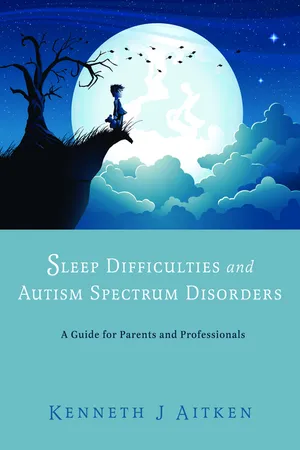
Table of contents
- Cover
- Of Related Interest
- Title Page
- Copyright
- Dedication
- Contents
- Acknowledgments
- Introduction
- Section A: Sleep and What we know About It
- Section B: Sleep Problems in General
- Section C: Sleep Problems in Asd
- Section D: Reasons Sleep Patterns May Happen or Can be Made Worse
- Section E: What Can You Do?
- Resources
- Appendix 1: Medications used in Sleep Disorders
- Appendix 2: Complementary and Alternative Treatment Approaches
- Appendix 3: Herbal Treatments
- Appendix 4: Assessment tools for Sleep Problems
- Further Reading
- Glossary
- References
- Index
