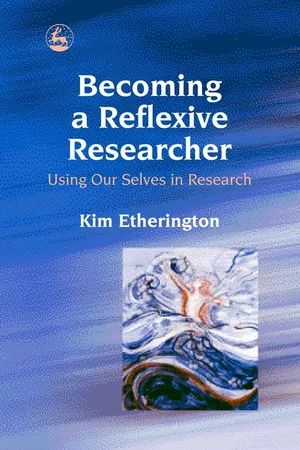
In this book, Kim Etherington uses a range of narratives to show the reader how reflexive research works in practice, linking this with underpinning philosophies. Placing her own journey as a researcher alongside others, she suggests that recognising the role of self in research can open up opportunities for creative and personal transformations.
- 228 pages
- English
- ePUB (mobile friendly)
- Available on iOS & Android
eBook - ePub
Becoming a Reflexive Researcher - Using Our Selves in Research
About this book
Information
Part 1
Bringing Theories Alive
Chapter 1
Introduction
This book is about a process of becoming – it implies movement, agency and continuity, rather than a striving to reach a state at which we have ‘become’. It is based upon the notion that we are constantly changing and developing our identities, and that they are never fixed. As we grow through our professional lives we make different choices at different times, and this book is for and about those who are interested in choosing, or who have chosen, to tread the researcher pathway.
There are many good books nowadays about ‘how to do research’: books about methodologies, philosophies, theories, uses of skills and practices of research, and even about representing and writing research. Many of these books, while not directly related to my own field, nevertheless provide useful information and knowledge that I can apply to my research role. As someone who is involved with teaching counsellors about research methodologies and supporting them to produce dissertations at Masters and doctoral level, I frequently hear the complaint that many research books are difficult to read and seem to have little relationship to the reader’s own lived experiences of undertaking research. Even mature academic researchers complain about the dearth of information about the process of becoming a researcher and the many aspects of life that this journey touches. So this book is a response to these comments.
Even less has been written that focuses on the personal experiences of social science practitioners who become reflexive researchers and, although I believe that aspects of this transition are particular to the field of counselling and psychotherapy, there are many that are also applicable to a whole range of practitioners whose work is focused on aspects of being human: medicine and related disciplines, law, anthropology, sociology, psychology, social work, mental health, education, disability studies, theology, to name a few. This book limits itself to stories about becoming a ‘reflexive’ researcher quite deliberately because it is this aspect that fascinates me and which has been paid little attention in research literature.
Some years ago my colleague Jane Speedy and I noticed how frequently MSc candidates would tell us about the transformations they were experiencing while undertaking the research module we were at that time teaching together (with input from other tutors). We began to anticipate these transformations, indeed almost to expect them as an outcome of this unit. Trainers at postgraduate diploma level have long recognized that people change and develop during their professional training – indeed if they do not then something seems sadly amiss.
Back in 1999 Jane and I delivered a paper at the research conference organized by the British Association for Counselling and Psychotherapy (BACP, then BAC) in which we focused on this phenomenon, and as a result of that I became intrigued to know more about how those transformations occurred (Speedy and Etherington 1999). About that time I became more aware of literature concerned with reflexivity and the use of self in research (Hertz 1997; Wosket 1999) and I undertook a reflexive research study in which I explored my practice with two ex-clients (Etherington 2000). In later reflective writing I examined how I had changed and developed through the process of conducting that study (Etherington 2001a) and during other studies that followed (Etherington 2001b, 2002a).
The research unit on the Masters course we teach at Bristol University seems to attract students who are interested in using reflexive methodologies. It would be disingenuous not to recognize that students are influenced by the methodologies used by us as their teachers and by the level of enthusiasm displayed in our teaching. However, I believe it goes beyond that.
Reflexive methodologies seem to be close to the hearts and minds of practitioners who value using themselves in all areas of their practices (including research) and who also value transparency in relationships. I am increasingly thinking that gender has a role to play in this. As I say in Chapter 2, reflexivity has been influenced by feminist approaches to research, and is closely in tune with women’s ways of knowing.
Using our selves in research
Having said that, it was a man, Clark Moustakas (1975, 1990) who described the stages of heuristic inquiry and introduced the concept of using ‘self’ as a major tool in the research process in psychological research (although a whole movement was emerging that supported reflexivity in research in the field of humanistic psychotherapy around this time). With his colleague Douglass (Moustakas and Douglass 1985) he described heuristic research, in its purist form, as a
passionate and discerning personal involvement in problem solving, an effort to know the essence of some aspect of life through the internal pathways of the self… When utilized as a framework for research, it offers a disciplined pursuit of essential meanings connected with everyday human experiences. (Moustakas and Douglass 1985, p.39)
Valle and Mohs (1998, p.96) suggest that Moustakas developed heuristic research in reaction to the dominant worldview of his day:
His humanistic (or ‘third force’) approach was both a reaction to, and a progression of, worldviews that constitute mainstream psychology, namely behavioural–experimental and psychoanalytical psychology.
However, his views are nonetheless influenced by realist notions and ‘essentialist’ notions of ‘self’ – as we might expect for someone of his time in the history of psychological research.
Paradoxically these notions led Clements et al. (1998, p.122), in their description of ‘organic research’, to describe heuristic inquiry as ‘masculine, theoretical, and inward focused’. So although many would view heuristic inquiry as valuing typically ‘feminine’ concepts, such as intuition, tacit knowing and ‘felt sense’ (as opposed to ‘masculine’ concepts such as logic, rationality and facts, that underpin positivist paradigms), these perceptions clearly depend on where one positions oneself at the time.
My own pathway
In preparing this book I have thought a great deal about how I started down the researcher pathway and what has influenced my development since I began my counsellor training in 1987. In retrospect I was fortunate that my postgraduate Diploma included an expectation that we submitted a small research project on a subject of particular personal interest. During my initial counsellor training I was employed by social services as a community occupational therapist, visiting disabled people in their own homes to assess their daily living requirements. The need for emotional support was not even considered back then, but my experience of working in the field had shown me that there were a great many people with disabilities who wanted and needed to talk about how their lives, and their sense of self and identity, were impacted by their experience of disability. That recognition led me to train as a counsellor and guided my choice of topic for my first piece of research: The Disabled Person’s Act: the need for counselling.
Students on that same Diploma nowadays are not required to undertake a research study, although they are expected to produce a major case study, which is approached in the spirit of research. I wonder though if the cost of separating research from professional training is that the research–practice gap has widened and that some practitioners lose sight at that stage of the possibility of taking the researcher pathway.
At that time I did not see myself as a ‘researcher’ but I did search the literature, conduct a small questionnaire survey of 26 disabled people and interview 8 volunteers in depth. Indeed, I now recognize that this was ‘research’ in its fullest, and even formal, sense. Back then, however, we had no training in methodology, methods or analysis, and my own view of research came from having been married to a biochemist since 1962: he wrote learned papers, presented them at international conferences, wore a white coat while he worked in his laboratory and used test tubes and spectrometers, and became excited about blobs on paper of which I could make no sense. This was what ‘proper research’ meant to me – so how could I see what I was doing as research?
Whether or not I had known it at the time, I became bitten by the research bug during that Diploma course and later plagued my tutor at the University to know when the first MSc in Counselling would commence, stating that my reason for wanting to do it was my interest in research. I was warned off at that point and told that research was not high on the agenda of the planned Masters, but rather an emphasis on training and supervision. However, early in 1990 I began the two-year course for an MSc in Counselling (Training and Supervision) and although there was very little formal research training on the curriculum then, we were expected to produce a dissertation. I engaged with excitement on a study that I now look back on as my first heuristic inquiry. It was a study of: The Father–Daughter Relationship and its Impact on the Lives of Adult Women.
Having successfully completed the MSc, my interest in research continued to flourish and grow. Concurrently, during these years, I had been experiencing several transforming relationships with therapists who had introduced me to my ‘inner Child’, who turned out to be full of curiosity and intelligence, and who had lain somewhat buried beneath layers of early childhood trauma. I had also discovered my ‘Adult’, who (much to m...
Table of contents
- Cover
- Of Related Interest
- Title Page
- Copyright
- Dedication
- Acknowledgements
- Contents
- Preface: In the Beginning is My Ending…
- Part 1: Bringing Theories Alive
- Part 2: The Masters Stage of the Journey
- Part 3: The Doctoral Stanges
- Part 4: The Postdoctoral Stages
- References
- Subject index
- Author index
Trusted by 375,005 students
Access to over 1.5 million titles for a fair monthly price.
Study more efficiently using our study tools.
Frequently asked questions
Yes, you can cancel anytime from the Subscription tab in your account settings on the Perlego website. Your subscription will stay active until the end of your current billing period. Learn how to cancel your subscription
No, books cannot be downloaded as external files, such as PDFs, for use outside of Perlego. However, you can download books within the Perlego app for offline reading on mobile or tablet. Learn how to download books offline
Perlego offers two plans: Essential and Complete
- Essential is ideal for learners and professionals who enjoy exploring a wide range of subjects. Access the Essential Library with 800,000+ trusted titles and best-sellers across business, personal growth, and the humanities. Includes unlimited reading time and Standard Read Aloud voice.
- Complete: Perfect for advanced learners and researchers needing full, unrestricted access. Unlock 1.5M+ books across hundreds of subjects, including academic and specialized titles. The Complete Plan also includes advanced features like Premium Read Aloud and Research Assistant.
We are an online textbook subscription service, where you can get access to an entire online library for less than the price of a single book per month. With over 1.5 million books across 990+ topics, we’ve got you covered! Learn about our mission
Look out for the read-aloud symbol on your next book to see if you can listen to it. The read-aloud tool reads text aloud for you, highlighting the text as it is being read. You can pause it, speed it up and slow it down. Learn more about Read Aloud
Yes! You can use the Perlego app on both iOS and Android devices to read anytime, anywhere — even offline. Perfect for commutes or when you’re on the go.
Please note we cannot support devices running on iOS 13 and Android 7 or earlier. Learn more about using the app
Please note we cannot support devices running on iOS 13 and Android 7 or earlier. Learn more about using the app
Yes, you can access Becoming a Reflexive Researcher - Using Our Selves in Research by Kim Etherington in PDF and/or ePUB format, as well as other popular books in Psychology & Research & Methodology in Psychology. We have over 1.5 million books available in our catalogue for you to explore.