![]()
STAGE 1
Preparing
Research needs careful preparation. Not just sharpening your pencil and making sure your calculator still works, but preparing ideas about what you might want to research (Chapter 2) and then plotting and planning how you can carry such research through (Chapter 3).
![]()
1
Beginners’ Nerves
Getting started – Thinking about research, theory and practice
Franz and Suzie sip cappuccino in the famous North London haunt, Café Mozart, after a long (and to Suzie somewhat panic-inducing) day at the local Arts Therapies Research Symposium.
‘I need a title ready for the seminar next week,’ says Suzie, ‘and I haven’t a clue what to do! And today didn’t help either – all that talk of “qualitative” this and “quantitative” that and “phenome”… I can’t even say that one! I mean, what’s all that got to do with art therapy? But if I haven’t got any ideas by next seminar, Peter Purt, who’s my tutor, will give me one of his looks!’ (Franz, listening to Suzie, suddenly catches himself giving her one of his looks and quickly looks down at his cappuccino.)
Suzie blows the froth on her cappuccino and sighs. This was not why she’d gone in for art therapy at Gamut College, she thinks sullenly.
Franz isn’t much happier, but for a different reason. He cuts through his Sachertorte with surgical precision as he tells Suzie: ‘I thought it was a lot of hot air! I mean, all those self-important people. All they argue about is theory and philosophy! I bet they don’t even do it themselves. I mean nobody actually told you what to do! And if I go to my manager in six months’ time and say that I’m still thinking whether it’s best to do qualitative hermeneutics or action research, he’s not going to be very sympathetic. I thought they were going to actually help me think how I can prove that my work makes a difference at Ivory Leaves.’ Franz dissects another slice of Sachertorte and reflects that this was just what he’d suspected the arts therapies were like – flaky!
But as Franz looks over to Suzie, who’s got a little moustache of cappuccino froth, life unexpectedly doesn’t seem too bad… They decide that the day has been quite exhausting and it’s time to go home and have a quiet night in, Suzie to Wembley Park, Franz to Bayswater. Before leaving, Suzie and Franz swap telephone numbers. ‘In case I hear of any other courses which might help you,’ adds Suzie, blushing imperceptibly as she sticks a little yellow ‘Post-It’ note on Franz’s black leather jacket.
Performance nerves
The time has come – and there’s no getting away from it or hiding behind jittery nerves. Research is knocking at the door. Either it is your Master’s dissertation, or pressure from the line manager at work, who may also be under pressure from the hospital, school, day centre or clinic accountant to justify funding your post as an arts therapist. Or you might simply be an enthusiastic arts therapist who needs a bit of pressure and entertainment. You decide to do a research project.
You know that your skills are in actually doing the work: being a therapist, writing up reports, putting together presentations, perhaps even fund-raising for instruments or art materials. But ‘research’ feels different; more serious – even just a bit more important. You are going to have to put your nose down, tweak your mind towards sustained inquiry and produce a piece of research. ‘Evidence-based research’ is what everyone’s talking about these days and you feel a little unsure of yourself… and where and how do you begin research in any case?
Let’s look at some of the thoughts you might be thinking.
Some notes (of caution and encouragement)
I’ve got loads of clinical experience – have worked with this patient group for many years, and read papers at conferences – surely doing research shouldn’t be too difficult?
Traditionally (i.e. a long long time ago), arts therapists wanting to do research would approach (or be approached by) an expert in research methods. This would be a psychologist or a researcher in one of the social sciences. This usually disempowered arts therapy clinicians, who continued to be therapists, and became adjuncts to the researchers – unless they themselves became researchers. This often meant mysteriously acquiring new thinking skills and an ability to distance themselves from their practice. Does this scenario appeal to you? Do you think it is useful to arts therapies research?
An encouraging development in arts therapies research is that increasingly, since the early 1990s, arts therapists are ‘doing it for themselves’, rather than getting ‘researchers’ to ‘do’ their research for them about arts therapy practice. In other words, we can all do research, by extending our clinical skills towards this most exciting endeavour.
The thinking emerging during the 1990s is that practitioners who extend themselves to include research in their working lives (rather than leave aside being practitioners and embracing research) are uniquely placed to do research, having an insider’s knowledge and understanding of the practice. But there are some difficulties. One is that as a researcher who is also a practitioner, you need to be aware of your personal, professional and clinical biases and see how or whether these can interfere with the way that you plan your project, the way that you write about it, your data collection, data analysis and so on (more about this later).
Your finely honed therapeutic skills and clinical intuitions will enrich your thinking about what you want to do, what questions you want to ask, and what answers you are looking for. You now need some research skills. Your clinical enthusiasm needs to be married to a different structure of thinking and working: that of research. In terms of what research to do – or what to research – do remember that the most useful research studies in terms of professional development are those that speak directly to clinicians, to your colleagues. Your questions might fascinate you personally – and, as you’ll see, they need to fascinate you to fuel your researcher’s zeal – but do they have wider relevance? More about this later.
I’ve no time!
We’ve no sympathy here, so get this thought securely out of your mind. The truth is that there is never enough time – and research always feels pressured. In fact, we suggest that feeling pressured is the only way to actually ‘do’ it – but you can help yourself to minimise ‘deadline’ pressures by being organised. We’ll offer you a few ‘lifelines’ (and ‘deadlines’) with regard to planning your time. Having too much time can work against you – you’re far less likely to complete your project without time constraints.
I wasn’t good at maths at school, numbers don’t make too much sense
Research doesn’t necessarily mean counting or measuring, and incidentally, doing research doesn’t even mean that you are a clever clogs. Rather, your capacity to be patient, dogged and organised is what will stand you in good stead. Plus a bit of flair, of course, and an openness to absorbing new concepts, including statistical ones, not to mention words with different meanings (such as ‘normal’, ‘significant’, ‘internal validity’ and ‘process’: more about these in Chapter 9). In any case, many research skills are non-mathematical: research in the arts therapies can involve many skills you’ve used or associate with your own training or work as an arts therapist.
I’m not very good at writing – and as an artist, I think in pictures (or music or movement) rather than words
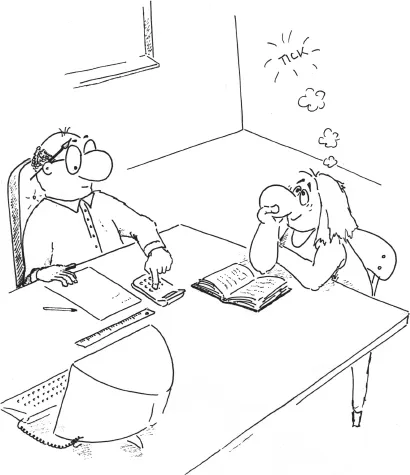
Yes, of course, thinking in words is different from thinking in sound or form or movement – but these are not necessarily antithetical to one another. Nor does thinking in words mean that you need to stop thinking in artform. On the contrary, the latter enriches our thinking and conceptualising. (We hope you like Lutz’ cartoons.) But there’s no getting away from writing, since your research ‘product’ will undoubtedly involve a written text. A good place to start is to think about reading. How often does something you read not keep your interest? Despite the content of the text being interesting, sometimes weak or incoherent writing can get in the way. We suggest that you write as much as possible, as soon as possible, and throughout this book we’ll be urging you to stop reading and get writing. It is a skill that comes with practice – and with being self-critical. It is not enough to ‘just write’! You need to mo...