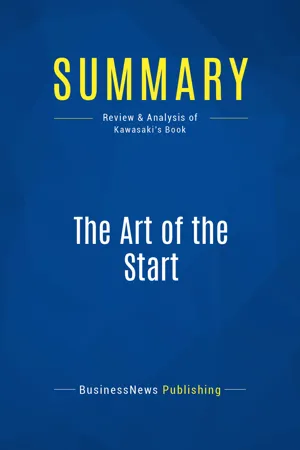
The must-read summary of Guy Kawasaki's book "The Art of the Start: The Time-Tested, Battle-Hardened Guide for Anyone Starting Anything".
This complete summary of the ideas from Guy Kawasaki's book "The Art of the Start" shows how starting a business is an art. In his book, the author explains a step-by-step approach for starting any business project, from launching a start-up to creating a new product. He also demonstrates the importance of giving meaning to everything you do to make things happen and achieve success.
Added-value of this summary:
• Save time
• Understand the key concepts
• Expand your business knowledge
To learn more, read "The Art of the Start" and find out everything you need to know about starting a new business and how to make it a success!
eBook - ePub
Summary: The Art of the Start
Review and Analysis of Kawasaki's Book
- English
- ePUB (mobile friendly)
- Available on iOS & Android
eBook - ePub
About this book
Information
Topic
Aides à l'étudeSubtopic
Activité entrepreneurialeSummary of The Art Of The Start (Guy Kawasaki)
1. The Art of Starting
Gathering information is useful but ultimately it’s what you actually do that counts. To spend more time doing rather than endlessly learning what to do:
- Decide how you can make a difference.
- Develop a mantra rather than a mission statement.
- Get your product into the marketplace.
- Define your business model – how you’ll make money.
- Compile lists of milestones, assumptions and tasks.
- Decide how you can make a difference – because nobody really knows in advance whether he or she is genuinely cut out to be an entrepreneur. Instead of going through an extensive aptitude test, strike out on your own if:
- You want to make the world a better place.
- You want to increase people’s quality of life.
- You want to right a terrible wrong.
- You want to prevent the end of something laudable.
- Develop a mantra rather than a mission statement – because nobody ever remembers a long winded mission statement. Instead, come up with a mantra everyone will know:
- “To do something insanely great”.
- “Authentic athletic performance”.
- “Fun family entertainment”.
- “Better than driving”.
- Get your product into the marketplace – that is, instead of worrying about writing a business plan, get started. Build a prototype, launch your service business or begin selling version 1 of your product, even if it isn’t as good as you’d like. Get into the marketplace and start selling rather than endlessly strategizing about what you’ll do in the future. Think big, use your prototype to do your market research and try to do things that will polarize people for and against you.
- Define your business model – how you’ll make money – because you won’t be able to actually change the world if you’re broke. In practice, this will mean:
- Selecting a niche to focus on initially.
- Keeping it simple – describe in 10 words or less.
- Copying what others are already doing to make money.
- Compile lists of milestones, assumptions and tasks – because these will keep you on track and focused.
- Milestones are the significant steps along the road to long-term success. The timing of achieving your milestones will dictate how rapidly your business will move forward. The seven key milestones are
- Prove your concept.
- Complete your design specifications.
- Finish a prototype.
- Raise capital.
- Ship a testable version to actual customers.
- Ship the final version to paying customers.
- Achieve breakeven.
- By listing the assumptions you’ve made going in, you can then continuously track these and react quickly if your initial assumptions were misguided or incorrect.
- A tasks list will help you appreciate the true enormity of what you need to accomplish and ensure nothing important falls between the cracks and is ignored.
- Milestones are the significant steps along the road to long-term success. The timing of achieving your milestones will dictate how rapidly your business will move forward. The seven key milestones are
2. The Art of Positioning
Positioning dictates what the heart and soul of the new organization will be in a powerful way that will differentiate the organization clearly and distinctively. Positioning will specify:
- Why the organization’s founders started the business.
- Why customers should patronize it.
- Why good people should work for this organization.
Positioning is a fundamental task of the aspiring business builder. It is a practical exercise that allows you to make your firm become relevant to the needs of your customers. Positioning also allows you to differentiate yourself distinctively.
The natural tendency of most entrepreneurs is to aspire to serve the general marketplace. This is unrealistic. All of history’s most successful companies have started out serving a niche market first, and then adding one niche after another until they dominate the market. You need to do the same, and therefore your positioning (and also the name of your enterprise) should reflect your specialization.
Good positioning is:
- Positive – that is, you exist to serve customers with great products rather than to put some other company out of business. Customers don’t care about destroying any evil empires. All they want to know is what you can do for them.
- Customer-centric – meaning you help your customers in some practical way rather than to become “the leading company in your field” (which is impossible to prove and of no use to your customers whatsoever).
- Empowering – what you do makes the world a better place in one way or another.
- Self-explanatory – and practical.
- Stated in plain English – rather than in the technical terminology of your industry.
- Personal – in that it specifies what you’ll do for each customer individually.
- Distinctive – it doesn’t use the usual generic but meaningless terms like “high-quality”, “robust”, “easy-to-use” or “fast”. Everyone tries to use these already whic...
Table of contents
- Cover
- Book Presentation: The Art of the Start by Guy Kawasaki
Trusted by 375,005 students
Access to over 1.5 million titles for a fair monthly price.
Study more efficiently using our study tools.
Frequently asked questions
Yes, you can cancel anytime from the Subscription tab in your account settings on the Perlego website. Your subscription will stay active until the end of your current billing period. Learn how to cancel your subscription
No, books cannot be downloaded as external files, such as PDFs, for use outside of Perlego. However, you can download books within the Perlego app for offline reading on mobile or tablet. Learn how to download books offline
Perlego offers two plans: Essential and Complete
- Essential is ideal for learners and professionals who enjoy exploring a wide range of subjects. Access the Essential Library with 800,000+ trusted titles and best-sellers across business, personal growth, and the humanities. Includes unlimited reading time and Standard Read Aloud voice.
- Complete: Perfect for advanced learners and researchers needing full, unrestricted access. Unlock 1.5M+ books across hundreds of subjects, including academic and specialized titles. The Complete Plan also includes advanced features like Premium Read Aloud and Research Assistant.
We are an online textbook subscription service, where you can get access to an entire online library for less than the price of a single book per month. With over 1.5 million books across 990+ topics, we’ve got you covered! Learn about our mission
Look out for the read-aloud symbol on your next book to see if you can listen to it. The read-aloud tool reads text aloud for you, highlighting the text as it is being read. You can pause it, speed it up and slow it down. Learn more about Read Aloud
Yes! You can use the Perlego app on both iOS and Android devices to read anytime, anywhere — even offline. Perfect for commutes or when you’re on the go.
Please note we cannot support devices running on iOS 13 and Android 7 or earlier. Learn more about using the app
Please note we cannot support devices running on iOS 13 and Android 7 or earlier. Learn more about using the app
Yes, you can access Summary: The Art of the Start by BusinessNews Publishing in PDF and/or ePUB format, as well as other popular books in Aides à l'étude & Activité entrepreneuriale. We have over 1.5 million books available in our catalogue for you to explore.