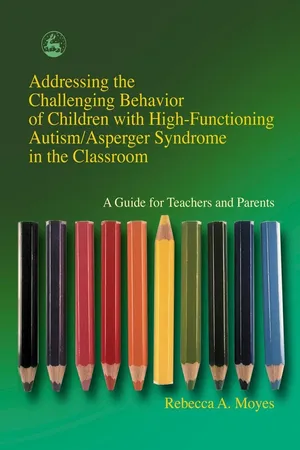
How do teachers and parents of children with autism address a child's social skills? And what do they do about problem behaviors? This book provides possible explanations for these behaviours, and a wealth of practical help for both teachers and parents to address them. Teachers learn how to create environmental supports and how to incorporate specific teaching strategies. Students with autism learn the new skills they might need, and ways of making their behavior more acceptable. This book is full of practical tips on how to tackle different kinds of challenging behaviors both in the classroom and outside it.
eBook - ePub
Addressing the Challenging Behavior of Children with High-Functioning Autism/Asperger Syndrome in the Classroom
A Guide for Teachers and Parents
- 160 pages
- English
- ePUB (mobile friendly)
- Available on iOS & Android
eBook - ePub
Addressing the Challenging Behavior of Children with High-Functioning Autism/Asperger Syndrome in the Classroom
A Guide for Teachers and Parents
About this book
Information
CHAPTER ONE
Traditional Approaches
For many children with autism, problems associated with behavior in the classroom can be expected. Indeed, behavioral differences are an important part of the diagnosis of autism and Asperger syndrome. The practice of including children with disabilities in typical classrooms, and in particular, children with autism, has not kept pace with providing training to school staff. If teachers felt competent in working with children with autism, they would be able to make the process of inclusion profitable for these children, as well as the typical students in their classrooms.
TRADITIONAL APPROACHES TO MANAGING POOR BEHAVIOR
Traditionally, the most common approaches that have been utilized to address problem behavior are aversives, restraints and/or behavior modification techniques.
Aversives
Aversives are defined as the use of negative reinforcers to interrupt or stop problem behaviors when they occur. Examples of frequently used aversives include reprimanding the child or removing enjoyable activities. However, in some places, other aversives used include squirts with water or other unpleasant substances, noxious-tasting materials and physical punishments (smacking, hitting).
EXAMPLE I
Ryan, when overwhelmed with his classwork, would frequently ‘dump’ all his papers off his desk. His teacher would then require Ryan to stand out in the hall by her door for ten minutes.
Aversives can also be responses to behavior that, because of their dramatic effect, startle or scare the student into stopping the behavior.
EXAMPLE II
Peter had a particular sensitivity to loud noises. His teacher, in an effort to get Peter to comply, would often shout ‘STOP THAT!’ to get him to complete the task at hand.
Overcorrection, another type of aversive, is where the student is required to complete the appropriate behavior several times because he did not do it when asked, or because he continued negative behaviors when he was asked to stop.
EXAMPLE III
Brad forgot to write his name on his homework paper. Since he did this quite frequently and reprimanding him did not seem to work, his teacher required Brad to stay in during recess time and write his name 100 times on a piece of paper.
It is important to understand that the use of aversives is a response to inappropriate behavior and should not be considered as a preventative measure for those types of behaviors.
Restraints
Restraints can be defined as techniques, appliances, etc. that restrain or ‘hold back’ a student from doing something which is dangerous to him/herself or others. Restraints might also be used to help secure attention, such as the use of seatbelts in classroom chairs.
EXAMPLE I
Michael, when stressed, would frequently begin to hit or kick his peers. His teacher, in an effort to calm him down, would often grab him, force his hands down and wrap her arms around his torso until he could contain himself.
EXAMPLE II
Sarah rode a special mini-van to school. She would often leave her seat and bother the other children or the driver. Finally, a seatbelt was installed in her seat. Sarah was buckled in each day so that she could not disturb the other individuals on the van.
EXAMPLE III
Robert would have several episodes a day where he would begin to bang his head hard on his desk. Staff could not discover any responses to this behavior that stopped the head banging. His school ordered a special helmet for Robert to wear that prevented him from inflicting injury to himself when he banged his head. This did not stop the frequency of this behavior, but prevented Robert from injuring himself.
Behavior modification
Another way to manage behavior is through behavior modification – the use of a collection of techniques that are assembled to increase the number of desirable behaviors and decrease or ‘extinguish’ the number of undesirable behaviors. Behavior modification only takes into consideration those behaviors that are observable and measurable. Behaviorists do not attempt to discover the reasons or causes for such behavior. ‘Targeted behaviors’ are broken down into tiny pieces of mastery that lead to the targeted behaviors. The tiny pieces are taught first and rewarded until they are mastered. Punishments (reprimands, withdrawal of privileges or favorite objects, time outs, and/or overcorrections) are used to decrease the number of undesirable behaviors, as are restraints and aversives. Generalizing the student’s responses so that they are appropriate in other settings and with other teachers may also have to be taught.
EXAMPLE I
Lisa frequently flapped her hands. Her teacher used overcorrection to stop this behavior. Lisa’s teacher would place her hands in her lap and then on her desk ten times every time Lisa flapped. She would reprimand Lisa with a statement: ‘No flapping!’ When Lisa did not flap for intervals of 15 minutes, she received a pretzel stick, her favorite food reward.
EXAMPLE II
Robert’s teacher was trying to teach him to attend to completing a task. First, she had to teach him to sit in a chair. Then Robert had to learn to stay seated in the chair for 15 minutes. Robert also had to learn to look into his teacher’s eyes. All of the above had to be taught and rewarded first before he could begin to attend to completing a task.
EXAMPLE III
Lisa’s kindergarten teacher was trying to encourage her to help clean up the toys. Lisa would put one or two toys away and then wander off while the other children in the class completed the task. The teacher was instructed by a behavior therapist to reward Lisa as soon as she helped with one or two toys, rather than waiting for her to put them all away. Lisa’s teacher was shaping her behavior by reinforcing approximations of the desired behavior.
Again, it is important to note that although behavior modification is a commonly used approach for handling problem behavior, it does not take into consideration the reason for such behavior. For instance, if a student is exhibiting self-stimulatory behavior because he is stressed, overcorrection may result in the student replacing one self-stimulatory behavior with another.
IS THERE ANOTHER WAY TO ADDRESS BEHAVIOR PROBLEMS?
Communication difficulties constitute one of the principal deficit areas in the syndrome of autism. Behavioral problems and atypical social skills development are other characteristics of this disorder. There is increasing professional acknowledgement of the relationship between the communication difficulty experienced by children (i.e. with autism) and the number of behavioral problems they may display. (Hodgdon 1995, p.265)
The amount of time that it takes to prepare how a teacher will respond to negative behaviors can be overwhelming. Teachers and staff may constantly feel as if they are ‘on edge’ waiting for the behavior to occur and then worrying if their responses are going to be effective. The use of a systematic approach to solving behavior problems that strongly takes into consideration the reason for why the behavior is occurring and builds the communication bridge to help prevent those problem behaviors can be far less frustrating.
The purpose of this book is to present such an approach. It begins with the use of a formal behavior support plan (Appendix 1.1). This plan takes into consideration what the student may be thinking and/or feeling as a reason for why his behavior is occurring. Creating environmental supports for problem behaviors and incorporating specific teaching strategies are one phase of this approach. The other phase is to teach students with autism the skills they are lacking so that they might then be able to behave appropriately.
As teachers and parents, we frequently acknowledge the need to teach our children to ‘own’ their behaviors. However, we must also recognize the need to be able to provide our children with meaningful strategies to help them accomplish this in their home, community and school environments.
APPENDIX 1.1
Behavioral Support Plan
Student Name:____________________Date: ____________
Define the problem behavior and why it is important to change:
Hypothesis regarding the problem behavior:
Identified skill to be taught to reduce problem behavior:
Antecedent strategies to put in place to prevent behavior:
Hierarchy of consequential strategies to use when behavior occurs:
Reward system for good behavior:
Methods and dates of data collection for evaluation:
CHAPTER TWO
Adopting a Team Approach to Writing a Behavioral Support Plan
Often, teachers and parents struggle with not only how to address problem behaviors, but when to address them. They may differ on what behaviors need to be tackled and/or what methods should be used to control them. As we will see in Chapter 3, the process of effectively addressing challenging behaviors comes from understanding why they are occurring. As mentioned previously, we spend many hours as educators and parents planning out possible responses to inappropriate behavior. Very little time is spent on putting preparations in place to prevent problem behavior or discovering why it may be occurring. Looking at negative behaviors as a form of communication (sophisticated or not, appropriate or not) will help us to decide what to do to help reduce the number of times these behaviors occur. In Chapter 3, we will focus on possible reasons for poor behavior. In this chapter, however, we will learn to observe behaviors using a nonjudgmental approach. We will learn to gather information as a team and analyze it systematically – free from the emotions that often cloud our lens. Gathering information...
Table of contents
- Cover
- Of Related Interest
- Title
- Copyright
- Contents
- Dedication
- Acknowledgements
- Preface
- Chapter One: Traditional Approaches
- Chapter Two: Adopting a Team Approach to Writing a Behavioral Support Plan
- Chapter Three: What Causes Misbehavior in Children with Autism? Forming a Hypothesis
- Chapter Four: Antecedent Strategies
- Chapter Five: Rewards and Motivators
- Chapter Six: Consequential Strategies
- Chapter Seven: Evaluation for Effectiveness
- References
Trusted by 375,005 students
Access to over 1.5 million titles for a fair monthly price.
Study more efficiently using our study tools.
Frequently asked questions
Yes, you can cancel anytime from the Subscription tab in your account settings on the Perlego website. Your subscription will stay active until the end of your current billing period. Learn how to cancel your subscription
No, books cannot be downloaded as external files, such as PDFs, for use outside of Perlego. However, you can download books within the Perlego app for offline reading on mobile or tablet. Learn how to download books offline
Perlego offers two plans: Essential and Complete
- Essential is ideal for learners and professionals who enjoy exploring a wide range of subjects. Access the Essential Library with 800,000+ trusted titles and best-sellers across business, personal growth, and the humanities. Includes unlimited reading time and Standard Read Aloud voice.
- Complete: Perfect for advanced learners and researchers needing full, unrestricted access. Unlock 1.5M+ books across hundreds of subjects, including academic and specialized titles. The Complete Plan also includes advanced features like Premium Read Aloud and Research Assistant.
We are an online textbook subscription service, where you can get access to an entire online library for less than the price of a single book per month. With over 1.5 million books across 990+ topics, we’ve got you covered! Learn about our mission
Look out for the read-aloud symbol on your next book to see if you can listen to it. The read-aloud tool reads text aloud for you, highlighting the text as it is being read. You can pause it, speed it up and slow it down. Learn more about Read Aloud
Yes! You can use the Perlego app on both iOS and Android devices to read anytime, anywhere — even offline. Perfect for commutes or when you’re on the go.
Please note we cannot support devices running on iOS 13 and Android 7 or earlier. Learn more about using the app
Please note we cannot support devices running on iOS 13 and Android 7 or earlier. Learn more about using the app
Yes, you can access Addressing the Challenging Behavior of Children with High-Functioning Autism/Asperger Syndrome in the Classroom by Rebecca Moyes in PDF and/or ePUB format, as well as other popular books in Psychology & Classroom Management. We have over 1.5 million books available in our catalogue for you to explore.