![]()
Chapter 1
Family Support: From Description
to Reflection
Pat Dolan, John Pinkerton and John Canavan
Introduction
This is the second set of descriptions of family support in its varied forms that we have assembled as editors (see also Canavan, Dolan and Pinkerton 2000). The message of the earlier book was that family support needed to find direction within its diversity. It was unsustainable as a challenging policy and practice direction if it could not move on from ‘being one of those warm and fuzzy terms which by being all inclusive ends up meaning nothing’ (Pinkerton 2000). There was a need for description, clarification and definition. That was the emerging agenda which needed to be addressed through policy, operational management, practice and research. Five years on, family support has become a major strategic orientation in services for children and families. It now occupies a significant place within the array of care and welfare interventions. It has global currency. Not only does it shape policy and practice in different countries but it accords strongly with the unifying global agenda for children and their families: the United Nations Convention on the Rights of the Child. Yet despite that continued development family support remains elusive. It’s there, governments are promoting it, agencies are organised for it, workers are delivering it and families receiving it – but what is it?
The clarification agenda still needs to be addressed. Family support continues to be remarkable for being so under-conceptualised. Its policy roots and practice implications have yet to receive definitive programmatic attention. Family support practitioners – and by that term is meant anyone involved in making it a reality, whether through front line service delivery, management, policy or evaluation – continue to work without a common view as to its meaning. That lack of clarity is a shared challenge to all of us involved with family support. It is that challenge of how to take a firm position on the content and meaning of family support in policy and practice that represents the context in which this book was born for us as editors.
The challenge took two forms. The first was the involvement of two of the editors in launching a post-graduate programme of training in family support (www.nuigalway.ie/soc) and having to find the secure conceptual grounding that such an enterprise required. The second resulted from a concern we all three shared about a policy vacuum around family support. That led us to facilitate a national policy symposium on family support in Ireland in 2002. In turn this prompted a request from the Irish Department of Health and Children to formulate a definition of family support as part of the consultative process leading to the development of a national Family Support Strategy. Responding to the challenge of those two ‘critical incidents’ in the development of our thinking about family support forced us to take a position on what we regard it to be. We are now working to an explicit, albeit provisional, definition of family support.
Our definition, like all the others which are being applied, implicitly or explicitly, within the field of family support, must be compared and contrasted and tested in practice. A sound, shared understanding of family support can only emerge through such a process of reflection. The varied accounts we have assembled here on practising family support, and the lessons there are to learn from that practice, provide an opportunity to reflect on our definition and to develop future directions in our thinking and activity. We also hope the chapters will add to the readers’ existing stock of concepts and frameworks of understanding, while developing their appreciation of how that knowledge can become a part of their practice.
This first chapter represents our guide to reading the chapters that follow. We begin by proposing social support as the theoretical linchpin to an understanding of family support. That is followed up with a model of family support linked to a definition and set of practice principles. With our position made explicit as a reference point we set out an approach to reflective practice and offer some guidance as to how to operate in this mode. It is our intention to encourage readers to respond from their own experience and understanding to our definition and in doing so move into reflective mode. Reflective reading, like reflective practice, must begin with clarifying what the starting point is for the individual reader. What any reader makes of this book will depend on his or her own experience of family support and sets of ideas about that experience. This means that certain chapters will have more immediate appeal for some readers than for others. The final part of this chapter provides summary information on each of the book’s chapters which may help readers select which are closest to their interests. However, whether engaging with the book on a selective or a comprehensive basis, we urge readers to stick with the tasks set in this first chapter of connecting thinking to practice in order to address the clarification agenda necessary if family support is to maintain and develop its position within child welfare.
Understanding family support
Despite the recognition of family support as a major strategic orientation, it is still at a relatively early stage in its development (Pinkerton, Dolan and Percy 2003). The dominant focus in child care services since the early 1990s has been on the protection and care of children who are at risk. There has been interest in preventive approaches to child welfare, involving support to families and children, aimed at avoiding the need for further more serious interventions later on (Gardner 2003; Jack and Jordan 1999). However the level of that interest has been dependent on the contingencies of an ever changing national policy climate (Tunstill 2003). Lurking in the shadows of the debate over family support, there is a much sharper political, social and economic challenge (Hardiker, Exton and Barker 1991; Pinkerton et al. 2003). Accordingly secure ground needs to be sought in understanding what exactly family support means in terms of services, policy and organisational contexts. It is timely to focus on developing a definition. That in turn requires a more explicit position on the theoretical underpinnings of family support.
Underpinning family support with social support theory
There is no dominant theoretical underpinning apparent in the literature that attempts to address the thorny question of what is family support. However, social support theory is a strong candidate for filling that space as the link between it and the practicalities of supporting families is so clear. There is strong research evidence gathered over the last 30 years that social support plays a crucial part in successful coping (Eckenrode and Hamilton 2000). It is known that its presence assists resiliency, has a buffering effect in dealing with stress and aids positive mental health (Rutter, Giller and Hegel 1998). Informal social support between family members and amongst friends can be seen as forming a ‘central helping system’ (Canavan and Dolan 2000). Whittaker and Garbarino in the 1980s neatly described social support within families as being the ‘bread and butter’ source of help (1983, p.4).
In the main, people access support from the informal sources of the nuclear and extended family and to a lesser extent friendships (Canavan and Dolan 2003; Cutrona 2000). When such natural support is deemed to be weak, non-existent or incapable of offering the help required, a person is more inclined to turn to formal sources of support. This is not to counterpoise the informal and the formal as an ‘either/or’ choice, for both have advantages and disadvantages. Whereas informal support is non-stigmatising, cheap and available outside of ‘nine to five’, there are forms and degrees of need where professional help is clearly required (Gardner 2003). Additionally, as Gardner (2003) and Belsky (1997) have cautioned, families can also be the main source of strife, including abuse. In such cases direct intervention from professionals is certainly necessitated.
Types and qualities of support within and beyond families
In the main there are specific types and qualities of support available to families (Cutrona 2000) and these are as follows.
Types of social support:
•Concrete support relates to practical acts of assistance between people, for example, childminding a sister’s young baby while she goes shopping. It has been noted that too often a family’s need for basic practical help is either missed or underestimated by professionals (Cochran 1993; Dolan and Holt 2002; Jack 2001).
•Emotional support comprises acts of empathy, listening and generally ‘being there’ for someone when needed (Cutrona 2000). There is a need to be discreet in how one offers emotional support, but it has particularly strong currency in that even if offered as an alternative to other types of need it is generally perceived as helpful (Cutrona 1996).
•Advice support can be more complicated and is often sought within families for its comfort and reassurance rather than the actual nature of the advice itself (Cotterell 1996). For example, in dealing with a family member with an illness such as cancer, other family members often seek advice which reassures them that they are doing their best for the sick person (Aymanns, Sigrun and Klaur 1995).
•Esteem support centres on how one person rates and informs another in terms of personal worth. For families, it is the foundation stone of their personal system (Burleson 1990).
Qualities of social support:
•Closeness – within family and other contacts, a person is more likely to access support from those that he or she sees as responsive and those with whom there is a shared sense of closeness. For example, research in Ireland and the US (Cutrona and Cole 2000; Riordan 2002) shows that this is particularly the case in respect of teen parents.
•Reciprocity involves acts whereby help is exchanged between people, ensuring that a person does not feel beholden to another. Very often within families this occurs automatically and its value lies in the comfort of knowing that the exchange of support is ready made and available if and when it is needed.
•Durability relates to the contact rates and length of time people are known to each other. Ideally reliable members are those who are known for a long period, are nearby to offer help, and typically are in no way intrusive (Tracy and Biegel 1994).
Thus, social support theory draws on a considerable body of research to clearly identify the types and qualities of relationships that provide support in a way that can be concisely demonstrated and easily understood. As such, it can be directly applied in the field of family support.
A model, definition and set of principles for family support
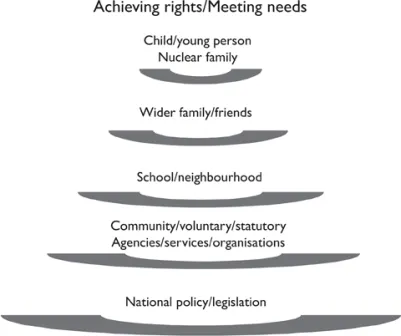
Using social support theory as a linchpin, it is possible to take a coherent view of family support in a way that is applicable across a range of contexts. This perspective allows the ultimate goal of achieving the rights of children and young people through meeting their needs within the family to be modelled within a set of levels of support, as set out in Figure 1.1 below. The emphasis on levels of support contained within the cupped model is consistent both with the social support and with wider family support literature. Beyond the nuclear family, there are extended family and friends, then the school and community, which in turn are supported by wider organisational networks, and finally, national policy and legislation.
Figure 1.1: A cupped model of family support
This model has been used within the Irish context to help distil a clear and detailed definition for family support as follows:
Family support is recognised as both a style of work and a set of activities that reinforce positive informal social networks through integrated programmes. These programmes combine statutory, voluntary, community and private services and are generally provided to families within their own homes and communities. The primary focus of these services is on ...