![]()
PART ONE
An Overview
![]()
Introduction
SUMMARY
This book is a planning guide for politicians, managers, commissioners, service providers and professionals engaged in or setting up strategic partnerships to improve local services of social and health care and education. It deals with the necessity for partnership and its purposes. It considers the practical questions of where it should be focused, who should be involved and how it should be implemented. A book of this kind cannot possibly cover every critical issue but I have tried to provide a framework of questions to work through and some common problems people have faced and needed to resolve.
What this book is about
Partnerships in Social Care is essentially about the effective co-ordination of public sector and voluntary effort which is intended to benefit people who are in need through ill health or social vulnerability. There is little doubt that co-ordinated and jointly planned services do deliver a better, more effective service to users of health and social services, education, housing, financial support, policing and the administration of justice. But it is clear from much painful experience that this is difficult to achieve. So much effort is required to get a partnership off the ground that it sometimes absorbs the energy and effort which should be devoted to providing improved service delivery in other ways.
This book is about planning and running successful partnerships. It starts from the assumption that they should never be an end in themselves but a means of doing some things better. It follows that the nature of the partnership in a particular case should be limited to what is likely to achieve that. Above all partnership is not an ideology; it is a method.
I will explore five themes:
•Is this partnership necessary?
•What is its purpose?
•Who is involved?
•Where will it function?
•How will it work?
This book is written as a handbook rather than a series of analytical essays and is based on my experience as a consultant working with many different kinds of partnership and on research evidence about some of the things that work and some that don’t. It is designed so that you can dip into it to explore the issues that are exercising you at the time. It is also constructed thematically so that you can see, almost at a glance, how each theme relates to the others.
A couple of points about the style of the book. There is a bibliography containing most of my source material other than personal experience but I have avoided numbered references and footnotes as being distracting in a book of this kind. Second, I have defined words where I have thought it helpful when they occur for the first time, and sought to remain consistent to the definitions throughout.
Third, I have dealt with the gender pronoun issue by using ‘he’ or ‘she’, ‘him’ or ‘her’ more or less alternately throughout the book. I am uncomfortable with ‘they’ where it is clearly singular in the context; and the ‘he/she’ variations are, to my mind, clumsy. So wherever you see ‘she’ or ‘he’ in this book, please remember that it has no gender significance whatsoever.
Who the book is for
The primary audience for this book will be the professionals, managers, commissioners, service providers and politicians responsible for delivering social care services. I have adopted a fairly broad definition of ‘social care’ to include health, adult social care, children’s services, housing, police, criminal justice, education and social security. The way all these services are provided has an impact not only on the service recipient directly but on the impact of the other services as well. Partnership among key public sector and voluntary agencies working in these fields is not an option; it is a necessity. If you need some ideas about how to plan it or do it, I trust you will find them here.
You can, of course, read the book from cover to cover. It is not a tome, as you can see from looking at it in your hand, so it won’t take you too long to do. On the other hand, if you prefer to get the general shape and the big ideas in brief, the synopsis, the next part of this chapter, will serve as a map for the book as a whole.
I do hope you find it helpful, stimulating, and even a little entertaining.
SYNOPSIS
The book is written in three parts.
Part One
Part One, essentially this introduction and the next chapter, gives you an overview of the key issues to consider in developing and managing a partnership. It explores in outline the five themes already mentioned. If you want an outline summary of all the ground you need to cover in developing your partnership, this is the place to start.
Part Two
Part Two explores the strategic issues. I once heard a local authority chief executive call these issues ‘the motherhood and apple pie stuff which just delays the real business’. Nothing could be farther from the truth. The agenda you set yourself and negotiate with your potential partners is the most important determinant of your chances of success.
Conflicting perceptions are part of the natural order of things; part of the reason working out effective partnerships is so difficult. But if you don’t look for agreement about what you are trying to achieve there is very little hope of agreeing how it should be achieved.
Consider two people in a room arguing about whether the window should be open or shut. There is no possible resolution of the conflict unless they agree what each is trying to achieve. Let us say ‘fresh air’ on the one hand (open) and ‘prevention of cold/draught’ on the other (closed). They can then seek a means of meeting both needs, at least partially, by alternative approaches or compromise. But the argument about the window can never be resolved. It is either open or shut. Partnership is often constrained by ‘window’ issues. The way to deal with them is to refer back to first principles and primary objectives; to look for other ways to address a problem.
Part Three
It is important to get the principles right but some clichés express a truth: the devil is indeed in the detail. In Part Three I consider the generic management and planning issues. You will need to extrapolate some of these using your knowledge of the special issues concerned with the particular target group of consumers, the different personalities involved in the partnership, the individual trajectory it has followed, its history, its politics and the current pressures which are being applied to it. I have done my best to infer what these might be from my own experience and I have suggested some further sources. But all partnerships are individual, so generic principles carry you just so far and no farther!
My intention is at least to give you as comprehensive an agenda as possible of issues to address and a commentary about some things I know have worked in the past and some things I know definitely do not work.
Because it is concerned with the practical world of ‘how to’ I suspect that for most people it will be most useful to read the book as a series of reference sections, as and when issues arise to be addressed. Each of the headings is covered, even if only in a paragraph or two, in the next chapter, so if you read that you start with the outline into which you can begin to paint your own colours as things develop.
In the final chapter I have tried to pull together the really critical issues which make or break successful partnerships. I have also tried to identify some of the factors which are likely to influence the way they will unfold in the future.
![]()
CHAPTER 1
Partnership: The Agenda
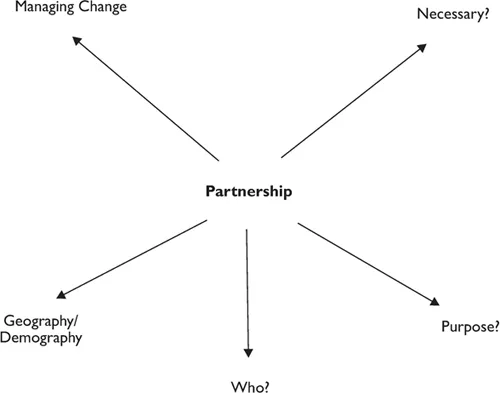
Figure 1.1 illustrates the main items on the partnership agenda and their principal relationships. Throughout the book you will find similar maps focusing in more detail on the issues to be dealt with. This is, if you like, the large-scale map to which they all relate. Let us consider the five main headings in this figure – these correspond to the five themes in the book. The first four headings are much the same as the four chapter headings in Part Two; the fifth, ‘Managing change’, corresponds to the two first chapters of Part Three.
Figure 1.1 The main items on the partnership agenda
IS THIS PARTNERSHIP NECESSARY?
Definitions
Some so-called partnerships are definitely not necessary as they are, because they have become historical relics with little of their original purpose. Typically events have moved on but the meeting habit remains! Historical relics apart, the first step in dealing with the question is to define what sort of partnership you have at the moment and what sort you want in the future.
For the purposes of this book I have defined the word ‘partnership’ in the broadest possible terms. You will find more discussion of the definition in Chapter 2 but the general sense in which I have used it corresponds with my opening statement that this book is concerned with ‘the effective coordination of public sector and voluntary effort which is intended to benefit people who are in need’.
Within that broad frame there are several different kinds of partnership corresponding to different purposes. They include partnerships for the collaboration of effort, commissioning of services, and consultation with, or the participation of, service users. Some partnerships are formed for the purpose of joint planning of a specific range of services but (more frequently, recently) broad-based strategic forums have been created to co-ordinate a wide range of collaborative effort.
For some specialist services some areas have opted to set up full joint management of a combined service. The most frequent examples of this are perhaps the Children and Adolescent Mental Health Services (CAMHS) combining psychiatry, psychology, education and social work. If you are planning a joint service of some kind in your area, have a look at your local CAMHS. It might provide you with some useful insights into what you should pursue and what to avoid.
Finally there are joint projects, focused on a specific task and usually time-limited. They can arise from a strategic forum initiative or from a less formal collaboration and they usually cease once the purpose is achieved (or abandoned).
Context
The context in which the partnership exists is all-important and it covers a range of factors including the financial and legal framework, the people involved, the drivi...