![]()
1.
THE PHYSICAL ARRANGEMENTS
A child who finds it difficult to comprehend the connections and meanings in his or her own world can often create personal order by, for example, wanting to watch the same part of a videotape again and again or by showing a great interest in something specific for a remarkable length of time. In this way the child tries to cope with the chaos created by confusion, by creating his or her own predictability.
The purpose of a clear physical structure is to limit the chaos for the child as much as possible and to make it easier for the child to understand what is going to happen next. The physical structure has to be simple, with an obvious message with regard to what to do and where. If possible, it is useful to have different locations for different activities. At home, there is usually a place where you eat, a place where you sleep, a place where you watch television etc. In an institution, the same place is often used for many different activities.
It is possible, both at home and in an institution, to compensate for the fact that the same location has to be used for different activities by, for example, placing a blotting pad on the table when it is being used for play, a different colour when the table is being used for homework, and a placemat at meal times. You could also attach a picture of the relevant activity on the blotting pad/placemat.
Many autistic children find it difficult to remain focused on what they are doing, and a picture can help remind them. Once the child’s attention is secured, he or she is spared the interruptions of impulse actions. On reaching a particular destination, the child will then be able to match the picture with another one, or simply put it in his or her pocket to indicate that the activity has been successfully completed.
Positioning the daily schedule
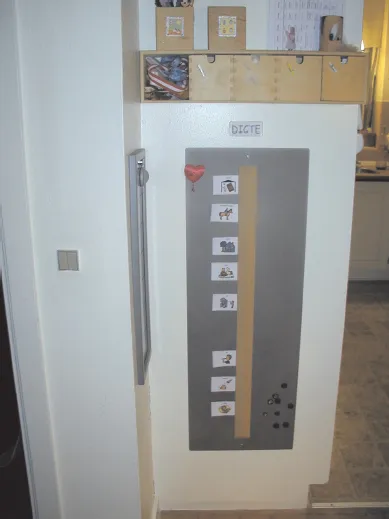
Dicte’s daily schedule has been positioned in a central place in the house so that she is aware of any possible changes (see Chapter 2, page 25).
Visual support for eating
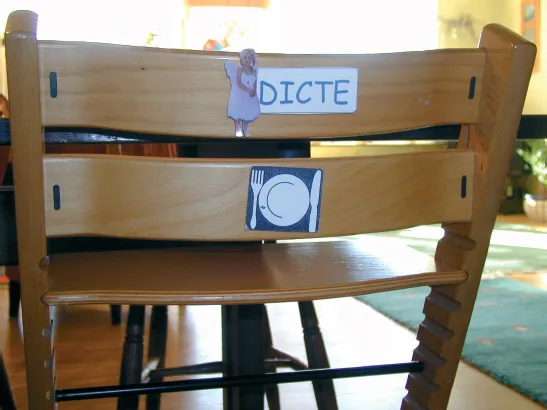
Dicte found it difficult to eat, but it became much easier for her to participate at meal times once her name was put on a chair alongside a picture of ‘Eating’ in a plastic pocket. Initially, she was given a picture of ‘Eating’ to hold, which helped her see what she was going to do next, because there was an identical picture on her chair and she could put her matching picture on top of it.
Arranging a bedroom
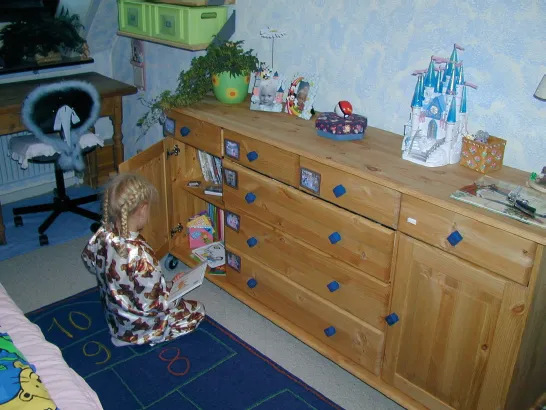
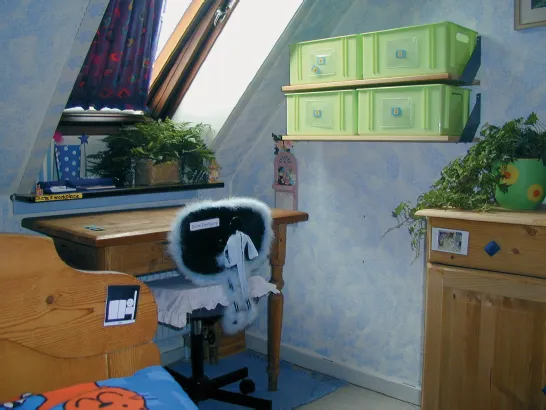
The clear arrangement of Dicte’s bedroom makes her feel safe and the room is no less comfortable than that of any other girl. The toys have been put away in drawers and boxes, which have been labelled with appropriate photos. Too much visual stimulation at one time can create ‘visual noise’ – and thus chaos. It may be easier to select a toy from a picture rather than choosing from open shelves.
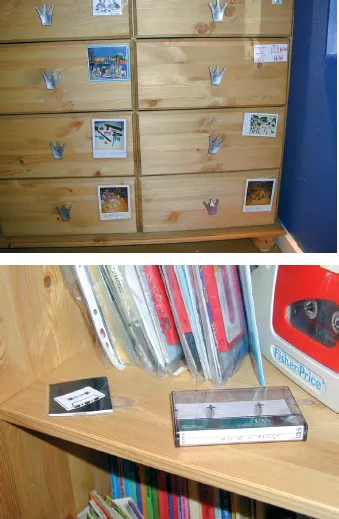
Top: When pictures were put on Dicte’s drawers and shelves and it became clear to her where her things were, she started to spend more time playing in her bedroom.
Bottom: Here a picture marks where the tape and tape recorder should be placed, so that Dicte can tidy up herself. Open bookcases with too many toys can be confusing for many children and may result in them choosing the same toy over and over again.
Dicte has a table where she can play and another one where she can work on the exercises in her boxes. The contents of her boxes vary (see Chapter 5). As autistic children often find it difficult to play on their own for any significant period of time, the assigned exercises can be put away so that the child can relax.
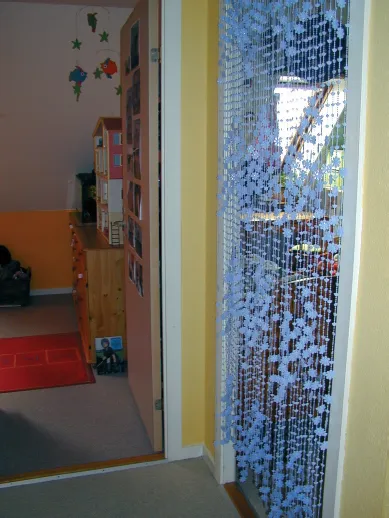
The door to Dicte’s room is a see-through curtain. She does not like the door being closed, but it is nice for her to have some kind of boundary for her room. This enables the child to hear where the adults are, while at the same time concentrating on his or her game or exercises.
Bedtime picture
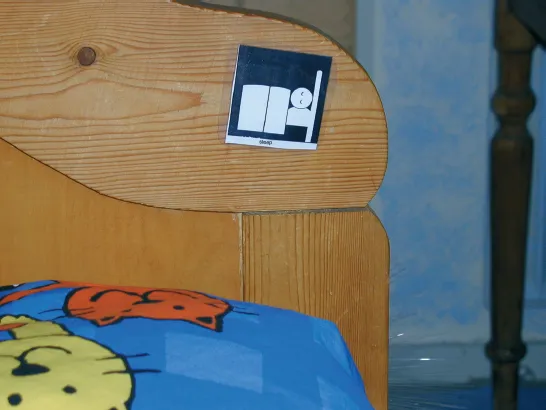
When Dicte was younger, it was very helpful for her to ‘check in’ with a picture for bedtime, which matched an identical bedtime picture placed in a plastic pocket on her bed. She then knew that she was going to sleep and not play when she went into her bedroom. Dicte no longer needs to match the picture, but she has asked for it to remain on the bed.
Refuge room under the stairs
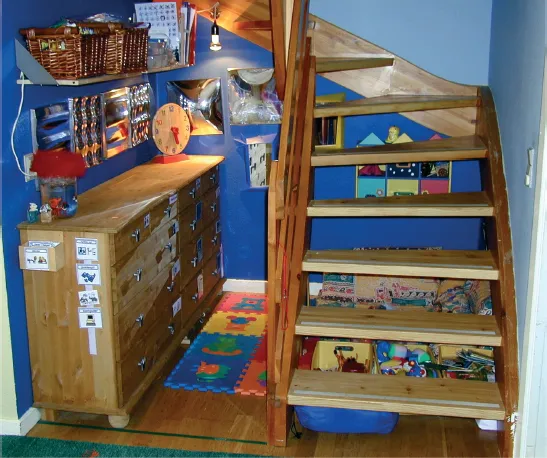
It is a good idea to create a cosy space in the corner of the living room for a child who wants or needs to be near the adults. In this space, the child can have organized toys for independent play so the adults can carry on with their normal activities while the child remains under supervision. Note the tape on the floor, which encourages the child to stay within the boundaries of the assigned area.
Help in remembering where you’re going
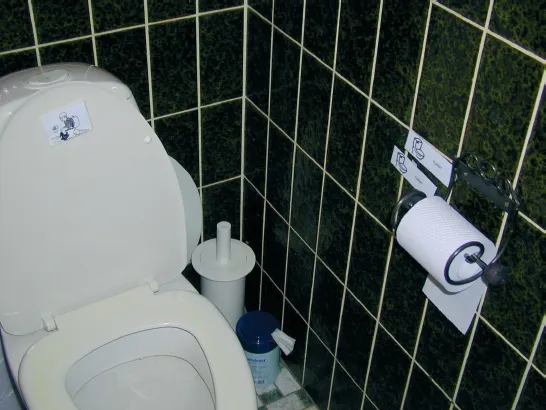
You can help children remember where they are going by handing them a picture when starting a new activity. Once the child reaches the destination (the toilet in this case), the picture is placed on the identical picture already attached beside the toilet. This makes it easier to maintain concentration and shuts out other stimuli or impulses en route.
![]()
2.
DAILY SCHEDULE
The purpose of the daily schedule is to make the day more manageable for the person with autism. The schedule needs to emphasize whether it is an ordinary day or whether there are likely to be changes. Will there be visitors, or does the shopping need to be done? Will there be a trip to the hairdresser or to the dentist?
The daily schedule is the adult’s message to the child about what is going to happen during the day. A child who does not get this information will try to make his or her own plans. This can then create uncertainty and frustration for the child when these plans collide with those made by others. Too little preparation can therefore result in unnecessary problems. However, the amount of information each individual child can retain varies considerably. A child who is not very good at postponing his or her needs should perhaps be given no more than two pieces of information at a time, whereas other children can cope with information covering the entire day.
The daily schedule can contain the following:
•objects
•photographs
•pictures or drawings
•the child’s own drawings
•written language, either as handwritten cards or notes on an ordinary calendar.
The form you chose depends on what makes the most sense to the child. Children may need different forms of communication at different times of their life. Small children may understand that they will have their nappy changed when shown a nappy. Older children may need to be reminded to go to the toilet by placing a picture of a toilet on t...