![]()
Chapter 1
The Hidden Treasure of the Self
Jenny Bates
In this chapter I will be exploring the theme of hidden treasure, using my own perceptions, intuitions, and experiences in sandplay with children, and relevant case material. However, I would like to acknowledge the thinkers and writers in the field who have influenced my way of working with children. These include the work and writings of C.G. Jung, D.W. Winnicott and Dora Kalff, and the ongoing inspiration provided by Dennis McCarthy. Last, as a student and practitioner of Shambhala Buddhist teachings, I have confidence in the basic goodness of all beings, beyond conceptual thought or dualistic thinking, and it is from this ground that I work with children as a play therapist.
In my work as a play therapist with children, sandplay is central and essential to the therapeutic process. Using a sandbox deeper than is customary (eight inches deep, as opposed to three or four) has resulted in all kinds of experiences with digging, burying, and seeking treasure. These experiences have aroused in me an interest in better understanding, via my thoughts and observations, the significance of hidden treasure in the world of children who come to play and use the sand.
The beauty of sandplay with children is that the symbol and its place in the sand scene stands for itself, with interpretation rarely needed by, or to, the child concerned. During the course of therapy and the creation of several sand scenes, and as a result of this symbolic play, the child will manifest changes in behaviors in her world that indicate the transformative effects of sandplay and of working in this non-verbal way. Sandplay and the use of symbolic objects that create the scene or story undoubtedly facilitate the integration of unconscious material with consciously held beliefs and feelings. For example, a child is not usually able to verbalize her sense of fragmentation or loss of self-confidence as a result of her experiences or upbringing. The symbol, however, does exactly that. I have come to think that the choice to select, hide, bury, and find treasure is symbolic of a child’s sense of self, her emerging “me-ness.”
It is as if the child is saying, “My sense of me is valuable, special, and needs to be protected. I can hide it from the world. I will decide how to hide it, who protects it and how, and to whom and when it will be revealed.” Thus she gains mastery over a mysterious, organic process of healing and development of identity that is necessary for healthy growth.
When a child is engaged in creating a sand scene of symbolic significance, the therapist serves as a witness and container, sharing in the intensity and unfolding of the creation and expression of something almost sacred, one could say. Sometimes it can feel as though we are standing on hallowed ground.
Case study: Amy
Nine-year-old Amy lived in kinship foster care with her great-aunt and uncle and older cousin. She felt deeply sad about the loss of her father through alcoholism, her mother through mental illness, and her older brother who was living separately. She had been with her foster family for four or five years and was doing well, according to her aunt. Amy had occasional visits with her mother and brother. However, it wasn’t long before I heard about the difficulties Amy was having with her older cousin in the home, as well as incidents of petty thieving and the struggle to maintain friendships at school.
I was struck initially by an artificiality in the way Amy presented herself. Her first few sand trays were rich and complicated, verging on the chaotic. They involved all kinds of loss, struggle, conflict, burials, and hidden treasure. After four months of continuous weekly sessions in which Amy established all kinds of physical and imaginative games, in addition to sandplay, she created the following scene:
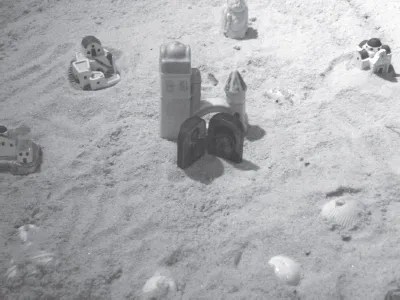
First she collected a few items of treasure—shiny beads, glass stones—and put them into a small treasure box, itself decorated with jewels and brass trimming. She buried the box in the center of the sand tray as deep as she could and covered it over with sand. On the surface, over the treasure, she placed a church and next to it a small Christian icon. She then selected other figures of saints and holy people and buried them in a circle around the central church. These were accompanied by church-like buildings. White shells and stones were then half-hidden in a careful arrangement around the central church.
Amy was in awe of what she had created. She had entered a hushed and silent space while creating this scene, had worked with focus and concentration unbroken from start to completion, saying very little. What was remarkable about this scene was its order, its arrangement around a central object. In fact we could call it an emerging mandala pattern, itself a symbol for the Self. Amy’s foster family were devout Christians, and it seemed that here she was expressing her growing sense of security in this home, with religion providing a grounding in community and spirituality, both an inner and an outer experience. There was also a sense of laying things to rest. In fact she named this scene “The Holy Graveyard” (Figure 1.1). Amy had recently been taken to the grave of her great-grandmother, after whom she was named. So the symbol here combines Amy’s inner self, her lineage, and her present family and community into a pictorial representation. This is something that a nine-year-old would find difficult to articulate verbally.
Amy’s therapy process has been the struggle to establish a secure yet authentically felt sense of self. If her immediate family were considered such “bad seeds” by her great-aunt and others in the extended family, what did that make her? She had developed an air of sweetness that was exaggerated simply to protect her from the worst possible threat of all, that is, “Be good, or you will be sent to Social Services,” from befalling her. However, in the experiences of choosing, hiding, burying, guarding, and finding treasure over and over again, the artificiality faded and Amy came to stand as truly herself within her foster family. Her inner self now successfully integrates both unconscious and conscious aspects, a process that I believe happens directly in sandplay and specifically in treasure-seeking.
Sandplay in itself combines elements that are known and unknown. When asked gently why a particular object was chosen, the child most frequently responds with a shrug of the shoulders or possibly “I don’t know.” The choosing and the placing come from the “I don’t know” but the final viewing of the completed scene impacts the conscious mind, often with a “Wow! Did I do that?” type of response. This is all information from which the inner self is constructed. Amy’s most recent sand story in this current series involved a treasure chest buried deep in the desert, over which many sandstorms blew. One day a family of tigers came to the treasure site. The baby tiger was chosen to find the treasure, and then the treasure was replaced by an Egyptian mummy that Amy named “T” (short for Tutankhamun). She spoke quietly to T, saying, “You’ve survived for a long, long time,” and then buried him in place of the treasure chest and closed him in. Now that her surviving self is safe and buried, representing a sense of a healthy lineage, her treasure is more readily accessible. She can be herself in her foster family, accepted for whom and what she is. It is healthy to have some aspects of ourselves buried or put away once some light has been shed on them.
Case study: Carla
Carla was an 11-year-old struggling to come to terms with her mother’s alcoholism, which had dramatically broken apart her family. Her mother now lived in a separate apartment, while Carla and her younger brother lived with their father in the original family home. One time Carla had called the police when she realized that her mother was driving her and her brother while intoxicated. This had thrust Carla suddenly into a world of adult matters and responsibility. After this, Carla became anxious and hypervigilant about her mother’s state and felt a need to take care of her younger brother. I saw Carla for three months in sessions every other week. Carla could talk about how she felt abruptly separated from her carefree childhood, by having to confront her mother’s drinking, and how she now felt unsafe around her. She was afraid to be alone at night for fear that her mother would get drunk. Carla was immediately attracted to the sandbox but also delighted in exploring other forms of non-verbal expression, such as messy painting, the doll’s house, clay and ball games, all of which served to reduce her anxiety and preoccupation. During the time that her mother gained sobriety in treatment and a measure of reliability, Carla said that she knew she would never be a child again, partly because of what had happened and partly because it really was time for her to be growing up anyway!
Carla herself decided to end sessions when her summer schedule became very demanding, and toward the end of our sessions together she created the following sand scenes in two consecutive sessions.
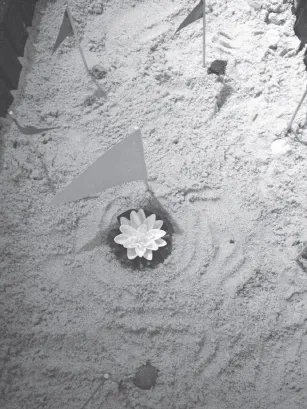
The first scene Carla named quite early on as “The Artifactual Day” (Figure 1.2). She was recreating a recent school trip to a local archeological site.
In the sandbox she made several sites, each with differing artifacts chosen from the shelves and marked with a flag. The flags were of differing colors according to a schema that indicated those sites already dug out and those still to be uncovered. The final site was located just off center and was a deep, deep well. Into this she put three treasured articles—a small, heart-shaped clock, a pair of golden slippers, and a small pile of coins. She then closed over the top of the well with a glass tile, a round mirror, and finally a large lotus flower. She marked the site with a large yellow flag. It was different from the others because this site could only be opened by professionals, as opposed to students.
Carla was indicating that explorations into her innermost self and secrets (the treasure at the bottom of the well) were entrusted to trained people. This central well with treasure, protected, can now begin to serve as an organizing principle in her life, constructed to contain all of her experiences. Other aspects of herself, represented in the other sites, were more accessible and more available to everyone.
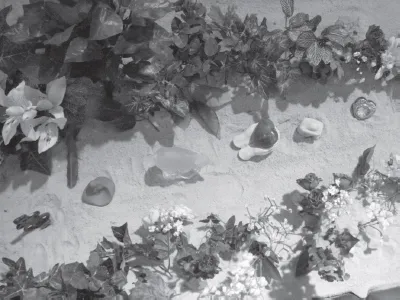
The sand scene in Carla’s following and final session was a summation of her life and her family up to this point. Carla was quiet, intent, and focussed throughout the entire, rather short time it took her to put it together. There was a flow in the creating that indicates the accessing of unconscious and semi-conscious material. While this scene does not contain treasure as such, it had a direct connection to the treasure from her previous sand tray. Carla chose six specific items from the shelves and placed them in a diagonal line spaced about a hand width’s apart starting from the bottom left-hand corner and moving toward the upper right-hand corner of the box—from unconscious to conscious, one could say (Figure 1.3). She then placed trees and flowers on either side of these six objects to create a pathway. Carla said, “This is a kind of time line.” Starting with the first object, she indicated that it showed two people coming together, then the second object the starting of a family, then the nurturing of children, then the growing of children, then the collapse of one of the family members, and finally the heart-shaped clock (a treasure from the previous sand scene). She said this represented her belief that time will heal.
Carla is at the stage developmentally when she can use verbal expression related to the non-verbal process utilized in the sand. Her sense of composure and confidence were palpable to me as she said goodbye. The sandplay had enabled her to put a jarring and challenging experience into a logical, coherent story. She had gained mastery over an unspeakable event and her treasure was now safely back in place. She was now able to spend the night at her mother’s home without experiencing her previous anxiety. We all feel more confident when unconscious content has light shed on it and it can become part of our self-expression.
In the world of one younger child, caught up in and confused by the bitter mistrust between separated parents, the treasure in his sandplay was hidden or buried but remained unprotected. It was subject to being found and devoured by a big monster of some kind—a fierce tiger or a raging T-rex or a rapacious crocodile. It felt like nothing was safe in his world, certainly not his precious and vulnerable self. He was not being physically abused in either home, as far as I knew, but his sandplay clearly revealed that he felt unsafe in his situation. There was no safe place for him to be, for his sense of inner security to develop; no protection from the psychological battering. The symbolic play speaks volumes where words are not yet available.
Case study: Veronica
Children use treasure, the symbol of treasure, as a way to speak about themselves, their sense of themselves, their feelings about who they are from the inside. Treasure is an expression of their sense of unique specialness, and how they use it in sandplay gives us a direct glimpse into their psychic world. Veronica, a five-year-old victim of sexual abuse, uses treasure all the time in her sand scenes. Treasure, in the form of hundreds of glass stones, white shells, marbles, and beads, etc., is strewn across the sand tray, in piles, in lines, some buried, some exposed, some in little boxes lying on the surface or buried deep.
This is a picture of psychic fragmentation that is hard to ignore. As she progresses in therapy and her external world becomes safer and more protected, her use of treasure changes and reflects a safer-feeling self. Now the treasure is more contained, more carefully selected, often protected by trees and flowers and surrounded by a fence. Psychi...