![]()
CHAPTER 1
Bagua, Bagua Quan and Bagua Daoyin
BAGUA
The Bagua are eight symbols called trigrams (gua) which are said to date back to the era of Fu Xi 4,500 years ago.
These eight symbols are
Each symbol is composed of three lines which are developed and read from bottom to top. There are two types of lines, one
which was later called the Yang line; the other
which was later called the Yin line.
It is said that Fu Xi surveyed heaven and earth, the mountains and the rivers, the birds and the beasts, men and women. He deduced the characteristics of all of nature’s works and used the Bagua symbols as representations. In Fu Xi’s era there was no written language. Men of learning in later times produced written explanations of the symbols and gave them names.
| Qian |
Zhen |
| Kun |
Xun |
| Kan |
Gen |
| Li |
Dui |
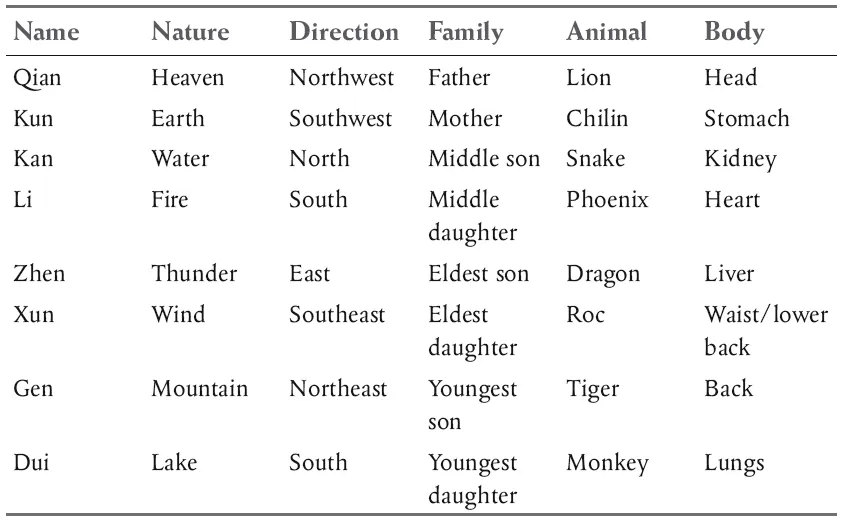
Later each symbol came to represent different objects according their Yin and Yang characteristics and their form of generation. For example:
Men of learning also produced two fundamental methods of arrangement of the Bagua based on the differences in their corresponding relationship. One is called ‘Pre-Heaven Bagua’ or ‘Fu Xi Bagua’ and is used to show the laws of nature. The other is called ‘Post-Heaven Bagua’ or ‘King Wen Bagua’ and is used to show applied changes in things. Subsequently the eight trigrams (gua), which were originally separate and independent, became a single entity called the Bagua. After this the concepts of the Sixiang, the Liangyi, Taiji and Wuji gradually developed.
As to the Iching (Book of Changes), this uses six symbols, produced by reduplicating two trigrams, to explain more complex changes in things.
BAGUA QUAN
Bagua Quan is a development of Chinese martial arts. Its origin is unclear but I think that it must be a Daoist system.
Bagua Quan and the Bagua are related to the twin aspects of ‘internal cultivation’ and ‘external application’.
In the matter of internal cultivation Bagua Quan uses the principles of the Bagua to distinguish between and exercise eight parts of the body:
heart, liver, lungs and kidneys
(the corresponding internal trigrams are Li, Zhen, Dui and Kan)
head, back, waist/lower back and stomach
(the corresponding external trigrams are Qian, Gen, Xun and Kun)
In the matter of external application Bagua Quan, using the attributes of Yin and Yang, groups martial arts moves and postures into eight categories:
Yin Yin Yin, Yin Yin Yang, Yin Yang Yang, Yin Yang Yin,
Yang Yang Yang, Yang Yang Yin, Yang Yin Yin, Yang Yin Yang
(Basically Yin is force exerted downwards and Yang is force exerted upwards).
However all the internally cultivated parts of the body and externally applied categories of movement are interrelated in accordance with Yin and Yang changes of the Bagua.
In other words every move in Bagua Quan must conform with the principles of the Bagua and at the same time have two functions – internally to nourish life and externally to resist the opponent.
For this reason the Bagua Quan school of martial arts is named after the Bagua.
DAOYIN
The meaning of ‘Daoyin’ is ‘to open up a pathway to allow movement to flow’; for example to open up a channel to direct the flow of water or open up a road to direct the flow of traffic. ‘Daoyin’ therefore implies three things:
- to open up a pathway
- to direct and guide energy
- the true direction
The art of Daoyin originated long ago in China and was already well developed and widespread in the Spring and Autumn and Warring States periods. It was a sort of stretching movement and a coordination of thought and breathing to free up the muscles and bones and open up the flow of the Qi and blood. In later years it was written about by practitioners of Daoism and comprehensively developed.
BAGUA DAOYIN
There are two stages in the ‘internal cultivation and external practice’ of the Bagua Quan system. The first is ‘guiding Qi by force’, the second is ‘driving force by Qi’.
The method used in the first stage is Daoyin. ‘Force’ (li) comes from specific limb movements. Through the stretching and the opening and closing of the body, the skeletal and muscular connections create different ‘pathways’ to ‘direct and guide’ the energy of the Qi into eight parts of the body – the heart, liver, lungs, kidneys, head, back, waist/lower back and stomach.
Unlike the ordinary art of Daoyin, Bagua Daoyin as part of Bagua Quan is a branch of martial arts. Bagua Daoyin is not only effective in building up and nurturing the body but also trains the power and postures needed for self defence, achieving the objective of ‘the combination of internal and external cultivation’. So Bagua Daoyin in addition to helping martial arts practitioners also has many other benefits. This is why I especially advocate and promote Bagua Daoyin.
![]()
CHAPTER 2
Bagua Daoyin, the Guiding Principle of Bagua
You have stretched yourself out. Your body has held a position for too long and your limbs want to spread out. Do you remember this feeling? All your muscles are tingling and your internal organs are nice and warm. This is Daoyin.
The practice of Daoyin originated in China long ago. Manuscripts unearthed from Han dynasty tombs have Daoyin illustrations. The Daoist philosopher Zhuangzi in his work ‘Great Master’ said ‘a true person’s breath goes down to his heel’, which is an early reference to Daoyin. This is an important clue since stretching exercises and soft hard exercises are not solely Chinese. The Chinese are not the only people who exercise by stretching. But why was it only the Chinese who developed the practice of Daoyin?
The Chinese believe that the two basic elements that maintain the body are Qi and blood. If we can maintain the free circulation of Qi and blood, the body will be naturally healthy. T...