The must-read summary of Michael Raynor's book: "The Strategy Paradox: Why Committing to Success Leads to Failure (and What to Do About It).
This complete summary of the ideas from Michael Raynor's book "The Strategy Paradox" shows that whenever you develop a strategy to achieve a specific objective, you are also automatically making some implicit assumptions about what the future market forces will be. If that forecast of future market conditions turns out to be incorrect, then your strategy which had a reasonable chance of success might turn out to be an absolute failure. In his book, the author explains that this is the essence of the strategy paradox. This summary explains how to hedge your strategic bets by creating a number of strategic options which can be harnessed depending on the actual marketplace conditions and the four phases of the strategic flexibility process.
Added-value of this summary:
• Save time
• Understand key concepts
• Expand your knowledge
To learn more, read "The Strategy Paradox" and discover the key to protecting your business from failure.
eBook - ePub
Summary: The Strategy Paradox
Review and Analysis of Raynor's Book
- English
- ePUB (mobile friendly)
- Available on iOS & Android
eBook - ePub
About this book
Information
Subtopic
Stratégie commercialeSummary of The Strategy Paradox (Michael Raynor)
The Problem – The Strategy Paradox
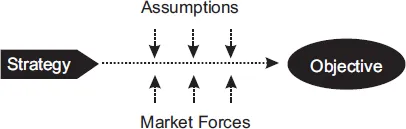
Any business strategy, even if perfectly executed, rests on an assumption made today about what the market conditions will be like in the future. If those market conditions end up being different, even a well conceived strategy for today’s marketplace conditions will fail. Instead of trying to predict the future, build in enough strategic flexibility to be able to respond to the marketplace conditions as they end up unfolding.
To be a success, many times a firm needs to make commitments of resources and capabilities which are hard-to-copy for competitors but also hard-to-reverse. Often these commitments take a substantial period of time before they bear fruit. They are entered into on the basis of set beliefs about what the marketplace conditions will be like in the future. If these beliefs turn out, in fact, to be wrong, an otherwise excellent strategy might fail to achieve the desired objective by a wide margin.
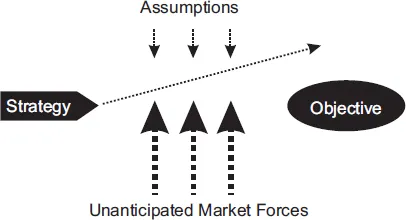
Similarly, if the assumptions about the marketplace or the consumer’s preferences end up being proven wrong, this can also mean a well conceived, carefully planned and flawlessly executed strategy ends up failing to achieve the objective.

In practical terms, the strategy paradox states: the business strategy with the greatest chance of success for a firm also has the greatest possibility of failure if market conditions change. The most profitable strategies which commit a company to seek competitive advantages such as product differentiation or cost leadership can be extremely profitable if the firm is lucky and it anticipates the marketplace conditions correctly, or exceptionally costly if they turn out to be wrong.
Companies deal with this inherent trade-off between risk and return in a number of different ways:
- Most firms accept a lower rate of return by executing a strategy which is not entirely optimized one way or another. This gives them a better chance of survival as the marketplace evolves. These firms don’t maximize their profits because they don’t put all their eggs in the one basket but nor are they bankrupted when the marketplace changes.
- Other companies try and become more adaptable so they can change their strategy as the market shifts. This is fine as long as the firm can continue to change at the same pace as the environment changes. There are however problems when some parts of the organization need to change faster while other parts need to change more sedately. That can cause some serious internal challenges.
- Some companies try and forecast what the market conditions will be like in the future and integrate that into their strategies. That’s fine when you get it right but it is impossible to forecast the future correctly indefinitely. Sooner or later (and probably sooner), your forecasts will end up being wrong. The marketplace has so many random factors which need to be taken into account you just can’t tell whether your predictions will end up being correct or not, even if you have a great track record of past success in forecasting the future. Besides which, an even more fundamental question is do you really want to commit all your resources to back your forecast about what’s going to happen in the future to the hilt?
- Other companies manage strategic uncertainty by using their hierarchies. Different levels of the hierarchy deal with different levels of strategic uncertainty. This typically tends to work out something along these lines:
- The board of directors specify the corporation’s overall exposure to strategic uncertainty and marketplace risk.
- Senior managers hedge the various risks and ensure all options remain viable.
- Operating divisional managers commit to a specific strategy but also work to avoid catastrophes should key assumptions turn out to be invalid.
- Functional managers are charged with delivering short-term results in this quarter or this financial year. They are typically so busy doing that they have little time to be...
Table of contents
- Book Presentation: The Strategy Paradox by Michael Raynor
Trusted by 375,005 students
Access to over 1.5 million titles for a fair monthly price.
Study more efficiently using our study tools.
Frequently asked questions
Yes, you can cancel anytime from the Subscription tab in your account settings on the Perlego website. Your subscription will stay active until the end of your current billing period. Learn how to cancel your subscription
No, books cannot be downloaded as external files, such as PDFs, for use outside of Perlego. However, you can download books within the Perlego app for offline reading on mobile or tablet. Learn how to download books offline
Perlego offers two plans: Essential and Complete
- Essential is ideal for learners and professionals who enjoy exploring a wide range of subjects. Access the Essential Library with 800,000+ trusted titles and best-sellers across business, personal growth, and the humanities. Includes unlimited reading time and Standard Read Aloud voice.
- Complete: Perfect for advanced learners and researchers needing full, unrestricted access. Unlock 1.5M+ books across hundreds of subjects, including academic and specialized titles. The Complete Plan also includes advanced features like Premium Read Aloud and Research Assistant.
We are an online textbook subscription service, where you can get access to an entire online library for less than the price of a single book per month. With over 1.5 million books across 990+ topics, we’ve got you covered! Learn about our mission
Look out for the read-aloud symbol on your next book to see if you can listen to it. The read-aloud tool reads text aloud for you, highlighting the text as it is being read. You can pause it, speed it up and slow it down. Learn more about Read Aloud
Yes! You can use the Perlego app on both iOS and Android devices to read anytime, anywhere — even offline. Perfect for commutes or when you’re on the go.
Please note we cannot support devices running on iOS 13 and Android 7 or earlier. Learn more about using the app
Please note we cannot support devices running on iOS 13 and Android 7 or earlier. Learn more about using the app
Yes, you can access Summary: The Strategy Paradox by BusinessNews Publishing in PDF and/or ePUB format, as well as other popular books in Développement personnel & Stratégie commerciale. We have over 1.5 million books available in our catalogue for you to explore.