![]()
![]()
I. THE CONCEPT OF DIAGNOSTICS OF TRADITIONAL CHINESE MEDICINE (TCM)
Guided by the theory of Chinese medicine, the diagnostics of TCM involves studying how to differentiate and diagnose diseases. It is the bridge between the basic theories and treatments, in the system of TCM.
II. THE CONTENT OF DIAGNOSTICS OF TCM
1. DIAGNOSTIC METHODS: INSPECTION, AUSCULTATION AND OLFACTION, INQUIRING, AND PALPATION
1.1 Inspection
Observation by the doctor, using his eyes, of the systemic and regional changes in the patient’s vitality, colour, appearance, secretions and excretions.
1.2 Auscultation and olfaction (listening and smelling)
Listening to the patient’s speech, respiration, and cough, and smelling the odours of the patient.
1.3 Inquiring
Asking the patient, or the patient’s companion, about the conditions associated with the illness in order to understand the pathological process.
1.4 Palpation
Includes feeling the pulse, and palpation of different parts of the patient’s body.
2. EIGHT PRINCIPLES
The Eight Principles describe the eight basic categories of syndromes – namely, Yin and Yang, exterior and interior, Cold and Heat, and deficiency and excess – used to analyze the location and nature of diseases, and the relative strength of the pathogenic factors and antipathogenic Qi.
3. SYNDROME DIFFERENTIATION
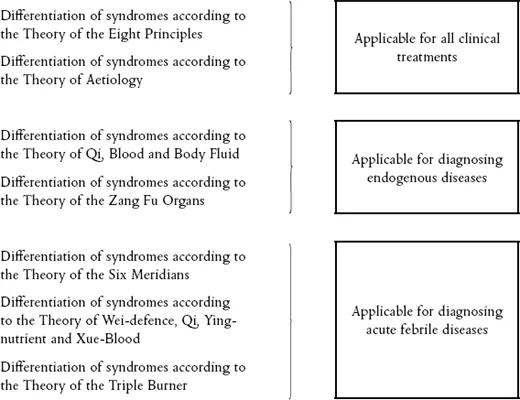
This involves a comprehensive analysis of the symptoms and signs obtained through applying the four diagnostic methods and interpreting them through the Eight Principles (see Figure 1.1).
Figure 1.1
Each method has its own features and lays stress on a particular aspect while connecting with and supplementing the others.
4. HOW TO WRITE CASE REPORTS
This is the basic skill that should be mastered by clinical doctors.
III. THE PRINCIPLES OF DIAGNOSTICS OF TCM
1. To examine the entirety of the pathological changes and the environmental conditions of the patient.
2. To differentiate the syndromes and seek causative factors.
3. To use the four diagnostic methods in combination for a comprehensive analysis.
![]()
![]()
I. INSPECTION
Inspection is aimed at diagnosing through observation of the whole body, including the excreta of the patients, to understand their pathological changes. Inspection includes the observation of vitality, colour, appearance, and so on.
1. OBSERVATION OF VITALITY
Shen (vitality)
Broad meaning: General manifestation of the vital activities of the human body. Shen refers to Life.
Narrow meaning: Spiritual activities. Shen refers to Spirit.
Material basis
Shen comes from the congenital Essence. It depends on the nourishment of acquired Essence after birth and the support of the normal functions of the Zang Fu organs.
The significance of the observation of vitality
To understand the strength of the antipathogenic Qi of the human body and the severity of the disease.
Observation of vitality focuses on the expression of the eye, consciousness and spirit, complexion, and appearance.
With vitality, less vitality, without vitality, false vitality
One can observe four types of vitality.
With vitality: The antipathogenic Qi has not yet been damaged, indicating that the disease is mild.
Less vitality: Here, the antipathogenic Qi is weak, as seen in deficiency patients.
Without vitality: This indicates the critical stage of a disease.
False vitality: A patient with serious disease shows a false manifestation of good vitality, this being the sign of approaching death.
| | Manifestations | Significance |
| With vitality | Normal appearance and colour, lustrous complexion, keen response, a sparkle in the eyes, full consciousness with normal speeches and movements, and regular respiration | Healthy. Even though the patient is diseased, the disease is mild, with a good prognosis |
| Less vitality | Listlessness, forgetfulness, sleepiness, low voice, tiredness, slow in movement | Weakness of functions of the Zang Fu organs. Mild disease with a good prognosis |
| Without vitality | Emaciation, with diseased complexion, slow in response, without sparkle in the eyes, not full consciousness, abnormal speech and movements (delirium, involuntary movement of fumbling and picking at the bed or clothes), and respiration | Failure of functions of the Zang Fu organs, poor pr... |