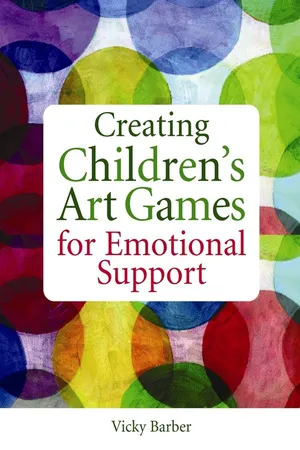
Creating Children's Art Games for Emotional Support
eBook - ePub

Creating Children's Art Games for Emotional Support

  1. 144 pages
  2. English
  3. ePUB (mobile friendly)
  4. Available on iOS & Android
eBook - ePub

Creating Children's Art Games for Emotional Support

About this book

Game playing is a highly effective way of engaging children and has long been acknowledged as an important means of psychological therapy. This book offers an abundance of fun games that help children to confront personal problems and issues in a light-hearted yet meaningful way.

These are games with a difference, as they must be constructed before they can be played. The creation aspect involves collaboration and cooperation within a team, and instils an empowering sense of ownership in the creators. By the time the game is ready to be played, children are confident, thoroughly engaged and ready to explore issues in a supportive environment. Each game has been tried and tested by the author, and is proven to really work.

This book is an essential tool for therapists, counsellors, social workers, youth workers and teachers supporting children and young people.

Trusted by 375,005 students

Access to over 1.5 million titles for a fair monthly price.

Study more efficiently using our study tools.

Information

Year
2011
Print ISBN
9781849051637
eBook ISBN
9780857004093
Part I

Warm-Up Games

Pass the Ball

Objective:

To expand imaginative thinking.

Playing the game:

A ball is passed round to music; when the music stops the person holding the ball is given a colour by the person on their right. Then the person with the ball has to think of three different things in that colour, e.g. a bus, fire engine, post box…

Guess the Colour

Objective:

To use role-play and colour playfully.

Playing the game:

One person goes out of the room. The group selects a specific colour and an object/animal in that colour The person is then invited back and has to guess what the colour is from the clues offered. The clues given should be of the objects, animals, etc. (e.g. elephant, bus, things in that colour).If the person guesses right they choose the next person to go out.

Make the Sound of…

Objective:

To use sounds playfully.

Playing the game:

One person thinks of something and makes its sound (e.g. a car, cat, bird, etc.). The group has to guess what it is. The person who guesses right goes next.

Guess What?

Objective:

To use air drawing to inspire the imagination.

Playing the game:

One person draws an object in the air (e.g. a chair, mirror, etc.) and the group has to guess what it is. The first person to do so correctly goes next.

Feel What It Is…

Objective:

To inspire the imagination.

Playing the game:

Standing in a circle, the first person draws on their neighbour’s back and this is passed round; the last person has to reveal what it is.

Whose Nose Is It?

Objective:

To be creative with the minimum of information.

Playing the game:

Each person in turn draws a nose belonging to an animal and the person who guesses it correctly goes next. The drawing could take place in the air too.

Getting to Know Each Other

Objective:

To learn names.

Playing the game:

Each person thinks of a positive/fun way to describe and introduce themselves using the first letter of their name (e.g. Lovable Lucy, Likeable Leon). Then in a circle each person takes turns to present their name with a description using mime (e.g. Lovable Lucy – here she can hug herself and say her name).

Colour Appreciation

Objective:

To enable mixing and mingling.

Playing the game:

On cue the group is invited to find another person wearing the same colour as themselves (this could go on to hair colour, eye colour, etc.).

Quick Colour Responses

Objective:

To reflect on similarity and differences.

Playing the game:

The facilitator calls out a colour and asks for a quick response to it (e.g. ‘red’ – blood, cherry, bus). They then get group members to call out the colours.

Variation:

Responses have to be of feelings only (e.g. ‘red’ – anger, passion, etc.).

Feeling Is the Object

Objective:

To develop powers of feelings.

Playing the game:

Several objects are placed in a bag. The bag is passed round and each person picks an object randomly. They then have to say something about the object – if possible, something to do with a memory.

Variation:

This game can be turned into a truth-and-lie one by making up a story around the object and the group having to guess whether it’s the truth or a lie.
Part II

Creating Games for Improving Self-Esteem and Confidence

Pushing the Boundaries

Objectives:

To teach children about the importance of boundaries...

Table of contents

  1. Cover
  2. Title
  3. Contents
  4. Acknowledgements
  5. Introduction
  6. How to Get the Most Out of This Book
  7. Step-by-Step User Guide
  8. List of Materials
  9. Case Studies
  10. Part I Warm-Up Games
  11. Part II Creating Games for Improving Self-Esteem and Confidence
  12. Part III Creating Games for Raising Self-Awareness
  13. Useful Templates and Resources

Frequently asked questions

Yes, you can cancel anytime from the Subscription tab in your account settings on the Perlego website. Your subscription will stay active until the end of your current billing period. Learn how to cancel your subscription
No, books cannot be downloaded as external files, such as PDFs, for use outside of Perlego. However, you can download books within the Perlego app for offline reading on mobile or tablet. Learn how to download books offline
Perlego offers two plans: Essential and Complete
  • Essential is ideal for learners and professionals who enjoy exploring a wide range of subjects. Access the Essential Library with 800,000+ trusted titles and best-sellers across business, personal growth, and the humanities. Includes unlimited reading time and Standard Read Aloud voice.
  • Complete: Perfect for advanced learners and researchers needing full, unrestricted access. Unlock 1.5M+ books across hundreds of subjects, including academic and specialized titles. The Complete Plan also includes advanced features like Premium Read Aloud and Research Assistant.
Both plans are available with monthly, semester, or annual billing cycles.
We are an online textbook subscription service, where you can get access to an entire online library for less than the price of a single book per month. With over 1.5 million books across 990+ topics, we’ve got you covered! Learn about our mission
Look out for the read-aloud symbol on your next book to see if you can listen to it. The read-aloud tool reads text aloud for you, highlighting the text as it is being read. You can pause it, speed it up and slow it down. Learn more about Read Aloud
Yes! You can use the Perlego app on both iOS and Android devices to read anytime, anywhere — even offline. Perfect for commutes or when you’re on the go.
Please note we cannot support devices running on iOS 13 and Android 7 or earlier. Learn more about using the app
Yes, you can access Creating Children's Art Games for Emotional Support by Vicky Barber in PDF and/or ePUB format, as well as other popular books in Education & Teaching Arts & Humanities. We have over 1.5 million books available in our catalogue for you to explore.