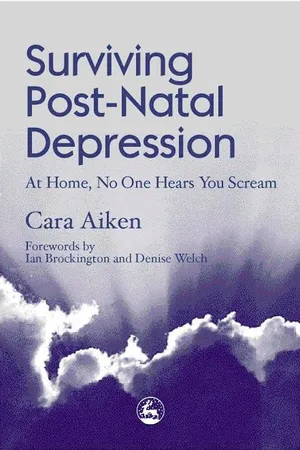
Research indicates that at least one in ten new mothers experience post-natal depression, yet there is little help available to sufferers. Cara Aiken's book will help them, and the professionals who work with them, to understand this illness. The book tells the stories of ten women from very different backgrounds - including the author - who have suffered post-natal depression. Their stories, told honestly and informally, will be a source of strength and hope for other sufferers. The book will also raise awareness of the illness and the destructive effect it can have on individuals and families. It offers positive suggestions and practical advice, based on personal and professional experience. It is a fresh, honest and positive book which will help professionals to understand post-natal depression and will be an invaluable resource for the many mothers who experience it.
- 176 pages
- English
- ePUB (mobile friendly)
- Available on iOS & Android
eBook - ePub
About this book
Information
Topic
PsychologieSubtopic
Psychopathologie1
Cara
I had been happily married to Roo for five years. We had a good social life, wonderful holidays, financial stability, a beautiful home, and both of us had secure jobs. Our relationship was filled with lots of fun and apart from loving each other deeply, above all else, we were great friends.
Our mutual friends were now having children, and I particularly wanted to start a family. Roo was totally indifferent, but we decided that if I was to fall pregnant, that would be fine, and if I didn’t, that would be fine too.
Prior to having children, I was totally irresponsible and extravagant. I bought myself old sports cars when my overdraft permitted me to, and zoomed around like a big kid. I took great pride in my appearance – loved nice clothes, make-up and especially my long red nails!
I had tons of fun during my childhood with my brother and sister, to whom I am still very close. We all had a terrific time together, and I wanted that all over again through my own children. I could not imagine life without a family – I have always had, and love, company around me and I realized that once I had children I would never have to spend time alone. Being blessed with boundless energy and the knack of being able to do ten things at once in pure juggling mode, I didn’t foresee any difficulty in adding a child to my busy agenda.
On reflection, I realize that looking through these rose-tinted glasses of mine, I only ever pictured having a toddler. I had totally overlooked the fact that there would be a baby first. Babies, to me, were like little aliens. I had never been exposed to one of those! But, decision made, we stopped using contraception and played a very long waiting game.
Out of the window went the theory, ‘If it happens fine, and if it doesn’t that’s fine too.’ It was not fine, and this situation made me feel desperate for a child. Every single month was filled with stress and strain. I became tearful each time my period reared its ugly head. If it was a day late I would use a home pregnancy test. The few minutes waiting for a positive result felt like hours. The disappointment each time felt like my world had come to an end.
And it nearly did one year on, when one evening I was doubled up in agony followed by a haemorrhage during the night. I had totally given up all hope of ever having children, but some hours later I was confronted with a positive pregnancy test. Through all the physical pain and fear, I almost jumped for joy. But this was short-lived. I miscarried one week later.
Back at home and a few months later hope welled up inside me. I put the idea of trying once again to Roo and we started all over again and again and again…
Making love was no longer spontaneous. The thermometer by the bed around the fourteenth day of my cycle told us when to ‘have sex’. The science outweighed the passion. After the so-called fertile period, I refused sex on the grounds that it might cause an early miscarriage.
Finally, after two long and stressful years, I conceived.
But outweighing the excitement of being pregnant were the constant fears of miscarriage. I wouldn’t hoover, iron, make love or do anything to risk losing this baby. My hormones were having a heyday. My emotions had gone crazy. I never seemed to stop crying. My family began to treat me like a celebrity, and admittedly I loved the attention I received. Having survived the first four months of this pregnancy, I actually began to enjoy it. During the last two months, though, I began to feel so, so tired, all of the time. The fear set in at this stage – I’d lie awake at night and realize the responsibility I was about to take on. I was filled with sudden panic – had we done the right thing? I woke up with this fear during the early hours of each morning and went to sleep each night filled with apprehension.
Georgina was born on 9 February 1990 following a very straightforward labour and birth. The midwife handed her to me immediately for a cuddle. I did not want to hold my baby. She didn’t feel like ‘mine’ – she was not beautiful – she was wrinkled and ugly. I could not relate to her. I was taken to the ward crying as Roo left me for the night. I wanted to go home too, with Roo, without my baby – this little stranger.
Once on the ward, I was devastated by the total lack of support from the nurses. I had decided not to breastfeed and didn’t want to, but received enormous pressure to do so, from all the staff. I didn’t want to handle the baby, let alone put her to my breast. I watched my child sleeping and wondered how she could possibly belong to me. She was my responsibility for life now. I was petrified by this thought.
Roo arrived the following morning full of excitement about the arrival of his beautiful daughter. He couldn’t wait to take us home. I was discharged not knowing how to bath my baby, change her bottom with confidence, or what to do when she cried. And when she cried, I cried, and never seemed to stop crying for a long time after that.
I was assigned a midwife until Georgina was ten days old, and a health visitor on the eleventh day. I was lucky – my husband had taken a week off work, and my mother came over each day during the second week to help me.
No one had told me to take things easy. On arriving home, the carry-cot containing a sleeping Georgina was put inside the cot, once our dog Yanni had had a good sniff around her, and out came the hoover and duster. I prepared mountains of food for the onslaught of visitors, and from that moment on, entertained a house full of family and friends for the next few days.
I began to feel that I had been sent home much too quickly. I was exhausted. I also realized that I still didn’t know how to change a nappy, clean a belly-button, make up feeds, work the sterilizer, bath the baby or wash her hair. What should I do when she cried, vomited, wouldn’t drink her milk? Yesterday I was a fat mum-to-be, today a mother. ‘Take your child, go home, bring it up – good luck.’ Should I lie her on her back, side, front, hang her from the ceiling? How should I cope when she screamed with colic pains? I could not sleep. I panicked when the baby woke up for a feed. I became emotional, with terrible mood swings. Roo didn’t understand how I was feeling or why I felt as I did. I couldn’t eat because of the constant lump in my throat. I felt as though I was continuously rocking a baby I did not even want to hold.
I couldn’t stand the sound of her crying. It grated on my nerves. I didn’t like her. She had made me feel like this. Roo couldn’t handle her or me. He, too, was petrified of this tiny creature which had put such huge demands on our once perfect lives. I then began to resent every knock on my front door. I didn’t want any more visitors. I didn’t want them to see me not coping, or being unable to show this baby love. Was I not meant to have ‘bonded’ with my child and feel thoroughly enthralled by her?
It was so important for me to set a routine for Georgina so that a small amount of normality could be established in my chaotic home. But the visitors wanted to hold her, pass her around, feed her – totally mess up any routine I might have had. And then, she wanted to be held – she’d got used to it. And so I was left with the tetchy, crying child when my visitors went home. I hated them for leaving me. I resented them walking out of my home to a life of normality.
By now my mind had become totally confused. Conflicting feelings and thoughts made me feel as though I was on a constant roller-coaster ride. The home I had once loved and proudly admired I now detested. I didn’t want to be there amongst all the baby gadgets and nappies. My weight plummeted and I was able to get back into my old clothes once again. But they never looked quite the same, covered in sick, dribble and bum cream. And I had to cut off those lovely long red nails. I couldn’t risk scratching the baby. What had happened to me? My self-image was suffering beyond recognition.
I was depressed – truly depressed – and felt totally alone. If the whole world was in my front room, I would still have felt this terrible isolation.
The loneliness was even more evident at night. I could barely face those late feeds alone. Luckily, I had my loyal old dog Yanni to sit with me when Roo was fast asleep. She truly gave me the courage to carry on. I felt comforted by the fact that Yanni was with me and that my relationship with her could remain strong and unaffected. She was the only one in my life that never annoyed me.
After a few episodes of lonely night feeding, I just couldn’t cope any more. On one particular night Georgina awoke at 2 a.m. crying. I dived under my duvet to block out the noise and realized ten minutes later that she had stopped. I was so relieved and went back to sleep. At 7 a.m., I had still not heard any stirring from the nursery. I thought the worst but at the same time was hopeful that I would never hear her again. That is something I will never be able to forgive myself for but feel that I must mention, for I am sure that many mothers have wished for the same in a moment of desperation.
Georgina did eventually wake up, I did feed her, but never again did she wake me up for a night feed. I had overcome a massive hurdle – no more lone feeds during the night.
A few weeks on and the novelty of ‘the new baby’ wore off … and so did the help and support. I was left alone with my baby – and she still cried and she still demanded.
The depression by this stage was nicely in place, only I hadn’t recognized it. Coping with everyday life was a constant and on-going struggle. I began to resent my husband as he left for work each morning. What wouldn’t I have given to walk out of that front door and close my life behind me. I was desperate to trade places with Roo – just for one day. I was so very low emotionally, and totally screwed up mentally. I started to bicker with Roo over the most trivial matters. This once fairy-tale marriage was appearing, to me, to crumble. I was scared. Roo, not being that interested in babies, didn’t show any interest whatsoever in Georgina, wasn’t particularly aware that she was even present unless she cried, and when she did, it put an enormous strain on our relationship. We were both uptight and each trying to protect the other from this alien little figure in our home. My conversation was solely ‘the baby’. But what was there to say about her? She had slept, cried and poohed as usual. Where was this interesting exchange of daily news? Roo wouldn’t talk about his day because mine had become so boring in comparison. He knew I resented his life.
One particular afternoon, my mother came over to find a screaming baby and a hysterical Cara. I was in a state of pure panic. What had I done with my life? I realized what it consisted of now. It felt like a prison sentence – the months stretching out ahead of me. The total lack of freedom. Why couldn’t I bond with my baby? My mother was shocked by my complete honesty.
I no longer wanted this child. I didn’t know what to do. Just shut her up and take her away. Mum offered to take Georgina away from me and to bring her up until I was feeling well enough to have her back. I couldn’t understand how she could want her. She had brought up her own three children and was now prepared to take mine too.
The health visitor arrived during this traumatic episode and immediately recognized my devastation. She gently suggested that I visit my GP as soon as possible for some advice, and that perhaps I was suffering from post-natal depression – something I knew nothing about. Mum didn’t take the baby home. I went to my GP. He told me, ‘Well done for admitting how you feel. It is quite normal to feel as you do, and you will bond once the baby starts to respond.’ I received no treatment.
Why hadn’t my friends reacted in the same way? Perhaps they had – who knows what goes on behind closed doors? And so I had to accept that these feelings were normal, that I was doing everything I could for my child, and struggle on. Friends would contact me, excited about my new arrival, looking for news about the baby. I couldn’t discuss her or my feelings. I should be happy and full of excitement. I wasn’t.
Then I had to face the reality that my cupboards were bare. I’d force myself to go shopping, in total panic in case the baby started crying as I pushed the trolley around the supermarket. What would I do if she cried? What would other people think of me? I became petrified of leaving the security of my home.
I’d look at women without children and try to imagine what their life content was. I wanted to warn them never to have a baby. I was jealous of them.
I was living constantly on a knife edge and desperately needed the hour of peace and quiet when the baby was taking her nap. I then became obsessed about loud noises, for fear of her waking up too soon. It could be the doorbell, a few noisy kids outside, the telephone…I remember the telephone ringing and me screaming ‘hello’ so loudly into the receiver (out of pure anger and frustration) that it was that which inevitably woke the baby up, rather than the phone ringing in the first place! Or, on the rare occasion that she had actually fallen asleep on me, I would be scared to breathe, cough or sneeze – I so desperately needed that time to myself.
And this stage was so very, very boring. I didn’t get to read a newspaper or concentrate on the radio or television. I felt totally out of touch with the real world. My depression was setting in deeper and deeper. My self-image had hit rock bottom – I was so desperate but did not know what to do. My mood swings were intolerable, and I hated and resented everyone who wasn’t in my actual situation.
I never knew that I was suffering from post-natal depression – it was me, my fault, my problem. I had no professional support and no hope of getting better in the foreseeable future.
I then began to suffer from feelings of extreme guilt – the lack of bonding with my baby. I had bonded better with my dog and my rabbit – immediately. Why, so many months down the line, had I not bonded with my own flesh and blood? I wanted to take my child, dump her and run. I never wanted to harm her, but I wanted someone to take her away and love her like I felt I never had or could. I needed to feel young again. I was only 26 years old, yet felt old, frumpy and ugly. I had no inclination to dress up – what point was there when I would soon be covered in dribble or sick? This resulted in an even lower self-image. How could my husband still love or fancy me when I looked and felt as I did? I completely lost my sex drive. I was in desperate need of love but felt as though I no longer deserved it. I was constantly tired, moody and tearful.
I would find myself at the doctor’s surgery with minor ailments at least twice a week as my physical health began to suffer too. I wanted to die and was hoping that something was seriously wrong with me. Each time I left the surgery I was actually disappointed that I would survive the latest cough or cold.
The tension in our household was like a balloon about to burst. I couldn’t cope. I was scared. I wanted to go to work but my confidence would not allow me to. I was still fighting to hide this deep depression and trying so very hard to live up to false expectations. I was insecure, bored, and felt totally inadequate. If this was what having a baby was all about, then why did women have them? I hated the professionals for not warning me about these feelings. The ante-natal clinic had boosted motherhood up to such an extent. No one had told me the truth.
Once Georgina started to respond, perhaps with just a small smile, a gurgle or simply her following me with her eyes, I felt very rewarded to receive something back after months of blankness and so much effort on my part. It felt like a big ‘thank you’. My life still revolved very much around feed and sleep times, but I did feel as though I was finally getting somewhere with her routine.
But one step forward and two steps back…I just couldn’t seem to crack it! Although I felt a bit better about Georgina, I was most certainly not enjoying motherhood yet. Being able to recognize the baby’s needs more did instil a little confidence in my actions, yet I was not confident or mentally strong enough to assert myself against conflicting advice, which you inevitably receive when you have your first child. I still felt like a bad mother, every move I made was wrong – the baby wasn’t gaining enough, or perhaps was gaining too much, should be on solids, should not be on solids, needed more winding, had a bad tummy because I was not winding her correctly, should be dressed more warmly, should wear a hat in the middle of June, etc. etc. I truly did not know which way to turn or who to listen to. I could not listen to my own instincts because I did not believe in them.
Georgina was a hungry baby and I introduced solids quite early as she was not satisfied with just a bottle – however much I gave her. It most certainly didn’t do her any harm, but I was plagued with fear after listening to all the adverse opinions offered to me.
My husband had still not bonded with the baby and offered me no emotional support. I was trying my hardest to be a good wife to him – I never wanted to let him down – and often pushed the baby aside to be just that. Then I felt guilty towards Georgina.
Everyone believed that I was coping really well. I had a wonderful way of hiding my true feelings. That made it more difficult because I just wanted to scream and cry in frustration. I remember talking to my mother one morning on the telephone and admitting that I just hadn’t taken well to motherhood. I told her that I had absolutely hated the p...
Table of contents
- Cover Page
- Other Books
- Title Page
- Copyright
- Contents
- Forewords
- Preface
- Acknowledgements
- The Contract
- Introduction
- 1. Cara
- 2. Rosemary
- 3. Jane
- 4. Julie
- 5. Pippa
- 6. Laura
- 7. Gail
- 8. Jenny
- 9. Sarah
- 10. Veritee
- 11. Summary
- 12. The Other Half
- 13. Post-Natal Illness: The Professional View
- 14. Practical Advice and Conclusions
- 15. The Myth of Perfect Mothering
- 16. Light at the End of the Tunnel
- Useful Addresses
- References
- Index
Trusted by 375,005 students
Access to over 1.5 million titles for a fair monthly price.
Study more efficiently using our study tools.
Frequently asked questions
Yes, you can cancel anytime from the Subscription tab in your account settings on the Perlego website. Your subscription will stay active until the end of your current billing period. Learn how to cancel your subscription
No, books cannot be downloaded as external files, such as PDFs, for use outside of Perlego. However, you can download books within the Perlego app for offline reading on mobile or tablet. Learn how to download books offline
Perlego offers two plans: Essential and Complete
- Essential is ideal for learners and professionals who enjoy exploring a wide range of subjects. Access the Essential Library with 800,000+ trusted titles and best-sellers across business, personal growth, and the humanities. Includes unlimited reading time and Standard Read Aloud voice.
- Complete: Perfect for advanced learners and researchers needing full, unrestricted access. Unlock 1.5M+ books across hundreds of subjects, including academic and specialized titles. The Complete Plan also includes advanced features like Premium Read Aloud and Research Assistant.
We are an online textbook subscription service, where you can get access to an entire online library for less than the price of a single book per month. With over 1.5 million books across 990+ topics, we’ve got you covered! Learn about our mission
Look out for the read-aloud symbol on your next book to see if you can listen to it. The read-aloud tool reads text aloud for you, highlighting the text as it is being read. You can pause it, speed it up and slow it down. Learn more about Read Aloud
Yes! You can use the Perlego app on both iOS and Android devices to read anytime, anywhere — even offline. Perfect for commutes or when you’re on the go.
Please note we cannot support devices running on iOS 13 and Android 7 or earlier. Learn more about using the app
Please note we cannot support devices running on iOS 13 and Android 7 or earlier. Learn more about using the app
Yes, you can access Surviving Post-Natal Depression by Cara Aiken in PDF and/or ePUB format, as well as other popular books in Psychologie & Psychopathologie. We have over 1.5 million books available in our catalogue for you to explore.